

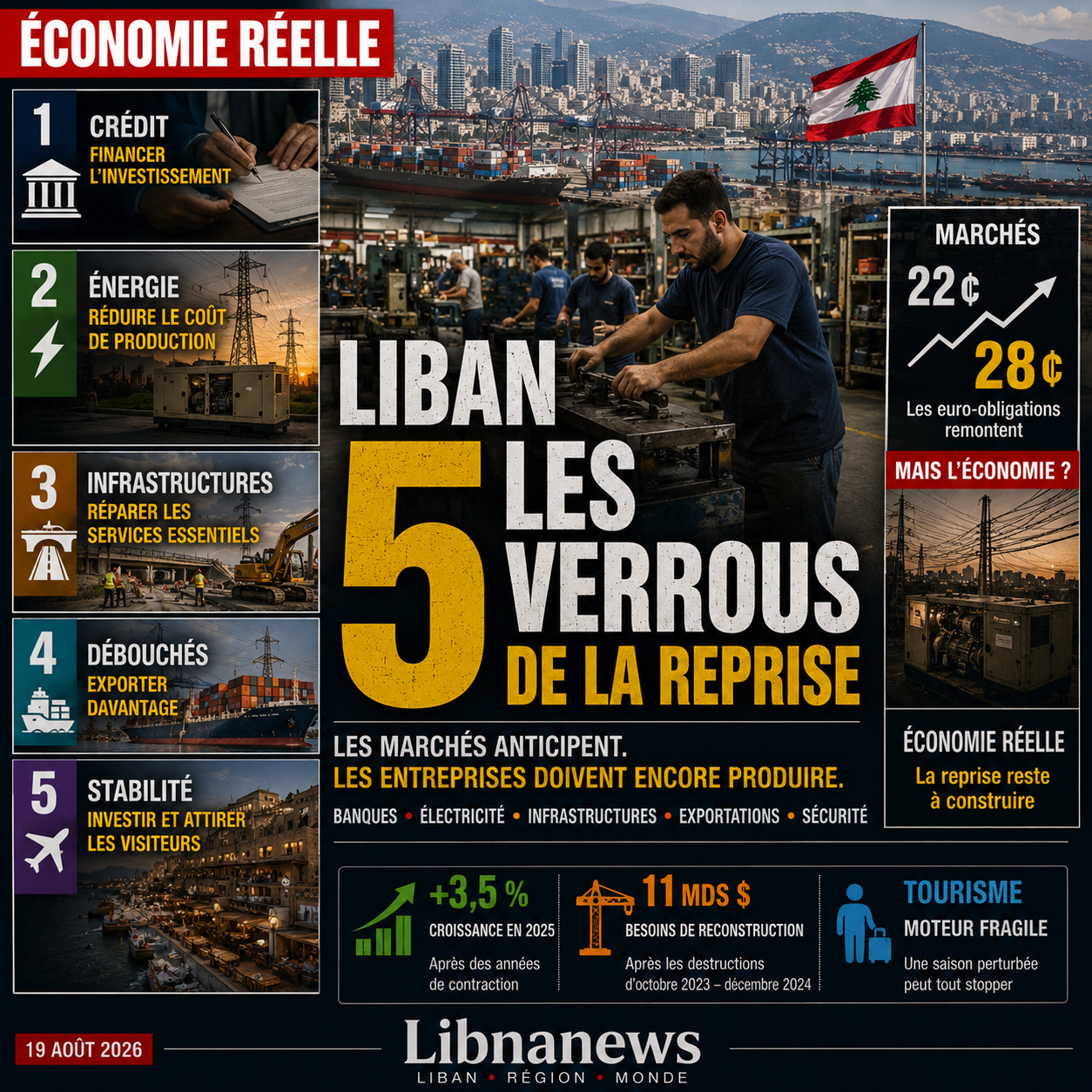
Bank recovery and improved financial indicators can create conditions for a recovery in Lebanon. They can’t produce it alone. A company that regains access to credit but always pays for expensive electricity, supports infrastructure failures, struggles to export and risks losing its customers in every security crisis remains confronted with the same structural obstacles. Five locks thus determine the transition from financial stabilisation to a real recovery in the real economy: financing, energy, infrastructure, markets and stability. The recent rise in sovereign bonds shows precisely why the anticipation of markets must be distinguished from the improvement actually felt by households and enterprises.
A Lebanese bond can earn several hundred in a few days. A factory, hotel or farm does not change this quickly.
This difference in temporality is at the heart of the Lebanese economic problem in 2026. Financial investors can buy a security today because they anticipate debt restructuring, bank reform or a political agreement whose effects will not be visible until later. The real economy, on the other hand, does not function on an anticipation. To produce more, a company must be able to borrow, obtain electricity at a predictable cost, have water and infrastructure, access customers, and have sufficient confidence in stability to invest.
Lebanon has already begun to find some positive indicators. The economy grew by 3.5% in 2025 after years of contraction. This improvement included macroeconomic stabilization, a recovery in tourism and the initial effects of reforms. She was still fragile. The growth of 2025 had also been lower than the 4.7 per cent originally envisaged, mainly due to a lower than expected tourist season, weak investment and delayed reconstruction.
The challenge now is to transform financial progress into productive capacity.
First lock: without credit, an economy invests with its savings
Bank reform is often presented from the perspective of depositors and the distribution of losses accumulated since 2019. This dimension is fundamental, but it is only part of the problem.
A bank is not only used to keep deposits. It normally converts part of the savings available into credit for households and businesses.
It is this function that was deeply damaged by the crisis.
When an SME wants to buy a machine, a farmer wants to modernise its operation, a hotel wants to renovate its rooms or a household wants to finance housing, investment becomes much more difficult without bank credit. Liquidated actors can finance their projects themselves. Others reduce, delay or abandon them.
This creates a two-speed economy. Enterprises with income in fresh dollars, family capital or financing from abroad can continue to invest. Local credit companies have a much lower margin.
Banking reform therefore has an objective that goes far beyond the resolution of the past:it must recreate a system capable of financing the future.
Successful restructuring should allow viable banks to have sufficient balance sheets to gradually resume their credit activities. It should also restore the confidence of applicants. Without sufficiently stable deposits, banks cannot sustainably rebuild their lending capacity.
But the return of credit will not be enough either.
A bank may have liquidity and refuse to finance a business if it remains too vulnerable. The cost of energy, security uncertainty, weak market opportunities and the state of infrastructure directly influence the risk assessment.
Banking reform is therefore the first lock, not the complete solution.
Second lock: electricity remains a cost of production
The second obstacle arises whenever a Lebanese company turns on a machine, refrigerator, air conditioner or computer.
The electrical problem is no longer limited to the number of hours provided by Electricity in Lebanon. He resides inaddition of the various sources necessary to obtain continuous service.
Enterprises and households pay for public electricity when it is available. They must then supplement this power with private generators, solar installations, batteries or their own generators.
These solutions enabled the country to operate despite the deterioration of the network. They also transferred part of the cost of the electrical system directly to users.
The World Bank still recently estimated public food at an average of only six to eight hours daily, according to a rotating system. This insufficiency obliges users to finance a second energy infrastructure in parallel with the former.
For a company, the consequence is directly measurable in the cost price.
A bakery must cool and produce. A factory has to run its machines. A hotel must provide lighting, hot water and air conditioning. A restaurant must maintain its cold chain. A trade must feed its equipment. When each has to produce part of its own electricity, the energy cost becomes a handicap of competitiveness.
Solar has reduced this dependency for some businesses and households. But it requires a significant initial investment. But the first lock immediately reappears:without a functioning banking system, the person who does not have the necessary capital cannot easily finance his energy installation.
The banking problem and the electrical problem are therefore mutually reinforcing.
Sustainable improvement requires restoring more reliable public production, reducing generation costs and further integrating renewables into the grid. Available estimates show that a transition to large-scale solar capacity can reduce the cost of production from dependence on imported liquid fuels.
For the real economy, the relevant measure will be simple: not only how many hours electricity in Lebanon provides, buthow much actually costs a continuous kilowatt hour to a company once all its sources are added.
Third lock: infrastructure generates invisible costs
Electricity is the most visible malfunction. She’s not the only one.
Water, sanitation, roads, telecommunications and municipal services also influence production costs. When a public service does not work, its expenditure does not disappear. It is often transferred to the household or enterprise.
The water sector provides a particularly clear example.
Inadequate public food leads households and establishments to buy water from private suppliers. Companies must have tanks, pumps or their own storage solutions. Each arrangement represents an investment and an operating cost that would be less important with a reliable collective service.
Wastewater treatment produces another type of cost.
A sewage treatment plant that works badly does not immediately send an additional invoice to a company. But the resulting pollution degrades water resources, agricultural areas and the coastline. It eventually generates health, environmental and tourism expenditures.
The processing facilities themselves depend on electricity. Cuts can disrupt pumps and station operation, again illustrating the interdependence of the various locks.
The World Bank has identified the rehabilitation of existing stations and the completion of unfinished facilities and networks as priorities for reducing water pollution.
In addition to these old problems, the destruction caused by the conflict has been added.
Reconstruction and rehabilitation needs assessed after damage suffered between October 2023 and December 2024 were met$11 billion. Of this total, about 1 billion were in public infrastructure in energy, transport, water, sanitation and municipal services.
The reconstruction of these facilities is therefore not a separate expenditure from economic policy.
A repaired road reduces transport times and costs. Reliable water supply reduces the use of private suppliers. A functional sewage treatment plant protects agriculture, health and tourism. A stable power grid reduces the need for generators.
The infrastructure thus acts on productivity without always appearing directly in a company’s balance sheet.
Fourth lock: producing is not enough, you have to sell
The fourth obstacle concerns opportunities.
In a country whose domestic market has been deeply weakened since 2019, the growth of productive enterprises depends more on their ability to find customers abroad.
The wine sector is a good laboratory for this problem.
Lebanon produces wines capable of positioning itself in demanding international markets. The fields have developed brands, distribution networks and a reputation that far exceeds the size of the Lebanese market.
However, this success does not remove logistical constraints.
Exporting involves transporting bottles to foreign markets, absorbing freight costs, complying with sanitary and commercial standards, having distributors and maintaining a sufficiently regular production.
When domestic demand weakens, access to external markets ceases to be only an opportunity. It becomes a condition of growth.
The same logic applies to agriculture and part of the agri-food industry. A Lebanese producer can be competitive on quality and lose its advantage over logistics.
Terrestrial passages are of particular importance here. Syria is the natural path to Jordan, Iraq and the Gulf markets. Border operations, road safety and transit costs therefore directly influence Lebanese export capacity.
At the same time, ports and airports play a central role in products with higher added value.
A real recovery must therefore be measured in exports of goods and services, not only in domestic consumption.
Lebanon has a large diaspora and products with a strong identity. But a productive economy cannot live long-term without the advantage of its diaspora. It must be able to sell beyond traditional community networks and win new markets.
Fifth lock: stability remains an economic variable
None of the first four obstacles is completely independent of the fifth: safety.
Tourism provides the most immediate demonstration.
A bank can be restructured, a company can have electricity and a hotel can have renovated its rooms. If airlines suspend their flights and foreign governments advise against travel to Lebanon, the tourist season may disappear within a few days.
The Lebanese economy remains particularly vulnerable to this phenomenon because tourism generates income in a very broad chain.
A visitor pays a plane ticket, hotel or rental. It spends in restaurants, shops, transport and leisure. The Lebanese in the diaspora also inject currency into the economy during their stay.
A bad season does not affect only hotels.
The growth of 2025 has already illustrated this dependency. Real GDP grew by 3.5%, but less than initially expected. Factors contributing to this gap included a lower-than-expected tourism season, low investment and continuing uncertainty.
New episodes of conflict recall the fragility of this engine. Air disturbance and uncertainty can suddenly interrupt an activity that took several months to rebuild.
Investment reacts similarly, but more slowly.
A tourist can cancel his trip for a week of tension. An industrialist who has to immobilize millions of dollars for ten years is wondering if tensions will return every year.
Stability is therefore not only a condition for tourism. It determines the risk rate applied to almost all productive investments.
Bonds may rise before the economy restarts
It is here that the signal sent by Lebanese sovereign obligations must be interpreted with caution.
At the beginning of August 2026, the Lebanese Eurobonds recorded a sharp rise. After changing around22 cents for a dollar of facial valuein late july, they reached about28 centsin the following weeks.
The movement was attributed in particular to the return of foreign buyers after the parliamentary advance of the bank restructuring project.
This increase is important information. It means that some investors believe that the likelihood of a resolution of the financial crisis or an improvement in the value of debt recovery has increased.
But28 cents for one dollar of debt do not mean that a lebanese company sells an additional 27 per cent, that households have recovered their deposits or that banks have resumed massive financing of the economy.
Bond markets buy future probabilities.
An investor can buy a 28 cent bond if he thinks that a future deal will make it possible to recover more. It does not need to wait for electricity to function, exports to grow or tourism to return to its previous level.
This is precisely why financial improvement can largely precede economic improvement.
It can even, for a time, coexist with a real economy in difficulty.
The risk of a two-speed recovery
The scenario to be avoided is therefore that of a Lebanon whose financial indicators improve while production conditions remain almost unchanged.
The bonds would go up. Debt negotiations would progress. The banks would be restructured. Monetary stability could continue. Capital would eventually begin to return.
Meanwhile, an SME would continue to finance its own electricity. A farmer would bear the costs of water and transport. An industrialist would hesitate to buy a new machine for lack of affordable credit. An exporter would remain dependent on uncertain roads and borders. A hotel could lose its bookings at the first security alert.
Such an economy would be financially less ill without still being truly productive.
The challenge in the coming months is precisely to move the improvement from the top to the bottom: from the state balance sheet to the banks, then from banks to businesses and households.
Reconstruction can accelerate this transmission. Requirements estimated at $11 billion include expenditures that could directly generate activity in construction, transportation, services and industry. But their financing must be accompanied by investments that can sustainably increase productivity.
Rebuilding destroyed infrastructure is necessary. To rebuild it without correcting the shortcomings that existed before the conflict would be to restore the old model.
Five indicators to determine whether recovery becomes real
The next Lebanese economic phase cannot therefore be evaluated with a single figure.
GDP will tell if total activity is increasing, but not necessarily why. The price of bonds will indicate what investors anticipate, but not what an SME is experiencing. The stability of the pound will give essential information about the currency, but it will not measure productivity.
In order to determine whether the recovery is truly economic, five indicators will have to evolve simultaneously:
- bank financing, with the measurable return of credit to households and especially productive enterprises ;
- real energy cost, calculated by adding together Electricity from Lebanon and the private solutions necessary to have continuous feeding;
- productive investment, in machinery, business, agriculture, industry and infrastructure rather than in financial assets alone ;
- exports, which will measure the ability of lebanese producers to regain or conquer external markets;
- tourism, including arrivals, nights, flights and expenses, which will provide an immediate indicator of confidence in the stability of the country.
The increase in Eurobonds shows that some investors are already beginning to look beyond the current crisis. For this to become a real recovery, credit will have to return to businesses, the cost of electricity will fall, productive investment will increase, exports will grow and tourists will continue to arrive when the next season begins.




