





Nawaf Salam’s government under pressure
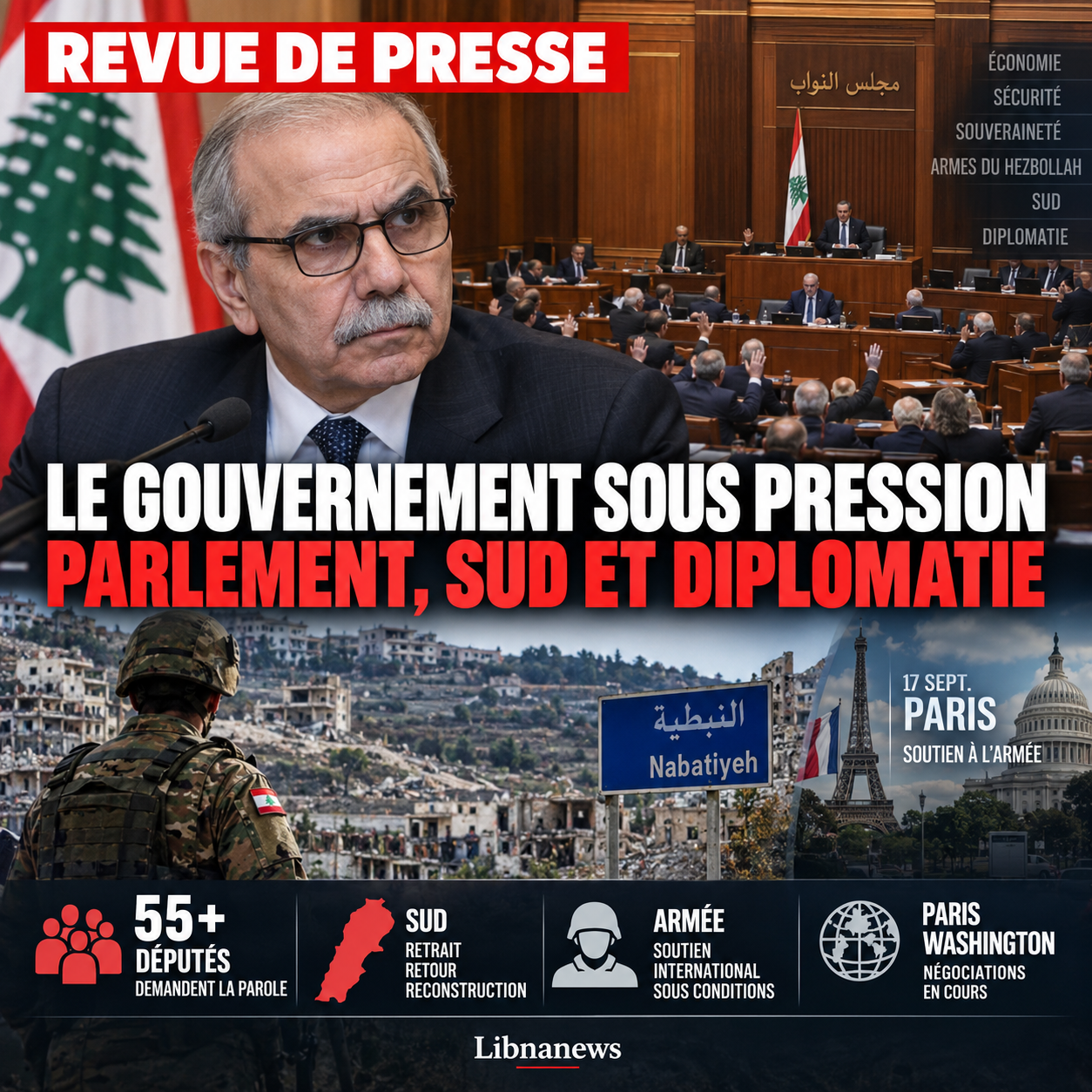
The parliamentary session devoted to government action largely dominates the political pages of the Lebanese press of 15 September 2026. It must extend over two days. The newspapers see it as less the immediate prospect of a fall in the cabinet than a political test for Nawaf Salam and his ministers. Ad Diyar believes that the government could be seriously shaken by criticism, without falling. The newspaper highlights criticisms of economics, security and political action. According to the parliamentary sources, the cabinet would not only have internal support. He would also benefit from external protection that would make his fall unlikely. Al Joumhouria also presents the session as a moment of strong tension. More than 55 Members would have asked for the floor. The debate should therefore go beyond simply monitoring ministerial action. It should focus on the main directions of the State, the situation in the South, the weapons of Hezbollah and the capacity of institutions to implement their decisions.
Al Joumhouria of 15 September 2026 distinguishes three levels of confrontation. The first concerns the government’s economic, financial, administrative and social performance. The second concerns sovereignty and security issues. It includes the cessation of Israeli attacks, the withdrawal of Israeli forces, the return of southerners and reconstruction. It also covers the issue of state monopoly of arms. Finally, the third level concerns the very functioning of the executive branch. In particular, Members must question the firm’s cohesion and its ability to transform its decisions into action. This reading grid can be found in different forms in several newspapers. The meeting thus appears to be a meeting point between the social crisis, the issue of arms and the consequences of the conflict in the South.
Ad Diyar of 15 September 2026 insists on criticism of the government’s results. The newspaper reports that President Joseph Aoun would be dissatisfied with the work of several ministers. He also referred to criticism of Nawaf Salam’s action on economic and social issues. On his political pages, Ad Diyar points out that the government’s promises far exceed the results achieved so far. The newspaper also notes a certain coldness in the relations between the President of the Republic and the President of the Council. However, these assessments are attributed to anonymous sources cited by the publication. They therefore do not constitute public statements by the two officials.
Al Liwaa of 15 September 2026 adopts a different reading on certain points, but joins other publications on the likely outcome of the meeting. The newspaper believes that parliamentary confrontation risks becoming a succession of confrontations between blocs. Each side will seek to challenge its opponents as much as the government itself. According to this reading, the debate on cabinet action could quickly lead to a broader discussion. It would focus on Hezbollah’s responsibility in recent wars, its consequences for the South and the economic crisis. However, the parliamentary power ratio would limit the possibility for a single camp to impose a decisive outcome. The session could therefore be tough in its form, but much less decisive in its immediate consequences.
South sets agenda for political debate
The situation in the South is the second major common subject. It gives the parliamentary sitting a scope that goes far beyond economic issues. Annahar of 15 September 2026 summarizes this articulation by presenting the session as a debate between the government and Hezbollah. Al Joumhouria also places the Southern dossier at the centre of the confrontation. The events around the heights of Ali al-Taher fuel questions about the Israeli strategy, the role of Hezbollah and the ability of the Lebanese army to regain effective control of the sectors concerned.
Al Binaa of 15 September 2026 devotes an important place to the consequences of the explosions on the heights of Ali al-Taher. The publication focuses on their impact on the ground and their military reach. It also refers to the contradictions it raises in the Israeli declarations concerning the control of the sector. According to the newspaper, the various announcements about the occupation, the withdrawal then a possible resumption of the site do not allow to produce a completely coherent Israeli version. Al Binaa also develops an environmental angle. An article states that the explosions would have produced a wave recorded by seismic monitoring systems. It calls for independent Lebanese expertise to measure geological, hydrological and environmental damage. The newspaper itself states that comparison with a nuclear explosion should not be understood as scientific equivalence.
Al Joumhouria of 15 September 2026 goes further in its analysis of territorial risks. The newspaper questions about a possible extension of Israeli operations to Nabatiyah, Iqlim al-Tuffah, Jabal al-Rayhan, Kfarhunah and Mashghara. It presents this hypothesis as a scenario and not as an acquired fact. According to the experts cited in the publication, Israel could seek to control certain areas without necessarily initiating a traditional land occupation of urban centres. Air surveillance, height control and military pressure could be used to limit movement in the targeted areas. The newspaper links this evolution to what it describes as a gradual enlargement of an Israeli control zone.
In this context, Joseph Aoun’s visit to Nabatiyeh retains a strong political dimension. Several publications of September 15 are recaptured on this trip. They see it as a message about the state’s presence in the South. Al Sharq stresses that the visit was presented as a support to the inhabitants and as an affirmation of the role of the institutions. MP Firas Hamdan, then received by Joseph Aoun, praised the presidential move. It also affirmed its support for efforts to secure Israeli withdrawal, the return of the inhabitants and the strengthening of stability. In Ad Diyar, former President Michel Sleiman also greets the visit. However, he asked Hezbollah not to repeat, in its terms, the mistake of not returning the positions concerned to the army.
Hezbollah, for its part, appears in several newspapers as engaged in a phase of military restraint. Ad Diyar of 15 September 2026 asks openly about the meaning of this attitude. The journal makes three possible explanations from sources close to the file. The party would first try not to offer Israel a pretext for a wider confrontation. He would then wait to see how Washington-Theran relations were evolving. Finally, he would like to preserve his capabilities after the previous losses and clashes. The newspaper also leaves open the hypothesis of deeper political adjustment. In this scenario, current military behaviour could be accompanied by broader negotiations on the security of the South and the future of the party’s weapons.
Paris, Washington and the army at the heart of the diplomatic sequence
The internal crisis is taking place alongside intense diplomatic activity. The Paris preparatory meeting on support for the Lebanese Armed Forces occupies a central place in Ad Diyar, Al Jumhouria, Al Sharq and Annahar on 15 September 2026. This meeting is scheduled for 17 September. Annahar explains that she is part of the Aqaba process, originally launched by King Abdullah II of Jordan. This year, France and Jordan want to devote part of this framework to Lebanon. Joseph Aoun, Emmanuel Macron and King Abdullah II must participate in this sequence alongside military leaders.
The issue goes beyond the search for new ad hoc aids. Ad Diyar of 15 September 2026 reports that the army command wants to defend an approach based on a lasting military partnership. It would no longer be simply a matter of receiving isolated equipment or financing. The aim would be to establish training, equipment, maintenance and technical cooperation programmes. The newspaper recalls that previous support conferences have sometimes created a significant gap between announcements and the resources actually obtained. The question of follow-up to commitments therefore becomes essential.
Al Jumhouria of 15 September 2026 stresses, however, that international aid could be linked to the performance of the Lebanese State. According to diplomatic sources cited by the newspaper, Washington would like to measure the military’s ability to extend its authority and prevent the presence of weapons outside the state. Support for the military institution is thus directly linked to the country’s most sensitive political dossier. The more the military capabilities increase, the more the international partners could demand concrete results on the ground.
This equation is reflected in the negotiations between Lebanon and Israel. Al Joumhouria reported that the postponement of the next meeting in Rome would not mean abandoning the process. The contacts would continue under American mediation. A meeting between Lebanese and Israeli diplomatic representatives in Washington should help keep the channel open. The publication states that discussions have already addressed areas where a mechanism could be tested. The challenge is to determine the conditions for an Israeli withdrawal, the deployment of the Lebanese army and the mechanisms for verifying commitments.
Al Sharq of 15 September 2026 gives another indication of the timetable. The newspaper quotes David Schenker, a former United States official in charge of the Middle East, as saying that decisive progress would be difficult before the Israeli elections scheduled for October. In his view, the current meetings are primarily used to preserve the process. He believes that the expansion of the Lebanese army’s deployment in sensitive areas would be crucial to a progressive Israeli withdrawal. This analysis joins the idea, presented in several publications, of diplomatic time suspended at Israeli and American political deadlines.
An internal crisis suspended from regional power relations
The regional dimension complements this one dominated by Lebanon. Tensions around Iran, the Strait of Ormuz, Yemen and Bab al-Mandeb occupy a significant place in Al Arabi Al-Jadid, Al-Quds Al-Arabi, Asharq Al-Awsat and Al-Akhbar of 15 September 2026. These developments have a direct impact on Lebanese reading. The newspapers question the ability of a possible dialogue between Washington and Tehran to change the balance of forces in Lebanon.
Al Arabi Al Jadid of 15 September 2026 reports the postponement of the Salalah meeting which was to bring together Iran and several States of the region on the question of the Strait of Ormuz. Tehran claims that Saudi Arabia requested this postponement. Differences persist on the maritime mechanism envisaged by Iran and Oman. At the same time, exchanges between Washington and Tehran remain tense. Donald Trump says Iran wants to reach an agreement quickly. The Iranian authorities, for their part, are calling for the lifting of American measures which they consider illegal.
Yemen is adding another hotbed of tension. Al Quds Al Arabi of 15 September 2026 reports a Houthis attack on King Khaled’s base in Khamis Mushait, Saudi Arabia. The newspaper also refers to the fighting between Yemeni government forces and the Houthis. Asharq Al-Awsat describes a military mobilization around Taez and highlights the risks associated with the evolution of the balance of forces around Mokha and Bab al-Mandeb. These events give an economic dimension to the crisis. Seaway safety and oil circulation are becoming major variables for the entire region.
For Lebanon, the stake is double. On the one hand, the state is trying to strengthen its position through military, diplomacy and negotiations. On the other hand, Hezbollah remains linked to a regional environment whose evolution depends largely on the relationship between Iran and the United States. It is precisely this superposition that explains the caution observed in several newspapers of September 15, 2026. The parliamentary session can put pressure on the government. It can expose its weaknesses and revive clashes around weapons. But it comes at a time when the toughest decisions concerning the South remain linked to Paris, Washington, Israel and the transformation of the regional power relationship.
Local politics: Nawaf Salam’s government tested by parliament and political divisions
A control session turned into a political test
The parliamentary session devoted to the action of the government of Nawaf Salam opened, on 15 September 2026, a confrontation that went far beyond the ordinary control of the executive. Ad Diyar of 15 September 2026 believes that the cabinet can be « shaken » without being overthrown. According to parliamentary sources cited by the newspaper, criticism should focus on economic, social, security and political outcomes. The daily notes that the majority of actors do not expect a fall in government. The session must nevertheless reveal the extent of the reproaches accumulated since its formation. The balance sheet of reforms, living conditions, public appointments and management of the Southern dossier must feed much of the interventions.
Al Joumhouria of 15 September 2026 indicates that more than 55 deputies have asked for the floor. This number gives the session a particular dimension. The journal distinguishes three main fields. The first concerns economic, financial, administrative and social action. The second relates directly to sovereignty. It includes Israeli attacks, the withdrawal of Israeli forces, the return of displaced inhabitants, reconstruction and the state monopoly of weapons. The third concerns the cohesion of the executive branch. Parliamentarians must therefore judge both the results of the government and its ability to implement its own decisions. Al Joumhouria believes, however, that criticism should not easily turn into a majority capable of overthrowing the cabinet or a minister.
Ad Diyar of 15 September 2026 presents the Free Patriotic Current as one of the main poles of the parliamentary offensive. Members of Parliament must raise several issues and criticize some departments. The newspaper quotes energy, education and foreign affairs. The issue of Hezbollah’s weapons should also cause a confrontation between the blocs. The members of the party would prepare to respond to any attempt to use the meeting as a forum against resistance. In the opposite camp, several change MPs, Kataeb and independents are presented by Ad Diyar as likely to defend the government. The position of the Lebanese Forces is also observed after the criticisms made by Samir Geagea on certain aspects of government action and the tensions around Foreign Minister Youssef Raggi.
Al Sharq of 15 September 2026, however, reports an important indication from MP Assaad Dergham. He claims that the opposition addressed fifty questions to the government on economic, social and daily issues. According to him, only fifteen replies had been provided and they would not be satisfactory. Despite this, Dergham states that the withdrawal of confidence in the government is not, at this stage, the chosen option. This position reduces the possibility of a parliamentary offensive up to the overthrow of the cabinet. Above all, she confirmed that the session should be used to record disagreements and publicly expose the weaknesses of the executive.
Al Liwaa of 15 September 2026 describes a confrontation framed by the balance of forces. Each block should use its speaking time to attack its opponents and defend its own record. The newspaper believes that the discussion of the government will soon be mixed with the discussion of political responsibilities in previous years. Criticism about electricity, water, the financial crisis or the issue of weapons cannot be separated, according to this reading, from the choices made by the various forces that participated in power. The session may therefore become an exchange of charges. Yet no single force seems to have the means to impose a new majority.
Aoun, Salam and Berri in the centre of institutional balance
Another feature of the press is the relationship between the three main institutions. Ad Diyar of 15 September 2026 reports, on the basis of informed sources in Baabda, that Joseph Aoun would not be satisfied with the work of several ministers. The President would also criticise certain aspects of Nawaf Salam’s action, particularly on economic and social issues. The newspaper evokes a colder relationship between Baabda and the Serail. However, these elements remain information attributed to anonymous sources. No public comments in the newspapers show Joseph Aoun calling for the departure of Nawaf Salam or the fall of the government.
On the contrary, the official activity of the President shows the continued institutional functioning. Ad Diyar and Al Sharq of 15 September 2026 report that Joseph Aoun received former President Michel Sleiman, Vice-President of the Tarek Mitri Council and several MPs. In particular, Firas Hamdan spoke with him about recent events in the South. He welcomed the presidential visit to Nabatiyah and stressed the need for a return of the inhabitants to their villages. It also supported efforts to secure Israeli withdrawal and strengthen the State presence.
For his part, Michel Sleiman placed the issue of arms at the heart of his intervention. According to Ad Diyar of 15 September 2026, the former president praised Joseph Aoun’s move to the South and the deployment of the army to Nabatiyah. However, he asked Hezbollah not to reproduce what he described as a serious mistake regarding the handing over of Ali al-Taher to the army. This statement illustrates a political line that is becoming more important in the debates: strengthening the army must not only be presented as a response to Israeli operations. It is also invoked in the internal debate on State authority.
Nabih Berri occupies a different position. Ad Diyar of 15 September 2026 considers that the Speaker of the House should seek to keep parliamentary exchanges under a certain ceiling. According to daily sources, he could suspend the session if verbal clashes exceeded the limits he considered acceptable. Its role, however, is not to prevent criticism. The convening of the sitting also responds to the rules of parliamentary scrutiny and requests from several Members. Parliament thus becomes the place where opposing views of government policy must be confronted.
Al Sharq of 15 September 2026 also reports that Berri received MP Imad Hout and the United Nations humanitarian coordinator in Lebanon, Imran Riza. Discussions focused on political and military developments, as well as reconstruction, infrastructure, public services and the needs of the southern regions. This activity highlights the dual role of the Speaker. He remains one of the main arbiters of the parliamentary game while maintaining a central place in matters related to the South.
Nawaf Salam, for his part, seeks to maintain government action in parallel with political confrontation. Al Binaa and Al Sharq of 15 September 2026 indicate that he chaired a ministerial meeting on the budget proposal. Information Minister Paul Morcos explained that discussions should continue at a forthcoming Council of Ministers meeting in order to complete the text. Salam also received a delegation from Dar al-Fatwa from Tyre and the South. The Mufti of Tyre, Medrar Habbal, said that the President of the Council had affirmed his commitment to the whole South and its inhabitants. The social needs and difficulties of the region have played an important role in the maintenance.
Hezbollah’s weapons remain at the heart of the national divide
The issue of Hezbollah is going through almost every political debate. It no longer concerns only the status of its weapons. It now concerns reconstruction, security in the South, the role of the army and relations between institutions. Al Binaa of 15 September 2026 reports a meeting of the Hizbullah and d’Amal leaderships. Both sides affirm that national partnership and coexistence must remain the basis for the protection of the country. They reject approaches based on the exclusion or domination of a camp. They also call for the maintenance of political and constitutional disputes.
Hezbollah and Amal also insist on civil peace. According to Al Binaa of 15 September 2026, both movements call it a red line and a common responsibility. They call for disagreements to be addressed through dialogue, understanding and institutions. At the same time, their declaration places reconstruction among the priorities. The return of the inhabitants to the affected villages, their compensation and the rehabilitation of the destroyed areas should not be postponed. Both movements call on the State to fully assume its responsibilities and to use available Arab and international support.
This position comes as Hezbollah’s opponents reinforce their criticism. Al Sharq of 15 September 2026 reports that the « Saydet al-Jabal Gathering » calls on the deputies to defend the Constitution and place the handing over of Hezbollah’s weapons to the army as part of the Taif agreement. The group felt that the issue existed well before recent conflicts. He also described Joseph Aoun’s visit to Nabatiyeh as an affirmation of the state’s presence in the South.
Al Sharq, however, gives an even more offensive reading in another article. The newspaper believes that Hezbollah, having shown the limits of its capabilities vis-à-vis Israel, would seek to move its confrontation towards the state. He quotes the words of MP Hussein Hajj Hassan, who claims that the resistance and its allies are not weak and warns those who seek to underestimate them. The newspaper’s commentary interprets these statements as an attempt to preserve an image of force. This assessment clearly falls within the editorial line of the publication. It must therefore be distinguished from the words themselves.
The debate is also taking place in the political camp near Hezbollah. Al Binaa of 15 September 2026 reports that Amal and Hezbollah insist on the need to avoid discord and maintain conflict in institutions. This insistence reflects the sensitivity of the period. Tensions around weapons are now linked to the human and material consequences of the conflict. The population of the South awaits reconstruction and return to villages. At the same time, part of the country calls for the army to become the only armed force with operational authority.
The social crisis and reforms fuel the cabinet’s challenge
However, political confrontation is not confined to Hezbollah. Ad Diyar of 15 September 2026 considers that economic and social difficulties are one of the most obvious weaknesses of the government. The daily reports on living conditions, wages and the limited results of reforms. He also criticises certain public appointments. These files must provide Members with a wealth of material to challenge ministers.
Al Binaa of 15 September 2026 reports a very critical position of the Syrian National Social Party. Meeting under the presidency of Assaad Hardan, the party considers that the continued rise in prices and the lack of adequate responses have aggravated the social crisis. He felt that parliamentary questioning was necessary but insufficient. The party asks the government to treat economic and social issues as national priorities. He also criticized him for his attitude to Israeli operations and called for more active diplomatic and legal action.
At the same time, some legislative issues are progressing. Ad Diyar and Al Sharq of 15 September 2026 report that the Finance and Budget Committee, chaired by Ibrahim Kanaan, approved a military cooperation agreement between Lebanon and Turkey. Its announced value is 100 million Turkish pounds. The Commission also approved a $250 million energy-related loan, including improvements to networks and equipment. Ibrahim Kanaan called for better monitoring of costs and accelerated procedures with international agencies. The Commission also processed the file of some Lebanese University employees to correct a salary situation dating back to 2014.
These decisions show that institutional life is not limited to confrontation around the government. They also offer opposing arguments to politicians. Firm supporters can highlight the resumption of institutional work, financial agreements and social projects. Its opponents can respond that the concrete effects remain too weak in the face of deteriorating living conditions. It is this tension between administrative decisions and perceptible results that should feed an important part of the parliamentary debate.
Dory Chamoun’s disappearance closes a long political sequence
Local politics was finally marked by the death of Dory Chamoun at the age of 94. Ad Diyar, Al Liwaa and Al Sharq of 15 September 2026 return to his journey. The son of former President Camille Chamoun, founder of the Liberal National Party, Dory Chamoun led this formation and represented the Chouf in Parliament between 2009 and 2018. He had previously presided over the municipality of Deir el-Qamar from 1998 to 2008.
The Liberal National Party presents him as a man committed to his principles and the sovereignty of Lebanon. Several political figures paid tribute to him. Al Liwaa of 15 September 2026 reports Saad Hariri’s reaction. The former President of the Council describes him as a faithful friend and companion of the period of 14 March, marked by assassinations, explosions and political confrontations around sovereignty. Ashraf Rifi also stressed his commitment to Camille Chamoun’s independence and political legacy.
His disappearance comes at a time when the themes that have structured much of his career remain at the centre of the Lebanese debate. Sovereignty, the role of the State, weapons, regional influences and the balance between communities remain the main subjects of confrontation. Parliament now finds them in a renewed form, while the economic crisis and the consequences of the conflict in the South add social and territorial pressure to the old political divides.
Quote and speech by political figures: sovereignty, South and social crisis dominate speeches
Joseph Aoun placed the State, the South and the Army at the centre of his speech
The press statements of 15 September 2026 show a President Joseph Aoun focused on three areas: the return of the state to the South, the strengthening of institutions and the search for new economic engines. His public statements differ from the many information attributed to anonymous sources about his relations with the government. They therefore help to define more precisely the speech taken by the Head of State. During his meeting with Mohammed Ben Sulayem, President of the International Automobile Federation, Joseph Aoun stressed the role of sport. Ad Diyar reports that he sees competitions as a way to bring Lebanon closer to the world. The organisation of the Rally of Lebanon and the presence of international leaders must, he said, help restore confidence. The president said that sport had become an « economic lever ». It directly links competitions with tourism, investments, international sponsors and the presence of large companies. In a country facing a sustainable economic crisis, this declaration gives sport a reach that goes beyond sport.
The presidential discourse, however, takes on a much more political dimension when it concerns the South. Joseph Aoun’s visit to Nabatiyah remains present in several publications of 15 September. Even when its interlocutors comment, displacement is interpreted as an affirmation of the presence of the State. Al Sharq reported the remarks of MP Firas Hamdan after his meeting with the President. Hamdan thanks Aoun for this visit and for the message of support addressed to the inhabitants. He stressed the importance of an effective state presence alongside them. He also said he supported the President’s efforts to secure Israeli withdrawal, allow the return of the inhabitants and strengthen stability. The visit thus becomes a political act: it combines territorial sovereignty with a concrete institutional presence.
Joseph Aoun also developed a cultural discourse on the role of Lebanon. At his meeting with the Amin Rihani Foundation, Ad Diyar reported that he praised the work done to preserve the author’s legacy. He sees the one hundred and fiftieth anniversary of his birth as an opportunity to highlight the literary and intellectual dimensions of his work, as well as his role in Lebanon and abroad. This register seems far removed from the political confrontations of the moment. Yet it complements the same representation of the country: that of a Lebanon that seeks to strengthen its institutions while reaffirming its international presence through culture, sport and its communities established abroad.
At the same time, the newspapers report information about Joseph Aoun’s possible dissatisfaction with some ministers and Nawaf Salam. Ad Diyar refers in particular to criticism of the economic and social situation. These statements, however, must be distinguished from presidential statements. They come from anonymous sources and do not constitute a public discourse by Joseph Aoun. This distinction is important. The statements directly attributed to the President in the sources of 15 September focus mainly on the role of the State, international openness, support for the regions and the strengthening of the institutional presence.
Nawaf Salam defends government continuity and attention to the South
Nawaf Salam intervenes in a more delicate position. His Government was about to face two days of parliamentary scrutiny. However, the public evidence reported on 15 September shows a President of the Council who continues government work without entering into verbal confrontation with his opponents. Al Binaa and Al Sharq indicated that he chaired a ministerial meeting on the budget. Information Minister Paul Morcos explained at the end that discussions had focused on the various budgetary provisions and that they should continue in the Council of Ministers in order to complete the project. The political message remains sober: at a time when Parliament is preparing its challenge, the executive is showing the continuity of its work.
The South also occupies an important place in the exchanges of Nawaf Salam. A delegation from Dar al-Fatwa from Tyre and South, led by Mufti Medrar Habbal, is received by the President of the Council. Al Binaa reported that the delegation explained the needs and difficulties of the region. After the interview, the mufti claims that Salam confirmed his commitment to « the whole South and its inhabitants ». He would also have been able to monitor the various cases and work on the treatment of social crises in order to meet the demands of the population. The formula is politically significant. The government is criticized for managing the consequences of the conflict and for the pace of reconstruction. It therefore seeks to present the South as a national responsibility and not as the exclusive domain of a political or community force.
Nawaf Salam does not respond directly, in the material published that day, to all the accusations made against his Government. This restraint contrasts with the violence of the debate announced in Parliament. The newspapers report criticism of reforms, cost of living, appointments, energy, internal relations in the cabinet and the issue of arms. Yet public government discourse remains primarily administrative and institutional. This difference between the virulence of parliamentary confrontation and the sobriety of Salam’s statements is one of the political features of the day.
Michel Sleiman calls Hezbollah directly on Ali al-Taher
Former President Michel Sleiman makes one of the most direct statements on the situation in the South. After his meeting with Joseph Aoun, he reviewed military developments and measures related to the ceasefire. Ad Diyar of 15 September reports that he welcomes the presidential visit to the South and the deployment of the army to Nabatiyah. But above all, he sends a message to Hezbollah. He hoped that the party would no longer reproduce what he described as the « great mistake » of not having handed over Ali al-Taher’s height to the Lebanese army.
Sleiman’s formulation directly links military events to the state authority debate. His point was not merely to condemn Israeli operations. It introduces Lebanese responsibility in the reflection on events. For the former president, the presence and deployment of the army is a central element of the response. Al Sharq reported a similar version of his remarks and stressed his call for action before losing new opportunities. The statement is of particular importance as the press questions the future of Hezbollah’s weapons and the ability of the army to become the effective military authority in the southern sectors.
Hezbollah and Amal focus on civil peace and reconstruction
The Hezbollah and Amal leaderships choose a different registry. Al Binaa of 15 September reported their joint statement after a meeting between their officials. Both movements claim that national partnership and coexistence are an essential basis for protecting Lebanon. They reject any political approach based on exclusion, domination or imposition of achieved facts. They call for differences to remain within their political and constitutional framework.
The most supported message concerns civil peace. The two formations describe it as a « red line » and a common national responsibility. They reject speeches of tension and calls that may fuel discord. In their view, conflict issues must be addressed through dialogue, understanding and institutional use. This position comes in a context where the issue of Hezbollah’s weapons is expected to occupy a major place in the parliamentary session. The choice of terms therefore aims to shift the debate from the balance of forces to the preservation of internal stability.
The joint declaration also insists on reconstruction. Hezbollah and Amal claim that compensation for the victims and the return of the inhabitants to their villages cannot be considered as files that can be postponed. They called for the mobilization of public resources, local capacities and Arab and international aid. The stated aim is to keep people on their land and restore normal life in the affected areas. The two training courses also ask the State to fulfil all its responsibilities. They call on political forces to avoid narrow calculations and to strengthen their exchanges.
The deputy Hussein Hajj Hassan, however, takes a firmer tone in words reproduced by Al Sharq. He claims that resistance, its people and its allies are patient for their own reasons and that this restraint should not be interpreted as weakness. He points out that his camp, according to him, retains capacities in the areas of resistance, politics and popular mobilization. Al Sharq interprets this as a warning to the state and the opponents of Hezbollah. This interpretation belongs to the newspaper. The statements themselves show above all the party’s willingness to fight the idea that its military or political restraint would result in a complete loss of ability to act.
Firas Hamdan combines state support and urgent reforms
MP Firas Hamdan provides another example of discourse linking the South to domestic politics. After his meeting with Joseph Aoun, he greeted the presidential visit to Nabatiyeh and stressed the role of the state with the inhabitants. Al Sharq reports that it supports efforts to secure Israeli withdrawal and the return of the population to its villages. It also calls for the South to be protected and its stability strengthened.
Hamdan, however, does not limit his intervention to security. He said that he had discussed with the President the economic and social difficulties facing the Lebanese. It calls for accelerated reforms to pave the way for economic recovery and restore confidence in Lebanon and its institutions. His speech thus links two dimensions often dealt with separately: sovereignty and reform. The presence of the State in the South cannot, in this approach, be separated from its ability to provide services and restore economic confidence.
Ibrahim Kanaan challenges the slow pace of international mechanisms
MP Ibrahim Kanaan intervenes mainly on financial and legislative matters. Following the meeting of the Finance and Budget Committee, Ad Diyar reported on the approval of a military cooperation agreement between Lebanon and Turkey. Its value is announced at 100 million Turkish pounds. The agreement should allow for exchanges of experience, equipment and other military needs. The committee also approves the project on renewable energy and network improvement.
Kanaan insists on the slowness of certain mechanisms. It calls for a review of costs and a more rigorous monitoring of project implementation. Al Sharq reports that he refuses to automatically take responsibility for delays to Lebanon alone. In his view, Parliament generally adopts the texts transmitted to it within a reasonable time. It attributes some of the delays to the procedures of the international institutions and the successive amendments requested.
His speech took on a political dimension when he addressed the announced support for the army. Ad Diyar reports that he recalls the existence of previous international conferences whose material results would have been disappointing. He therefore called for judging the next Paris meeting on concrete results rather than statements. This speech joins a more general concern in several newspapers: international support for the army must translate into real capabilities, not stay at the level of promises.
Oppositions prepare arguments before parliamentary session
Assaad Dergham specifies in Al Sharq of 15 September 2026 the line that should be followed by part of the opposition. He claims that fifty questions were addressed to the Government on economic, social and daily issues. According to him, only fifteen responses were received and they are not convincing. Despite this criticism, he states that the withdrawal of confidence in the government is not envisaged at this stage. This position makes it possible to distinguish two objectives: severely challenge the balance sheet of Nawaf Salam without necessarily seeking to immediately cause the firm to fall.
The Syrian National Social Party adopts a tougher line. Al Binaa reports that he considers the parliamentary challenge insufficient in the face of the scale of the social crisis. He denounces the rise in prices and the lack of treatment deemed serious. The party also believes that the government and the Ministry of Foreign Affairs do not sufficiently assume their responsibilities in the face of Israeli operations. He called for stronger diplomatic and legal approaches. It sets as priorities the cessation of attacks, the Israeli withdrawal, the return of the inhabitants, the reconstruction and release of the prisoners.
The Gathering of Saydet al-Jabal, quoted by Al Sharq, takes an opposite perspective on Hezbollah. He believes that Parliament must address the handing over of the party’s weapons to the army on the basis of the Taif agreement. For this group, the issue of the state monopoly of arms predates recent wars and must remain a constitutional principle. He also presented Joseph Aoun’s visit to the South as confirmation of the return of the state to a region long dominated by other relations of power.
Dory Chamoun hailed as a figure of sovereignty
The death of Dory Chamoun finally provokes several political statements that reactivate the vocabulary of sovereignty and independence. The Liberal National Party, quoted by Ad Diyar, Al Liwaa and Al Sharq on 15 September 2026, pays tribute to its former president. He describes him as a man of courageous principles and positions committed to Lebanon’s independence and the refusal of guardianship.
Saad Hariri recalled his companionship with Dory Chamoun during the period of 14 March. Al Liwaa reports that the former President of the Council describes him as a faithful friend and companion of years marked by threats, assassinations and explosions. Ashraf Rifi also stresses his commitment to sovereignty and independence. Neemat Frem refers in Al Sharq to an official who has defended Lebanon’s right to be a free and responsible State.
These tributes are not just personal testimony. They also use terms that dominate the political confrontations of 15 September: sovereignty, state, independence, national decision and refusal of guardianship. The disappearance of Dory Chamoun thus gives politicians the opportunity to recall principles that remain at the centre of the debate on the South, Hezbollah weapons and institutional authority.
Diplomacy: Paris and Washington at the heart of the battle to restore Lebanese sovereignty
Paris prepares lasting support for the Lebanese army
Lebanese diplomacy approached a dense sequence, dominated by the Paris meeting of 17 September 2026 and continued contacts with Washington. These two tracks are closely related to the situation in the South. They concern Israeli withdrawal, the deployment of the army and the search for a mechanism capable of stabilizing the border on a lasting basis. Ad Diyar of 15 September 2026 stresses that the Paris meeting is preparatory. It should therefore not be confused with an international financing conference. However, Beirut wants to take advantage of this step to change the nature of support for its army. The objective is to move from ad hoc support to structured military cooperation over several years.
According to Ad Diyar, the army command intends to present in Paris a clear vision of its needs. Applications are not limited to weapons and ammunition. They also cover training, maintenance, communications, intelligence, logistics and technical equipment. This approach is based on a simple idea: the delivery of equipment is not enough to build a sustainable military capability. The army therefore wishes to participate directly in the definition of programmes financed by foreign partners. It wants to prevent aid being determined solely on the basis of the priorities of donor countries.
This will also stems from previous experiences. Ad Diyar of 15 September 2026 recalls the Rome and Cairo conferences on supporting Lebanese military and security institutions. The newspaper notes a gap between the commitments announced and the means actually received. Administrative delays, changing priorities of donor States and the lack of permanent monitoring mechanisms have reduced the impact of certain promises. Ibrahim Kanaan echoes this criticism before the Finance and Budget Committee. He recalled that several conferences had already been held to support the army and called for the new commitments to produce concrete results.
Al Joumhouria of 15 September 2026 specifies several needs that Lebanon must present to its partners. They include vehicles, communications equipment, protective equipment and equipment for field operations. Financial support to the military is also a central issue. The economic crisis has severely reduced the capacity of the institution. The partners therefore seek to maintain the availability of its workforce while improving its operational capacity. Paris also wants to further integrate the Internal Security Forces into the international system. Improved internal security capacity would allow the army to focus more resources on its territorial and border missions.
Annahar of 15 September 2026 places the meeting within the framework of the Aqaba process. The mechanism, launched in 2015 by King Abdullah II of Jordan, provides a framework for international cooperation on several regional security issues. France and Jordan have chosen this year to give special place to Lebanon. Joseph Aoun, Emmanuel Macron and Abdallah II must therefore be at the centre of the meeting. More than 20 military officials and representatives of international institutions are also expected. Above all, the meeting should prepare for a broader conference in support of the Lebanese Armed Forces.
International aid is accompanied by requirements on State authority
However, military support is not presented as unconditional. Al Jumhouria of 15 September 2026 reports, on the basis of diplomatic sources, that a part of the US administration wants to establish a link between the scale of aid and the ability of the Lebanese State to implement its commitments. The main issue concerns weapons held outside the official framework. The partners also expect the army to extend its authority in areas where the presence of the State remains insufficient.
This condition gives the conference a direct political dimension. The aid to the army is no longer only intended to prevent its weakening. It must help build an institution capable of assuming more responsibility. Ad Diyar highlights this relationship between capabilities and obligations. The more resources the army receives, the more international expectations for it will increase. Donor States will want to measure its capacity to occupy the ground, control sensitive sectors and become the military reference point for the State.
The situation in the South makes this issue urgent. Joseph Aoun’s visit to Nabatiyeh is presented in several newspapers as an affirmation of the institutional presence. The diplomatic meetings in Paris must extend this message. Beirut seeks to demonstrate that the strengthening of the army can provide a concrete solution to the problem of the security vacuum. Diplomatic calculation is to obtain resources and political coverage from foreign partners, while presenting the military deployment as a guarantee of stability.
Al Joumhouria points out that the Paris talks also take place as several capitals reflect on the future of the international presence in the South. The United Nations Interim Force in Lebanon mission is entering a new phase at the end of the year. In this way, Paris, Rome and Washington would discuss possible modalities to succeed the current arrangements. Sources do not yet provide a definitive formula. However, they show that the military issue is linked to a broader reflection on the security architecture of the South.
Washington maintains the negotiation channel between Lebanon and Israel
The second major diplomatic track is in Washington. The postponement of the new negotiating meeting between Lebanon and Israel, originally envisaged in Rome, did not interrupt contacts. Al Jumhouria of 15 September 2026 reports that a meeting between the Lebanese and Israeli diplomatic representatives should enable the process to continue under American mediation. In this way, the United States seeks to prevent a technical or political delay from turning into a rupture.
Al Liwaa of 15 September 2026 refers to a meeting in Washington between Lebanese representative Nada Hamadeh Moawad and his Israeli counterpart Yechiel Leiter. The newspaper believes that this step temporarily replaces the planned meeting in Rome. However, it is more critical than other publications on the official reasons for the postponement. According to his analysis, Jewish holidays, preparations for the Paris meeting and the UN General Assembly are not enough to explain the gap. Rather, Al Liwaa linked this decision to the difficulties that had arisen at the previous Rome meeting, including the criteria for verifying the application of possible arrangements in specific sectors.
Al Joumhouria offers a less pessimistic reading. According to a diplomatic source quoted by the newspaper, the postponement to October does not mean that negotiations are paralyzed. US contacts are continuing. The process would have gone beyond the mere question of whether the parties should engage in dialogue. The problem now is how to turn this framework into executable measures. This difference is essential. Diplomacy no longer seeks only to preserve a channel of discussion. It tries to define arrangements that can be applied in the field.
Negotiations include what the newspaper describes as « experimental zones ». The idea would be to test mechanisms combining Israeli withdrawal, Lebanese army deployment and verification of commitments. If a device operates in a limited area, it could then be expanded. But the difficulties remain important. It is necessary to determine who makes the first movement, how to control performance and what guarantees are granted to each party. The issue of Hezbollah weapons also remains at the centre of the differences.
Beirut seeks withdrawal while Israel demands guarantees
Al Joumhouria of 15 September 2026 summarizes the report of diplomatic forces around three positions. Lebanon calls for Israeli withdrawal, restoration of sovereignty, stability and the possibility of initiating reconstruction. Israel calls for guarantees preventing the reconstruction of a military threat from Lebanese territory. Washington is trying to keep both parties in a negotiating framework that can articulate these two requirements.
This equation explains the importance attached to the deployment of the army. For Beirut, each area under the effective control of the regular forces can serve as an argument for an Israeli withdrawal. For Washington, the same deployment can become a way to reassure Israel. Lebanese diplomacy is therefore trying to transform the army into a point of convergence between two conflicting demands: restoring national sovereignty and providing security guarantees.
The difficulty is that military operations continue during the discussions. Al Jumhouria warns that every new strike increases Israeli concerns while increasing political pressure in Lebanon. The more military realities accumulate, the more difficult compromises become to implement. Diplomatic time can thus become a risk factor. An extended deferral allows the facts to change the ground even before an agreement is reached.
Al Liwaa adopts precisely this reading. The newspaper considers that Israeli military pressure is used as an instrument in the report of diplomatic forces. According to his analysis, the destruction and evolution around Ali al-Taher would be aimed, inter alia, at encouraging Lebanon to accept more binding negotiating modalities. This interpretation belongs to the newspaper. However, it illustrates the mistrust of part of the press about a process in which negotiations continue while military operations change the situation on the ground.
Israeli calendar slows down outlook agreement
The Israeli elections scheduled for October also weigh on expectations. Al Sharq of 15 September 2026 quotes David Schenker, former American leader for the Middle East. He believes that a settlement in the negotiations between Lebanon and Israel will be difficult before the end of the Israeli election. The main function of the current meetings would be to prevent the collapse of the process.
Schenker also insists on the responsibility of the Lebanese army. According to Al Sharq, it must expand its deployment in sensitive areas and prevent Hezbollah from re-establishing a military presence there. If it succeeds, it could promote a progressive Israeli withdrawal. It also foresees that future steps could include prisoner exchanges and withdrawals from certain sectors. However, it believes that Washington must provide a monitoring mechanism that is sufficiently credible to verify commitments.
Ad Diyar of 15 September 2026 partly shares this scepticism on the calendar. The newspaper considers that the Paris meeting and contacts in Washington are taking place in a waiting period. The Israeli and American deadlines reduce the possibility of an immediate breakthrough. He therefore believes that the current initiatives are primarily used to preserve the channels and prepare for the next steps. This caution goes through several publications, even when their political assessments differ.
France consolidates its military relations with Beirut
The Franco-Lebanese relationship is not limited to the Paris conference. Al Sharq of 15 September 2026 reports the meeting between Defence Minister Michel Menassa and the new French Ambassador to Lebanon, Patrick Durel. This task visit allows both officials to examine French support to the army and military cooperation. Menassa thanks Paris for its continued assistance to Lebanon and the military institution.
Discussions also focused on the future of the international arrangements in the South and the Paris meeting. France thus retains several functions. It is both a military partner of Lebanon, a player in the international presence in the South and an organizer of an initiative to mobilize other states. This position enables it to link the political, military and diplomatic dimensions of the Lebanese file.
The army commander, Rodolphe Haykal, is also pursuing discussions with Arab partners. Al Binaa and Al Sharq of 15 September 2026 report his meeting with the Qatari ambassador to Lebanon, Saud bin Abdelrahman Al Thani. Haykal thanks Qatar for its continued support for the military institution. He stressed the importance of relations between the Lebanese Armed Forces and Qatar. This meeting recalls that the financing and equipment of the army is not based solely on Western partners. Beirut also seeks to maintain and develop Arab aid.
Bilateral relations expand Lebanon’s diplomatic margin
The Finance and Budget Committee provides another example of this diversification. Ad Diyar and Al Sharq of 15 September 2026 report the approval of a military cooperation agreement between Lebanon and Turkey. Its value is announced at 100 million Turkish pounds. The device must cover the exchange of experience, equipment and different needs of the army. The Ministries of Defence and the Military Command must monitor its implementation.
President Joseph Aoun also uses his hearings to maintain links with the diaspora and foreign officials of Lebanese origin. Ad Diyar reported his meeting with Alice Abu Khalil, MP for the Quebec Parliament. Exchanges focus on Lebanese-Canadian relations and their development in several sectors. The situation of the Lebanese community in Quebec and Montreal is also discussed. This diplomacy of expatriate communities remains of particular importance for a country with a large share of economic and human networks abroad.
The religious dimension also remains present. Al Binaa reports on the exchanges between former Minister Wadiah Khazen and Paul Richard Gallagher, responsible for the Holy See’s relations with States. Khazen conveyed his wishes to Pope Leo XIV and stressed his interest in Lebanon. Gallagher claims, according to the newspaper, that the country retains a special place for the Holy See because of its model of coexistence and dialogue. It reaffirms the Vatican’s support for the unity, sovereignty and mission of Lebanon.
These channels show Lebanese diplomacy simultaneously engaged on several levels. Paris must serve to strengthen the army. Washington maintains negotiations with Israel. France, Qatar and Turkey appear to be security partners. Canada and the Vatican maintain other dimensions of the Lebanese international network. However, the Southern dossier remains the one that orders the whole. The success of this diplomatic activity will be measured by its ability to obtain an Israeli withdrawal, prevent further changes in the terrain, strengthen the army and make possible the return of the inhabitants to the affected areas.
International policy: Iran, Yemen and maritime routes put the region under high pressure
Ormuz crystallises the arm between Washington and Tehran
The confrontation between the United States and Iran largely dominates the international news reported by the newspapers of 15 September 2026. It now exceeds the military face-to-face. It directly affects shipping routes, energy exports and the relationship between Tehran and the Gulf monarchies. Al Arabi Al Jadid of 15 September 2026 devotes considerable attention to the postponement of the meeting to be held in Salalah, Oman. The meeting was intended to enable Iran to present to several Gulf States and Iraq the details of a new maritime mechanism in the Strait of Ormuz, negotiated between Tehran and Muscat. Its postponement shows that regional differences remain important.
Versions differ on the specific causes of this decision. The Iranian Foreign Ministry claims that the meeting did not take place at Saudi Arabia’s request. Spokesperson Esmaïl Baghaei, on the other hand, rejects the idea that this decision would be directly linked to the events in Yemen. He describes this interpretation as misleading and recalls that the Yemeni crisis has ancient roots. Oman adopted a more cautious formulation. The authorities explained that the meeting was postponed in order to create better conditions for constructive dialogue and lasting agreements. Oman’s Foreign Minister Badr al-Busaidi reaffirms his commitment to a regional dialogue capable of supporting stability. Al Arabi Al Jadid, however, reports that another explanation is provided by a Gulf State official. According to him, Riyadh proposed changes to the Iranian-Oman project on Ormuz. Saudi Arabia would fear that the proposed mechanism would devote a new state of affairs in the Strait to Tehran. This divergence shows that the Gulf States want to reduce the risk of escalation without recognizing Iran’s unilateral ability to set traffic rules in this major energy route.
Al Binaa of 15 September 2026 reports the explosion of the oil tanker Al Gaya in an area south of the Strait. According to the version of the Revolutionary Guard Corps quoted by the newspaper, the vessel entered a prohibited area before striking a mine. The Iranian naval forces claim to have previously warned of the risks associated with the crossing concerned. The same source announces that a list of 77 vessels considered not to comply with Iranian rules has been established. Such vessels could be subject to restrictions, fines, detention or seizure in future passages. These claims remain those of the Iranian authorities. At the same time, Al Binaa notes that oil prices are highly sensitive to developments in Ormuz and Bab al-Mandeb. Every attack, maritime restriction or disruption of an infrastructure increases the perceived risk to supply. Tehran’s ability to influence maritime traffic thus gives it a means of pressure that goes beyond the military field.
Trump keeps the pressure while leaving the way open for an agreement
Donald Trump adds a contradictory dimension to this crisis. Al Liwaa of 15 September 2026 reports that the US President claims that Iran wishes to reach an agreement quickly. He indicated that he would decide whether the United States should embark on that path and said that he was open to that possibility. Asharq Al-Awsat reports a comparable statement. Trump says Tehran insists on getting an agreement quickly. However, it does not specify the conditions that would allow an agreement. At the same time, he maintains a speech of power. Ad Diyar reports that he claims that the United States produces and delivers large quantities of weapons to its forces in the Middle East and elsewhere. He also argues that oil continues to cross Ormuz. He blames some countries for not contributing sufficiently to the US effort and believes that they will have to contribute at its cost.
The nuclear issue remains at the centre of the confrontation. Al Arabi Al Jadid of 15 September 2026 reports that Mohammad Eslami, head of the Iranian Atomic Energy Organization, was unable to attend the General Conference of the International Atomic Energy Agency in Vienna. Tehran accuses Washington of having pressured to block his participation. The US Minister of Energy, Chris Wright, said that Eslami was on a list of sanctions and that the request for an exemption allowing his movement had been rejected. The Austrian authorities state that they have requested this derogation from the competent United Nations mechanism, without success. Asharq Al-Awsat also reports US criticism of Iran’s nuclear obligations. Chris Wright blames Tehran for limiting inspectors’ access to damaged nuclear sites.
However, mediation efforts remain active. Asharq Al-Awsat of 15 September 2026 reports that Pakistan is seeking a return to dialogue. His representative at the United Nations said that Islamabad was working for a ceasefire, a reduction in tensions and a resumption of negotiations. But Washington and Tehran continue to diverge on the starting point of any negotiations. Iran calls for an end to the US measures it considers illegal and for the lifting of sanctions. The United States called for safeguards on the nuclear programme and for fuller cooperation with international monitoring mechanisms.
Gulf monarchies try to contain regional escalation
The Gulf States are increasing consultations. Al Arabi Al Jadid of 15 September 2026 reports exchanges between the Prime Minister and Minister for Foreign Affairs of Qatar, Mohammed bin Abdelrahman Al Thani, and several of his regional counterparts. The discussions concern the reduction of tensions and the protection of stability. Doha affirms its support for efforts to preserve freedom of navigation and pave the way for a wider agreement. The Saudi and Emirati Foreign Ministers, Faisal bin Farhan and Abdallah bin Zayed, also insisted on coordination among the members of the Gulf Cooperation Council.
Abdallah ben Zayed exchanges with his Egyptian counterpart Badr Abdelatty. Both officials insist on the security of the Red Sea and Bab al-Mandeb. Saudi Arabia is also continuing its military consultations with Washington. Al Quds Al Arabi and Asharq Al-Awsat of 15 September 2026 report the meeting between Crown Prince Mohammed bin Salmane and the commander of the United States Central Command, Admiral Brad Cooper. It intervenes at a time when Houthis operations place the security of Saudi territory directly at the centre of the crisis.
Riyadh also insists on the civilian nature of its nuclear programme. Al Arabi Al Jadid reported the statements of Saudi energy minister Abdelaziz bin Salman in Vienna. He claimed that the programme was peaceful, transparent and intended to enable the Kingdom to benefit from nuclear energy. Asharq Al-Awsat states that Riyadh is also working on uranium exploration. The Director General of the International Atomic Energy Agency, Rafael Grossi, said that his organization was ready to assist Saudi Arabia in this process.
Yemen becomes a central front of regional confrontation
Al Quds Al Arabi of 15 September 2026 reports that the Houthis announced a large-scale operation against King Khaled’s air base in Khamis Mushait, in southern Saudi Arabia. Their military spokesperson Yahya Saree claims that military installations, hangars, runways, radars and ammunition depots were targeted by ballistic missiles and drones. He claims significant damage. Saudi authorities activated warning systems in the Abha and Khamis Mushait areas before announcing the danger. The damage advanced by the Houthis is not independently confirmed by the other sources of the corpus.
Tehran rejects any direct responsibility for the movement’s military decisions. Al Quds Al Arabi reports that Esmail Baghaei presents Ansar Allah as an independent Yemeni force making decisions according to its own interests. He claims that Iran does not intervene in Yemeni cases. This position seeks to dissociate the Iranian strategy from the operations led by the movement. It is contested in several other publications, which instead emphasize the military and political links between Tehran and the Houthis.
Fighting intensifies parallel around Taez. Asharq Al-Awsat of 15 September 2026 reports that government forces resumed positions in the Jerdad area and advanced towards Ghayl Bani Omar. Air strikes targeted gatherings and Houthis equipment in several sectors. Government forces claim to have destroyed military equipment and inflicted losses on their opponents. The Houthis responded by shooting several areas around Taez.
Local authorities are also seeking to consolidate their internal front. Asharq Al-Awsat reports that Governor Nabil Shamsan met with local leaders and officials. It wants to strengthen cohesion behind government forces and prevent local divisions from benefiting the Houthis. The humanitarian situation is deteriorating in parallel. The Yemeni Ministry of Human Rights, quoted by the newspaper, reports that civilian deaths and injuries have occurred and that tens of thousands of people have been displaced since the beginning of the new phase of fighting. These data come from the Yemeni government.
Bab al-Mandeb becomes a military, commercial and energy issue
Asharq Al-Awsat of 15 September 2026 describes the concerns raised by the evolution of the balance of forces around Mokha, Bab al-Mandeb and the Red Sea islands. The newspaper reports the analyses of Yemeni officials who fear that the control of these areas will facilitate the trafficking of weapons and allow the Houthis to increase their pressure on navigation. The issue goes beyond Yemeni military balances. Bab el-Mandeb connects the Red Sea to the Gulf of Aden. Any lasting threat to navigation can increase the cost of transportation, insurance and goods. It can also affect energy prices.
Al Akhbar of 15 September 2026 offers a very different reading of the Houthis abilities. The newspaper devotes a long time to developing their military, industrial and intelligence capabilities. He stressed the experience gained during years of war and the establishment of local production capacities. It also describes the development of intelligence, communications and camouflage techniques. The newspaper acknowledges close cooperation with Iran and Hezbollah, but presents Ansar Allah as a movement with considerable autonomy in its decisions.
The divergence between the sources is clear. Al Akhbar insists on the military and political autonomy of the Houthis. Rather, Asharq Al-Awsat stresses the risk that their expansion will serve Iran’s strategic interests. Al Quds Al Arabi reports both the operations claimed by the movement and the Iranian denial of direct intervention in its decisions. These differences show how the military conflict is accompanied by a battle over the very nature of the movement and its relationship with Tehran.
Gaza and the West Bank remain under strong pressure
Al Quds Al Arabi of 15 September 2026 reports the continuation of Israeli attacks in the Gaza Strip despite the ceasefire agreement in force since October 2025. The newspaper reports deaths and injuries in several areas. It also describes firing and bombing around areas close to the Israeli checkpoint. Health facilities continue to face serious challenges. The lack of fuel and resources threatens, inter alia, the operation of several facilities.
The newspaper also reports data from the Gaza Ministry of Health on the human situation since the beginning of the war. These figures are attributed to local health authorities. Human rights organisations also denounce attacks on former Palestinian prisoners released during exchanges. The agricultural sector remains severely affected. A report by the Gaza Ministry of Agriculture quoted by Al Quds Al Arabi states that a large majority of agricultural land has suffered damage.
In the West Bank, Al Quds Al Arabi quotes B-Tselem. The Israeli organization accuses the authorities of pursuing a policy of gradually dismantling the Palestinian collective presence. It refers to the displacement of communities, pressure on the economy, violence and difficulties in accessing land. The newspaper also reports that some European countries are considering strengthening sanctions against trade relations with Israeli settlements.
The settlement issue also affects the Palestinian citizens of Israel. Al Arabi Al Jadid and Al Quds Al Arabi of 15 September 2026 report the concerns caused by a new settlement in the Majd al-Krum region of Galilee. Local officials see this as an attempt to replicate methods used in the West Bank. People and politicians seek to organize a legal and popular response.
Syria faced with social anger after fuel increases
Al Quds Al Arabi of 15 September 2026 reports demonstrations in several Syrian provinces following the rise in fuel prices. Increases include petrol, diesel and domestic gas. Roads are blocked in Raqqa, Hasaké, Deir ez-Zor and in northern Aleppo. Protesters are also trying to disrupt the movement of goods and petroleum products.
Asharq Al-Awsat confirms the expansion of the challenge. The newspaper reports road closures and disruptions of truck and tank traffic. The People’s Council provides for a hearing of the Minister of Energy after a request by more than fifty deputies. The demonstrations are of particular political significance. They take place in several regions considered to be part of the social base of the new authorities.
The increase in fuel acts as a multiplier of difficulties. It affects transport, production costs and the price of basic necessities. The events thus reflect a gap between expectations arising from political change and the economic results felt by the population. The dossier quickly surpasses the energy policy alone and becomes a test for the Syrian authorities’ ability to meet social expectations.
Iraq tries to contain factions while diversifying its alliances
Asharq Al-Awsat of 15 September 2026 reports that the case of weapons held by the Iraqi factions remains unresolved. According to the newspaper’s sources, some groups would accept a commitment not to use their weapons without consenting to their immediate surrender. Negotiations could extend until the beginning of 2028. The paper presents this as a major difficulty for the government, as it postpones the establishment of a complete state monopoly on weapons.
Al Binaa of 15 September 2026 reports the visit to Paris of Iraqi Prime Minister Ali al-Zaidi and his meeting with Emmanuel Macron. The Iraqi official claims that his country will not allow its territory to become a base for threatening neighbouring States or settling accounts between regional and international powers. However, he argues that Baghdad can use its channels with several actors to help reduce tensions.
Cooperation with France also covers energy and defence. Al Binaa reports that TotalEnergies and the Iraqi government must engage in discussions on large-scale energy projects. They aim in particular at increasing oil production and improving the control of energy resources. Paris and Baghdad also agreed on a roadmap for future French arms purchases. This cooperation illustrates Iraq’s willingness to diversify its partners while maintaining room for manoeuvre between the various regional blocs.
Sudan under further expansion of drone attacks
The Sudanese war remains another major home. Al Quds Al Arabi of 15 September 2026 reports an attack by the Rapid Support Forces on Damazin, capital of Blue Nile State, near the Ethiopian border. People say they heard explosions. Local authorities claim that the army’s defences intercepted the drones and that the situation is under control. They do not report a specific human assessment in the reported information.
This attack shows the geographical spread of the conflict. Damazin is far from many of the fronts that dominated the early stages of the war. The use of drones now allows warring parties to touch more remote areas. This increases the risks to infrastructure and civilian populations.
At the same time, the humanitarian situation is becoming critical. Al Quds Al Arabi reports the warning of the International Organization for Migration. The Commission believes that the system for more than 100 non-governmental organizations to distribute aid to the Sudan could collapse in a few weeks due to lack of funding. Its Executive Director, Amy Pope, warned that the absence of new funds would prevent relief from being delivered to areas where needs are increasing.
Economy: bank restructuring, return of credit to housing and international financing at the heart of Lebanese fragility
The Monetary Fund returns to Beirut with banking at the forefront
The visit of a delegation from the International Monetary Fund is the main Lebanese economic event of 15 September 2026. Al Sharq of 15 September 2026 states that the mission begins its meetings that day and is to remain in Lebanon until 18 September. The Department of Finance should serve as a focus for discussions. Representatives of the Fund must meet with the public administrations and bodies concerned with financial, economic and reform issues. This visit comes as the Lebanese authorities continue to face the consequences of the banking crisis and the need to define the rules for restructuring the sector. The timetable also gives this mission a political dimension. It begins at a time when Parliament is preparing to review the Government of Nawaf Salam’s assessment and when economic and social issues must occupy much of the debate.
Al Akhbar of 15 September 2026 places banking restructuring at the centre of its edition. According to information gathered by the newspaper, a new formula would be discussed with the Monetary Fund. It would address the governance of banks that will need to be restructured. Al Akhbar explained that the Fund had considered a mechanism for placing each institution under temporary management with significant authority. However, an intermediate solution would now be explored. It would be to appoint a supervisory or coordinating officer in each bank. He would not have all the powers of a temporary administrator. Rather, its role would be to monitor the establishment and coordinate with the Bank of Lebanon.
This difference is far from technical. It directly affects the question of who will lead the banks during their restructuring. Al Akhbar presents the discussions as the result of a balance of forces between the Monetary Fund, bank owners and the Bank of Lebanon. According to the newspaper, the Fund seeks to restructure the sector while moving away from the current owners of the management of the processed establishments. Banks would instead seek to preserve some of their capital and influence. The daily considers that the issue of leadership accountability is one of the most sensitive aspects of this process. This presentation corresponds to the analysis and sources of Al Akhbar. It should not be confused with a decision officially announced by the Monetary Fund.
The choice of a supervisory officer rather than an administrator with executive powers could therefore represent a compromise. The first would monitor the implementation of decisions and relations with the Bank of Lebanon without taking direct direction of the institution. For banks, this would limit the transfer of power. For the Fund, it could establish a permanent monitoring mechanism. However, the information available does not yet indicate that this formula will be definitively adopted. It must be part of the discussions during the international mission.
The visit of the Fund also gives priority to conditions for financial standardization. The government must show that it can move forward on reforms while addressing social concerns. The banking sector remains essential to this equation. Without banks able to resume normal activity, financing of enterprises, investment and households will remain limited. However, a restructuring that does not address the issue of loss and liability could also prolong mistrust. The September discussions therefore focus on the future structure of the system as well as on its accounts.
Housing credit could resume in 2027 with a cap of $100,000
Ad Diyar of 15 September 2026 highlights a case that directly affects households: the announced return of loans from the Public Housing Foundation in early 2027. The newspaper states that the loan ceiling should reach $100,000. The subject is important because real estate credit was one of the main victims of the financial crisis. For years, access to housing had largely been based on aided lending mechanisms. Their disappearance left many households without a realistic opportunity to finance the purchase of a residence.
The announced return of these loans is therefore a first sign of a return to long-term credit. However, the maximum amount of $100,000 must be read in the light of the real estate market and revenues. The main problem is not only the ceiling available. It also concerns the ability of households to repay a loan on a regular basis over several years. The system can only function sustainably if revenues become more predictable and funding mechanisms have stable resources.
Ad Diyar places this issue among his main economic subjects, which underscores its social significance. Housing is not just about real estate. It affects family stability, the maintenance of young people in Lebanon and the possibility for the middle classes to build up a heritage. The return of credit could also affect several construction-related sectors. Even a limited recovery can support real estate transactions, construction, technical services and housing equipment activities.
However, the recovery announced in 2027 does not mean a return to the pre-crisis financial model. The banking sector remains under restructuring and the State’s capacity to subsidize credit on a sustainable basis remains limited. The new device will therefore have to operate in a very different environment. Details of financing, eligibility conditions and repayment mechanisms will be crucial. The 15 September sources set the planned timetable and the announced ceiling, but they are not sufficient to present all the future modalities of the programme as acquired.
$250 million loan to strengthen energy networks
At the same time, the Finance and Budget Committee approved funding of $250 million for the energy sector. Al Sharq of 15 September 2026 states that the project is intended to strengthen the transport and distribution networks and upgrade facilities and equipment that need to be rehabilitated. The meeting was chaired by Ibrahim Kanaan, including Finance Minister Yassine Jaber and Executive Director of Electricity of Lebanon Kamal Hayek.
The energy issue is particularly sensitive to the Lebanese economy. Poor network conditions increase household and business costs. It also reduces the competitiveness of industry and services. Investments in infrastructure can therefore have a wider effect than the only improvement in power supply. They can reduce losses, improve equipment reliability and limit certain production costs.
However, Ibrahim Kanaan requested a detailed implementation report on projects with the World Bank. He criticized the slowness of certain procedures. According to Al Sharq, Parliament should not be automatically held responsible for all delays. Kanaan believes that the texts submitted to the Chamber are often reviewed within a reasonable time. It attributes some of the delays to the procedures of international bodies, as well as to the modifications and successive requests accompanying the funding.
This criticism raises the question of the effectiveness of international loans. The amount announced is not sufficient to measure the economic impact of a program. Equally important are the pace of disbursements, the schedule of work and the ability of administrations to deliver them. Kanaan therefore asks to review the cost of borrowing and to clearly identify what has already been carried out. It criticizes programmes whose signature takes place several years before their full implementation. For public finances, this issue is important because a loan generates bonds even though its economic effect may be delayed.
Energy financing thus becomes a test of the new relationship between Lebanon and its donors. The authorities need foreign capital to rehabilitate infrastructure. International bodies, in turn, require monitoring procedures, reforms and guarantees. Between these two imperatives, delays can become very long. The government’s ability to accelerate implementation without reducing controls will therefore be one of the criteria for measuring the effectiveness of this funding.
Aman seeks an additional $200 million
Another major economic aspect is social protection. Al Sharq of 15 September 2026 reports a meeting between the Minister of Social Affairs Hanine Sayed and the deputies of Tripoli, Akkar and Miniyeh-Denniyeh. Discussions focused on the Aman programme and the conditions for access by the most vulnerable families. Funding continuity is presented as the central issue.
Hanine Sayed requests approval of an additional $200 million from the World Bank. The text has yet to be submitted to the General Assembly of Parliament. According to the Minister, this funding is necessary to ensure Aman’s continuity and expand the number of families covered. It presents the programme as a national priority for social protection.
This demand shows that the Lebanese crisis continues to require large-scale assistance mechanisms. Financial and banking reforms cannot produce immediate effects for the most vulnerable families. The government must therefore maintain support programmes as structural reforms progress. This coexistence between social assistance and economic transformation represents a budgetary challenge. A significant part of the mechanisms still rely on international funding.
The meeting also covers the Ministry’s social service centres in Tripoli, Akkar and Miniyeh-Denniyeh. Al Sharq reported difficulties in buildings, equipment, human resources and operations. Needs are increasing while the structures responsible for providing services remain fragile. Social protection therefore does not depend solely on the amount of aid paid. It also relies on administrative capacity to identify beneficiaries, process files and provide local services.
The stakes are also territorial. Northern regions are among those with strong economic and social pressures. The enlargement of Aman could reduce some of the vulnerability, but it is not a regional development policy. The program provides a safety net. It does not replace job creation or improvement of public services. The discussions reported by Al Sharq thus show two levels of response: to maintain immediate assistance and to restore structures capable of providing more sustainable services.
Budget becomes one of the main tests of the Salam government
The government is also preparing its budget proposal. Al Binaa and Al Sharq of 15 September 2026 report that Nawaf Salam chaired a ministerial meeting devoted to the various items of the text. Information Minister Paul Morcos said the review should continue at the next Council of Ministers meeting in order to complete the project.
This preparation takes place in a politically difficult climate. The government’s parliamentary challenge session must devote significant attention to living conditions, public revenues and reforms. Budget choices will therefore be examined through two conflicting requirements. The State must increase its resources and finance its institutions. But households and businesses are already under strong economic pressure.
Al Liwaa of 15 September 2026 states that the increases in taxes and charges provided for in Budget 2027 should also be observed in discussions with the Monetary Fund. This articulation between the Fund’s budget and mission reinforces the political sensitivity of the dossier. Increasing revenues can help reduce public imbalances. But it can also increase the cost of living when it is based on indirect taxes or fees paid by users.
Parliamentary debate must therefore measure the government’s ability to build a budget that is not just an accounting budget. Several political forces already blame the executive for the lack of sufficiently visible improvement in social conditions. Al Binaa reports that the Syrian National Social Party denounces the continued rise in prices and the lack of sufficient responses. The party believes that the cost-of-living crisis has reached a level that threatens the country’s social security.
The budget thus becomes an instrument for judging Nawaf Salam’s economic policy. It will need to specify expenditure priorities, revenues and means of financing services. It should also be compatible with reforms negotiated with international institutions. Finally, it will have to respond to a population whose purchasing power remains severely weakened. These three constraints make exercise particularly difficult.
Work and businesses remain vulnerable by the consequences of the conflict
Al Binaa of 15 September 2026 reports the statements of the Minister of Labour Mohammad Haidar at the Arab Labour Conference in Cairo. The Minister considers that it is impossible to examine the employment situation independently of the general situation in Lebanon. He claims that Israeli operations have caused significant human and economic damage. Companies, factories, hospitals and infrastructure were affected.
Haidar insists on the link between material destruction and use. Whenever a company or factory is struck, the loss is not limited to buildings. It affects employees, families, incomes and production cycles. The Minister states that protecting the Lebanese economy also means protecting workers and employers. He called on the Arab countries to help Lebanon preserve its institutions, jobs and productive capacity.
His speech also seeks to overcome the traditional opposition between employees and companies. It presents both sides as partners in the same productive process. The ministry must protect the rights and dignity of the worker, but also help businesses survive and preserve jobs. Haidar states that his Ministry is working to strengthen dialogue between the State, workers and employers.
The Minister also stated that the crisis should not be used as a pretext for stopping reforms. He mentioned the development of social protection, modernization of the ministry’s services, improvement of governance and digital transformation. This approach complements assistance programs like Aman. The aim is to build social institutions capable of operating beyond emergency aid.
The question of work is directly related to reconstruction. Destruction in the South reduces local production capacity and weakens businesses. Reconstruction is therefore not only a real estate or public expenditure. It can become a tool for economic recovery if it allows businesses, farms and businesses to resume their business. Conversely, any delay prolongs the loss of income and increases dependency on aid.
The oil surge threatens to pass the regional crisis on to Lebanese prices
Annahar of 15 September 2026 devoted an analysis to the consequences of the increase in oil. The newspaper reports that the price of Brent’s barrel was close to $107 in mid-September due to regional tensions and supply risks. This increase is not limited to the price paid at the pump. The cost of energy enters into transport, electricity, industry and agriculture. It is then passed on to the prices of food, goods and services.
This transmission is particularly important for Lebanon. The country depends heavily on energy imports. A sustainable increase in oil is therefore directly costing businesses and households. It can also increase the foreign exchange requirements for imports. In an economy still marked by a deep banking and monetary crisis, this external pressure can complicate recovery.
The tensions around Ormuz and Bab al-Mandeb are therefore also a Lebanese economic issue. Disruption of shipping routes increases transportation and insurance costs. Even when goods continue to arrive, their price may rise. The increase is then passed on to importing companies and then to consumers.
This situation also reduces the government’s margin. An increase in taxes or charges as energy costs increase may increase the pressure on purchasing power. Conversely, a policy of general subsidies would place a heavy burden on public finances. The 2027 budget will therefore have to be prepared in an environment where much of the energy variables are beyond the control of the Lebanese authorities.
Lebanese banks seek to preserve their presence in the regional financial landscape
Ad Diyar of 15 September 2026 also places the Lebanese banking sector in a regional context. The newspaper announces the participation of bank leaders in a meeting of the International Union of Arab Bankers in Istanbul and mentions several distinguished officials. This event comes at a time when the Lebanese banking sector is trying to redefine its place after years of crisis.
The presence of Lebanese professionals in regional banking meetings shows that the sector maintains networks and expertise. However, it does not mean that the structural problems are solved. In Lebanon, the priority remains restructuring, governance and confidence-building. Discussions with the Monetary Fund on the management of restructured banks, on the contrary, show that the fundamental issues remain open.
The contrast is therefore clear between the regional dimension of the sector and its domestic situation. Lebanese banks have long held an important place in Arab financial exchanges. The crisis has severely reduced this function. To find it, they will have to demonstrate that new institutions have sufficient capital, credible governance and rules to protect depositors and resume financing of the economy.
The mission of the Monetary Fund, the envisaged return of credit to housing, the financing of energy and the extension of the Aman programme thus show several Lebanese superimposed economies. The financial sector is still looking for its model after the crisis. Households are waiting for credit to return. The State depends on international funding for its infrastructure and social protection. Companies suffer the consequences of the conflict and the cost of energy. It is in this environment that the government must prepare its budget and defend its economic performance before Parliament.
Justice: The appeal against the general amnesty revives the prison crisis and the constitutional debate
Amnesty suspension provokes anger in Roumieh
The case of the general amnesty clearly dominates Lebanese judicial news of 15 September 2026. Asharq Al-Awsat devotes a long time to the decision of the Constitutional Council to suspend the application of the law pending consideration of the appeal filed by the strong Lebanon bloc, chaired by Gebran Bassil. This suspension caused an immediate reaction to Roumieh prison. Islamic detainees began an open hunger and drink strike. They also announced that they would stop taking their medication, including for some inmates with chronic diseases. The movement then extended to all prisoners in Building B, according to information reported by the newspaper. The challenge thus transforms a constitutional remedy into a prison crisis with health and security consequences.
Asharq Al-Awsat of 15 September 2026 explains that the detainees hold the political forces who contributed to the blocking of the amnesty responsible for the consequences of their movement. They denounce their long years of detention and claim that some of them have for years been deprived of the opportunity to raise their children and live with their families. In their statement, they refused above all that their situation should become an instrument of political confrontation. They ask that their case be treated as a judicial and humane matter. They also call for popular mobilizations in Beirut and in different parts of the country.
The strike is not confined to Islamist detainees. A security source quoted by Asharq Al-Awsat states that all detainees in Building B joined the movement from Sunday evening. This extension alters the nature of the protest. It can no longer be reduced to a claim by a single category of prisoners. It puts the whole prison problem at the forefront: overcrowding, slow trials, length of detention and difficulties of the prison administration. The appeal against amnesty thus becomes the trigger for a challenge that expresses older problems.
The spokesman for the detainees, Sheikh Omar al-Atrash, describes the strike as peaceful action. Asharq Al-Awsat reports that he refuses to allow the amnesty file to move from a human issue to dealing with prison overcrowding and the slow pace of proceedings to a political or community battle. He recalled that, according to him, the law had enjoyed broad political agreement and the signature of the three presidents. It therefore considers the appeal to be a challenge to this compromise. This reading is that of the prisoner representative. An appeal to the Constitutional Council is a procedure provided for in the Lebanese institutional system.
The Constitutional Council must decide a matter that goes beyond the fate of detainees
The suspension of the law does not mean its annulment. Al Sharq of 15 September 2026 publishes a legal analysis on the scope of the appeal and the arguments to be considered by the Constitutional Council. Jurist Osama al-Arab distinguished several issues. One of the most important concerns the value of the reasons that accompany a law. These reasons may help to understand the purpose pursued by the legislator. However, they do not necessarily have the same legal force as the provisions adopted.
This distinction has a direct consequence for the appeal. According to the analysis published by Al Sharq, the possible existence of a questionable wording in the grounds of the law is not automatically sufficient to render the whole text contrary to the Constitution. Constitutional control focuses on the standards actually created by the legislator. In order to lead to annulment, an irregularity invoked in the grounds must therefore be reflected in the legal content of the law itself.
The debate also concerns the separation of powers. The appeal may raise the question of whether Parliament has exceeded its role by intervening in situations that normally fall within the purview of administration or justice. But Al Sharq recalls that the Lebanese system does not organize a completely watertight separation of powers. It is also based on their balance and cooperation. A law with consequences for administrative or judicial decisions is therefore not automatically unconstitutional.
Amnesty also has a special nature. It is precisely within the legislative power and by definition has an effect on prosecution and punishment. It would therefore be insufficient to find that the law amends the consequences of a judicial procedure to conclude that Parliament has usurped the functions of justice. The Constitutional Council must determine whether the legislator has established a general rule or, on the contrary, has used the law to intervene in individual decisions in a manner inconsistent with the separation of powers.
This distinction is essential. If the text directly refers to specific administrative or judicial decisions and replaces the competent authority, a constitutional problem may arise. If Parliament has adopted a general standard which then produces effects on existing situations, the analysis is different. The debate therefore focuses less on the very principle of amnesty than on its legal construction.
Equality before the law and proportionality at the heart of the appeal
Al Sharq of 15 September 2026 identifies equality as one of the most serious arguments of the debate. A general amnesty is necessarily an exception to the normal functioning of criminal justice. It erases or alters the consequences of certain offences. It must therefore be based on criteria sufficiently objective not to become a privilege granted to specific persons.
However, equality before the law does not require that all situations be treated in a strictly identical manner. The legislator may create different categories where an objective justification exists. The question before the Constitutional Council, therefore, is not simply whether some detainees are granted amnesty, while others are excluded. It is necessary to determine whether the distinctions chosen are based on a rational and proportionate criterion.
The control of proportionality is of particular importance here. An amnesty may pursue several objectives. It may seek to resolve a prison crisis, close certain files inherited from periods of conflict or respond to an exceptional political situation. However, the categories chosen must remain consistent with this objective. If exceptions or beneficiaries are arbitrarily defined, the text may become vulnerable before the constitutional judge.
The analysis published by Al Sharq also leaves open the possibility of an intermediate solution. The Constitutional Council is not necessarily faced with a choice between full validation and complete cancellation. While certain provisions are deemed to be contrary to the Constitution but may be separated from the rest of the text, more limited intervention remains legally possible. The fate of the law will therefore depend on the nature of the irregularities that may be found and their place in its general economy.
This dimension explains why suspension causes so much uncertainty. The detainees and their families had interpreted the adoption of amnesty as the prospect of a future exit. The appeal puts this perspective on hold without knowing whether the text will finally be confirmed, corrected or annulled. Judicial temporality then conflicts with the urgency felt in prisons.
Overcrowding and slow trials return to the centre of the case
Asharq Al-Awsat of 15 September 2026 stresses that Roumieh’s anger cannot be understood independently of the general prison crisis. Detainees present amnesty as a response to overcrowding and the slow pace of proceedings. Their movement is therefore also aimed at drawing attention to the conditions of detention and the time spent behind bars before the final outcome of certain cases.
Refusal of food, drink and medicine places an additional responsibility on administration. The Internal Security Forces are responsible for the management of prisons. A deterioration in the health of strikers could turn a judicial challenge into a humanitarian emergency. Asharq Al-Awsat believes that the movement also raises concerns about the return of tensions in prisons.
The problem of judicial time appears in prisoners ‘ statements. They refer to years of detention and families that are permanently separated. Their spokesperson explicitly places the slow pace of trials among the reasons why, in his view, amnesty is necessary. This argument obviously does not resolve the question of individual criminal responsibility. It highlights another question: how far can an amnesty be used to compensate for the structural weaknesses of the judicial system?
An amnesty can free places and end certain prosecutions. It alone does not reform the mechanisms that produce overpopulation. If the length of proceedings remains excessive and the prison infrastructure remains inadequate, the same difficulties may reappear. The Roumieh movement therefore reveals a wider problem than the contested text. The legal debate is about the constitutionality of the law, while the prison crisis is about the state’s capacity to judge and detain under acceptable conditions.
The dossier becomes a new subject of Community and political confrontation
The amnesty law is now caught up in a political confrontation. The Bloc of Lebanon fort used its right to petition the Constitutional Council. Detainees and their representatives denounce this approach. Asharq Al-Awsat reports that Sheikh Omar al-Atrash insists on the support that the law would have enjoyed in the Sunni community and among various political forces. He interprets the action as a challenge to an agreement which, in his view, exceeded the usual divisions.
This reading shows precisely the risk of a communitisation of the file. A debate that should cover the offences covered, the criteria for amnesty and constitutional principles can quickly become a confrontation between political groups and communities. The detainees themselves claim to refuse this transformation. Yet their appeal for popular support and their references to political consensus show that the case has already come out of court.
Al Liwaa of 15 September 2026 reports MP Mohammad Sleiman on the amnesty. He claims that the people concerned demand « right and justice » and refuse to remain victims of injustice. However, it insists on recourse to the law and waiting for the decision of the Constitutional Council. This position combines political support for the amnesty and recognition of the ongoing constitutional procedure.
Parliament could also make amnesty one of the subjects of the government’s challenge. Al Joumhouria of 15 September 2026 cites the general amnesty as one of the topics that could be raised during the parliamentary session. The file therefore passes simultaneously through three spaces: the Constitutional Council, prisons and Parliament. Everyone obeys a different logic. The judge must check the conformity of the text. Prisoners are under pressure from their strikes. Political leaders seek to defend or challenge the compromise that led to the adoption of the law.
Amnesty raises the question of the boundary between political solution and criminal justice
The current debate highlights the special nature of the general amnesty. An individual pardon intervenes on a sentence in a particular case. A general amnesty results from a legislative decision and changes the legal consequences of categories of offences. It therefore has an inevitable political dimension. But this dimension does not allow the legislator to escape constitutional principles.
The analysis published by Al Sharq on 15 September 2026 insists precisely on this tension. Parliament has the power to vote an amnesty. However, it must respect equality, separation of powers and proportionality. Political compromise is not enough to protect a text against constitutional control. Conversely, the existence of a political effect is not enough to make amnesty illegitimate.
The Constitutional Council must therefore examine the precise structure of the law. It is its responsibility to determine whether the categories selected are based on objective criteria. It must also check whether Parliament has remained in its legislative area. Finally, it must distinguish between the normative provisions and the political motivations which accompanied the adoption of the text.
This procedure may seem abstract in the face of the Roumieh strike. However, it remains essential. The pressure created by the prison situation cannot replace legal review. Similarly, the constitutional remedy cannot remove the concrete problems that prisoners raise. The case thus requires the State to deal with two emergencies at the same time: to ensure that the law complies with the Constitution and to prevent prisons from becoming the place of a new human and security crisis.
Prisoners threaten to expand mobilization outside prisons
The prisoner statement reported by Asharq Al-Awsat of 15 September 2026 does not limit the movement to prisons. It calls for demonstrations in Beirut and in various Lebanese regions. Prisoners ask their families and supporters to defend what they present as a just cause. They also appeal to the Syrian people to support their movement, invoking a common experience of the injustices they denounce.
This appeal shows that the file can quickly become a public order problem. The internal strike puts pressure on the prison administration. External mobilization would put political pressure on the government, Parliament and the forces that filed the appeal. The longer the Constitutional Council’s decision-making period, the more likely the judicial issue is to be dominated by street mobilization.
The remedy also places the government in a delicate position. It is not for the executive to dictate its decision to the Constitutional Council. On the other hand, the State remains responsible for the safety and health of detainees. It must therefore manage the consequences of a suspension which it cannot simply cancel by administrative decision. This separation of roles is fundamental in a case where each political actor tries to influence the outcome.
The final decision of the Constitutional Council will determine the immediate fate of the law. However, it will not automatically resolve the problems revealed by the challenge. The lengthy detentions reported by prisoners, the slow pace of proceedings and overcrowding will remain judicial and administrative files. Amnesty may change the number of persons detained. It does not replace a reform of the functioning of the courts and the prison system.
Society: Lebanese caught between cost of living, social fragility and lasting consequences of war
In the South, daily life is divided between military risk and financial pressure
The social situation in Lebanon appears first in the daily lives of the inhabitants of the South. Al Arabi Al Jadid of 15 September 2026 summarizes this reality by two overlapping concerns: the danger of strikes and the cost of invoices. The newspaper describes families facing Israeli operations in several locations, including Zawtar al-Sharqiyah, Al-Mansouri and Kfar Rummana, while absorbing a further increase in current expenditures. The issue is therefore no longer just security. It also concerns the ability to continue living in areas where economic activity has been weakened and infrastructure remains fragile.
Fuel is one of the first positions of this pressure. Al Arabi Al Jadid reported that the price of the gasoline can was close to $30. The distributors cited in the publication link this evolution to the international increase in oil, itself fuelled by regional tensions. For households, this increase acts on several levels. It increased the cost of moving, but also the operation of private generators. According to the newspaper, the power supply provided by the public network remains limited to one or two hours a day in many areas. Families therefore have to buy some of their electricity from private producers whose costs depend directly on fuel.
The increase in energy then spreads to all consumption. Transport becomes more expensive. Shops pass on part of their expenses. Food products are subject to additional transportation and conservation costs. Al Arabi Al Jadid describes a crisis where the generator bill, the price of bread and travel expenses add to the risks associated with the military situation. The phenomenon concerns the entire country, but it is becoming even more difficult in the South because the inhabitants must simultaneously bear the insecurity and economic losses caused by the conflict.
The reconstruction also remains suspended from security. Al Arabi Al Jadid of 15 September 2026 points out that repeated violations on the ground prevent talking about a real return to economic stability in the affected areas. Investing in a house, operation or trade becomes difficult when the possibility of further destruction remains. The newspaper believes that the South, however, among the regions most in need of investment, still faces a heavy debt burden and limited public resources. International support is also considered insufficient by publication in relation to needs.
This situation explains the place taken by social demands addressed to the government. A delegation from Dar al-Fatwa from Tyre and South, led by Mufti Medrar Habbal, met Nawaf Salam. Al Binaa and Al Quds Al Arabi of 15 September 2026 report that the delegation outlined the needs of the region. According to the mufti, the President of the Council affirmed his commitment to the whole South and its inhabitants. It would also have ensured that social crises were monitored in their various forms in order to respond to local demands. The central question therefore becomes that of translating these commitments into aid, services and reconstruction.
The return of the inhabitants remains inseparable from reconstruction
The issue of internally displaced persons in the South is covered by several publications. Hezbollah and Amal, in a joint statement by Al Binaa of 15 September 2026, claim that reconstruction, compensation for the affected persons and return to the villages can no longer be considered as files that can be postponed. Both movements call for the mobilization of State resources, local resources and Arab and international aid. Their stated aim is to allow the inhabitants to stay on their land and restore normal life in damaged areas.
This claim has a very concrete social dimension. Returning to a village does not only mean being able to enter it. Housing, water, electricity, a road and access to health care and school are needed. Economic activity must also be resumed. A physical return without recovery of services may therefore keep families in a precarious situation.
Al Binaa also reports a critique from a political source of state action in the South. According to this source, if the authorities cannot prevent attacks, they must at least provide concrete assistance to the inhabitants. The text criticized those responsible for increasing visits and statements without always sufficiently responding to daily difficulties. This assessment is based on the source cited by the newspaper. However, it reflects a more general social question: the inhabitants now assess the state’s presence not only by the symbols of sovereignty, but also by the services it is capable of providing.
Joseph Aoun’s visit to Nabatiyah is thus interpreted in two ways. Politically, it affirms the presence of the State. Socially, it creates an expectation. Al Sharq of 15 September 2026 reports that Firas Hamdan thanked the president for the message of support and reinsurance addressed to the inhabitants. He stressed the return of people to their villages and the protection of the South. He also spoke with Joseph Aoun about the economic and social difficulties facing the Lebanese. His intervention therefore explicitly links security, state presence and living conditions.
The return of families thus becomes one of the most concrete indicators of the restoration of public authority. As long as residents cannot resume normal life, stabilization remains incomplete. The reconstruction of houses is essential, but it is only part of the problem. Public services, jobs and local networks must also be restored.
The Aman programme remains one of the main safety nets for vulnerable families
Social fragility is not confined to areas affected by military operations. Al Sharq of 15 September 2026 reports a meeting of the Minister of Social Affairs Hanine Sayed with several MPs from Tripoli, Akkar and Miniyeh-Denniyeh. The interview focuses on the Aman programme and the difficulties families face in accessing it. Participants reviewed mechanisms to track recipient files and requests.
The issue of financing is central. Hanine Sayed requests approval of an additional $200 million from the World Bank. The dossier has yet to be presented to the General Assembly of Parliament. The Minister considers this to be necessary to ensure the continuity of the program and increase the number of families covered. It presents Aman as a national priority of social protection policy.
The importance of this funding shows the magnitude of the needs. Several years after the beginning of the economic crisis, part of the population remains dependent on social transfers to ensure its essential expenditure. Such programmes therefore play a stabilizing role. They reduce part of extreme poverty and enable some families to maintain a minimum of consumption.
But Al Sharq also shows the institutional limits of social protection. The meeting with Northern MPs focused on the department’s development services centres. Several structures need equipment, staff or material improvements. The problem therefore lies not only in the amount of aid available. It also concerns the ability of the administration to reach beneficiaries.
The North particularly illustrates this challenge. Tripoli, Akkar and Miniyeh-Denniyeh are concentrated in populations facing severe economic difficulties. Local centres are responsible for processing applications, guiding families and providing several services. When these structures are themselves fragile, the effectiveness of social policy decreases. International funding must therefore be used both for direct delivery and for strengthening the mechanisms for distributing them.
The world of work suffers the destruction and weakening of enterprises
Minister of Labour Mohammad Haidar places the issue of employment in the general context of the country. Al Binaa of 15 September 2026 reports his speech at the fifty-second Arab Labour Conference in Cairo. He claims that it is impossible to talk about the situation of work in Lebanon, not to mention that of Lebanon itself. According to him, Israeli operations have caused human, economic and material damage. Companies, factories, hospitals and infrastructure were affected.
Haidar insists on the social consequences of destruction. When a company is struck, he explains in substance, the loss is not limited to the building. Employees are losing their jobs. Families are losing their income. Production chains stop. Protection of the economy thus becomes a form of social protection. The Minister calls on the Arab countries to support Lebanon not only through declarations of solidarity, but also through measures capable of preserving institutions and jobs.
It also advocates a partnership approach between employees and employers. For Haidar, they are not two opponents but the components of the same production process. The Ministry must protect the rights, dignity and social security of workers. It must also help businesses continue to operate and maintain their jobs. Dialogue between the State, employees and employers is presented as a means of achieving this balance.
Finally, the Minister said that the crisis should not be used as a pretext to interrupt reforms. He spoke of modernization of the ministry, digital transformation, updating databases and improving governance. The stated objective is to build a more effective and sustainable social protection system. This administrative reform seems less spectacular than financial aid. However, it is essential for workers to have effective access to their rights.
Higher prices turn energy into a national social problem
Energy appears in almost every aspect of daily life. Annahar of 15 September 2026 points out that the rise of oil to 107 dollars a barrel is not only about motorists. The price of energy is included in the cost of transport, electricity, agriculture and industry. It is then passed on to food, goods and services.
For Lebanese households, this mechanism is aggravated by weak public services. Al Arabi Al Jadid shows that many families have to pay both public electricity and a private generator. When the fuel increases, the generator bill follows. Incompressible expenses then take on an increasing share of income. Families have fewer resources for food, health, education and other needs.
The cost of travel is also a social problem. Workers who have to travel daily to their place of employment directly support the increase in gasoline. People in remote areas are particularly vulnerable because they have few alternatives. Increased transportation can also affect students and families with children in school away from home.
This pressure is all the more difficult to absorb because incomes are not growing at the same rate. The sources of September 15 thus highlight a crisis where energy-imported inflation combines with the fragility of Lebanon. The cost of living depends on oil fixed on international markets, an insufficient electricity grid and a transport system highly dependent on cars and fuels.
Education facing local difficulties and operating costs
Al Liwaa of 15 September 2026 places in one the closure of two schools in Jbeil, presented as a file that caused local controversy. This episode recalls the fragility of some schools and the importance of any school disruption in a country where families have already endured several years of successive crises. The available corpus reports the file, but does not provide sufficient solid data in the exploitable elements to accurately assign responsibilities or detail all the causes of these two closures. It would therefore be excessive to draw wider conclusions that are not established by the sources.
However, the educational problem appears in the background of the social crisis. Transport and energy expenditures affect families and establishments alike. Schools must also pay for electricity, heating, equipment and travel. The economic difficulties of parents therefore affect the ability to pay for school fees or related services.
In the South, the situation is even more sensitive. Military operations and population displacement can interrupt school continuity. The return of the inhabitants to the villages therefore also implies the reactivation of the establishments. Political declarations on reconstruction cannot be separated from this dimension. A locality whose housing is repaired but whose school does not work is difficult to live in for families.
Ali al-Taher raises environmental and health issues
The consequences of military operations are not limited to buildings and infrastructure. Al Binaa of 15 September 2026 focuses on the effects of explosions on the heights of Ali al-Taher. The newspaper reports that a very large amount of explosives would have been used against an underground network. The author stresses the need to distinguish the nominal power of conventional explosives from a nuclear explosion. It therefore rejects a scientific assimilation between the two phenomena.
The article focuses on possible consequences for soil, vegetation and water. Large underground explosions can cause local cracks, collapses and material displacements. They can also increase erosion and change water circulation locally. Al Binaa states, however, that hydrological consequences cannot be asserted without an independent study. This reserve is important: the newspaper calls for scientific data rather than drawing conclusions from images alone.
The publication calls for an independent team of specialists in geology, engineering, water, environment and seismology. It offers soil, water and dust samples and maps of cracks and collapses. The aim would be to establish an internationally usable technical dossier.
For local people, this issue is directly social. The state of soil and water resources affects agriculture, housing and health. Sustainable reconstruction therefore requires a clear understanding of the extent of environmental damage. The consequences of war do not necessarily disappear with the end of explosions. They may remain present in the territory and affect living conditions for several years.
Local solidarity tries to maintain a collective life in the South
Despite insecurity, some initiatives seek to maintain a social presence in the affected areas. Al Sharq of 15 September 2026 reports the organization in the South of a rally entitled « The land is ours… and space. » According to the newspaper, thousands of people from different localities and ages participated despite the security risks. The publication presents this mobilization as a civilian response to the continuation of military operations.
Beyond the political interpretation given by the newspaper, the presence of families and citizens in a collective event shows a desire to maintain a social life despite the war. Meetings, local activities and public events perform a function that goes beyond entertainment. They help to preserve links between inhabitants and prevent the areas affected from being reduced to areas of displacement and destruction.
This social resistance, however, has material limitations. Collective events do not replace housing, schools, jobs and infrastructure. They show an attachment to the territory, but it must be accompanied by conditions to live there. This is precisely the problem raised by requests to the government: the symbolic presence of the state must be followed by services and funding.
Territorial divides reinforce the need for a national social policy
The files of 15 September 2026 finally draw several forms of vulnerability that do not fully overlap. In the South, the priority is security, the return of the inhabitants and reconstruction. In the North, discussions around Aman show the importance of poverty and assistance mechanisms. For employees, the central issue is the maintenance of jobs and social protection. For all households, energy and prices weigh on the daily budget.
This diversity makes a single-program response difficult. Aman can support the poorest families, but he doesn’t rebuild the villages. Reconstruction aid may allow the return to the South, but it does not reform social protection. Investments in electricity can reduce some costs, but their effects take time. Social policy must therefore combine immediate assistance, public services and economic recovery.
The newspapers of 15 September also show how social difficulties remain dependent on external factors. The global increase in oil is increasing bills. Military tensions prevent reconstruction. Social programmes depend in part on the World Bank and other donors. This dependency reduces the state’s margin at a time when citizens demand a stronger presence.
The challenge is particularly visible in the South. At the same time, residents demand security, compensation, services and the possibility of resuming an activity. In other regions, pressure is more pronounced in terms of cost of living and access to social assistance. In both cases, the question remains of the capacity of institutions to transform their commitments into concrete improvements in living conditions.