

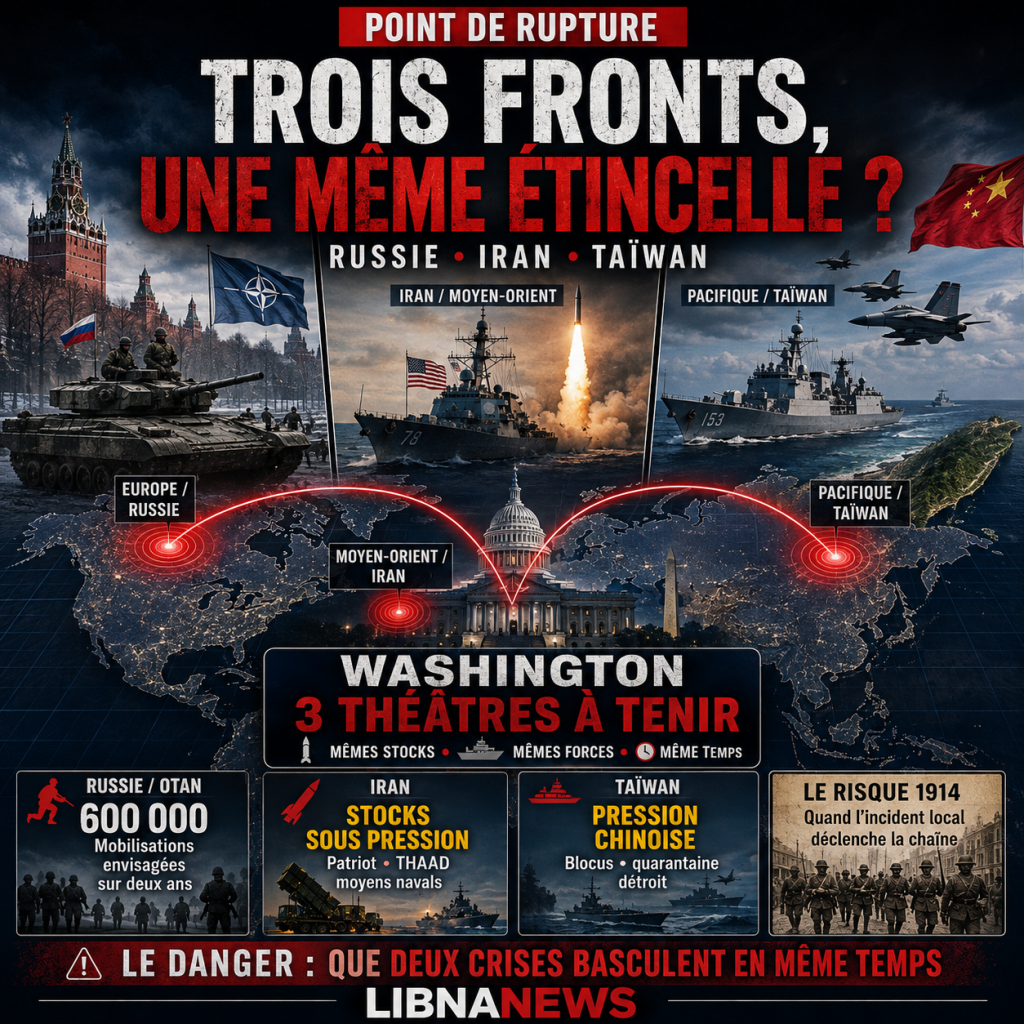
Over the last few weeks, the signals have been accumulating. The CIA Director went to Moscow discreetly to warn Russia against any attack against a NATO country. Ukrainian intelligence reports that the Russian General Staff is preparing an additional 600,000 men for mobilization over two years. In the Middle East, war with Iran continues to absorb ships, missiles and some of America’s military attention. In the Pacific, allied leaders are beginning to openly worry about the consequences of this dispersion as China increases its pressure around Taiwan.[1]
None of these events, taken separately, announce a world war. Their accumulation, on the other hand, raises a question that would still have seemed outrageous a few years ago: what would happen if two of these fronts actually opened at the same time? The United States should then protect Europe from Russia, pursue an already costly war against Iran and maintain enough forces in the Pacific to deter Beijing from taking advantage of the situation around Taiwan.
This is where the situation of 2026 becomes different. The crises are no longer leakproof. A Patriot fired at an Iranian missile cannot be used elsewhere. A building sent to the Gulf is not available in the Pacific. A battery moved to Europe to reassure Poland or the Baltic countries is missing at the same time in another theatre. Moscow, Beijing and Tehran do not even need to coordinate their operations: each benefit from the fact that the other two forces Washington to disperse its resources.
The danger does not necessarily come from a concerted Third World War project. It comes from the much more banal possibility that a local incident requires a government to respond and then its opponent to respond in turn. Europe already knows this mechanism. On 28 June 1914, two shots were fired in Sarajevo. Thirty-seven days later, the main European powers were at war.
The CIA Director’s trip to Moscow: a warning that goes beyond ordinary diplomacy
John Ratcliffe’s move to Moscow on 25 August is one of the most unusual signals of recent weeks. According to several American media, the CIA director went to the Russian capital to warn Moscow about an attack or action likely to provoke a confrontation with NATO members, particularly Estonia, Latvia and Lithuania. The Russian authorities have acknowledged contacts between intelligence services, without detailing their content.[2]
Two symmetrical errors must be avoided. The first would be to consider this displacement as proof that a Russian invasion of the Baltic States is imminent. No deployment comparable to the concentration observed around Ukraine at the end of 2021 is currently visible. The second would be to trivialize the mission. A CIA director does not go discreetly to Moscow, in the middle of a major strategic confrontation, for a simple routine meeting.
The Institute for the Study of War goes further: it believes that the nature of Ratcliffe’s displacement suggests that Washington fears Russian action in the relatively short term, but probably not a general invasion. The most plausible scenario would be an air strike, a missile, a drone or a limited incursion to test article 5. This reading remains an analysis, not an intelligence information made public; However, it has the merit of specifying the type of risk that Western planners are now concerned with.[3]
The Baltic governments themselves are more cautious. Tallinn and Riga say they did not change their immediate threat assessment and do not see today the preparations that preceded the invasion of Ukraine in 2022. This difference is important: the American alert focuses more on an ambiguous test, provocation or operation than on armored columns preparing to walk on Tallinn.
The November 2021 precedent comes naturally to mind. William Burns was then sent to Moscow while Washington observed Russian preparations around Ukraine. Comparison does not mean that history repeats itself. However, it recalls the function of these missions: to convey directly a message that Washington wants Moscow to understand gravity, without the noise of public diplomacy.
The most worrying hypothesis is not necessarily a conventional invasion. A limited operation would require much less preparation: missile or drone strikes, small incursion, air or marine incidents, difficult sabotage, attack on critical infrastructure. The objective could be less territorial than political: to test NATO’s ability to produce a collective response.
In this sense, a few kilometres of territory would not be the real issue. The issue would be the credibility of Article 5. A hesitant Western reaction could convince Moscow that the Alliance’s collective commitment has exploitable political limits. A strong military reaction, on the other hand, could open for the first time a direct confrontation between Russian forces and NATO forces.
600,000 men: a major signal, but not 600,000 soldiers ready to march on NATO
The second signal concerns information made public on 27 August by the Ukrainian intelligence services. According to the Ukrainian Presidency, the Russian General Staff is said to have prepared an additional mobilization scenario of 600,000 people out of 2026 and 2027, amounting to about 300,000 this year and 300,000 in the following year. The origin of the information requires caution: it comes from a state directly engaged in war and does not amount to independent confirmation of a final order of the Kremlin.[4]
However, it is accompanied by other indices. There were reports of Russian exercises to test the administrative and logistical capacity of a new mobilisation, notably in Kaliningrad. This included assessing the capacity to accommodate, feed, equip and quickly organize a large number of recruits. At the same time, Russian rights organizations reported an increase in pressure on some citizens to sign military contracts.
Above all, the figure of 600,000 must not be translated into the spectacular formula of 600,000 men immediately available to attack Europe. Much of this is likely to be used to offset Russian losses in Ukraine, rotate, reconstitute units and build reserves. Between the administrative call and an operational unit there is a long process of training, coaching, equipment and logistics.
But the increase in the Russian human reservoir remains strategically important. It can allow Moscow to continue a war of attrition in Ukraine while gradually rebuilding capabilities that can be used elsewhere. The decisive question will therefore be less the number announced than the destination of men and equipment.
Finnish President Alexander Stubb also defends a much less alarmist reading. He claims that he sees no evidence or fact to conclude that Russia would today be able to open a second front against NATO. According to him, Russian losses in Ukraine and the Alliance’s conventional and nuclear power make such a choice unsound. Its warning is useful: to confuse preparation for a long war with preparation for an immediate attack against NATO would lead to overinterpretation of the available data.[5]
If new formations were concentrated in Belarus, Kaliningrad, the military district of Leningrad or near the Baltic and Finnish borders, with fuel depots, ammunition, engineering units, air defences and field hospitals, the interpretation would change significantly. At present, such a massive offensive device is not observed. This does not cancel the signal; This limits the scope.
A significant mobilization also represents a social cost to the Kremlin. The partial mobilization of 2022 had caused departures abroad and a visible concern in Russian society. If Moscow decided, however, to return to a much wider mobilization, this choice would indicate either a sufficiently serious deterioration of the military situation, or a desire to have a greater mass of forces than is necessary to maintain the current front alone.
The 2008 precedent: when Moscow already mentioned nuclear weapons against Poland
Current concerns about Poland and the Baltic countries do not arise in a historical vacuum. During the Russian-Georgian war of August 2008, when Nicolas Sarkozy, French President and President-in-Office of the European Council, was negotiating a ceasefire between Moscow and Tbilisi, the confrontation between Russia and the West was already accompanied by nuclear rhetoric aimed directly at Warsaw.
On 15 August 2008, General Anatoli Nogovitsyne, Deputy Chief of the Russian General Staff, warned that the agreement allowing the deployment of elements of the American anti-missile shield to Poland was exposing the country to a Russian strike. He had explicitly recalled that Russian military doctrine allowed the use of nuclear weapons in certain circumstances. The statement had been widely interpreted as a nuclear threat against Poland.[6]
The brutality of the exchanges of the time is also documented. A Nicolas Sarkozy adviser will reveal a few months later that Vladimir Putin had said, about Georgian President Mikheil Saakashvili: « I will hang him by the balls, » before calling upon Saddam Hussein’s precedent. Sarkozy responded by asking him if he wanted to end up like George W. Bush. The story illustrates the violence of the negotiating climate. On the other hand, the public sources we found do not allow us to say that Putin personally threatened Warsaw with a nuclear strike in front of Sarkozy: the nuclear threat against Poland was made publicly by the Russian General Staff a few days later.[7]
This precedent shows that the Russian nuclear threat to a NATO member is not a recent invention of the Ukrainian war. It has long been part of a strategic language intended to remind us that certain conventional confrontations could go beyond their original framework.
In 2008, this threat did not lead to war. However, it has revealed an element that remains central today: Moscow also uses nuclear deterrence as a tool of political communication designed to increase the psychological cost of Western intervention. From the first direct strike between Russia and NATO, each government should calculate not only the ratio of conventional forces but also the risk of rising to extremes.
American weakness: not the lack of power, but the scarcity of some ammunition
The United States remains the military power with the widest spectrum of capabilities. But a superpower does not fight with budget aggregates: it fights with missiles, ships, crews and really available stocks. But the war with Iran revealed a severe tension on some high-tech munitions.
At the end of August, the Associated Press reported, citing an American defence official in Europe and a NATO official, that the situation of US Patriot stocks in Europe had become « neyond critical », beyond the critical threshold. The Iranian conflict would have been the turning point after several years of deliveries to Ukraine. CISC analyses also highlighted the low availability of Patriot and THAAD stocks and, above all, the slow recovery of these stocks.{8]
The problem is industrial. A modern missile does not replace itself in a few days. Production chains require specialized components, thrusters, electronics, testing capabilities and skilled labour. The increase in rates can take several years. The modern war thus reveals a paradox: the United States has an immensely larger economy than its opponents, but its industrial defence apparatus has been dimensioned for decades for limited conflicts and not for simultaneous attrition in several theatres.
Mark Cancian, a former naval colonel and an analyst at the CISS, sums up the problem brutally: in the simulations of a war around Taiwan, many critical munitions are exhausted in a few weeks. According to him, the United States was probably already insufficiently equipped for a major conflict with China even before the war against Iran. And for Patriots and THAADs, he adds, « there are no good substitutes » once the stocks are exhausted.[9]
All ammunition should not be added as if it were interchangeable. Patriot, THAAD, SM-3, SM-6, Tomahawk and air-to-air missiles perform different functions. But they all depend on an industrial base whose capacities cannot be multiplied instantly. The real phenomenon is therefore increasing competition between theatres for limited industrial, naval and logistical resources.
A munition consumed in the Gulf is no longer available elsewhere. A building sent to the Middle East is not simultaneously present in the Pacific. A battery deployed to protect an American base from Iran does not protect a European facility. This logistical evidence becomes a strategic problem when three major theatres are simultaneously under tension.
The issue is therefore not whether the US could defeat Iran separately, defend its European allies or intervene in Asia. The real question is how many major crises they can support simultaneously without the quality of their response falling on one front.
Iran transforms the Middle East into a consumer of American power
The conflict with Iran can no longer be analysed as an exclusively Middle Eastern crisis. Each Iranian salve obliges the United States and its allies to choose which threats to intercept and with which ammunition. The cost ratio is often unfavourable to the defender: a relatively cheap drone or missile may require the use of a multimillion dollar interceptor.[10]
This asymmetry does not give Iran conventional military superiority. Washington maintains very superior offensive, air, naval and intelligence capabilities. But Tehran can impose a global opportunity cost. The more the United States needs to protect its bases, Israel, its buildings and its partners, the more capacity American planners would prefer to maintain for Europe or Asia.
The resumption of the strikes on 30 August recalled the fragility of the attack. The United States hit Iranian launchers near the Strait of Ormuz, claiming to prevent a new threat to navigation; Tehran then announced fire on American sites in Jordan. After more than six months of war, the conflict therefore remains capable of returning rapidly.[11]
The resumption of clashes at the end of August shows that this consumption is not only theoretical. U.S. military officials expressed concern about the extension of operations against Iran. Behind operational considerations is a simple equation: every additional month of war increases the need to produce, transport and replace sophisticated munitions.
For Iran, therefore, the strategy may be less to defeat the United States militarily than to raise the price of its presence. A sufficiently long campaign can affect stocks, vessel rotations, crew availability and US domestic policy.
It is here that the Middle East joins Europe and Asia directly. Moscow and Beijing do not need Iran to win. It is enough for them that Iran obliges Washington to devote more resources to a theatre that is neither Ukraine nor Taiwan.
The Israeli Electoral Factor: War as a Variable of Domestic Politics
To this military logic is added a particularly sensitive political timetable. Israel is scheduled to hold its parliamentary elections on 27 October 2026. The election is the first major national electoral test since successive wars in Gaza, Lebanon and Iran. The Benjamin Netanyahu coalition is approaching the deadline in a politically difficult situation, as several opinion polls have suggested that it could lose its majority, even if the opposition does not necessarily have a simple alternative coalition.[12]
It would be abusive to conclude that an Israeli military operation would be decided solely for electoral reasons. The security threats facing Israel are real and military decisions are the result of a complex set of operational, strategic and political considerations. But it would be equally naive to exclude the electoral calendar from analysis.
A government in the countryside generally seeks to avoid the image of weakness. In the current Israeli context, this concerns Iran, Hezbollah and Lebanon directly. An Iranian attack, a visible reconstruction of Hezbollah’s capabilities or a serious incident on the northern border could immediately become internal political subjects.
The risk is that the space available for compromise will be reduced. A deduction that could be presented in normal times as a strategic decision can be described in the campaign as a capitulation. Conversely, a military operation can be politically valued as a demonstration of determination.
For Lebanon, this dimension is of particular concern. The country remains exposed to a logic in which its territory can once again become a theatre of confrontation between Israel and the Iranian axis. Israeli operations in South Lebanon, discussions on Hezbollah disarmament, uncertainties about the future of UNIFIL and the lack of a lasting political settlement are all points of friction.
An Israeli-Iranian escalation before 27 October could therefore have a Lebanese extension even if neither Beirut nor a majority of Lebanese wanted a new war. Lebanon remains vulnerable precisely because it does not fully control the decisions of those who may use or strike its territory.
American midterms: Trump also has a calendar
The American calendar is almost as important. The mid-term elections of November 2026 are approaching as Donald Trump’s foreign policy became an internal issue. Reuters stressed on 22 August that the president was coming to the midterms with little diplomatic success: the war with Iran remains costly, Ukraine is not resolved and the Middle East crises persist.
This creates conflicting incentives. On the one hand, the administration may wish to avoid a new war or an extension of the Iranian conflict before the election. An increase in the price of energy, US military losses or the impression of a slurry could have a political impact. On the other hand, an attack on US soldiers, a Russian provocation or a crisis around Taiwan could make any restraint politically costly.
The problem of credibility becomes an electoral issue. A president accused by his opponents of letting Russia test NATO or letting China impose a blockade on Taiwan could be tempted to respond quickly. Conversely, an elected president on the promise to end wars may hesitate to engage the United States in another major confrontation.
This contradiction increases uncertainty for Washington’s opponents. They may believe that the electoral calendar limits American freedom of action; but they may also underestimate the violence of a reaction designed precisely to prevent the image of weakness. Electoral periods therefore do not necessarily make States more peaceful. They sometimes make their response thresholds more difficult to predict.
Finally, there is direct interaction between the American and Israeli calendars. Between Israeli legislative acts of 27 October and the American midterms of November, the two governments simultaneously enter a period when security decisions will be immediately interpreted through the electoral prism. This proximity can reduce the political margin for de-escalation.
Taiwan: Perhaps the most dangerous scenario is not invasion
This tension is particularly visible in Indo-Pacific. The Washington Post reported that the depletion of some U.S. stocks caused concerns among allies facing China. The movement of naval assets towards the Middle East and the temporary withdrawal of the last American carrier present in Asia reinforced this perception.[13]
Yet it would be misleading to assimilate the absence of an aircraft carrier in the absence of American power. The United States has bases in Japan and Guam, long-range bombers, nuclear attack submarines, satellites, cyber capabilities and regional allies. In a war around Taiwan, submarines, anti-ship missiles and dispersed forces could be more decisive than the spectacular image of a naval group.
The Washington Post reports that a Taiwanese official now expects significant delays in PAC-3 deliveries and calls the move of American attention to the Middle East a « trouble. » More than 30 buildings to operate in the Pacific were reportedly sent to the Middle East during the war with Iran. For Asian allies, the problem is no longer theoretical: it begins to affect deliveries, exercises and naval presence.[14]
But the perception of availability counts. A China convinced that Washington is temporarily overloaded can be tempted to test its commitments without choosing the most risky option of an amphibious invasion. Some 40, a partial blockade, maritime controls or gradual exclusion zones could create a much more ambiguous crisis.
Since June, Beijing has intensified so-called law enforcement patrols around Taiwan. The Han Kuang exercises held in August precisely simulated scenarios of blockade, disruption of communications and escort of merchant ships. Reuters described an anti-lock exercise in which Taiwanese navy and coast guard escorted a commercial building.
The danger of quarantine lies in its ambiguity. Beijing could present it as a police measure in waters that it considers Chinese. Washington should then decide if it forces the passage. The first collision, first shooting or first human loss could turn a coercive operation below the threshold of the war into a direct Sino-American confrontation.
Another advantage for Beijing would be that it would test not only the United States but also Japan, the Philippines, Australia and other regional partners. The question would then be less about who owns the most ships than whether the American alliance architecture actually works under pressure.
North Korea has already entered the European war
The map of actors must now be expanded. The Ukraine war no longer only opposes Russia to Ukraine supported by the West. North Korea became a major military supplier to Moscow and crossed an additional threshold by sending soldiers to fight alongside Russian forces. According to South Korean and Western assessments, approximately 14,000 North Korean military personnel have already been recruited, particularly in the Kursk region. Pyongyang continues to supply short-range ballistic missiles and considerable quantities of artillery ammunition.[15]
The South Korean Ministry of Defence estimated on 24 August that North Korea had supplied Russia with more than 15 million artillery rounds, expressed in 152 mm equivalents. Seoul also states that Pyongyang is preparing the possibility of further deployments, although no further massive departures were considered imminent. Kim Yo Jong denied the Ukrainian claim that up to 50,000 additional soldiers could be sent. This divergence must be maintained: the existence of military cooperation is established, its next volume is not.
This involvement changes the strategic reading of war. Russia now enjoys an external human and industrial depth that allows it to sustain an attrition that its national capabilities alone would make more expensive. In return, North Korea receives money, resources and, potentially, technology or a return to military experience. Seoul also believes that some North Korean missiles used in Ukraine have gained precision with Russian help. The European war thus became a laboratory for an Asian nuclear power.
The consequence goes beyond Ukraine. Pyongyang has missiles capable of threatening South Korea and Japan, develops vectors within Guam’s reach, and has ICBMs whose theoretical reach reaches the American continental territory. On 31 August, the North Korean Ministry of Foreign Affairs further stated that its nuclear arsenal would continue to grow. A simultaneous Korean crisis with a confrontation around Taiwan would force Washington to protect Japan, South Korea, Guam and its own forces at a time when resources were being sought in Europe and the Middle East.[16]
The link between theatres is already visible even in relations between Washington and Seoul. Donald Trump ordered in August a substantial reduction in some joint exercises with South Korea, citing their cost but also Seoul’s refusal to participate in US operations against Iran. Thus, a conflict in the Middle East already affects the American military posture on the Korean peninsula. It is exactly the type of strategic transmission that characterizes a system that has become interdependent.[17]
China: less a military alliance than an industrial depth
The Chinese role must also be seen beyond diplomatic communiqués. Beijing does not officially fight alongside Moscow or Tehran and carefully avoids an alliance that would force it to automatically enter into war. But China’s industrial power is an essential strategic depth for states subject to Western sanctions.
In the Russian case, Western governments have been accusing Chinese companies for several years of feeding military production chains with dual-use goods: machine tools, microelectronics, optical components, engines and elements needed for drones. In the Iranian case, the issue became even more visible. In August, the US administration sanctioned more than 20 entities in Asia, including China and Hong Kong, which it accused of contributing to Iran’s nuclear, ballistic or military programmes.[18]
The Shahed drone industry illustrates this dependence in particular. Industrial investigations have identified in recent versions of engines, gyroscopes and electronic components from Chinese manufacturers or through Chinese intermediaries. This does not mean that the Chinese state leads Iranian production. This means that China’s industrial depth allows Iran to gradually replace Western components that have become difficult to obtain under sanctions.[19]
Even more sensitive, information released this summer reported negotiations or contracts for Chinese air defence systems for Iran. Reuters also reported allegations that Beijing could provide anti-aircraft systems in Tehran, allegations denied by China. This point must remain presented as disputed. But its very existence shows what the next step would be: the shift from industrial and commercial assistance largely due to a more directly identifiable Chinese military rearmament.[20]
Finally, the Sino-Iranian relationship has an energy dimension. China remains the main source of Iranian oil. It thus gives Tehran a financial breath that the American sanctions are precisely seeking to abolish. In late August, Washington launched a new campaign of secondary sanctions targeting Asian and Chinese intermediaries. Part of the conflict with Iran thus also becomes a Chinese-American economic confrontation, without Beijing and Washington shooting at each other.
Hybrid war: the European front already exists below the threshold of Article 5
Another weakness of an exclusively conventional reading is to wait for Russian tanks at the border to speak of confrontation. Part of the conflict between Russia and Europe is already taking place in the grey zone: cyber attacks, interference, alleged sabotage, clandestine operations, attacks on infrastructure and drone incursions.
On 30 August, German Chancellor Friedrich Merz announced that Berlin was finalising a response to the discovery, near a Ukrainian Antonov at Leipzig/Halle airport, of a drone loaded with explosives. The German government had not yet officially attributed the operation, but Interior Minister Alexander Dobrindt spoke of a hybrid attack scenario. German media evoke a possible attribution to Russia. Moscow regularly denies being at the origin of sabotage operations in Europe.[21]
On the same day, a NATO official acknowledged an increase in Russian hybrid activities while stressing that the Alliance did not see an imminent threat of conventional attack. This combination is important. It means that the most immediate risk may not be an invasion, but a multiplication of actions sufficiently aggressive to provoke a Western reaction while remaining ambiguous enough to complicate the application of Article 5.[22]
It is in this area that the real strategic accident could occur. A sabotage killing dozens, an attack on a major energy infrastructure or an explosive drone destroying a Western military aircraft would immediately raise the question of attribution and response. The bolder clandestine operations become, the harder the border between hybrid and open war becomes.
The contrast with the rapprochement between Russia, China, Iran and North Korea becomes interesting. Their set remains much less institutionalized than NATO and their interests are not identical. But their military, industrial and economic cooperation is progressing, while political confidence within the Western camp is growing. The western advantage remains considerable; However, its trend is less favourable than it was when Washington could almost automatically rely on the trust of its partners.
It is a weakness that Moscow and Beijing can exploit without firing a single shot. The deterrence of an alliance is based on the conviction that an attack against one will actually provoke the reaction of others. The more Washington gives the image of a transactional relationship with its allies, the more an opponent can be tempted to test the point where this solidarity stops. This does not mean that NATO will disintegrate in the event of a crisis. This means that doubt itself has strategic value.
The paradox is strategic. Trump calls on the allies to spend more, to take over a higher share of their defense and to support the US goals against Russia, Iran and China. On the first point, its pressure has produced real results: Europeans have greatly increased their military budgets and NATO has reaffirmed in Ankara its collective commitment. But trade wars, territorial threats and the political conditionality of certain American demands simultaneously make it more difficult to build the necessary solidarity when it comes to sharing risks and not just budgets.
Opinion surveys show that this erosion exceeds governments. In 36 countries surveyed by Pew in the spring, only 23% of those surveyed in the median reported having confidence in Trump to manage international affairs. In Germany, the share of Washington taking into account the interests of other countries increased from 60% in 2023 to 23% in 2026. In several historical allies, the image of the United States has returned to levels close to the lowest measured since the early 2000s.[23]
The Palestinian question adds a different fracture. A significant part of the public opinion and several European governments have moved away from Washington on Gaza, the West Bank, colonization and American support for Israel. This does not destroy the Atlantic Alliance, but reduces the available political capital when a US administration then asks the same governments to participate in a new campaign against Iran, increase sanctions or make more military assets available.
The case of the Falklands, or Falklands, is even more revealing. In the spring, an internal Pentagon document reported by the American press included a review of the United States position on the sovereignty of the archipelago as one of the means of pressure against London, while the United Kingdom had refused some support requested in the war against Iran. Washington then recalled that its official position of neutrality over sovereignty had not changed. But the mere fact that the issue appeared in a retaliatory scenario has a strategic significance: a dispute over a war in the Middle East could potentially be linked to an existential territorial issue for one of the oldest allies in the United States.
The NATO summit in Ankara in July showed that this tension could now directly affect the functioning of the Alliance. Trump again attacked Spain, described as a bad partner, revived his claims to Greenland and linked disputes with some allies to their attitude in the war against Iran. At the same time, the 32 members reaffirmed their commitment to Article 5. The two realities coexist: NATO’s military architecture remains solid, but the political confidence that supports it has become less automatic.[24]
The degradation is not just about Ottawa. In January, American threats to Greenland, the autonomous territory of the Kingdom of Denmark, had led European leaders to convene an extraordinary summit and prepare a trade response of up to EUR 93 billion. Trump then retreated, but the European debate had already changed: it was no longer just about how to maintain American protection, but how to reduce Europe’s vulnerability to possible American coercion.[25]
Canada is the most spectacular example. After repeated threats against its sovereignty and a new trade confrontation, Trump threatened on August 24 to impose 50% tariffs on Canadian automobiles, trucks and parts from 2027. Ottawa announced reprisals. Beyond trade, the relationship between two countries whose economies, defence industries and continental security are deeply integrated has become a balance of power. The Pew Research Center measures this break: 83% of Canadians still saw the United States as a reliable partner in 2022; By 2026, they were only 35%.[26]
However, American vulnerability is not limited to missile stocks. It is also political. For decades, the main strategic advantage of the United States was not only its military budget, but the alliance network built in Europe, North America and Asia. This network transforms American power into collective power. Donald Trump helped weaken this multiplier precisely at a time when the dispersal of US forces makes it more indispensable.
Trump needs his allies as he weakened them
Moscow, Tehran and Beijing benefit from the same American dispersion
The core of the problem is now interconnection. Iranian intensification consumes more American missiles and attracts resources to the Middle East. Moscow observes a Western defence that is more demanding and can be tempted to increase pressure on Ukraine or to test NATO. Washington then strengthens Europe. Beijing notes that American attention is divided and in turn increases pressure around Taiwan.
There is no need to demonstrate the existence of a common headquarters between Russia, Iran and China to see this convergence. The interests of the three powers remain different. But each benefit objectively from the constraints that the other two impose on Washington. It is less an integrated alliance than an opportunity alignment.
Faced with them, the Western bloc is also less homogeneous than it seems. Ukraine is not a member of NATO, Israel does not belong to the Atlantic Alliance, Taiwan is not covered by a guarantee comparable to Article 5 and European, American and Israeli interests do not always coincide.
This lack of rigidity can reduce the risk of automatic war, but it also creates uncertainty. However, uncertainty about the reaction of the opponent is precisely what encourages testing. A perfectly credible alliance deters; An alliance that we don’t know how far it will go can encourage us to check its limits.
1914: Sarajevo did not create war, it activated an already unstable system
Comparison with 1914 should be used with caution. Historical analogies become misleading when they replace analysis. Economies, technologies, international institutions and especially nuclear weapons make 2026 profoundly different from 1914.
But Sarajevo teaches one essential thing: a local event can become global when the international structure is already saturated with tensions. On June 28, 1914, Gavrio Princip assassinated François-Ferdinand and his wife. World war does not begin that day. For several weeks, governments still have choices.
Austria-Hungary sends an ultimatum to Serbia. Russia supports Belgrade. Mobilization begins. Germany supports Vienna and considers Russian mobilization a threat. France and Britain are gradually being trained. In 37 days, a local attack became a European and then a world war.
What matters is the mechanism. Each government believes in defending its credibility. Each mobilisation presented as defensive is perceived by the other as potentially offensive. Every step back becomes politically more expensive. Military plans are gradually reducing the space for diplomacy.
So the lesson of 1914 is not that history repeats itself exactly. It is that systemic wars can arise from a succession of locally rational decisions. Each actor thinks he controls the next step; none control the entire chain.
Sarajevo of 2026 could be a drone, missile or ship
It is useless to look for a new archduke François-Ferdinand today. The event triggering a contemporary crisis could be much more commonplace: a Russian drone shot down in NATO territory, a missile killing US soldiers in Poland, a naval collision in the Baltic, an attack on a submarine cable, a Chinese ship trying to impose an inspection on a vessel escorted by the United States, or an Iranian salve causing heavy American casualties.
Imagine a Russian missile hitting a Polish facility and killing several American military. Moscow claims that this is a mistake. Warsaw asks for an answer. If Washington does not react, its opponents can interpret this restraint as a limitation of Article 5. If it destroys the battery responsible, Russia may consider that it has just been attacked by the United States.
The next day Moscow responded against a military installation in Poland. NATO has several Russian objectives. Beijing then observed an America engaged simultaneously in the Middle East and Europe and imposed some forty maritimes around Taiwan. Washington escorts a ship; a Chinese unit is trying to stop it; A shot is exchanged.
This scenario is not a forecast. It is precisely what a risk analysis must distinguish from a forecast. Its probability remains lower than that of a continuation of contained crises. But its potential gravity is such that even the moderate increase in its probability becomes strategically significant.
As in 1914, mobilization can create its own logic
The parallel with 1914 becomes even more relevant when we examine mobilization. At the time, general Russian mobilization was interpreted by Berlin not as a mere precaution but as a step that dangerously reduced the time available to act.
The contemporary world has infinitely superior means of communication, but the security dilemma remains. If Russia mobilizes several hundred thousand men, Poland and the Baltic States can increase their own preparations. NATO then moves units eastward. Moscow presents these movements as evidence of a Western threat and in turn reinforces Kaliningrad and Belarus.
Each camp can then honestly say that it only responds to the other. The mechanism operates without any government initially preparing an attack. A defensive measure for one becomes a threat to the other.
The CIA director’s trip to Moscow makes sense here. Intelligence channels can be used to transmit red lines when ordinary diplomatic channels are no longer sufficient. This can be read as a sign of danger, but also as a safety mechanism to prevent misinterpretation.
Nuclear power prevents war… until the day it no longer prevents it
The fundamental difference with 1914 obviously remains nuclear weapons. It dramatically increases the cost of an error, but at the same time reduces the rational interest in direct war between major powers.
In 1914, governments could still imagine a short and victorious campaign. In 2026, no serious leader can ignore that a war between Russia and the United States or between China and the United States carries a risk of nuclear escalation.
That is why deterrence is probably the main obstacle to a world war. But it assumes that actors understand the intentions and thresholds of others correctly. A strike deemed limited by the person who orders it may be considered strategic by the person who undergoes it.
So the question is not just whether a leader wants to use nuclear weapons. It is about whether a chain of events can gradually reduce the options until one of the actors believes that not climbing threatens its security more than climbing.
Lebanon, a small country at the crossroads of a global confrontation
For Lebanon, this global architecture is not abstract. The country is on one of the lines of contact between Israel and Iran. Every change in the power ratio between Washington and Tehran, every Israeli electoral calculation and every Hezbollah decision can result in strikes, displacement, destruction of infrastructure and further contraction of the Lebanese economy.
Six months after the beginning of the war against Iran, the Associated Press also notes that the conflict did not produce the Middle East hoped by its initiators: Iran survived the strikes, the Strait of Ormuz became a strategic lever and several Gulf monarchies are asking more about the strength of the American guarantee. This erosion of confidence also matters to Lebanon: it encourages each regional actor to seek his own guarantees rather than rely on a common security order.[27]
The danger is aggravated by decision asymmetry. The Lebanese State may wish to de-escalate without being able to guarantee that it will take place alone. Israel decides its operations according to its own assessment of the threat. Iran maintains a strategic influence on the regional axis to which Hezbollah belongs. Hezbollah has its own military capabilities and its own calculation. The United States is exerting diplomatic and military pressure far beyond Beirut.
The Israeli electoral calendar until 27 October potentially reduces the political space for concessions. The US midterm calendar adds a second deadline. An escalation between Israel and Iran during this period could produce immediate pressure on the Lebanese front, precisely at a time when the leaders of the two main Western allies concerned would have little interest in appearing weak.
The uncertainties surrounding the future of UNIFIL add another variable. A less robust international presence in the South could reduce the link and interposition mechanisms available in an incident. However, in a time when the danger comes precisely from computational errors, the disappearance of rapid communication mechanisms is a risk factor.
For Beirut, the challenge should therefore be to multiply the mechanisms that prevent a local incident from becoming a casus belli: military channels, international diplomacy, clarification of responsibilities, strengthening of the Lebanese army and seeking a sustainable security system in the South. Lebanon has no interest in becoming Sarajevo from a confrontation that goes beyond it.
A World War That Has No Name yet
The answer depends on the definition chosen. If world war is called any simultaneous confrontation involving directly or indirectly several great powers on several continents, some elements are already present. Russia is fighting Ukraine with massive support from the West; The United States and Israel face Iran; The military competition around Taiwan is intensifying.
But a more rigorous definition requires direct war between several major powers and a genuine fusion of theatres. This threshold is not crossed. American and Russian soldiers are not officially fighting. The American and Chinese forces are not shooting at each other. Beijing did not go to war for Moscow.
It is therefore more accurate to talk about a systemic pre-confrontation phase. Conflicts remain legally and militarily distinct, but their resources, schedules and consequences are beginning to overlap.
The danger lies precisely in this intermediate zone. As long as crises are considered separate, it may be tempting to take more risks in theatre. But as soon as opposing responses mobilize the same stocks, alliances and forces, crises gradually cease to be independent.
The Third World War, if it were to occur, would probably not begin with a solemn declaration. It may be recognized retrospectively, as the moment when several local crises ceased to be contained and when the great powers began to fight directly.
The real American problem: industrial time
The shortage of missiles should not be described as a frozen photograph. Washington is increasing its orders and production capacity. The problem is the delay. Between a budgetary decision and the delivery of an operational interceptor are complex industrial chains, rare components, trials and sometimes several years of escalation.
This creates an essential strategic concept: the vulnerability window. If the US opponents believe that Western stocks will be significantly higher in 2029 than in 2026, they can conclude that the relative power ratio is temporarily more favourable. The incentive is no longer only to enjoy a weakness, but to enjoy a weakness before it disappears.
This mechanism of « now or never » is historically dangerous. A power that thinks it is in relative decline or thinks it is closing a window can take more risks than a power convinced that time is playing for it. U.S. rearmament programs are therefore paradoxal: they reinforce the deterrence in the medium term but may, during the transition phase, give some opponents a reason to act earlier.
The situation is all the more difficult because Europe itself cannot instantly replace American capabilities. Military budgets are increasing, production chains are being revived and cooperation is deepening. Sweden has just announced, for example, the deployment of Gripen and a war building in Finland to strengthen territorial surveillance. But some intelligence, missile defence, command and strategic transportation capabilities remain highly dependent on the United States.[28]
The uncertainty surrounding the future US military presence in Europe adds a variable. Reuters revealed on 27 August that the Pentagon was preparing several options for US personnel in Europe as part of a revision expected in the autumn. Even without immediate withdrawal, the mere fact that Europeans ignore the future level of American engagement can influence both their own decisions and Russian calculations.[29]
The economic cost of a multi-faceted war
A modern world war would probably begin to produce global economic effects even before the major powers officially declared war. Two geographical points concentrate a disproportionate part of this vulnerability: the Strait of Ormuz and the Strait of Taiwan.
Ormuz remains one of the main energy passages of the planet. Summer tensions have already disrupted traffic and increased costs. A lasting closure or a campaign of strikes against the Gulf infrastructure would cause a shock on oil, gas, shipping and insurance. For European and Asian economies, this would mean a sharp return to inflation at the very moment when public budgets should finance rearmament.
Around Taiwan, the shock would be different but potentially deeper. A Chinese quarantine would immediately disrupt one of the world’s leading commercial arteries and access to an essential part of the production of advanced semiconductors. The problem would not only concern smartphones: automobiles, industry, data centres, weapons and telecommunications depend on these chains.
Simultaneity of an energy crisis in the Middle East and a trade crisis in Asia could lead to a global inflationary and recessive shock. Governments should finance defence, household support and secure supplies simultaneously. Financial markets would probably begin to integrate the risk of a systemic war long before a historian could date its beginning.
For Lebanon, already weakened by a dollarized economy, de facto restructured debt and dependence on energy imports, such a shock would be particularly violent. A new war in the South would therefore only be part of the problem: oil increases, maritime insurance, regional trade and diaspora transfers would also be exposed.
The most modern risk: don’t know immediately who hit
In 1914, the identity of the Sarajevo assassin was not in doubt. In 2026, the first major incident could be marked by uncertainty. A drone can be purchased commercially, a ship can sail under third-party flag, a cyber attack can transit through several countries and a clandestine operation can be designed precisely to leave several possible explanations.
This ambiguity could be stabilizing if it gives governments time. It can also become explosive in a media environment where the first images circulate in minutes and where politicians, social media and public opinion immediately demand a response. Governments can be pushed to act before the technical allocation is complete.
The problem becomes even more serious when some infrastructure is used by both conventional and nuclear forces. A cyberattack against a command network, a strike against a radar or the destruction of a satellite can be interpreted by the adversary as preparing for a much wider attack. The real intent of the assailant then matters less than the perception of the one who must decide to respond.
This is why direct channels between headquarters and intelligence services are becoming increasingly important. Ratcliffe’s trip to Moscow is not just a sign of tension. He also recalls that at a time when diplomatic relations are the worst, opponents paradoxically have the most need to be able to speak quickly.
Who better separate crises, and who benefits from their simultaneousity?
This is probably the central question. The United States has an interest in compartmentalizing conflicts. Washington would prefer to treat Iran, Russia, China and North Korea separately in order to be able to concentrate maximum military and diplomatic superiority on each theatre.
The four opponents have, to different degrees, the opposite interest. Russia benefits from every American missile consumed in the Middle East. Iran benefits from each battery and building immobilized in Europe or Asia. China benefits from American naval dispersion. North Korea benefits from any crisis that reduces the availability of US forces in Korea and Japan.
There is no need for them to organize a secret meeting for this convergence to exist. It results mechanically from the structure of the American forces. Everyone can act for their own reasons while inadvertently improving the position of others. It is this potential simultaneousity that turns several regional crises into systemic risk.
The Western bloc certainly has superior economic resources. But these are fragmented among States with different priorities. South Korea must retain its ammunition facing the North; Japan must protect its own territory; Europeans must support Ukraine and rebuild their stocks; Israel is using interceptors in the Middle East. Thus, the theoretical pooling of capacities is constrained by national needs.
Ukraine illustrates this constraint. Its new Minister of Defence estimates the military funding gap to cover at $27 billion and Kyiv still requires hundreds of Patriot interceptors. A war that endures thus continually absorbs Western resources at a time when they are needed to rebuild reserves for other theatres.[30]
The Arctic, another line of fracture between allies and opponents
The shift of strategic competition towards the Arctic deserves special attention. Russia has an old and dense military apparatus, while NATO has expanded to include Finland and Sweden. Canada, Denmark across Greenland, Norway and the United States are therefore in contact with a space where confrontation with Moscow is becoming more important.
The paradox is that Washington simultaneously weakened some of the confidence of its Arctic partners. Donald Trump’s pressures around Greenland and tensions with Canada forced Ottawa and several northern capitals to think more about their autonomy. A policy designed to strengthen the US position can therefore have the opposite effect if it convinces the allies that US pressure is itself a risk to be managed.[31]
For Moscow, this potential disunity is an opportunity. Russia does not need to provoke a major military crisis: it is enough for Western allies to devote political capital to their internal differences. A base, radar or allied port is only fully valid if the political relationship that allows them to be used remains strong.
The Ukraine War is also a military school for Pyongyang, Tehran and Beijing
The North Korean involvement in Ukraine exceeds the number of soldiers or shell shells provided in Moscow. Pyongyang forces gain experience against an army supported by NATO, in an environment saturated with drones, electronic warfare, sensors and precision strikes. This experience can then be reinjected against South Korea, Japan, and US forces.
North Korean missiles used by Russia are also real-world tests. Each launch provides information on the accuracy, reliability and ability of Western defences to intercept them. Seoul believes that cooperation with Moscow can accelerate the improvement of North Korean military capabilities.[32]
The same mechanism exists with Iran. The massive use of Iranian-designed drones has transformed the Ukrainian battlefield into a laboratory: Ukrainian countermeasures reveal vulnerabilities, Russian and Iranian adaptations enable them to be corrected. The circulation therefore concerns weapons, but also data, tactics and experience.
China is observing this war with the same attention. Without being a co-belligerent, it can learn about the vulnerability of armoured vehicles, the importance of cheap drones, the stocks needed for a long war and the dependence of modern armies on communication networks.
The fifth front is already open within democracies
Confrontation directly penetrates Western societies. Influence, cyberattacks and electoral manipulation campaigns can weaken an opponent without destroying a single military base.
The European External Action Service described in March 2026 a Russian modus operandi aimed at the elections: delegitimizing the leadership several months before the election, exploiting national fractures during the campaign, and then attacking confidence in the integrity of the vote. In particular, Germany, Poland, Romania, Moldova and the Czech Republic are mentioned.[33]
The Romanian case has shown how far this question can go. The authorities declassified evidence of a coordinated campaign on TikTok and cyber activities; One user reportedly spent $381,000 to promote content favourable to Călin Georgescu. The Constitutional Court annulled the first round. Even without proving that a foreign operation had determined the result, confidence in the election itself had become the object of the conflict.[34]
The aim is not necessarily to have an openly pro-Russian candidate elected. It may be to convince voters that aid to Ukraine costs too much, that sanctions explain their standard of living, that institutions lie or that allies lead their country towards a war that does not concern it. If a parliament reduces the appropriations for Kyiv, the military effect is achieved without border crossing.
Artificial intelligence further lowers the cost of this war: fake media-imitating articles, voice cloning, deepfakes and automated networks. After an incident in Estonia, conflicting versions could reach tens of millions of Europeans before NATO even established the facts.
When Washington also intervenes in the European political debate
This issue becomes more complex when the influence comes from the United States. It would be wrong to establish an equivalence between clandestine operations attributed to the Russian services and public intervention by American officials. But the political effect deserves analysis.
JD Vance publicly supported European political forces and criticized allied governments. In Germany, its rapprochement with AfD and Elon Musk’s interventions were seen as an unusual interference. In Hungary, Vance went to Budapest in April 2026 and supported Viktor Orbán while accusing the European Union of influencing the election.[35]
At the same time, the Trump administration began a confrontation with Brussels on the Digital Services Act. The Washington Post reported that an internal state department investigation had not established politically advanced accusations of European censorship, without preventing Washington from continuing its campaign.[36]
The paradox is profound: at a time when the United States needs its allies to take more responsibility for Russia, China and Iran, some American policies help to make alignment with Washington politically more questionable.
Under the sea, in space and in networks: fronts without front lines
Undersea cables, satellites and digital networks have become military as well as civilian infrastructures. Their destruction or interference can affect several theatres simultaneously while making attribution difficult.
Cables carry most of the digital intercontinental communications. Their sabotage can cause significant economic effects without immediately providing an obvious casus belli. Space is even more sensitive: GPS, communications, intelligence, launch detection and guidance depend on satellites.
The dual character of some systems creates a risk of escalation. An attack designed to blind conventional forces can be interpreted as the preparation of a nuclear strike. Cyberspace presents the same problem: an intrusion against an electrical or military network can remain dormant and then be activated in the middle of a crisis.
The more artificial intelligence is used by decision-support systems and the shorter the delays, the more dangerous a bad classification becomes. Technology gives managers more information, but sometimes it gives them less time to understand what they mean.
Suwałki and Belarus: a few dozen kilometres at the heart of the European risk
The Suwałki corridor, between Poland and Lithuania, connects the Baltic States to the rest of NATO and lies between Kaliningrad and Belarus. An operation to cut or simply threaten this axis would have a disproportionate strategic effect.
The presence of Russian nuclear weapons announced in Belarus adds an additional dimension. It does not mean that a weapon would be used in a border incident, but it requires any Western planning to incorporate a nuclear component from the outset.[37]
That is why a new Russian mobilisation would be much more worrying if large units were directed towards this space. The figure of 600,000 does not alone tell what Moscow is preparing; The geography of deployments will say much more.
Turkey, India and Middle Powers: World War wouldn’t produce two perfect blocks
Turkey is a member of NATO but has a special relationship with Moscow, controls the Black Sea Straits and has its own interests in the Caucasus and the Middle East. India cooperates with the United States, Japan and Australia against China but maintains a historic military relationship with Russia and buys its energy.
Saudi Arabia, the United Arab Emirates, Brazil, Indonesia and other Powers would probably also seek to preserve a margin of non-alignment. Their behaviour would be crucial for sanctions, energy, trade routes and payment systems.
A long war would therefore also be a competition for non-alignment: which block manages to maintain access to raw materials, ports, markets and financing from the intermediate powers.
The real industrial battle would be measured on the three hundredth day
US stocks are part of the problem. The other question is the ability of opponents to produce. A war between great powers would probably be decided not only by the quality of the first rounds, but by the ability to replace destroyed missiles, drones, vehicles and components.
Russia has transformed part of its economy to support a long war. Iran produces drones and missiles in quantity. North Korea supplies massively Moscow with artillery. Behind them is the Chinese industrial power.
The United States retains a considerable technological advantage, but some chains have been optimized for sophisticated systems produced in limited volumes. A war of attrition demands to regain the mass. Europe faces the same problem: budgets are growing faster than factories.
The current period is therefore special: the West has decided to rearm, but part of this rearmament still exists only in the form of future contracts and capabilities. If Moscow or Beijing think that the balance of forces will be less favourable in three years, they can be encouraged to take more risks before this window closes.
Economic war would begin before general mobilization
A simultaneous confrontation around Ormuz, Taiwan and Europe would probably cause a global economic shock even before a general mobilization. Ormuz would touch energy; a blockade of Taiwan would hit semiconductors and shipping; a Chinese-American trade break would upset thousands of value chains.
Markets would themselves become a warning system. Marine insurance premiums, freight, oil, gold, options and obligations would respond to expectations prior to military releases.
United States public finances are also a constraint. This does not mean that Washington would be unable to finance a war, but a confrontation in several theatres would sharply increase already high federal spending and would force arbitrage between defence, debt, taxation and domestic spending.
For Lebanon, the effect would be immediate: more expensive energy, more expensive freight, pressure on imports and the dollar, affected tourism and the risk of further economic contraction. A contemporary world war could begin for many people with an energy and food bill before being manifested by military mobilization.
Perhaps the most dangerous factor remains the conviction that the other bluff
Physical abilities are not enough to explain wars. They also begin with errors of judgment. Trump may think Putin will step back. Putin can believe Washington will not defend Tallinn. Xi may estimate that the US will not risk a war for Taiwan. Tehran may judge that Washington will accept more heavy losses. Netanyahu may think that Iran is too weak to respond. Kim Jong-un may consider that a busy America elsewhere will let a provocation pass.
Only one of these calculations is wrong to create a dynamic that is difficult to stop. Election periods exacerbate the problem because a leader may have less freedom to accept a setback publicly.
This is also what distinguishes the real power from the perceived power. The United States may have sufficient resources while being perceived as too dispersed; Russia can be militarily exhausted while giving the impression of being ready to take more risks. War often arises in the gap between these two realities.
What could change the situation
The first indicator is the geography of Russian mobilization. The figure of 600,000 is spectacular but insufficient. The training of units, railway transfers, depots, engineering, field hospitals, fuel stocks and possible concentration in Belarus, Kaliningrad or near NATO borders must be monitored.
The second is the real state of Western stocks. Production increase announcements are not worth immediate availability. The pace of manufacture of Patriots, THAAD, naval missiles and precision munitions will determine some of the American credibility in the coming months.
The third is the American naval device in the Pacific. The temporary absence of an aircraft carrier is not decisive in itself, but a prolonged reduction in the US presence, combined with the cancellation of exercises and tensions on ammunition, could alter Chinese calculations.
The fourth is Chinese behavior around Taiwan. It is necessary to monitor the transition from simple exercises to administrative acts of sovereignty: inspections, controls, interceptions of commercial vessels, new restricted areas or permanent presence of coastguards at key points.
The fifth is the level of American losses in the Middle East. An Iranian attack causing a significant number of American deaths could create a much stronger political response obligation than current trade.
The sixth is the electoral calendar. On 27 October in Israel then the American midterms are two times when governments can become more sensitive to perceived weakness. Domestic policy does not mechanically determine war, but it alters the political price of restraint.
Finally, communication mechanisms must be monitored. Paradoxically, a proliferation of military and intelligence contacts is not necessarily a bad sign. In the most dangerous crises of the cold war, direct channels have often prevented an error from becoming irreversible.
The danger begins when retreat becomes more expensive than climbing
The signals of the last few weeks do not make it possible to announce an imminent world war. However, they are sufficiently numerous and coherent to justify a much more serious concern than a few months ago.
The CIA director’s move to Moscow indicates that Washington considers the risk of a Russian NATO test to be sufficiently credible to send a warning directly to the Kremlin. The Ukrainian scenario of an additional 600,000 mobilisations remains to be confirmed independently, but it suggests that Moscow prepares the possibility of a sustainable human effort. Tensions on American stocks show that the war against Iran already has strategic effects in Europe and Asia.
In addition, there are two political calendars: the Israeli elections of 27 October and the American mid-term elections of November. For a few weeks, Israel and the United States will simultaneously enter a period when any military restraint can be politically exploited as evidence of weakness. For Lebanon and Iran, this factor cannot be ignored.
The 2008 precedent finally recalls that Russian nuclear rhetoric towards Poland does not date from the present war. At the time of the Georgian crisis, Moscow had already publicly mentioned the possibility of a strike, including a nuclear strike, in response to the deployment of the American missile shield.
The parallel with Sarajevo must be understood correctly. François-Ferdinand was not murdered in a peaceful world that went crazy in one day. He was murdered in an already tense system, where alliances, mobilizations, rivalries and fear of decommissioning had made every decision more dangerous.
So the most worrying point of 2026 is not that a leader seems to consciously want to trigger a Third World War. It’s almost the opposite. Everyone can think that he only defends his interests in his own theatre, responds to a limited provocation or temporarily exploits a weakness of the opponent.
This is how international systems sometimes lose control of themselves. Iran is pulling to increase the cost imposed on Washington. Washington is responding to maintain its credibility. Moscow is testing a limit because America seems busy. NATO responds to safeguard Article 5. Beijing believes that the opportunity is favourable to tighten the ladder around Taiwan. Washington intervenes to prevent the collapse of its credibility in Asia. No decision taken in isolation needs to be aimed at a world war.
Risk begins when the possibility of falling back becomes politically more expensive than that of moving forward. That was what happened during the crisis of July 1914. This is precisely what must be prevented today.
A window of vulnerability that Washington opponents can be tempted to exploit
The weeks between the end of August and the elections in October and November therefore deserve special attention. They combine several forms of vulnerability that, taken separately, would remain manageable: temporary weakness of some American stocks, uncertainty about a new Russian mobilization, intensification of operations around Taiwan, war with Iran and Israeli and American electoral campaigns. Their superposition, however, creates a window in which perceptions can evolve faster than material capabilities.
In international relations, an opportunity window does not need to be objectively real to produce effects. It is enough for a leader to believe that she exists. If Moscow thinks Washington is temporarily too busy to respond forcefully in Europe, the Kremlin can take a risk that it would not have taken six months before. If Beijing believes that US naval assets and stocks are sufficiently dispersed, it can push further a coercion operation. If Tehran believes that Washington cannot sustain the cost of interception, it can increase pressure.
The danger then comes from a succession of possibly erroneous perceptions. The United States may be weaker than its opponents think. NATO can respond faster than Moscow anticipates. Washington can accept much higher costs in Asia to prevent Taiwan from changing its status. Israel can choose escalation precisely when Tehran believes its politically coerced government. The history of wars is filled with decisions taken on the basis of a poor estimate of the opposing will.
The American situation is paradoxical in this regard. The relative shortage of some interceptors can give an image of vulnerability, even though the United States retains an immense offensive capability. This dissociation between stress defence and available strike power is dangerous. An opponent may conclude that Washington is too weak to respond, provoke an attack, and then discover that the White House chooses an offensive response precisely because it cannot afford a long defensive campaign.
The industrial time factor must also be taken into account. The United States and its allies are investing in increased ammunition production, but the effects are not instantaneous. A window of relative weakness can therefore be temporary. A revisionist power that believes this window intended to close can be prompted to act earlier. It is the classic mechanism of « now or never », particularly dangerous when it encounters electoral calendars and perceptions of decline.
On the other hand, this same situation may encourage caution. Moscow knows that an open attack on NATO could lead to much greater Western economic mobilization. Beijing knows that a war around Taiwan would upset world trade on which part of its prosperity still depends. Tehran knows that an attack causing massive American losses could trigger a much more destructive campaign. Israel knows that a prolonged regional war would also have a considerable economic and human cost.
Thus, there are still strong climbing brakes. That is precisely why it would be wrong to present world war as inevitable. The current configuration is dangerous not because it necessarily leads to the disaster, but because it increases the number of paths that can lead to it. The role of diplomacy, military communications and deterrence is to close these paths before an incident turns them into motorways.
The real test of the coming months will therefore be the ability of the powers to separate crises. If Washington and Moscow maintain a channel to manage incidents, if Chinese operations around Taiwan remain below the threshold of an effective quarantine, if confrontation with Iran can be contained and if Lebanon is not reabsorbed in an Israeli-Iranian war, the system can regain an unstable form of equilibrium. If, on the contrary, two of these crises simultaneously cross their military threshold, the margin of manoeuvre will be reduced sharply.
It was at this point that the parallel with 1914 would become really worrying: not because an assassination or an incident would have magic value, but because several governments could discover at the same time that the decisions taken to preserve their credibility created commitments that they no longer know how to defeat. The prevention of a world war is, therefore, less important today than in the precise management of small incidents, red lines and adverse perceptions.
[1]CBS News, 27 August 2026, » CIA Director John Ratcliffe, during secretive trip, warned Russia not to attack NATO »; Washington Post, 26 August 2026, « U.S. weapons shortage from Iran war alarms allies confronting China ».
[2]CBS News, 26-27 August 2026, on John Ratcliffe’s visit to Moscow and the warning about NATO members.
[3]Institute for the Study of War, Russian Offensive Campaign Assessment, August 27, 2026. The ISW believes that limited action against a NATO member could seek to test the Alliance’s ability to invoke and implement Article 5.
[4]Presidency of Ukraine, briefing of the Chief Intelligence Directorate and the Foreign Intelligence Service, 27 August 2026: scenario of 300,000 mobilised in 2026 and 300,000 in 2027. These figures are a Ukrainian assessment and not an official Russian announcement.
[5]Reuters, 29 August 2026, interview of Alexander Stubb at Bild. The Finnish President said he did not see « neother evidence nor fact » supporting the idea of a forthcoming Russian attack on NATO.
[6]The Guardian, August 15, 2008, « Moscow warns it could strike Poland over US missile shield ». General Anatoli Nogovitsyne stated that Poland was exposing « 100% » to a strike and recalled that Russian doctrine allowed the use of nuclear weapons.
[7]The Guardian, November 14, 2008, account attributed to Nicolas Sarkozy’s advisor on the Sarkozy-Putine exchange of August 12, 2008 about Mikheil Saakashvili. Le Monde, 18 August 2008, recalls Sarkozy’s lengthy talks with Dmitri Medvedev and Vladimir Putin during the Georgian mediation.
{8]Associated Press, 27 August 2026, US and NATO officials cited on the critical situation of Patriot stocks in Europe.
[9]Washington Post, August 26, 2026. Mark Cancian, CISS: simulations of a conflict around Taiwan exhaust many critical ammunition in a few weeks; He stressed the lack of good substitutes for Patriot and THAAD once the stocks were consumed.
[10]Associated Press, August 28, 2026, review of the first six months of war with Iran and regional consequences on the credibility of the American guarantee.
[11]Associated Press, August 30, 2026: American strikes against Iranian launchers near the Strait of Ormuz and Iranian announcement of fire on American sites in Jordan.
[12]Reuters, 12 July 2026: Israeli legislative elections are scheduled for 27 October 2026; Several polls indicate that Benjamin Netanyahu’s coalition could lose its majority, without an alternative majority being evident.
[13]Washington Post, 26 August 2026, on the redeployment of American resources from the Indo-Pacific to the Middle East and the concerns of Asian allies.
[14]Washington Post, 26 August 2026: more than 30 Pacific buildings were reportedly sent to the Middle East; A Taiwanese official anticipates the delays of CAP-3 and describes the displacement as « troubling ».
[15]Reuters, August 24, 2026, « North Korea preparing further Russia troop deployments ». The South Korean Ministry of Defence reports that Pyongyang continues to provide Russia with short-range ballistic missiles and more than 15 million artillery shots, and is preparing for further deployments of troops.
[16]Reuters, August 31, 2026, « North Korea says hostile US policy unchanged, vows to strongthen nuclear force ».
[17]Reuters, 16-17 August 2026, on Donald Trump’s decision to reduce certain American-South Korean exercises, notably after Seoul’s refusal to participate in actions against Iran.
[18]Reuters, 25 August 2026, on the new US campaign of sanctions against Iran, including more than twenty entities in the Middle East and Asia, including China, accused of supporting Iranian nuclear and ballistic programmes.
[19]Wall Street Journal, August 26, 2026, investigation into the increasing dependence of Shahed drones on engines, gyroscopes and electronic components from China or through Chinese intermediaries.
[20]Reuters, July-August 2026: information referred to a possible Chinese supply of air defence systems to Iran; Beijing denied these allegations. Reuters, July 29, 2026, « China, crude calculus in Iran war ».
[21]Reuters, 30 August 2026, « Merz says Germany finalising response to suspected Leipzig attack ». Berlin talks about a hybrid attack scenario but had not yet officially attributed the incident.
[22]Reuters, August 30, 2026, « NATO sees no imminent threat of attack. » NATO says it sees more Russian hybrid activities while not seeing an imminent threat of conventional attack.
[23]Pew Research Center, survey conducted in 36 countries from 8 February to 13 May 2026, published on 23 June 2026. Median confidence in Donald Trump for international affairs: 23%. In Germany, 23% believe that the US takes into account the interests of other countries, compared to 60% in 2023.
[24]Reuters, 8 July 2026, NATO summit in Ankara: Donald Trump attacked Spain and re-launched the Greenland dispute while then reaffirming Alliance unity. Reuters, July 3, 2026: The 32 members had approved a text reaffirming a « ironclad » commitment to collective defence.
[25]Reuters, 22 January 2026, « EU leaders to meet U.S. despite Trump U-turn on Greenland ». Europeans had prepared a package of 93 billion euro commercial retaliation after the US threats to Greenland.
[26]Pew Research Center, June 23, 2026, « Trump Gets Negative Reviews Internationally as Fewer Say U.S. Is a Reliable Partner ». In Canada, the share of the United States rated reliable increased from 83% in 2022 to 35% in 2026.
[27]Associated Press, August 28, 2026: six months after the beginning of the war, Iran retained levers, especially around the Strait of Ormuz, while several Gulf partners questioned the strength of American protection.
[28]Reuters, August 28, 2026, « Sweden to deploy fighter jets, wars to Finland ».
[29]Reuters, August 27, 2026, « Pentagons NATO review preparing troop options for Hegseth by November 6 ».
[30]Reuters, August 30, 2026, « Ukraine defence chief to outline war plan as Kyiv seems more funds »: Kyiv estimates its military financing deficit at $27 billion.
[31]On Arctic tensions and increased cooperation between Canada and the Nordic countries in the context of US pressure on Greenland, see the developments of 2026 reported by Reuters and the governments concerned.
[32]Reuters, 24 August 2026: South Korean intelligence believes that North Korea is preparing new deployments in Russia and drawing operational lessons from its commitment; Seoul estimates that more than 15 million artillery rounds were delivered in Moscow.
[33]European External Action Service, 4th EAAS Report on Foreign Information Handling and Interference Threats, March 2026: Elections are described as a priority target of Russian operations, with a three-phase logic observed in particular in Germany, Poland, Romania, Moldova and the Czech Republic.
[34]Associated Press, December 2024, based on declassified Romanian documents: coordinated campaign on TikTok and Telegram around Călin Georgescu; One user reportedly paid $381,000 to promote content. Russia denied any interference.
[35]CBS News, 8 April 2026; Washington Post, February 21, 2025: JD Vance publicly supported Viktor Orbán and met Alice Weidel; Elon Musk also supported AfD. These interventions are public and are not treated here as illegal operations attributed to Russia.
[36]Washington Post, 20 March 2026: Trump administration campaign against certain European digital rules; According to the newspaper, an internal investigation by the State Department had not established politically advanced accusations of European censorship.
[37]Russia and Belarus announced the deployment of Russian tactical nuclear weapons on Belarus territory. Their precise operational status and location remain partly opaque; However, their declared presence is changing strategic planning around NATO’s eastern flank.




