

In the occupied West Bank, olive harvest is advancing without access to land. The Palestinian Minister of Agriculture mentioned on 31 October about 60% of the crop already harvested. At the same time, the United Nations humanitarian report of 29 October documents attacks on pickers and cancellations of access, including in areas where passages had been coordinated with the Israeli authorities.
A progression of surfaces, not a production balance
Theministerial review of 29 octobercovers approximately 445,000 dunums harvested, with a target of 780,000 dunums. The 57% announced measure progress on targeted surfaces, not the tonnage produced or the revenues of operators.
The31 October, Minister Rizq Slaimiya mentioned about 60% of the harvestalready done. However, this declaration does not provide any new harvested area or calculation method for direct comparison with the 29 October balance sheet.
The campaign involves local communities, cooperatives, associations and volunteers. The Ministry reports 35 major collective operations and more than 2,750 tools or lots of distributed equipment, directly to farmers or to structures responsible for lending them. He also reported the interruption of activities in Hebron and the prevention of several initiatives in Ramallah and Al-Bireh governorate. Material support therefore does not remove barriers to entry into plots.
Incidents identified during collection
In its29 october and issued on 31 octoberThe United Nations Office for the Coordination of Humanitarian Affairs, OCHA, recorded 38 attacks by settlers linked to the harvest between 20 and 26 October, causing injury or damage. These 38 incidents are included in the 62 settler attacks that resulted in victims or property damage identified by OCHA in 49 West Bank communities during the same period.
L-OCHA describes physical violence, theft of olives or equipment and the destruction of agricultural property. It also reports coordinated access suspensions in parts of Jenin and Nablus, as well as behind the barrier in Qalqiliyah governorate. In Salfit, planned passages have been cancelled, sometimes less than a day before.
Israeli army defends its system
In aseparate communiqué of 27 octoberThe Israeli army claims to be working to facilitate gathering and prevent violence. It refers to a hundred sites where the harvest is coordinated under the protection of the security forces and ensures that the vast majority of these operations take place without unusual incidents.
The army reported that it had strengthened the central command system and said that the forces took violence and criminal activities seriously, regardless of who committed them. This general presentation of its action does not respond individually to the incidents then detailed by the OCHA. The two documents also do not cover the same perimeter: the military communiqué insists on coordinated operations, while the humanitarian statement also documents parcels whose access is prevented.
An economic challenge beyond the season
From itsreport of 2 octoberThe OCHA identified several cumulative difficulties for agricultural households: access restrictions, theft of crops, destruction of trees and infrastructure, and higher input prices. The olive season thus concentrates risks that are not limited to the number of violent incidents. An inaccessible piece of land also represents prevented work and a crop whose recovery becomes uncertain.
The same report described in Beit Ula, near Hebron, access to approximately 1,500 dunums of agricultural land, nearly half of which were planted with olive trees. This example illustrates a lasting difficulty, distinct from a one-off attack during harvest. The Department continues its collection campaign, while access to certain parcels remains subject to restrictions and permits to pass.
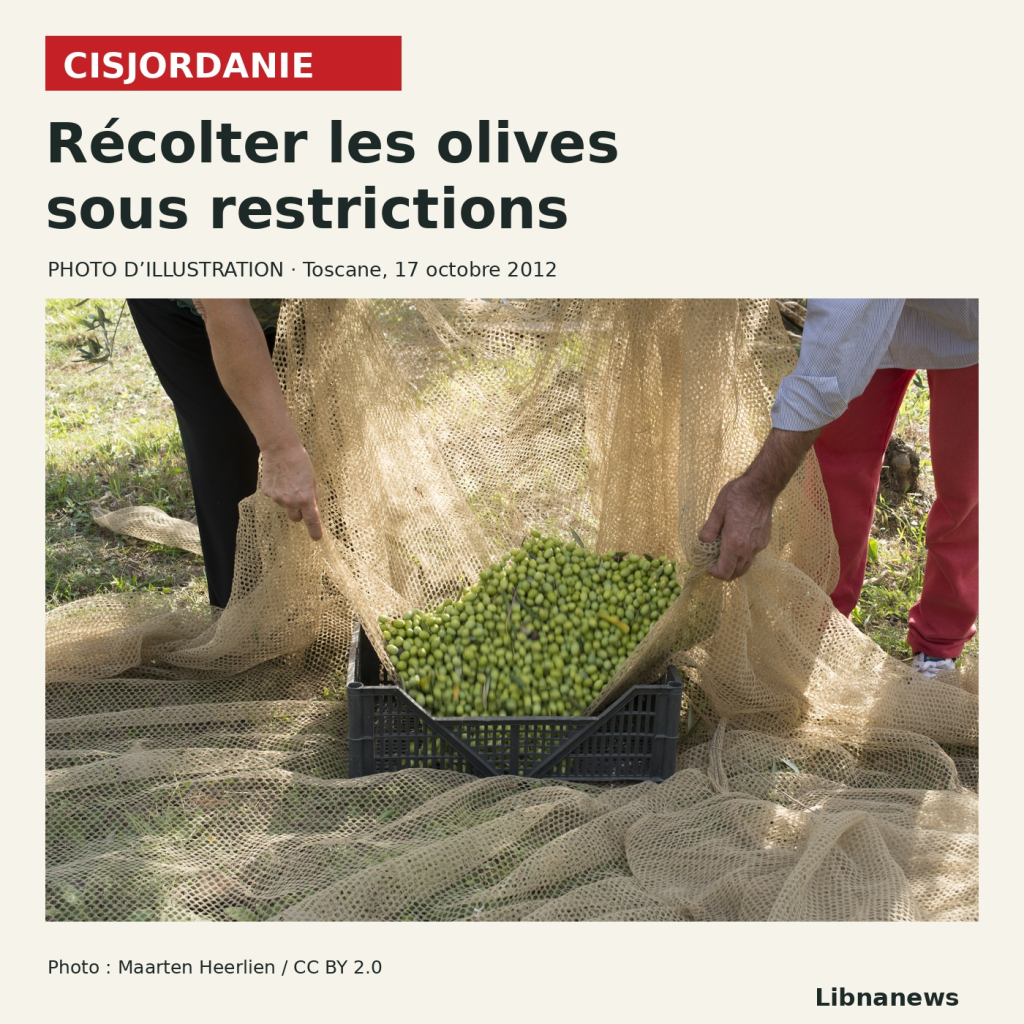
Illustration photograph: olive harvest in Tuscany (Italy), October 17, 2012. This image does not show the West Bank.« Securing the harvest », Maarten Heerlien / Wikimedia Commons,CC BY 2.0. Libnanews graphic dress; photograph resized proportionally, without cropping or modifying its content.






Comments