

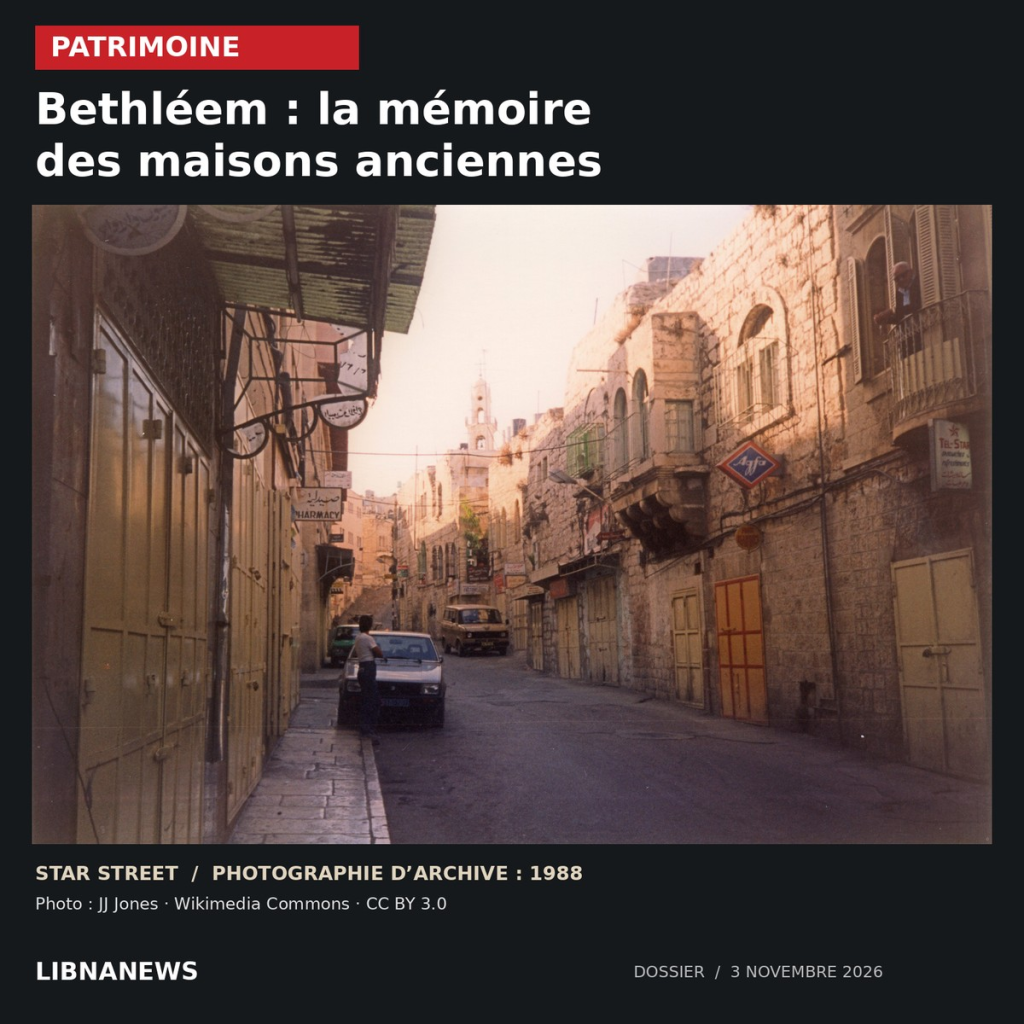
In Bethlehem, ancient houses tell of the organization of families, the work of artisans and the rise of commerce. Common courses, shops and residences with European décor make up a heritage distinct from the shrines alone. Around Star Street, their conservation also involves protecting the surroundings of the pilgrimage route listed at Unesco.
In Bethlehem, the courtyard at the centre of family life
The Bethlehem Gate portal, accessed on November 3, 2026, describes neighbourhoods related to the families who shaped them. Tarajmeh’s name recalls the profession of interpreter. Those of Al-Najajreh and Al-Farahiyeh refer to long-established family groups. This geography brings the history of the inhabitants closer to that of the buildings.
In the Diyar guide signed Ghadeer Najjar, whose preface dates from July 2017, thehoshmeans a set of houses grouped around a courtyard. This space hosted daily activities, parties and family meetings. The narrow passages connected the houses, while the doors marked the accesses. The housing thus formed a collective whole, beyond each dwelling.
Star Street, a street of pilgrimage and work
On the route to the Nativity, traditional yellow limestone buildings combine accommodation on the floor and workshops at street level. According to Bethlehem Gate, Star Street hosted the work of olive groves and mother-of-pearl. Craftsmen made objects for visitors and pilgrims. The street also bears the memory of wedding processions, funerals and Scout parades.
The Latin, Orthodox and Armenian patriarchs traditionally borrow for their solemn entrances to Bethlehem during Christmas celebrations. His role has evolved with travel in the city. The opening of Eating Street during the British mandate reduced its importance. The work of Bethlehem 2000 then contributed to its rehabilitation.
Two early 20th century houses
Diyar’s guide describes Mansour House, built in 1914 for Hanna Mansour. It illustrates the European influence on the residences of this period. A large arcade porch covers a terrace overlooking Star Street. Floral motifs decorate the walls and ceiling of the living room.
Ghazzawi House, dated 1924, for its part reflects the prosperity of a trading family. It combines red stone, furniture from France and floral decorations. Two shops overlooking the street hosted the post under the British mandate. These houses are part of a complex where Ottoman houses and early 20th century residences coexist with Italian influences.
Unesco perimeter to distinguish from its surroundings
World Heritage Registration dates from 2012. It concerns the Church of the Nativity, its architectural ensemble and a portion of the pilgrimage route. She doesn’t class the whole old town of Bethlehem.
The Unesco states that the traditional buildings along this route are not part of the registered property. However, it calls for their protection and preservation as part of the approach to the church. Preserving the road therefore also means taking into account the houses that accompany it.
On July 2, 2019, the World Heritage Committee removed the site from the list of heritage at risk. In particular, he welcomed the restoration of the Nativity and the adoption of a management plan.
Restored houses for new uses
Rehabilitation can also give new use to preserved units. According to Bethlehem Gate, near the Nativity, Hosh Al Syrian brings together courses connected by narrow passages, stairs and stone arches. The whole was built over centuries. Its restoration allowed a conversion into a guest house. The work also revealed underground parts, under the already known spaces.





Comments