

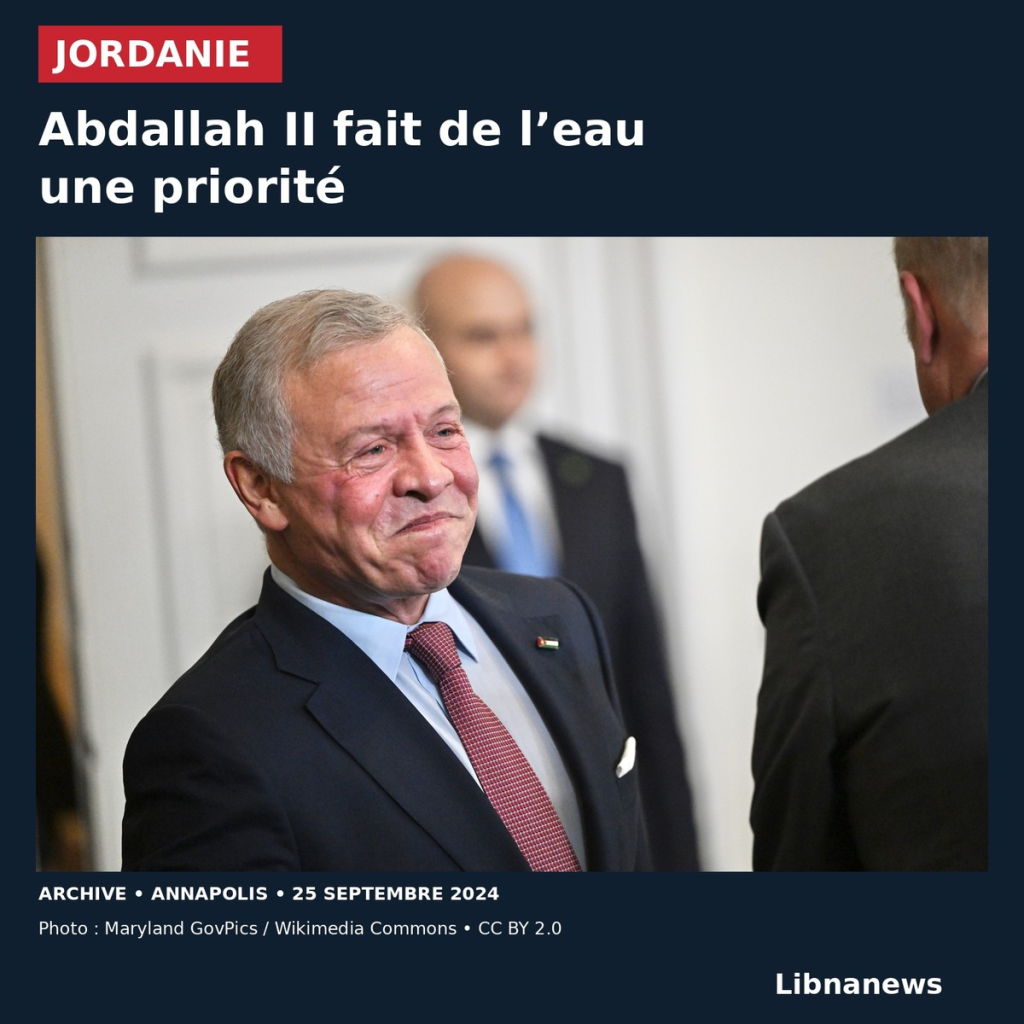
Abdullah II made water security a priority of sovereignty in his Speech from the Throne of November 2, 2026. The text published the same day by the Royal Jordanian Court calls on the government to pursue water projects. The sovereign also calls for preventive plans to protect the resources and rights of future generations.
This message comes at the opening of the third ordinary session of the Twentieth Parliament. It accompanies a call to speed up major economic projects. The king asks that their effects be measured in the lives of citizens, especially in the services and opportunities offered to families.
Aqaba-Amman, a large-scale desalination project
The speech does not name the Aqaba-Amman project in its passage dedicated to water. This programme, however, allows us to measure the means envisaged to strengthen the supply of the kingdom. Its realization should not be confused with an already available capacity.
The European Bank for Reconstruction and Development describes a plant targeting 300 million cubic metres per year. A 438-kilometre pipeline must transport desalinated water from Aqaba to Amman. The facility also includes a renewable energy installation. It is based on a public-private partnership and a 30-year concession to the Jordanian Ministry of Water and Irrigation.
The EBRD fact sheet, consulted on November 3, 2026, indicates an approval as of February 25, 2026. The planned loan amounts to up to $475 million. Its beneficiary is National Carrier Project Company, owned by Meridiam and Suez. For the bank, this resource must reduce pressure on overexploited aquifers and strengthen resistance to the effects of climate change.
Approved funding, effects still expected
The Asian Infrastructure Investment Bank is providing another financial component. The fact sheet, consulted on November 3, 2026, indicates $250 million approved on March 25, 2026. The target annual production ranges from 250 million cubic metres for Amman and 50 million cubic metres for Aqaba. These figures describe objectives, not volumes already delivered.
The Bank takes over the EBRD’s environmental and social A ranking. The land rights of way, the sensitivity of the marine environment and the geographic scope of the project justify this category. Risks identified include effects on corals, brine releases and energy consumption. Evaluations and management plans guide their processing.
Financial approvals therefore do not demonstrate full disbursement or commissioning. In his speech of 2 November, Abdullah II also recalls Parliament’s oversight mission on government action. The continuation of water projects is part of this framework, beyond the announced capacity.





Comments