

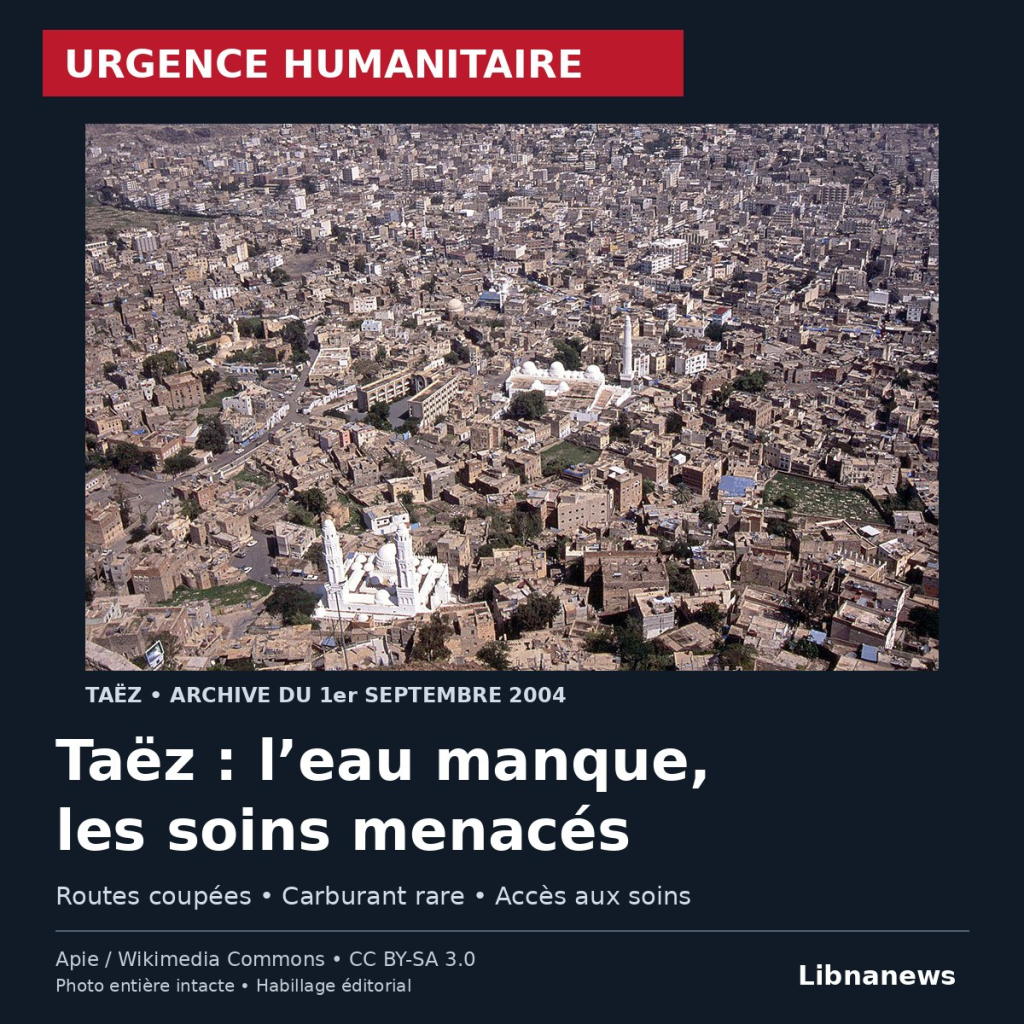
The water crisis in Taëz threatens the continuity of care. Roads cut off and lack of fuel hinder patient delivery, pumping and movement. In this Yemeni city, point distributions support cisterns-dependent neighbourhoods. Hospitals are also struggling to receive their supplies.
Saudi humanitarian centre KSrelief continues its distribution of drinking water in the district of Al-Mudhaffar. In a dispatch dated November 2, 2026, Saudi official agency SPA reports a distribution made the previous day. Thirteen points served 3,480 people among displaced families, affected communities and host communities, according to the announcement. This aid comes after repeated warnings from humanitarian organisations about the deterioration of supply in Taez.
Water in Taëz: roads count as much as well
Water production in the city had fallen by half by 20 October, according to Laurent Bukera, United Nations humanitarian coordinator in Yemen. Alternatives were exhausting, while road closures and insecurity prevented the arrival of essential products. In particular, there was a lack of fuel to operate pumps and transport.
On 23 October, Jens Laerke, UN humanitarian spokesman, described increased dependence on tanker trucks. Their traffic was restricted by the cut roads and the scarcity of diesel. According to the information presented at the press conference, the cost of water transported had approximately tripled. The shortage affected the available volumes and the ability of families to buy them.
The Wadi al-Dabab basin, at the southwest entrance to Taez, concentrates part of the tensions around supply. On 26 October, the internationally recognized Yemeni government accused the Houthi forces of preventing the arrival of water. His Ministry of Human Rights also blamed them for exposing the transport routes to bombing. This government charge is part of the conflict over the control of access to the city.
Families dependent on neighbourhood reservoirs
Fahd Ali’s children will seek water from free donor-funded reservoirs. Their father describes these movements, containers in hand, in Al Arabi Al Jadid of 3 November 2026. Oum Adel, for his part, tells how his family alternates between free distributions and the purchase of small quantities. For these homes, the supply is recompensated on a daily basis, depending on availability and the remaining money.
Queues form around rapidly emptied tanks. After the collection, it is still necessary to carry water in the dwellings, through the sloping streets. Donations are not always enough to maintain this circuit. Deliveries also depend on diesel and route safety. Abdallah al-Sharabi, owner of a tanker truck, explains that he ceased his activity for both reasons in the same report by Fakhr al-Azab.
Dialysis also depends on the journey to hospital
For patients on regular treatment, access to roads conditions each medical appointment. Maamoun Abdelwahad Naaman, interviewed by Reuters in Taëz on 12 October 2026, explained that he remained in the city to continue his dialysis sessions. According to him, the fighting made it too dangerous to return to his village of Al-Kalabah, followed by a new journey to the health centre. The disease forced him to live away from home.
At Al-Thawra Hospital, Youssef al-Zakari, the head of the kidney centre, reported a serious shortage of supplies. He reported receiving about 120 patients a day, while a delivery expected from Aden remained blocked. Katja Juric, the programme manager of the International Organization for Migration, also described private institutions with sufficient drugs and funding. The arrival of wounded increased the pressure on the teams and the capacity to receive them.
In its 11 October 2026 review, UNICEF identified 98 partially functional or non-functional health facilities in Taez. Difficulties on the southern main supply route affected institutions like their patients. Shortages of equipment and obstacles to movement were combined, with the risk of discontinuing treatments that required regular monitoring.
Restrictions on access to the core of charges
Human Rights Watch attributes the bulk of the supply crisis to Houthis restrictions. Its survey, published on 29 October, is based on 15 interviews. Interviewees include residents, doctors and members of civil society. Caregivers describe shortages of anaesthetics and medical supplies, as well as the difficulties of patients with chronic diseases.
On 21 October, a Houthi spokesman accused government forces of blocking the roads. Human Rights Watch challenges this version in light of the testimonies and findings of the United Nations. On 22 October, Amnesty International requested the reopening of the main roads, including the road from Taëz to Aden. The organization calls on all parties to facilitate impartial humanitarian assistance and to protect civilians.
Water supply becomes a health issue
Fighting and fuel shortages threaten UNICEF-supported water systems in Taez. On 20 October, the Agency estimated their population served to three million people, including at least 1.6 million children. She warned that the degradation of water and sanitation increased the risk of diarrhoeal diseases and cholera. These diseases, in turn, can exacerbate child malnutrition.
UNICEF reported providing diesel to maintain pumping and emergency water and sanitation services for more than 300,000 people. Local humanitarian actors also continued to mobilize their reserves for pumps and hospitals, according to the United Nations press briefing on 23 October. Distributions announced in early November continue these efforts in some neighbourhoods. Their continuity depends on a regular resupply of water and fuel, on roads accessible to both the rescue and the sick.





Comments