






A truce in transport that does not solve the issue of revenue
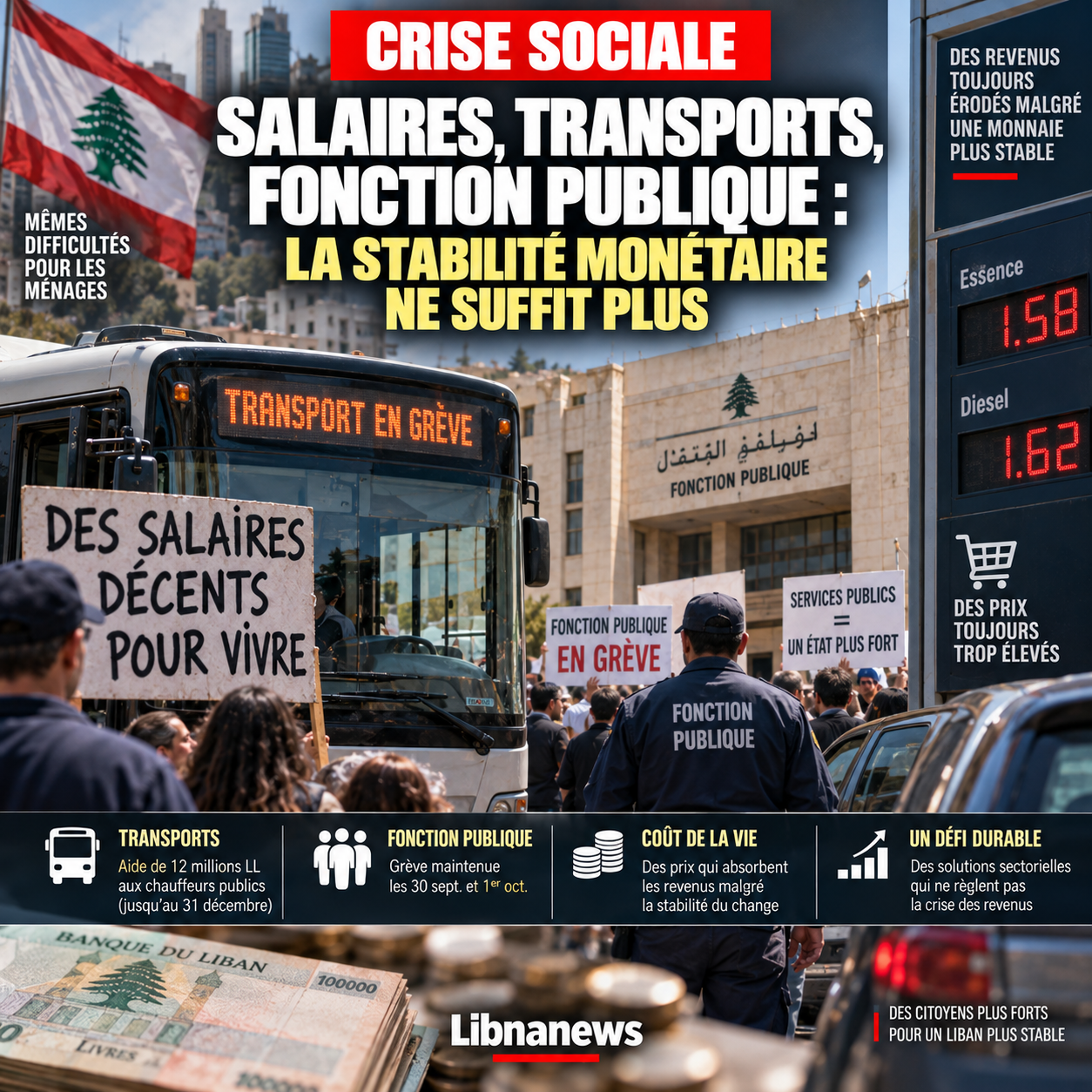
30 September 2026 was to be an important day of social mobilization in Lebanon. It finally opened up to a more complex situation. The movement announced by road transport and the General Workers’ Union was suspended after negotiations with the authorities. On the other hand, public administration employees maintained their own slogan. They confirmed the general strike on Wednesday 30 September and Thursday 1 October, as well as the closing scheduled for the following Friday. The juxtaposition of these two decisions gives a precise picture of the social climate. The government is still able to defuse certain mobilisations when it puts concrete measures on the table, but it does not have a general response to income erosion. In transport, the suspension of the movement took place after a long meeting with the Ministry of Finance. Representatives of the sector insisted that the strike was not an end in itself. It was a means of pressure to enforce negotiated decisions. One of the most precise measures concerns regular public drivers. A monthly financial aid of £12 million is to be paid from 1 October until 31 December in a first phase. This three-month period is revealing. It provides an immediate response, but is not yet a permanent income support mechanism. The suspension of mobilization cannot therefore be equated with the disappearance of the problem. Rather, it opens an audit period during which unions will observe the implementation of commitments. The cost of transport remains at the centre of the social equation. For a driver, the increase in fuel directly reduces disposable income. For an employee, it increases the daily cost of travelling to work. For a company, it affects delivery and services. An increase in fuel flows through several layers of the economy before reaching the price paid by the consumer. The debate on transport is therefore less a sectoral crisis than an indication of the difficulty in maintaining purchasing power in an economy where a significant part of daily expenditure remains directly or indirectly linked to the dollar.
The continuation of the strike in the public administration shows in parallel the limits of a sectoral response policy. The employees specifically asked their colleagues not to take into account the information announcing a general cancellation of the transaction. This clarification itself reveals the fragmentation of the social front. The suspension decided by transport organizations did not automatically concern the civil service. Government officials continue to address a problem that has been built over several years: the collapse of the real value of wages and the subsequent accumulation of measures to enable administrations to continue to operate without completely reconstructing wage policy. Aids, premiums and allowances were able to relieve officials on an ad hoc basis. They do not necessarily replace a salary whose real value is predictable and whose amount allows the planning of household expenses. This difference is essential. One-time help responds to an emergency. A wage defines the lasting value of work. The Lebanese crisis has gradually blurred that border. Part of the income now depends on corrective mechanisms created to compensate for the loss of purchasing power. The problem can no longer be reduced to the question of how much to add to the income of the following month. It deals with the very structure of remuneration. It also concerns the State’s ability to finance its employees in a sustainable manner without causing a new fiscal imbalance. This difficulty explains why social negotiations are progressing in stages. But it also creates a risk: each sector that gets an improvement encourages others to demand a similar correction. The state then finds itself faced with a succession of separate negotiations while the fundamental cause is common. Drivers, civil servants and private sector employees do not have the same statutes. Yet they all have the same mechanics: when prices rise faster than their incomes, nominal wage stability turns into a real drop in living standards.
The cost of living becomes the real thermometer of the crisis
The peculiarity of the present phase is precisely the discrepancy between the signs of monetary stabilization and the daily experience of households. During the most brutal years of collapse, the exchange rate was the main thermometer of the crisis. Every drop in the pound almost immediately produced a new wave of prices. The link was visible and understood by all. The situation today is different. Greater exchange rate stability can reduce some panic mechanisms without returning lost purchasing power to households. In supermarkets, consumers continue to compare prices for food and essential goods. Arbitration takes place on quantities, marks and sometimes on the postponement of a purchase. This development is important because it shifts the centre of gravity of the problem. The question is no longer just how much the national currency is worth. It becomes: how many products does a salary actually allow to buy? The cost of fuel illustrates this transformation. Even when the price of an imported product is not subject to a dramatic exchange-related shock, transportation, energy, storage and delivery can increase its final cost. Traders pass on part of these charges. Households then reduce their consumption. This reduction can in turn affect businesses and businesses, which sell less while their own costs remain high. This allows the country to experience a form of monetary stability without real social stabilization. It is this distinction that explains the rise of claims. A worker does not measure his standard of living only during the dollar. It measures it with rent, food basket, fuel, school fees, health and essential services. When these expenditures absorb an increasing share of income, the feeling of crisis persists even if the exchange market seems calmer.
The risk is all the more important as temporary solutions can mask the magnitude of the problem. The aid of 12 million pounds to public drivers provides an identifiable answer to a professional category. It alone does not alter the organization of transport in Lebanon. However, the absence of a sufficiently developed public network makes a large part of the population dependent on private cars, taxis, private services or public road transport. The cost of mobility then becomes a direct component of the wage needed to work. An employee may receive an increase and lose a portion a few weeks later if the cost of transportation increases. Conversely, artificially containing fares paid by passengers can weaken drivers if their loads increase. The social conflict therefore moves from one actor to another without disappearing. This mechanism also appears in the public service. Effective administration requires employees present and adequately remunerated. But increasing the wage bill with no corresponding revenue can create additional pressure on public finances. The State must therefore simultaneously improve revenue, increase revenue and modernize its functioning. These objectives are complementary in the long term, but they can conflict immediately. Officials need a correction now. Tax and administrative reforms have a slower impact. This difference in timing explains part of the tension. It also fosters the feeling that employees immediately bear the cost of adjustment while the benefits of reforms remain future. In these circumstances, the return of social movements is not an accident. It translates a question left open since the collapse: how to rebuild income after stabilizing some of the monetary mechanisms?
Category solutions that push the problem away without creating wage policy
The Government’s response at this time reveals a preference for negotiation on a case-by-case basis. This method has an obvious advantage. It helps to prevent a series of different claims from immediately turning into a unified social movement. Drivers can get specific help. Public employees negotiate their salaries. Workers’ organisations discuss wages, transport or social benefits separately. Each file can thus be adjusted to the constraints of the sector concerned. But this flexibility has a cost. It gradually produces a system where incomes depend on an accumulation of distinct, sometimes temporary, mechanisms whose coherence becomes difficult to perceive. The issue of the minimum wage remains particularly sensitive in this context. An increase can improve the nominal income of the least paid employees. However, if it occurs without improving productivity and without a sufficient recovery in activity, some firms may find it difficult to absorb. They can reduce their numbers, increase their prices or further develop informal work. On the other hand, leaving the minimum wage too far behind the real cost of living means institutionalizing wages that no longer cover basic needs. So there is no magic number. A credible wage policy must incorporate several parameters: price, economic activity, public revenue, business situation, transport, social protection and changes in the cost of services. It must also avoid that each correction is quickly overtaken by further price increases. Lebanon needs to move from a logic of compensation to a logic of income. As long as the measures remain essentially corrective, negotiations will resume whenever inflation or energy costs absorb some of the gains achieved.
This situation also raises a question of justice between professional categories. A public driver can benefit from support because his sector has an organisation capable of negotiating. A state employee may use the stoppage of work to exert pressure. An employee of a small business or an informal worker may not have the same means. Yet it is experiencing the same increase in the food basket, fuel or services. A social policy based mainly on the ability of each group to obtain compensation may therefore increase the gap between those who have a balance of power and those who do not. This is where social protection systems should normally intervene. However, their weakening during the crisis has increased dependence on ad hoc support, employers, families and sometimes community networks. The question of social benefits thus joins that of wages. A slightly higher remuneration is not enough if an exceptional illness, education or expenditure can completely unbalance a household’s budget. The wage dispute is therefore also a conflict over the quality of public services and collective protection mechanisms. This is what makes the situation of 2026 different from a conventional negotiation on a wage increase. It is not just a question of distributing the fruits of growth between employers and employees. Incomes and protections must be rebuilt after a collapse that has profoundly altered the economic references of the population.
Public service becomes a test for state reconstruction
The conflict between public employees has a particular dimension in this context. The government says it wants to rebuild institutions, strengthen financial control, modernize administration and improve services. These objectives require a public service capable of working normally. However, a State cannot permanently ask its agents to carry out institutional reform if their remuneration remains at the centre of a permanent conflict. The strike of 30 September and 1 October is therefore not confined to civil servants. Every closure of an administration affects citizens and businesses. The files are getting late. The formalities are getting longer. Investments can be slowed down. The quality of public service is deteriorating, which in turn reinforces mistrust of the State. A vicious circle can then settle: weak administrations provide less efficient services; citizens are less willing to pay taxes for these services; revenue remains low; The State has less means to pay its employees properly. Breaking this mechanism requires more than an increase. It is necessary to define the number of staff required, their duties, their level of pay and service objectives. Digital transformation can reduce some repetitive tasks, but it itself requires investment and skills. It does not automatically replace civil servants. On the contrary, a more digital administration needs agents capable of managing systems, checking data and accompanying citizens. Wage reform should therefore be linked to a reform of the administration, without one being used as a pretext to delay indefinitely the other.
The political difficulty lies in the timetable. Employees call for immediate improvement because their spending is immediate. A comprehensive reform of the State takes several years. The authorities are therefore obliged to manage two temporalities. They must prevent the collapse of purchasing power in the short term while avoiding the creation of impossible financial commitments. Temporary aid came from this contradiction. They save time, but they become problematic when they become permanent systems. The case of road transport is instructive. Monthly assistance until 31 December may provide a bridge to a more stable scheme. If no solution is developed before that date, the same crisis may simply reappear as 2027 approaches. The logic also applies to the other categories. The government cannot negotiate indefinitely quarter after quarter. It will need to develop a more readable policy on wages, allowances, transport and social benefits. Otherwise each budget deadline will become a new confrontation. Social stability will then depend less on the ability to prevent a strike than on the ability to predict real household income.
A less dramatic social crisis than collapse, but potentially more sustainable
The new phase of the Lebanese crisis could thus be less dramatic than that of the monetary collapse, while being more difficult to resolve. A sharp fall in currency is immediately visible. The erosion of real income acts more slowly. It obliges households to reduce the quantities purchased, to postpone expenses, to change their movements or to abandon certain services. Each decision taken in isolation seems modest. Yet their accumulation is transforming the standard of living. The political risk comes precisely from this accumulation. Drivers suspended their mobilization because they obtained concrete commitments. Public employees maintained theirs because they felt their case was not resolved. Other categories observe these negotiations. If they find that only mobilisation can obtain a correction, they can be encouraged to adopt the same strategy. The government could then find itself facing not a single movement, but a succession of social conflicts. This fragmentation sometimes makes the crisis less visible nationally. It makes it no less profound. It can even install sustainably, sector after sector.
The challenge is therefore to avoid social policy becoming a series of truces purchased for a few months. The aid of £12 million to public drivers shows that negotiation can produce a concrete measure. The continuation of the administrative strike immediately shows that this method does not solve the whole problem. The real fracture line now lies between nominal income and real income. As long as households continue to see prices absorb their wage adjustments, each increase will appear temporary. As long as companies remain fragile, they will find it difficult to finance a lasting correction alone. As long as public finances remain under pressure, the state will look for intermediate arrangements rather than a complete overhaul. Lebanon is thus facing a different stage from that of the early years of the crisis. Stabilizing the currency was a necessary condition for stopping the collapse. This stabilization is not enough to rebuild the standard of living. The social question of 2026 is therefore moving towards a more difficult terrain: to determine what income really makes it possible to live, how to finance it sustainably and how to avoid the cost of stabilization being borne mainly by those whose wages have already lost most of their old value.