





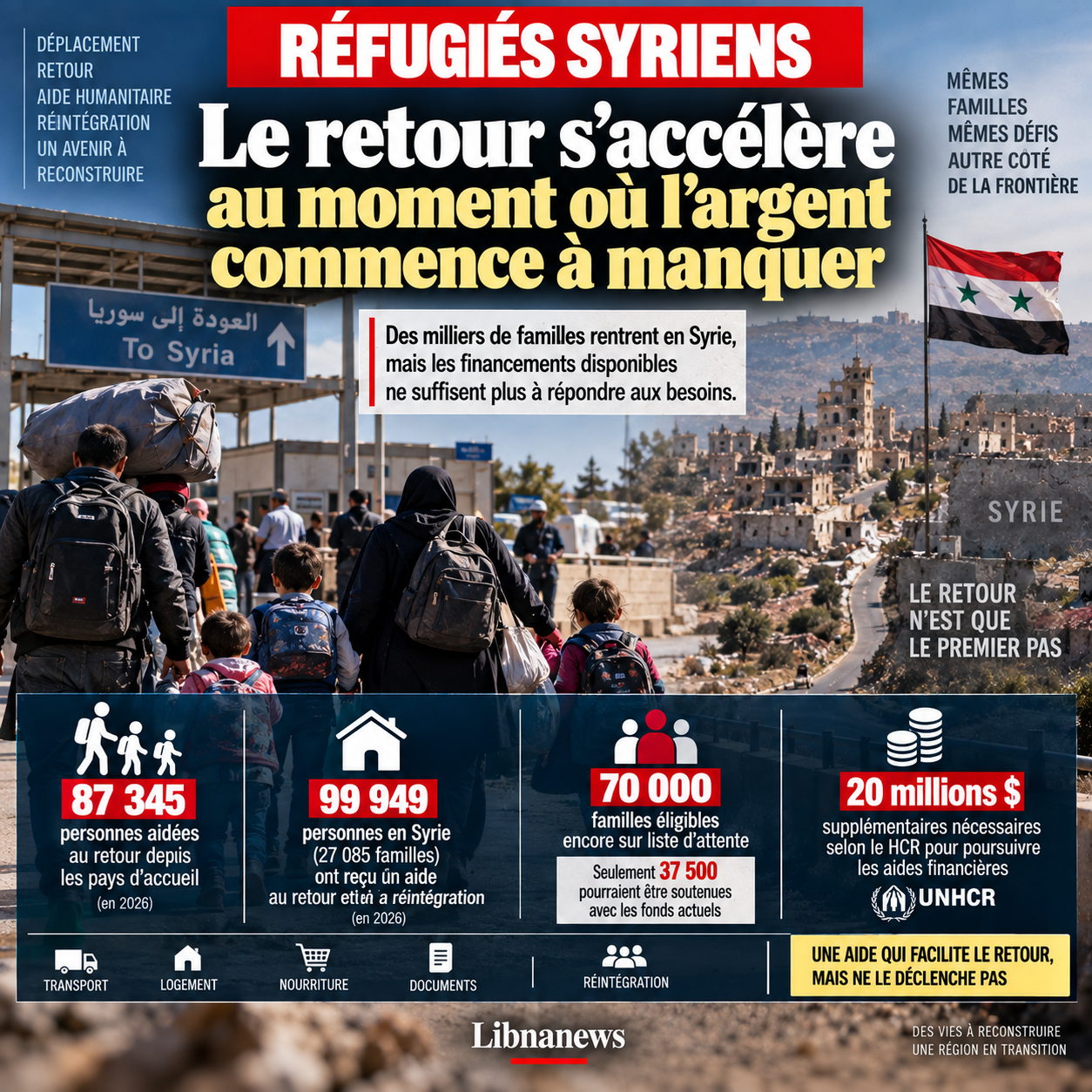
The return of Syrian refugees is entering a paradoxical phase. As departures to Syria intensify and host countries want to accelerate the movement, the financial mechanism for accompanying families is beginning to lack resources. In 2026, 87,345 people have already benefited from financial assistance related to their return from countries hosting Syrian refugees. Within Syria, 99,949 persons, representing 27,085 families returned to Syria, were assisted with return and reintegration. However, some 70,000 eligible families would now remain on the waiting list, while the available funding would only support around 37,500.
The deficit is large enough for the Office of the United Nations High Commissioner for Refugees to need an additional $20 million in order to continue the financial assistance for the first months following arrival in Syria. These sums are not used to convince refugees to leave. On the contrary, surveys of beneficiaries show that aid usually comes after the decision to return has been taken. It is used to make this choice materially possible: to pay for transportation, to move family business, to obtain documents, to stay in accommodation, to buy food or simply to travel through the first few weeks in a country where return does not necessarily mean immediately finding a home, income and public services.
That’s where the paradox is. The Governments of the host countries have long requested that return be facilitated. At a time when it becomes more important, reducing the resources devoted to its support risks precisely weakening the families who take the step. So the question is no longer just how many Syrians return. It is to determine under what conditions they can stay after income.
$100 to leave, $600 to start over
The aid mechanism makes it possible to measure very concretely the economy of a return. In host countries, a person who voluntarily decides to return to Syria may receive a one-time grant of $100. For the most vulnerable families, additional support of between $100 and $300 can be provided as needed. Once in Syria, households meeting the criteria of the programme are eligible for reintegration assistance of $600, which is also paid once.
These amounts may seem modest in terms of the cost of a move and full relocation. They are. The scheme itself recognises that the aid does not cover all expenses related to return. Rather, their function is to absorb some of the immediate costs which, for a family with very low resources, may be sufficient to make travel impossible.
Transport is the first expenditure. All those interviewed among refugees returning from Lebanon and Iraq allegedly used some of their aid to pay for their journey to Syria. In Turkey, this proportion reaches 96%. In Jordan, the amounts were distributed between transportation, basic needs and debt repayment. Behind the political debate on return therefore appears a very simple reality: going home costs money.
A family doesn’t cross the border with just a few clothes. It may have to carry furniture or effects accumulated for years of exile, pay formalities, find a vehicle and finance several days or weeks without income. The $100 per person is therefore not a starting bonus. They reduce part of the cost of a decision already taken.
Money is not what decides refugees to return
This is one of the most important lessons learned from surveys of beneficiaries. Financial aid facilitates return, but it would generally not be the trigger. Interviewees indicated that they had already decided to leave before receiving support.
This distinction is essential in a case often reduced to a financial equation. It would be tempting to imagine that increasing the amount of aid would suffice to cause a wave of returns. The available data do not support this. The decision depends on much deeper elements: perception of security, family situation, possibility of finding a home, work prospects and appreciation of what awaits the family on the other side of the border.
The aid then intervenes. It turns an intention into a feasible move.
This function may seem secondary. She’s not. A person may wish to return for several months without having the necessary resources to pay for the trip and the first expenses. The larger the family, the more the cost increases. For the most vulnerable households, therefore, a few hundred dollars can determine not the desire to return, but the moment when that desire can become a reality.
This is precisely why the lack of funding becomes a problem as returns increase. It should not necessarily prevent the most determined families from leaving. However, it can delay the poorest or lead them to return to much more precarious conditions.
70 000 eligible families, only 37 500 covered
The main alarm signal comes from the waiting list. Approximately 70,000 families would meet the criteria for support. The resources available would cover approximately 37,500. The gap therefore exceeds 30,000 households.
This is no longer an abstract budgetary risk. The programme already has an identified population that could receive assistance if the funds existed. Lack of resources directly determines the number of families accompanied.
The additional requirement is estimated at $20 million. This sum is intended to continue the aid to persons who have returned during the first months following their arrival. When compared to international budgets for more than a decade for the Syrian crisis, the amount may seem limited. When it comes to the situation of a family without stable income, it can determine the possibility of paying rent, buying food or dealing with the most urgent expenses.
This scale difference summarizes part of the humanitarian problem. A few hundred dollars is modest for an international lessor but considerable for a household that has exhausted its savings over several years of travel.
The shortage also occurs at a time when the aid system must change its function. During the years of displacement, resources were largely devoted to maintaining families in host countries. When returns accelerate, an increasing part of the effort must follow people to Syria. Funding does not disappear with the return. He has to move with him.
The first month in Syria can decide the sustainability of the return
This is probably the least visible issue. A refugee crossing the border is no longer physically present in his host country, but his journey is not complete. The success of the return depends largely on what he then finds.
The $600 for reintegration is precisely the result of this critical period. It can contribute to housing, food and essential expenses. Its aim is not to finance a family on a sustainable basis, but to give it a minimum of margin when it has to rebuild its daily life.
Survey results show that the effect is measurable. Of the families surveyed in Syria after the aid was paid, 96% reported an improvement in their living conditions. In addition, 94% reported a decrease in the level of stress within the household. Overall, 89 per cent of respondents on return support indicated that assistance had improved their ability to cover expenses, while about 90 per cent reported a decrease in family tension.
These results do not, of course, mean that a single aid of a few hundred dollars solves the difficulties of reintegration. Rather, they show how small the financial margin of some families is. A relatively small sum can have an immediate effect on household stress precisely because the household has very few reserves.
The question then becomes that of the next. What happens when the $600 is spent?
Return cannot be sustainable without income
This is where humanitarian aid reaches its limit. It can pay for the journey and absorb the first expenses. It cannot replace an economy. For a family to remain in Syria for a long time, it must have access to income, housing and essential services.
The challenge is all the more important because not all returning families have an intact heritage. Housing was destroyed or damaged during the war years. Some properties have changed usage or are no longer immediately accessible. Families can return to their home areas without being able to return to their former home.
Return aid must therefore be distinguished from reconstruction. The $100 before departure is used to cross the border. The $600 reintegration can help in the first weeks. None of these amounts can finance the substantial repair of a dwelling or guarantee several months of income.
The more massive the return movement becomes, the more important this distinction becomes. A policy based solely on the number of border crossings could produce encouraging statistics while allowing a new precariousness within Syria to develop.
The real indicator of success is therefore not only the number of people returning, but the number of families who can stay there.
Cutting help too soon could cost more then
Lack of funding has an economic paradox in this regard. Host countries and donors have an interest in sustainable voluntary returns. A failed return can cause a new shift and re-create some of the costs that were precisely sought to reduce.
Financing the first months of reintegration can therefore be less costly than managing a new displacement situation in the future. The reasoning is not only humanitarian. It concerns the very effectiveness of international spending.
A family returning to Syria with sufficient resources to move, find temporary housing and meet its basic needs has more time to look for work and reorganize its life. A family that arrives almost without money must immediately choose between debt, family help or new mobility.
That is why the additional $20 million requested takes on a strategic dimension. They do not only represent the financing of a social programme. They constitute part of the cost of stabilizing the return movement.
If donors consider that the return of refugees is now a priority, precisely reducing the resources to consolidate it would create a contradiction that is difficult to justify.
Lebanon has an interest in helping families to Syria
For Lebanon, the stakes are particularly important. For more than a decade the country has been supporting the economic, social and political consequences of the massive influx of Syrians. The return is therefore presented by a large part of the political class as a national objective.
But Lebanese interest does not stop at the border crossing. A fragile return that leads a family to leave a few months later does nothing long-term. Beirut therefore had an objective interest in having international programmes devote more resources to the post-departure phase.
This reality can change the debate with donors. For years, Lebanese officials have criticized international organizations for funding the presence of refugees in host countries rather than their return. When returns become more numerous, the question can be reworded: can resources previously spent in Lebanon gradually accompany families to Syria?
The logic does not imply a sudden disappearance of aid in host countries. Vulnerable populations remain there and still need support. Rather, it implies a gradual reallocation of resources according to actual movements.
Financing then becomes a transitional instrument.
A waiting list that creates inequality between returns
The current shortage also produces a difference between families who are eligible for the same programme. Some receive support, others have to wait because the resources are insufficient. This situation can become particularly difficult to manage when people have comparable levels of vulnerability.
The aid must therefore be prioritized. The most fragile households, those with fewer resources or the most urgent needs, should logically be served first. But any prioritization leaves families out of the system.
The more the waiting list increases, the more likely the program will lose part of its ability to accompany the movement when it occurs. A family can decide to return before their turn comes. She will then travel the same trip without the intended assistance.
The paradox is obvious: the poorest people are precisely those for whom financial assistance can make the greatest difference, but they are also most exposed to the consequences of a budget shortage.
Financing for return thus becomes a question of equity as well as volume.
The figures show that aid is primarily for basic needs
The way money is spent also helps to understand what reintegration means in practice. Beneficiaries do not primarily describe exceptional purchases. They talk about transportation, documents, food, housing and debt repayment.
These items reveal a return economy dominated by basic needs. Families do not have much capital to start a new life. They use help to take the first steps.
Debt repayment, particularly among some beneficiaries in Jordan, is particularly revealing. Several years of displacement can produce accumulated debt. Returning does not automatically remove these obligations. Part of the aid is therefore used to close the travel accounts before it can actually finance the new facility.
Another example is the transport of goods. A family that has lived for several years in a host country has necessarily accumulated essential objects. Abandoning these goods to reduce the cost of travel may force them to be purchased in Syria. Paying for their transport can therefore be economically more rational, even if it increases the immediate expense.
The border is thus only a moment in a much longer financial process.
Aid must not become a political bonus at the outset
The observation that money facilitates return without being the main factor is also of ethical importance. Programmes should avoid the perception of financial assistance as an incentive to push refugees out of host countries regardless of their circumstances.
The results available provide an important nuance on this point: the beneficiaries interviewed had generally already made their decision. Support reduces practical obstacles but would not, in the majority of cases, be the basic reason for departure.
This distinction maintains the principle of voluntary return. The aid accompanies a decision instead of buying it.
It also obliges governments not to confuse return policy with financial policy. Increasing amounts is not enough to address the factors that hold certain families: security, housing, employment, family ties or uncertainty about their future conditions.
Funding is therefore necessary but not sufficient. This is precisely what makes its shortage paradoxical: it cannot create the return movement alone, but its absence can greatly complicate a movement that already exists.
$20 million to avoid a hole in the transition
The additional requirement of $20 million must finally be placed in this equation. It is not about indefinitely financing the lives of tens of thousands of families. The demand is for the first months following their return, i.e. the period when their vulnerability may be greatest.
The list of 70,000 eligible families shows that demand is no longer theoretical. Funding available for about 37,500 households covers just over half of the identified need. The gap may therefore become more visible as new families return.
For host countries, donors and Syria itself, the calculation should be relatively simple: a sustainable return requires more than a border crossing. A bridge must be created between displacement and relocation.
The current financial assistance is one of the decks of this bridge. It is modest, temporary and does not solve housing or employment. But family surveys show that it reduces material hardship and stress when households have the least margin.
The risk is, therefore, that the international community will succeed in achieving the long-awaited objective of accelerating returns while underfunding the phase that should make them sustainable. The paradox would be costly: after spending years to accompany the trip, miss a few tens of millions of dollars at the time when you have to accompany the trip out.