





A reconstruction that seeks to change the rules of the game
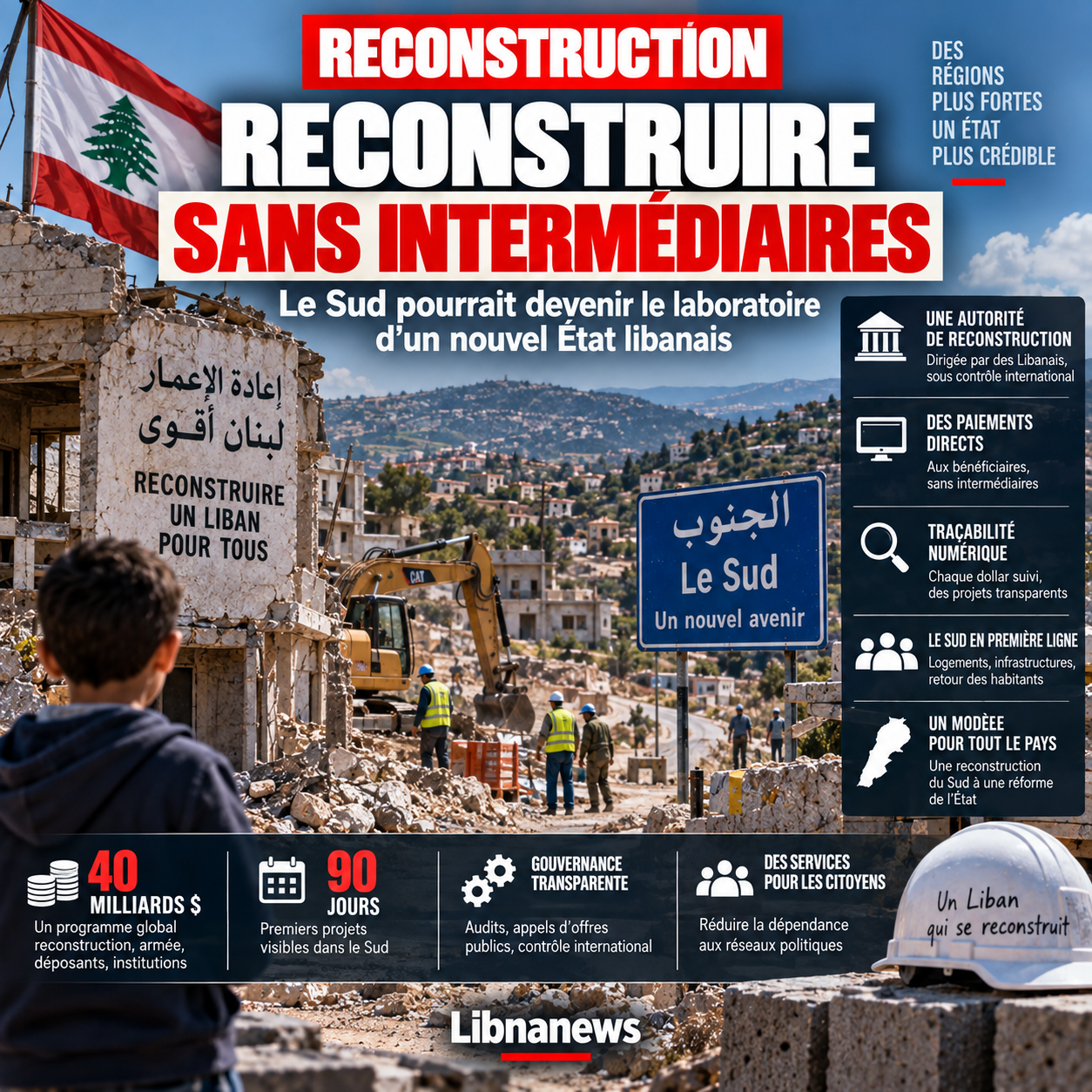
The reconstruction of Lebanon would no longer be conceived solely as an operation to repair houses, roads and infrastructure destroyed by war. In the draft presented by the documents studied, it would become the instrument for a much deeper transformation of the functioning of the State. The central idea is to create a Lebanese structure to manage a significant part of the funds, to impose a digital traceability of expenditure and to pay certain aid directly to the beneficiaries. The South and the southern suburbs of Beirut, among the most affected territories, would be given priority. But the program would be national in scope. Behind the reconstruction thus appears an institutional objective: to reduce the role of political intermediaries in the distribution of public and international money, then gradually transfer these new methods to ordinary administrations.
The mechanism described is particularly ambitious. It is based on a structure called the Lebanese State Reconstruction Authority, which should be established by law and led by Lebanese. However, it would have international control and would work under the supervision of donors. This combination seeks to resolve an ancient contradiction. Foreign partners want guarantees on the use of their funds. But direct external administration would be politically difficult to accept and could be seen as a form of guardianship. The project therefore tries to draw an intermediate line: Lebanese leadership, Lebanese legal basis, but audit and transparency involving international actors.
But the real change lies in the circulation of money. The proposed system would limit the passage of funding through traditional political and administrative networks. Payments could reach recipients directly. Public procurement would be published on a digital platform. Every dollar should be tracked. The identity of the beneficiaries could be verified. Dispute mechanisms would also be provided. Technology would therefore not be a mere administrative tool. It would become one of the means used to change relations between the state, parties and citizens.
Forty billion dollars, but not just for destroyed buildings
The amount of $40 billion referred to in the project is not a mere estimate of the damage caused by the war. It is presented as a much larger strategic envelope. It should finance past and present reconstruction, strengthening the army, financial stabilization linked to depositors, digital transformation, municipal rehabilitation and institutional reconstruction.
This precision is essential. Talking about a $40 billion fund dedicated only to material destruction would give an incorrect picture of the project. The ambition is to simultaneously finance several pillars of a new state architecture.
This approach is based on political reasoning. Rebuilding buildings without rebuilding institutions would, according to the logic of the project, duplicate previous weaknesses. Similarly, strengthening the army without providing public services to the people of the South would leave intact the social dependencies that developed around other actors. Finally, reforming banks without changing public spending mechanisms would not be enough to restore confidence.
The various components are thus voluntarily linked. Physical reconstruction must produce a state presence. The presence of the State must create confidence. Trust must encourage the return of economic activities to institutions. And this standardization must gradually reduce the capacity of political organizations to perform functions that should be the responsibility of the public authorities.
It is precisely this articulation that makes the project much more political than a classic international aid programme.
The first achievements expected in 90 days
The planned schedule places considerable emphasis on speed. The first reconstruction projects in the South should be visible within 90 days of the start of the programme. This deadline is not only technical. She’s responding to a strategy.
The project designers assume that public confidence cannot be achieved through declarations. It should be quickly demonstrated that the State is able to repair a road, rebuild public equipment, pay compensation or restore a service without waiting for years.
The first phase would cover 12 months. It would include the consolidation of the ceasefire, the legal establishment of the reconstruction authority, the first construction projects in the South, the deployment of the army in areas affected by an Israeli withdrawal, the launch of financial audits and the opening of a digital platform to monitor reconstruction expenditure.
Emergency housing and return programmes should also begin during this period. Municipal reconstruction would be undertaken in parallel. At the end of the first year, the change should be sufficiently visible that the population can measure a concrete difference.
The project thus makes speed a political instrument. Each completed project must strengthen the credibility of the State. On the contrary, any delay may reinforce the idea that official institutions are unable to meet needs.
A digital platform to track every dollar
The most innovative pillar of the programme is the mandatory digitisation of fund management. The principle is summed up by a simple formula: no money without digital transparency.
Each expenditure should be monitored. Each beneficiary should be identified. Markets should appear on an accessible platform. Data on funded projects would be made public. The logic is to minimize the opaque areas in which favouritism, hijacking or clientelism can develop.
The stakes go beyond the traditional fight against corruption. The system also aims to reduce the role of the intermediary. In the traditional operation of many social or local programmes, the citizen often depends on an administration, an elected one, a party or a personality capable of speeding up a file. The new model would seek to establish a more direct relationship between the institution and the recipient.
A household whose housing has been destroyed could, therefore, be recorded in a verifiable database. His right to compensation would be determined according to defined criteria. Payment could then be made directly without going through a partisan structure.
The same principle could apply to contractors. Calls for tender, contracts and payments would be recorded. It would become easier to know which company had obtained a contract, for what amount and for what purpose.
The project obviously does not guarantee the disappearance of corruption. A digital platform can itself be manipulated if the initial data is false or if the controls are weak. But it alters the possibilities of verification and creates traces that do not exist in a system largely based on opaque decisions.
A Lebanese authority, but under international surveillance
The governance of the new structure is one of the most sensitive issues. Its board of directors would be appointed by the President of the Republic and the President of the Council, with the participation of a group of international donors. No party or department would have sole appointment authority.
An independent audit commission would also include periodic international participation. Disbursement decisions would be taken by the authority and not directly by sectoral ministries. The reports would be transmitted simultaneously to the Government of Lebanon and the international supervisory mechanism.
The objective is clear: to prevent a ministry controlled by a political force from deciding alone on the allocation of billions of dollars.
But this organization opens up a major institutional issue. How far can a special structure take over functions normally performed by ministries without further weakening public administration?
The project attempts to address this objection by presenting the authority as a transitional mechanism. Ultimately, its functions should be transferred to permanent national institutions. It would therefore serve as a laboratory to install new rules before they are incorporated into the State.
Success will depend precisely on this transition. If the authority becomes more powerful than ministries, it could create a parallel state in the name of state reconstruction. If, on the contrary, it gradually transfers its methods to administrations, it could contribute to their modernisation.
The South and the South Suburb in front line
The programme has a geographical and social priority. The people who have suffered the greatest destruction must be the first beneficiaries. The South therefore occupies a central place, just like the southern suburbs of Beirut.
This priority could be politically sensitive in a country where the distribution of resources is regularly interpreted through Community balances. The documents make it clear that it should not be considered as a religious advantage. It would be justified by the magnitude of the damage and the role of the South in the envisaged security arrangements.
The political message sought is also explicit: the return of the state to the South should not be presented as a punishment for the people who supported Hezbollah. It must take the form of reconstruction and concrete improvement of their living conditions.
This distinction is fundamental. A strategy that combines state-building with a collective sanction against a community could have the opposite effect. It would strengthen existing defensive solidarity and political networks.
The programme therefore aims to dissociate the population from the military structure without opposing the State to the population. Residents must be able to see that they obtain housing, infrastructure and services regardless of their political position.
The central battle: who will distribute help?
It is here that the fusion between digital reconstruction and the fight against clientelism makes sense. In Lebanon, the distribution of aid is never completely neutral when it comes through a political intermediary. A person who facilitates access to compensation, finances a repair or finds an administrative solution can turn a service into a loyalty relationship.
The envisaged system seeks to remove part of this mechanics. If the aid comes directly to the beneficiary according to public criteria, the intermediary loses some of its power.
This transformation is not just about Hezbollah. The documents anticipate resistance from other traditional political actors. Sponsorship networks exist in several regions and communities. Officials may consider that a centralized digital administration threatens their ability to intervene in resource distribution.
The banking sector could also resist certain aspects of the programme, including those relating to loss distribution and depositors. The interests threatened by the reform are therefore multiple.
Reducing the debate to a confrontation between the state and Hezbollah would be insufficient. The project potentially calls into question a much broader way of operating Lebanese policy.
The particular case of Nabih Berri in the documents studied
The documents also anticipate possible opposition from the Speaker of the Chamber Nabih Berri. This hypothesis must be presented with caution: it is an anticipation contained in the project under study, not evidence of an opposition actually announced by the person concerned.
The logic attributed to plan designers is that the new architecture could reduce the role of traditional intermediaries in representing and distributing resources within the Shia community. A reconstruction directly managed by a national authority and numerically controlled would alter the usual channels of political mediation.
The document also refers to the use of constitutional mechanisms to prevent an actor from having a right of blocking alone. Again, this is a work scenario attributed to the authors of the project, not an institutional decision already taken.
This dimension nevertheless shows how far the reflection goes. Reconstruction is not only seen as a means of replacing Hezbollah services. It could change all the relations between citizens, elected representatives, parties and administration.
Hezbollah faced competition from services
The most strategic dimension concerns Hezbollah. The project starts from the observation that its relationship with part of its base is not based solely on weapons or ideology. It is also based on a network of services, support, protection and intermediation.
In this reading, brutally asking the population to break up with the party would be ineffective. A credible alternative should first be offered.
Reconstruction thus becomes a form of institutional competition. If the state rebuilds a house, finances a municipality, directly pays aid and guarantees security, it occupies a space until then filled with other structures.
The documents consider speed as essential. An administration that promises for two years without a construction site would lose the battle before it even started. Conversely, a reconstructed house or compensation actually paid may alter the perception of the role of the State.
This strategy does not guarantee a change in the political orientation of the population. The documents sometimes suggest a gradual evolution of loyalty, but there is no mechanical evidence that an improvement in services would lead to electoral or ideological change. A population can benefit from public services while maintaining its political convictions.
What the program can change more surely is functional dependence. A citizen who can obtain his rights directly from the State needs less intermediary, regardless of his or her political opinion.
The risk of reconstruction seen as an instrument of political combat
However, there is a contradiction in this strategy. The more documents explain that reconstruction must reduce dependence on Hezbollah, the more the party can present the program as a political operation directed against it.
This perception could complicate local acceptance of the scheme. A family whose house is destroyed wants compensation. But if aid is publicly presented as a tool to transform its political environment, it can create distrust.
Communication therefore becomes almost as important as the financial architecture. The programme must be able to be presented as a reconstruction of the most affected regions and a restoration of public services, rather than an attempt to buy loyalty.
The documents themselves emphasize this nuance. They recommend avoiding a language of announcing the destruction of Hezbollah’s social base. They favour a discourse focused on the reconstruction of the state and assistance to communities that have suffered the most.
The difference is not just rhetoric. It will determine how the programme will be received in the South.
A transformation that could go beyond reconstruction
If the model works, its impact could eventually exceed the destroyed regions. The digital platform, transparent tendering, direct payments and verification mechanisms could be extended to other jurisdictions.
The project foresees that, after the consolidation phase, between the second and fifth years, the functions of the special authority will gradually be transferred to the permanent national structures.
The South would then become a testing ground for a much wider reform of the state. A procedure created to compensate a destroyed house could then inspire a national social assistance mechanism. A platform for reconstruction markets could be used for other public procurement. A basis for verifying beneficiaries could be integrated into a more general digital administration.
This development, however, remains conditional on a fundamental question: will political institutions really agree to transfer the power to distribute resources to automatic and transparent mechanisms?
Because behind the billions, buildings and platforms is the real stake of the program. The proposed reconstruction is not only about how much money will be spent. It seeks to determinewho will have the power to distribute it. This is precisely what could make the South not only the main post-war material project in Lebanon, but also the ground for the deepest confrontation between two models of the State: the one where the citizen obtains a service through a political network, and the one where he is supposed to obtain it directly because he possesses the right.