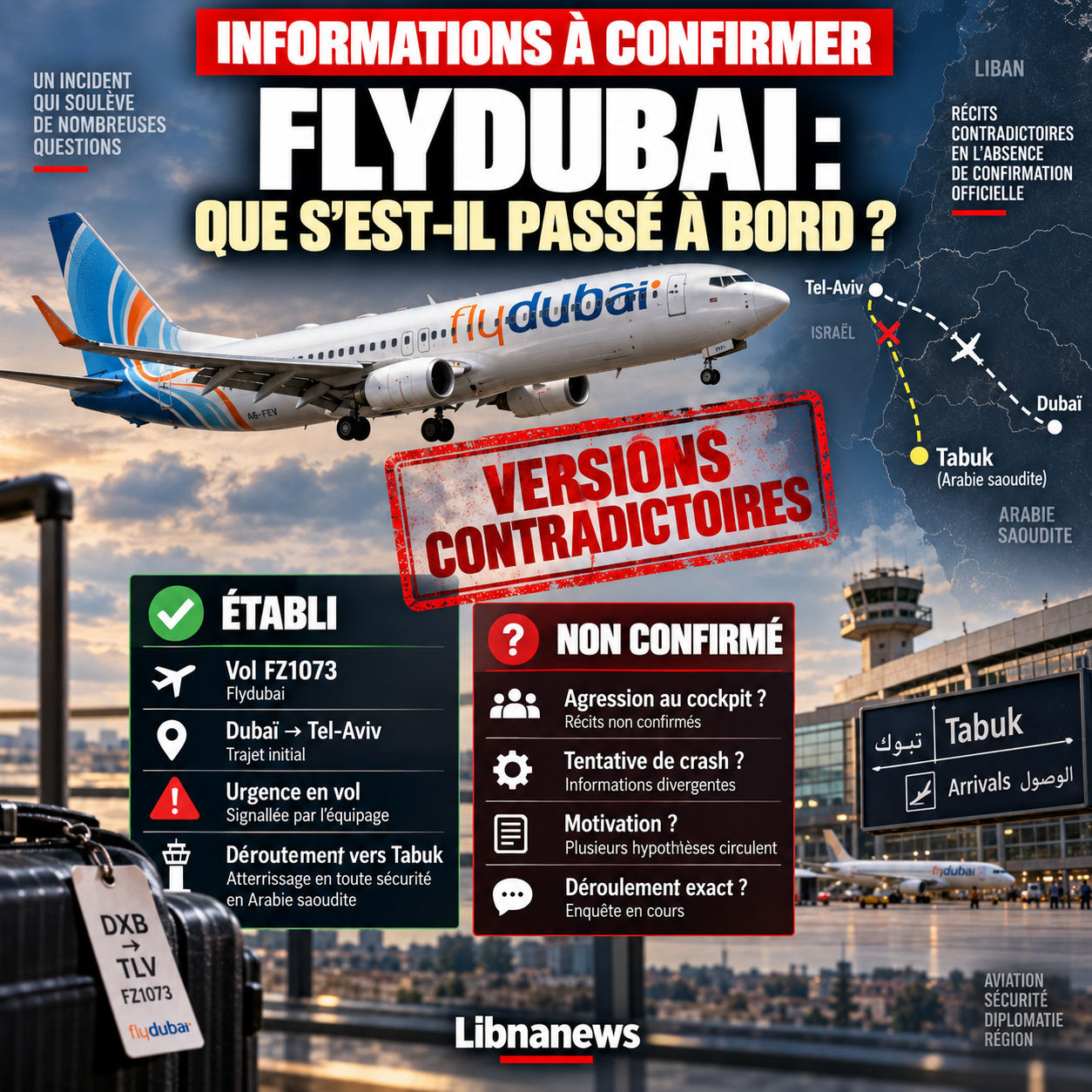
Spectacular information is circulating Wednesday, September 30, 2026 on social media about a Flydubai flight to Israel with about 150 passengers on board. Several messages attributed to Israeli media successively evoke a sudden descent of the aircraft, a stabbing attack in the cockpit, an attempted suicide of a pilot, or a desire to deliberately cause the plane crash. At this stage, these versions are not sufficiently corroborated by official or independent sources to be presented as established.
Images presented as coming from inside the aircraft show a panic situation among passengers. They were quickly accompanied by much more accurate accounts of what would have happened in the cockpit. However, these accounts differ on essential elements, including the alleged author, his motives and the exact course of the incident.
There is no immediate evidence of an attempt by a pilot to crush the aircraft or of a terrorist attack. This lack of confirmation requires a distinction between images and testimonies attributed to passengers, on the one hand, and interpretations broadcast in the following minutes, on the other.
Flydubai: several contradictory versions
A first version broadcast by an Israeli channel states that one of the pilots attempted suicide. According to this account, the aircraft was said to have made an extremely rapid descent from about 30,000 feet to 15,000 feet. The second pilot then intervened to prevent him.
A few minutes later, another version began to circulate. It also evokes a suicide attempt, but a knife attack inside the cockpit. A passenger presented as a witness to the incident claims to have heard screams before seeing the cockpit door open. She says she saw blood and someone attacking a pilot with a small knife.
According to the testimony reported on social media, Israeli passengers and crew members were then brought under control of the aggressor. A doctor and nurse on board allegedly provided first aid to the injured pilot.
However, this version is not identical to the first information disseminated. It profoundly changes the nature of the event as it introduces physical assault and passenger intervention into the cockpit.
Suicide, embezzlement or attack: the stories diverge
A third version attributed to Israeli journalist Amit Segal claims that the co-pilot had repeatedly stabbed the main pilot. Crew members and passengers would then have managed to enter the cockpit and control the attacker.
In this account, the incident was allegedly considered by the Israeli authorities as a terrorist attack after the hearing of passengers and an initial assessment of the situation. However, this qualification must remain valid until confirmed by an official communication from the competent authorities.
Another information attributed to the Israeli Channel 12 indicates that the first officer would have sought control of the aircraft to cause it to crash. Again, this version differs from that of an attempted spontaneous suicide and introduces the hypothesis of a deliberate diversion.
The publications appearing in the following minutes also give different figures concerning the loss of altitude. Some messages suggest a drop of 30,000 to 15,000 feet, about 4,570 metres. Others speak of a loss of about 4,000 meters.
These differences may seem secondary, but they are important when checking an air incident. Track and altitude data are normally elements that can be confronted with flight tracking information and data held by the aviation authorities.
Nationality of pilots also advanced without confirmation
Another statement broadcast by an Israeli channel presents the co-pilot as an Omani national and the other pilot as an emirati. The Omani co-pilot reportedly attempted to cause the crash of the aircraft carrying approximately 150 Israeli passengers.
This information is particularly sensitive since it introduces a nationality into an event presented simultaneously as a possible terrorist attack. It therefore requires independent confirmation before any presentation as a fact.
In the information available at the time of writing, there is no solid enough official evidence to confirm this identity, the nationality of the two pilots or the motivation attributed to the alleged perpetrator.
The same principle applies to the number of Israeli passengers announced. Several publications refer to about 150 people, but this figure must also be distinguished from a flight manifest or from information officially communicated by the company.
What needs to be established
Several elements would help to clarify the incident quickly. The first is the precise identification of the flight concerned, with its number, time of departure and journey. This information would enable objective verification of the aircraft’s trajectory and possible sudden loss of altitude.
The second element expected is a communication from Flydubai. The company would be able to confirm the existence of an incident on board, the health of its pilots and passengers, and the conditions under which the flight ended.
The aircraft authorities in the United Arab Emirates and the Israeli authorities could also determine the nature of the occurrence. If an attack actually occurred in the cockpit, an investigation should establish how a weapon could be found there, who used it and under what circumstances.
The characterization of a terrorist attack also requires evidence of the alleged perpetrator’s intention. An attempt at suicide, an attack between crew members and a deliberate desire to cause the fall of a passenger aircraft are three very different scenarios.
Necessary prudence in front of initial information
The speed of message traffic illustrates the difficulty of dealing with an air incident in real time. In less than a quarter of an hour, the publications evolved the story of a brutal descent by a suicide bomber into a stabbing attack and then into an attempt to hijack a terrorist.
Not all of these scenarios are necessarily incompatible, but their succession does not automatically allow them to be considered confirmed. An investigation may establish that a pilot assaulted his colleague before attempting to take control, but this chronology must be demonstrated.
Passenger testimonies can provide important information about what happened in the cabin. However, they do not necessarily make it possible to know the intentions of a person in the cockpit or the exact technical parameters of the device.
In the immediate future, the most serious information — stabbing, attempted crash, Omani nationality of the co-pilot and terrorist qualification — must therefore remain presented as reported statements and not as definitively established facts.
The identification of the flight and the publication of the trajectory data should enable at least part of the narrative to be verified, in particular the possible sudden loss of altitude. The human circumstances of the incident will require a communication from Flydubai and the investigating authorities.