






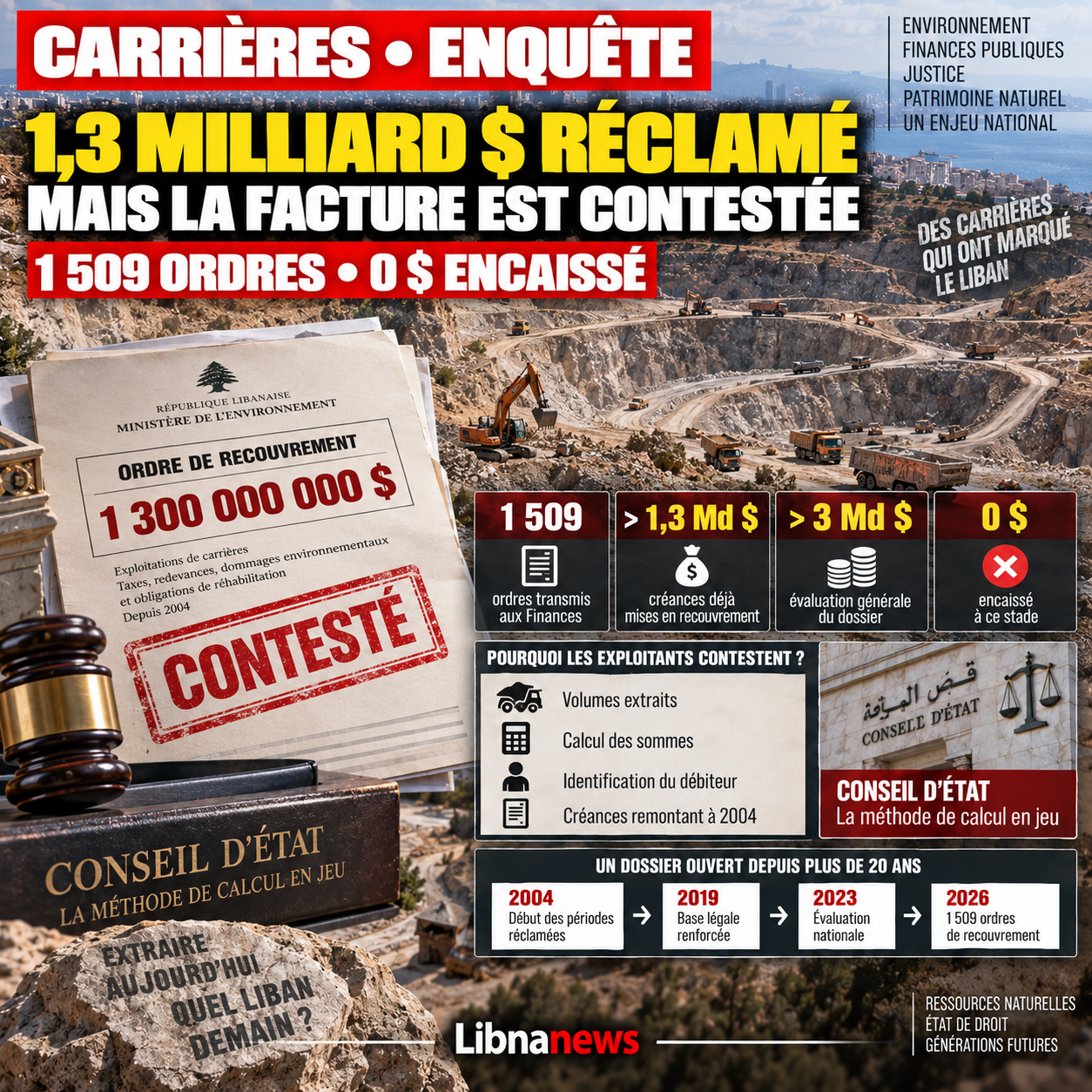
From 71 unusable orders to 1,509 receivables transferred to Finance
Today’s conflict between the Ministry of the Environment and quarries does not begin with Tamara El Zein or with the current debate on possible government reshuffle. It is the result of a case which has been open for more than 20 years, but which the State had never succeeded in transforming the offences found into actually recoverable claims. The novelty of 2026 lies precisely in this change of nature. The administration is no longer simply identifying quarries, measuring the areas exploited or quantifying the damage. She started sending individual recovery orders to Finance.
As at 23 September, 1,509 orders had been issued in excess of $1.3 billion. Others were still to be established after receiving additional data from the Internal Security Forces. However, no payments had been received. Several operators contested the sums before the administration and the competent courts. Others appealed to the Council of State against the calculation method adopted by the government. The litigation has therefore left the only political field to enter a judicial phase on which much of the case now depends.
The figure of 1.3 billion must be distinguished from another estimate, over three billion dollars, advanced for all the rights, damages and rehabilitation obligations identified by the administration. The two amounts do not correspond to the same stage of the procedure. The three billion represent the overall assessment of the amounts allocated to the farms identified. The $1.3 billion corresponds to orders already prepared and forwarded to Finance. The difference, therefore, does not constitute, in the state of information available, an abandonment of nearly two billion. It mainly corresponds to files that have not yet all travelled the same administrative path.
This distinction is at the heart of the current controversy. She also explains why Tamara El Zein insists on the need to complete the files properly before transmitting them. The department had already issued 71 recovery orders prior to its arrival. However, they had physical defects that prevented their normal treatment. The episode seems derisory to the amounts involved, but it summarizes part of the problem: for years, the state has had impressive figures without being able to produce the administrative instrument to effectively claim the money.
The problem dates back to 2002, but the bill starts in 2004
The main regulatory framework for the sector dates back to Order 8803 of 4 October 2002, as subsequently amended. It organizes the exploitation of careers and crushers, provides for authorisation procedures and assigns a central role to the National Career Council and crushers. On paper, exploitation must be governed by technical, environmental and financial conditions. In the field, a considerable part of the sector worked differently.
Some farms continued their activity without a proper authorisation. Others used permits issued for different objects, including operations presented as land enhancements. Some have exceeded authorized surfaces or volumes. Successive Governments have also adopted temporary measures to continue certain activities or to move stocks. This succession of exceptions gradually produced a sector in which the rule existed, but its application was sufficiently discontinuous for irregular situations to continue.
The legal turnaround comes with Article 61 of the 2019 Finance Act. The text requires the prosecution of persons who have exploited a land as a quarry, sandstone or crusher without legal authorization or in violation of their authorization. It provides for the payment of taxes, royalties and other sums due for the years of operation from 2004, as well as the fulfilment of obligations to repair environmental damage.
Decree 6569 of July 2020 further clarified the modalities for the implementation of this mechanism. In particular, the quantities extracted had to be determined since 2004. This requirement explains why the file could not be settled from administrative records alone: it was necessary to physically reconstruct what had been extracted.
The army provided the missing piece: the measure of excavated territory
The Directorate of Geographical Affairs of the Army then carried out extensive survey work. The first detailed studies covered 1,235 quarries identified as significant cases of degradation. For each site, the database could contain coordinates, area, volume extracted, nature of materials, ownership of the land and, when the information was available, the identity of the operator.
The result was for the first time a national measure of the phenomenon. More than 15 million square metres had been exploited, an area close to three quarters of Beirut. The volume of materials extracted was approximately 197 million cubic metres. The sites also included 149 quarries on state-owned land.
Based on this data, the Ministry of Environment and the United Nations Development Programme published in June 2023 a first global estimate: at least $2.39 billion was due from the sector. This calculation did not include a single category of receivables. It added different elements: taxes and fees, regulatory costs, compensation for environmental degradation and rehabilitation costs.
This is an essential difference from the old career discussions. The problem was no longer just to sanction exploitation without a licence. It became possible to calculate, plot by plot, what the extraction had represented in volume and to attach several categories of sums due.
The work was then expanded and corrected. In 2026, the Department referred to approximately 1,506 parcels included in the surveys used for the general assessment. The number of recovery orders may be higher than the number of parcels, as the same site may generate several obligations or involve several periods and persons responsible.
Nasser Yassin had launched the recovery, but had been hit by the identification of the debtors
The first concrete attempt to transform the theoretical billions into individual bills began under Nasser Yassin. At the end of 2024, the first minutes were sent to the operators. The department began with approximately 450 careers with a tax number with the Department of Finance. These sites accounted for a significant portion of the largest area holdings and already concentrated more than $550 million in potential claims.
This first wave reveals one of the least visible problems in the file. Measuring a career from the sky is relatively simple. Legally identifying the person who has to pay is much less.
The owner of the land is not necessarily the operator. A company may have operated for part of the period and then been replaced. A career may have worked for several social reasons. Some land may belong to the state or communities. In other cases, the identity of the operator does not appear clearly in the tax bases.
The department was therefore required to match three files that had never been designed to work together: the army’s geographic records, the finance tax data and the security forces’ information on the operators.
It was this operation that Tamara El Zein resumed after arriving at the ministry in 2025. It did not create the debt file. It inherited a mechanism launched under its predecessor and then undertook to correct files that could not be recovered in their original form.
The details of the first 71 orders explain why the file was so late
One of the most revealing elements concerns the first 71 recovery orders. They had been established prior to the arrival of Tamara El Zein, but material deficiencies prevented their normal treatment by the financial administration.
The department explained that it wanted to avoid replicating this situation on a large scale. It has therefore taken over the files with the Directorate of Geographical Affairs of the Army, the Ministry of Finance and the Internal Security Forces. The objective was to properly associate each operation with a taxpayer and produce documents that could be executed under the public collection rules.
This administrative dimension is less spectacular than the figure of three billion, but it is the real point of break. Lebanon had already calculated the damage. He had failed to build a complete chain from the geographical survey to the tax debtor.
As of September 23, 2026, this channel exists for 1,509 orders. That is why the battle is now moving towards the courts.
Carriers no longer dispute the amount: they attack the method
The operators concerned initiated several types of remedies. Some objected to the department. Others have appealed to the competent courts. Appeals were also filed with the Council of State against the Government’s decision establishing the method of calculating the amounts claimed.
The dispute relates in particular to the possibility of claiming today amounts corresponding to holdings dating back to 2004. It also covers the manner in which volumes have been reconstituted, the identification of the responsible operator and the various components of the claim.
It is on this ground that the essential decision will be made. If the State Council invalidates the calculation mechanism, it is not some invoices that will be challenged, but potentially part of the architecture built since 2019. If, on the contrary, the mechanism is confirmed, operators will have to challenge their files individually rather than the general principle of the claim.
The Department prepared several hundred responses to appeals with its legal team and the Department of Justice Affairs Authority. The case is no longer a simple confrontation between the minister and career owners. It has become a national administrative dispute whose outcome will determine whether article 61 of the 2019 Finance Act can really produce the effects for which it was adopted.
Kura’s cement works bring back a more embarrassing question: can we continue digging while contesting old debts?
The debate took a particularly sensitive turn in the North. On 21 September 2026, the committee following the file of the quarrying operations of the Kura cement plants publicly asked how the State could allow the resumption of excavation work when the financial and environmental claims of the operators were still outstanding.
The issue is a separate problem in calculating debts. Does the State have to make any new authorization conditional upon payment of the amounts claimed for previous activities?
Article 61 of 2019 was precisely conceived in such a logic. In the Litani basin, the public establishment responsible for the river had requested as early as February 2020 that applications for the exploitation and movement of stocks be suspended until the operators concerned had paid the environmental taxes, charges and obligations dating back to 2004. The aim was to prevent an operator from continuing to benefit economically from materials already extracted while the debt corresponding to that holding remained unpaid.
Six years later, the problem comes back more acutely. The department claims to have established the debts. The operators contest them. Meanwhile, the cement industry and the construction sector need raw materials.
This is where the environment directly meets industrial policy. A general ban can disrupt the supply of cement and aggregates. Unconditional authorization may, on the contrary, remove much of its power from the collection mechanism.
Quarries are not a marginal sector: they feed cement, concrete and public works
The sector’s ability to withstand regulatory attempts is not solely due to possible political protections. It also holds its place in the real economy.
Lebanon cannot build without aggregates. Cement plants need limestone and other materials. Concrete, roads, embankments and major works consume considerable volumes of stone, sand and gravel. To close all farms abruptly without alternatives would immediately shift the problem to construction and supply prices.
This dependence has often contributed to transforming interim authorizations into durable solutions. With each attempt to close, the economic argument reappears: construction sites risk stopping, the price of cement or aggregates increase, jobs are threatened.
The result was a system in which the economic necessity of the material was regularly used to postpone the resolution of the environmental issue.
This is why the current case is more difficult than a campaign against « illegal » careers. At the same time, it is necessary to recover old claims and to organise a future extraction compatible with the rules. Without a second component, the country will quickly return to the same exceptions.
Career management plan remains weak
The 2002 Decree provided for a territorial organization of activity. However, Lebanon has never managed to stabilize a sustainable model in which extraction is concentrated in suitable areas, away from homes and under effective surveillance.
This weakness has encouraged the proliferation of scattered farms.
Some quarries have developed near villages. Others have profoundly altered entire slopes. In several regions, the consequences go beyond the landscape: dust, heavy-duty vehicles, noise, changes in flow, risks to groundwater and soil destruction.
The problem is therefore twofold. The recovery concerns the past. The management plan concerns the future.
Even if the State recovers the amounts claimed, it will not have settled anything on a lasting basis if the same exceptional authorisation mechanisms continue to produce new irregular farms.
It is on this point that the current confrontation takes on a political dimension. Operators do not only defend their past debts. They also have an interest in knowing the rules under which they can continue to work.
Tamara El Zein claims to be under pressure, but authors are not identified
The Minister recognizes that the issue generates pressure. However, it asserts that it does not wish to decline and presents the defence of debts as an obligation to the Treasury.
We must stop here at what is established and what is not.
The existence of pressure is affirmed by Tamara El Zein herself. On the other hand, the information available does not allow the precise identification of the authors or their form. There is no evidence that a specified operator would have requested his departure. There is also no evidence to establish that a specific political official is a condition for the Minister’s continued maintenance of a change in collection orders.
The reshuffle file must therefore remain separate until proven otherwise.
The name Tamara El Zein actually circulates among those who might be affected by a government change. Confrontation with quarries naturally feeds the hypothesis of a link. But simultaneity is not evidence.
The real investigation now consists in identifying who is asking for his replacement and why.
The best pressure indicator will be the trajectory of recovery orders
Rather than immediately seeking a political leader behind each opposition, there is a more concrete way to follow the balance of power: to observe what happens to the 1,509 orders.
Are they normally registered by Finance? Are recovery procedures initiated? Do operators get a stay? Do the decisions of the Council of State suspend the entire mechanism or only certain cases? Are new permits granted to large debtors? Are the amounts renegotiated?
These questions will help measure pressure much better than reporting.
If the mechanism continues despite appeals, the Ministry will have managed to institutionalize the case beyond the person of Tamara El Zein. If, on the contrary, administrative treatment slows down, new authorizations multiply and claims are gradually reduced, the confrontation will have taken another direction.
This is also what makes possible reshaping sensitive. The departure of a minister should not theoretically alter a debt established by the administration. If its replacement changes the processing of cases, it will then become possible to talk about a political issue directly related to careers.
The real figure to be monitored is no longer 3 billion, but the first payment
Since 2022, public debate has grown accustomed to billions. First 2,39 billion. Then more than three billion as the files were completed. These amounts had an important function: to show the economic extent of the phenomenon.
They’re not enough anymore.
In September 2026, the decisive indicator is much simpler: no amount has yet been recovered under the disputed orders.
The change from zero to the first payment will therefore be more significant than a new overall revaluation.
It will state that an operator has either accepted his debt or exhausted his remedies or concluded a settlement procedure in accordance with the law. From then on, the mechanism will cease to be only theoretical.
It is probably for this reason that the battle is today harder than it was in 2023. At the time, the ministry published a study. In 2026, he sent invoices.