





$1,400 to $1,500 before even school and health
The Lebanese social crisis is changing in nature. It is no longer limited to the poverty of unemployed households or to the collapse of wages caused by the monetary crisis. The available data now show that a family with two people working can remain unable to finance its essential expenses. It is this breakdown that explains the multiplication of strikes, demands for advance pay and warnings about possible social burning.
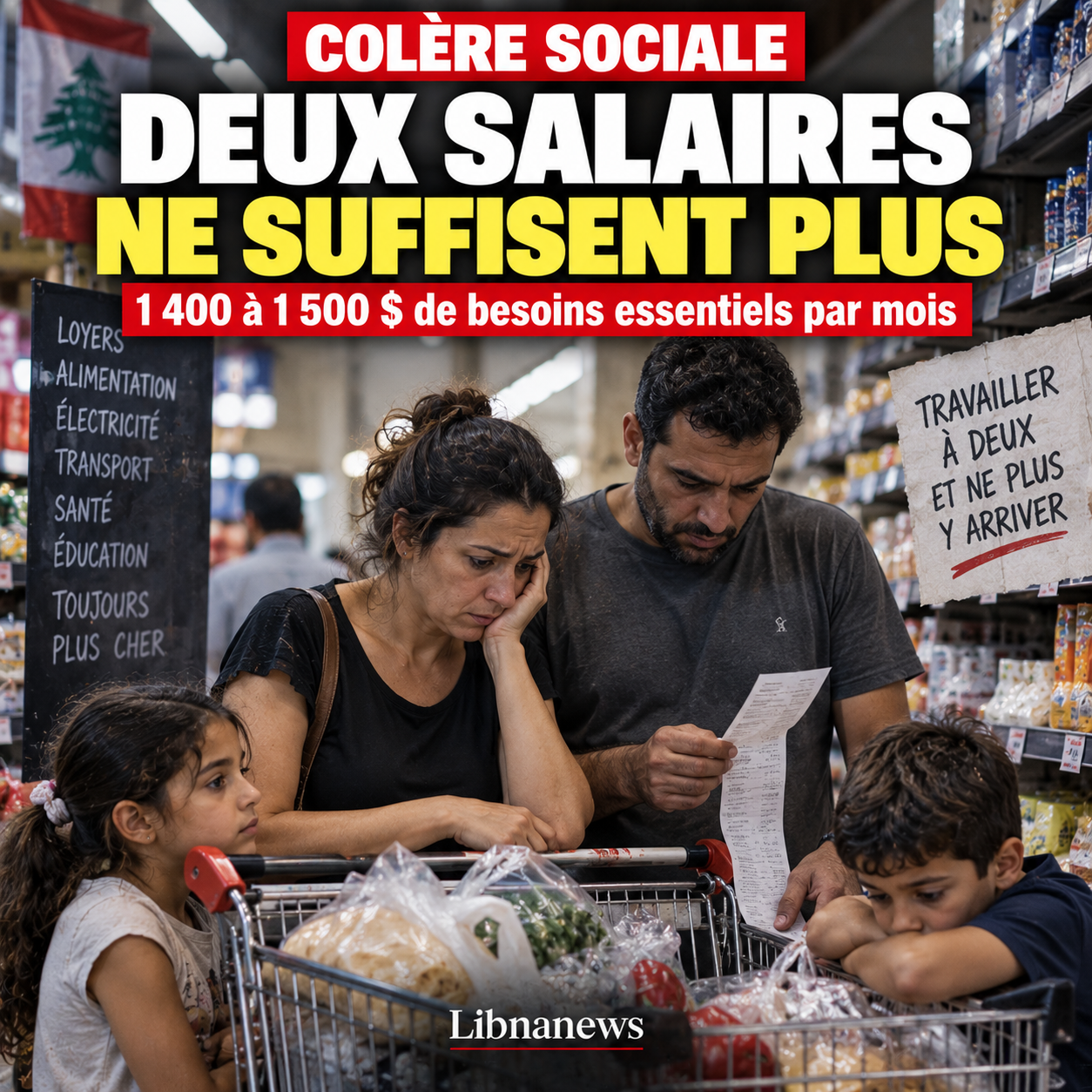
A detailed estimate for a family of four persons renting accommodation in Beirut or its suburbs is between $1,400 and $1,500 per month for the cost of only five posts: housing, food, electricity, water and transport. Two displacement models give slightly different results. With a private car, accounting for only gasoline and not the entire cost of the vehicle, the bill is about $1,403. With two people regularly using the service and the minibus or bus, it reaches about $1,486.
However, these amounts are not a full family budget. Education is not included. Medical care, hospitalization and medicines are also available. Telecommunications, internet, clothing, cleaning products, personal hygiene and unforeseen expenses are also excluded. The food model used is itself minimal. It does not include red meat, chicken, cheese or fresh fish. It essentially corresponds to a threshold to cover basic calorie requirements.
Faced with this expenditure, there is a particularly low benchmark income. A survey conducted from 9 to 19 May 2026 among 2,485 private sector workers who were active prior to the outbreak of the March conflict, including 1,787 Lebanese, estimated the average monthly income of the Lebanese worker remaining in employment in the sample at approximately $560. Before the conflict, the income was $668. The decrease is therefore 16.2%.
The comparison is brutal. With a single income of $560, the five essential expenses represent between 250.5 per cent and 265.4 per cent of income. With two workers each earning $560, the family has $1,120. However, it still has a deficit of between $283 and $366 a month before it even paid for school, doctor or medicine.
The problem is therefore no longer just unemployment. It becomes the structural insufficiency of paid work.
Income collapsed as prices continued to rise
Historical comparison measures the depth of the rupture. In 2018, the average wage income reported to Social Security was around £1.8 million, or about $1,195 at the time’s exchange rate. Current estimates refer to approximately £88 million, or nearly $980, for this specific indicator. But the recent survey of Lebanese workers still in operation after the conflict resulted in an average monthly income of $560 in its sample.
These indicators do not measure exactly the same and should not be confused. The wage income reported to Social Security and labour income calculated in a survey also covering certain categories of self-employed workers meet different definitions. However, they converge on one observation: the purchasing power of labour remains much lower than before the collapse.
At the same time, prices rose dramatically for several years. Inflation was 2.9% in 2019. It increased to 84.3% in 2020, then to 15.8% in 2021 and to 17.2% in 2022. It reached 221.3 per cent in 2023 before slowing down to 45.2 per cent and then 14.6 per cent in 2025. By 2026, initial expectations were set at around 8% at the end of the year. However, the cumulative rate over the first eight months is already around 17%.
The slowdown in inflation therefore does not mean a return to pre-crisis prices. It only indicates that prices increase less rapidly than at the time of hyperinflation episodes. For a family whose income has already lost a large part of its value, a further 17 per cent increase occurs on an already extremely high price basis.
Another problem complicates the analysis: the official price index is still based on a consumption structure built on old weights dating back to 2012. However, the real household budget has changed dramatically since the collapse of 2019. Services previously funded or partly subsidized by the State are now paid directly by families. The weight of private electricity, purchased water, medical care and transportation has therefore increased considerably.
Statistical inflation is no longer sufficient to describe impoverishment. An average price increase may mask a much greater increase in spending that is impossible to avoid.
700 dollars for housing: one rent already exceeds one income
The accommodation illustrates this disconnection. A rent survey in Beirut and its suburbs holds approximately $700 a month as an indicative value for a two-bedroom apartment. This figure is not presented as an official statistical average, but as an order of magnitude based on actual prices and offers.
Geographical differences are significant. An apartment can be offered around $500 in Chiyah. In Sainte-Thérèse, prices are around $650-700. In Tariq al-Jdideh, an old house without parking can cost about $600, while a better equipped apartment with parking can cost up to $1,000. In Mar Elias, the chosen level is around $700.
In the periphery, the amounts fall without necessarily becoming accessible. Bchamun and Ain al-Remmaneh are around $500 in the examples observed. Aramoun can go down to 400 bucks. In Hamrah and Ras al-Nabeh, a two-bedroom apartment can reach about $1,000. In Ras Beirut, some estimates start around $1,200 and can rise to $1,500 in Qoreitem.
By simply taking $700 as a benchmark, rent represents 125 per cent of the $560 monthly income used for comparison. In other words, a worker earning this amount cannot even pay for the family home alone until he has bought a single kilo of food or paid a single kilowatt of electricity.
This explains part of the silent social transformations: the prolonged retention of young adults in the family home, the increase in income required in the same household, the return to certain peripheral areas, the reduction of the area of housing and the increased dependence on family solidarity.
Housing is no longer a post among others. For part of the households, it absorbs the equivalent of an entire wage.
Double electric bill: about $204 per month
Electricity is another spectacular example of the transfer of government costs to households. A family doesn’t just pay a public bill. It must combine the electricity supplied by the State with that of a private generator.
The calculation is based on an average annual consumption of approximately 5,409 kilowatt hours, or nearly 451 kilowatt hours per month. With only four daily hours of public power, the share provided by state electricity can be estimated at around 128 kilowatt hours per month, compared to about 323 kilowatt hours from the generator.
Public electricity consumption costs approximately $17.6 before certain charges and taxes. The portion provided by the generator reaches approximately $174 with the August 2026 rate, set at 48,241 pounds per kilowatthour for subscribers less than 700 metres above sea level. A fixed fee of £685,000 for a ten amp subscription brings the generator’s bill to about $182.
By adding about five dollars per month for a public subscription of twenty amperes, the combined bill reaches nearly 204 dollars, before all taxes and stamps. Electricity alone represents approximately 36.4 per cent of the $560 monthly income.
The historical comparison is also enlightening. The average official price of the kilowatt-hour produced by the generators was around 38 cents in 2025. It then increased by about 43% to 54 cents. In some real situations, the kilowatthour provided by a generator can even be charged at more than one dollar.
The family therefore pays twice for the failure of the public service. It pays the state electricity bill when it is available, and then finances a much more expensive private network to cover long periods of absence. When oil prices rise, the second bill climbs almost immediately.
194 dollars for a diet that does not even contain meat
The minimum diet adds about 194 dollars per month. This amount is based on a survival basket designed to provide about 2,100 calories per person per day. For a family of four, it includes 19 products.
The basket includes about 28.1 kg of bread per month, 9.6 kg of Egyptian rice, 7.8 kg of bulgur, 7.2 kg of pasta and 8.4 kg of potatoes. It also includes chickpeas, lentils, beans, oil, sugar, milk powder, apples, cabbage, carrots and some other products.
After valuing the quantities with the prices observed in September 2026, the cost reached approximately 17.4 million pounds, or approximately 194 dollars. This amount represents 34.6% of the reference monthly income.
But the figure must be correctly interpreted. It does not correspond to the food budget of a normally consuming family. The basket does not include chicken, red meat, cheese or fresh fish. Animal protein sources are mainly limited to eggs, sardines and powdered milk. Cereals and pulses occupy a central place.
The amount of $194 is therefore more a subsistence threshold than a budget for a diversified diet. A family that wishes to buy meat, chicken, cheese, more fruits and vegetables or specific products for children regularly exceeds this amount.
The pressure on the feed is probably higher than the overall calculation of $1,400 to $1,500.
Transportation can swallow between $187 and $270
Moving to work is another difficult expense to reduce. Two scenarios measure the weight.
In the first one, the family owns a car. An average of 12,893 kilometres per year was used by a particular car to survey transportation patterns, or approximately 1,074 kilometres per month. With an average fuel consumption of nine kilometres per litre, it takes about 119 litres of gasoline each month.
As of 18 September 2026, the 20-litre 95-octanian gasoline can cost £2.81 million. The monthly fuel represents approximately £16.8 million, or nearly $187. This amount is equivalent to 33.4% of the reference monthly income.
And that $187 doesn’t match the real cost of a car. Maintenance, oil, tires, insurance, taxes, parking and depreciation of the vehicle are not recorded.
The second scenario concerns two people working regularly and using public transport. With twenty-two working days and forty-four monthly trips per person, an indicative fee of £400,000 for a service and £150,000 for a minibus or bus produces an invoice of approximately $197 for the first person and $74 for the second. The total is about $270.
This represents 48.2% of the income of a single worker. It does not necessarily mean that the car is cheaper, since the first model only counts gasoline. Above all, it shows that, due to the lack of a structured and affordable public network, going to work can consume a considerable amount of income earned through work.
Water illustrates forced privatisation of basic needs
The same logic applies to water. An annual subscription to a public institution may remain below about $200. But when the network does not provide enough water, families have to buy from private suppliers.
A volume of 1,000 litres can be charged around $20. A family buying this amount every two weeks spends about $480 a year, more than double the public subscription. In some regions and for certain consumptions, annual requirements can be as high as 120,000 litres, with an estimated invoice of around $2,450.
The mechanism is identical to that of electricity: the citizen finances an insufficient public service and then pays a private supplier to actually obtain the service.
This is one of the most important features of the current social crisis. The level of official levies is not enough to measure what the defaulting state actually costs. Part of the cost appears in private invoices that households are forced to pay to replace absent services.
Health has moved from group funding to the patient’s portfolio
Medical expenditures further exacerbate this situation. Before 2019, about a third of the medical and hospital bill could be directly supported by the patient. Today, this proportion exceeds half in several estimates. Some evaluations even place it above 70%.
This change profoundly alters the structure of the family budget. A household can balance its expenses for several months and then switch sharply when a member becomes ill. Hospitalisation or chronic treatment is enough to absorb the remaining savings.
This is precisely why estimates of $1,400 to $1,500 underestimate the real fragility of families. They exclude medical risk. It has become largely privatized.
The same applies to education. A family with children in school bears additional expenses that can transform an already structural deficit into a complete financial impossibility. The question asked is no longer: on which position can it save? Several key positions have already been reduced to a minimum.
Wage advances become a social indicator
The impoverishment also appears in a phenomenon less spectacular than the major manifestations: the increase in financial advances requested from employers before the end of the month.
These advances indicate that revenues no longer cover the entire monthly cycle. Households consume part of their future wages to finance their current expenses. When this practice repeats itself, it functions as a form of debt in the very short term.
It also shows the limits of wage statistics. Two workers can officially keep their jobs and receive their wages each month while being unable to finance their needs until the next pay.
The labour crisis thus becomes a domestic cash crisis. Pay exists, but it happens too late compared to bills. Households reduce purchases, defer care, borrow from their families or demand advances.
This helps explain why anger can rise even in the absence of another spectacular monetary breakup. The impoverishment no longer needs a daily collapse of the pound to progress. It is now the result of the persistent gap between income and essential expenditure.
Unions under suspicion of containing rather than leading anger
It is in this context that trade union movements take on a political dimension. Public sector strikes, wage demands and professional mobilizations are increasing. Yet part of the debate is now about the real role of trade union structures.
Some analyses consider that organizations close to the government intervene especially when social pressure becomes too strong. They would organise limited movements, negotiate some benefits and then help to reverse the mobilization without calling into question the general policy of wages, prices and taxation.
The General Workers’ Union is directly targeted by this criticism. The accusation is severe: some mobilizations would serve more as a valve than as a real balance of power to transform economic policy. This reading must remain a political interpretation and not be transformed into demonstrated fact.
But another element is more concrete: a leading union leader would strongly oppose the training of mobilizations towards a street logic likely to open a period of disorder and raise the question of the government’s survival.
This concern shows that the trade unions themselves perceive the risk of overflow. The problem is to defend claims whose economic legitimacy is difficult to contest while avoiding them becoming the vehicle for general political confrontation.
Fear of « street exploitation »
Warnings about a social explosion are now explicit. Economic circles believe that the accumulation of expensive living, economic slowdown and pressure on households can lead to an explosion if the government does not quickly regain control over prices, taxation and social policy.
At the same time, these circles warn against political exploitation of anger. Their reasoning is that demonstrations can begin on legitimate social demands and then evolve towards a confrontation that nobody controls the outcome.
This fear does not call into question the reality of claims. Rather, it shows that the level of tension has reached a threshold where the social and political issues are beginning to get confused. When the income of two workers is no longer sufficient to finance housing, minimum power, electricity, water and movement to work, the challenge can no longer be reduced to artificially induced agitation. The possibility of political recovery exists, but it occurs on a ground already prepared by measurable material degradation.
The danger is precisely to reverse the order of causes. Presenting mobilization as a threat to stability may temporarily avoid the street, but does not reduce the rent by $700, the electricity bill close to $204, or the approximately $194 required for a minimum power supply, or the $187-270 spent on travel. Fear of disorder is therefore not a social policy. It can only delay the expression of a crisis whose determinants remain present.
This distinction becomes important when politicians talk about security risk. Some institutions now believe that the social situation is at a level of severity comparable to the strategic threats to the country. The wording is exceptional. It means that impoverishment is no longer considered merely an economic problem. It becomes a question of national stability.
Hezbollah and the temptation of social pressure on the government
To this concern is added a more sensitive political dimension. The hypothesis of Hizbollah’s use of social mobilizations is circulating in political circles. The reasoning is based on the current context: the party is under heavy pressure on the issue of weapons, while the government claims to extend state authority and monopolize decisions on war and peace. An important social mobilization could therefore create a second internal front against the executive.
The hypothesis mentioned is not necessarily that of a willingness to overthrow the government. Rather, it would encourage or accompany certain mobilizations in order to create additional pressure and change the balance of power. This reading remains a political analysis and cannot be presented as evidence of an established plan.
However, some movements may combine economic demands with political objectives. The case of travel agencies organizing religious movements to Iran is revealing. A mobilization is envisaged around the resumption of direct flights with Tehran and the return of Iranian companies to Beirut airport. The motive may be economic for the professionals concerned, but the claim also has an obvious political dimension in the context of relations between Lebanon, Iran and the United States.
It is precisely this overlap that makes the street difficult to read. A demonstration can start from a real professional claim and then acquire a political significance. On the other hand, the political nature of certain actors is not sufficient to invalidate the economic problems they raise. The government must therefore avoid two symmetric errors: denying any possible instrumentalization or considering any protest as a partisan operation.
Public sector concentrates government contradictions
Civil servants are at the centre of this crisis. Their situation summarizes the problem facing the government. Remuneration has been deeply devalued since 2019. Successive adjustments prevented a total collapse, but did not replenish the previous purchasing power. At the same time, a massive and unfunded wage increase could revive fiscal and inflationary imbalances.
The problem is not just the amount of remuneration. The administration itself is described as a « time bomb ». Its structure remains marked by recruitment, religious balance, political protections and restructuring difficulties. Any wage reform therefore immediately encounters a wider question: how many people should the State employ, according to what rules and with what productivity?
The government must respond to employees who can no longer live properly without replicating the policies that contributed to the financial crisis. An increase financed by new monetary issues or an uncontrolled deficit could temporarily improve nominal income before being absorbed by further price increases.
But the macroeconomic argument also has a limit. To ask staff indefinitely to wait for a complete reform while their expenses are immediate is to transfer the cost of adjustment to them. The debate therefore concerns the construction of a sustainable increase, not the simplistic choice between general increase and compensation freeze.
This difficulty explains why strikes return regularly. Advances, bonuses and temporary adjustments make it possible to earn a few months without solving the structure of the problem. Every new price increase then reduces their effect, and the same demands reappear.
Budget 2027 risks adding pressure instead of removing it
The draft budget 2027 is being implemented in this climate. The State is looking for additional revenue while households have already exhausted much of their adjustment capacity. The use of taxes and duties on consumption is particularly sensitive because it directly affects expenditure which is difficult to avoid.
Gasoline taxation is an example. Fuel is not just an individual car expense. In a country where public transport remains insufficient, it determines the cost of moving to work. It is also involved in the cost of transporting goods. An increase is therefore transmitted to a large part of the economy.
Value added tax produces the same problem when it affects goods consumed by all. Unlike a progressive tax on income or wealth, a consumption tax takes a proportionately larger share of the disposable income of modest households, which spends almost everything they earn on current needs.
The criticism of fiscal policy is precisely this: the State seeks to increase its revenue within an economy where there is already insufficient disposable income. The accounting priority is to balance the accounts. The social question is to determine what actually remains in the household’s portfolio after the levies.
This contradiction is particularly evident in the example of a couple earning a total of $1,120. Before any new tax, its five essential expenses can already reach $1,403 to $1,486. The deficit therefore exists before the additional tax intervention. Each tax increase must necessarily be offset by the abolition of another expenditure or by debt.
The stability of the pound has not stabilized the cost of living
The situation is all the more paradoxical as the exchange rate of the pound has been relatively stable since August 2023. In a highly dollarized economy, this stabilization should have reduced some of the price fluctuations. Yet the cost of living continues to rise.
This divergence shows that the current crisis can no longer be explained solely by monetary depreciation. Prices are now driven by other factors: energy, imports, taxation, private service costs and oligopolistic structure of several markets.
Oil growth plays a particularly important role. It increases the price of petrol, but also that of electricity produced by generators, the transport of goods and many services. The energy shock is therefore spreading in several parts of the family budget.
Maintaining the exchange rate around £89,500 per dollar does not automatically protect income. A salary may retain the same nominal value in dollars while purchasing less electricity, food or transportation a few months later.
This is why 17% inflation in the first eight months of 2026 is politically significant. It intervenes without further devaluation of the book. The government can no longer rely solely on monetary stability to present an improvement in the economic situation.
Private services have become a second tax
One of the most profound phenomena of the crisis is the transformation of private alternative services into quasi-compulsory levies. A household may choose to reduce leisure or some purchases. It cannot live long-term without water, electricity, transport or medical care.
Where the State does not provide these services in sufficient quantity, the household must purchase them elsewhere. The generator becomes mandatory. Tank truck becomes necessary. The car or service replaces public transport. Care is paid more directly by the patient.
These payments work as a second tax, but without redistribution mechanism. The family pays taxes and public tariffs first. It then finances private solutions that compensate for the inadequacy of the corresponding service.
The case of electricity is particularly relevant. A family can spend about $204 a month on a combination of public and private electricity. This amount is equivalent to more than one third of the $560 benchmark income. However, this expenditure is not an exceptional service. It simply provides a relatively continuous power supply.
Water reproduces the same model. An annual public subscription may remain below $200, but a family forced to buy 1,000 litres every two weeks adds about $480 a year. In higher consumption situations, the private bill may exceed $2,000.
The social crisis is therefore also a crisis of the State providing services. Reducing pressure on households means working on prices, but also reducing their dependence on private solutions.
Why simply raising wages will not be enough
In view of these figures, the demand for wage increases is logical. But it cannot be the only answer. If the cost of electricity, transport, water, housing and health continues to rise, each income increase will be gradually absorbed.
The central question therefore becomes that of disposable income after incompressible expenditure. Effective social policy can work on both sides of the equation: raising certain incomes and reducing the cost of essential services.
Electricity again offers the most obvious example. Reducing dependency on generators could return tens of dollars a month to a family without changing its nominal salary. More efficient public transport would have the same effect. Better health coverage would reduce the risk of a health accident destroying a household’s financial balance.
Housing is more difficult to deal with quickly, but it cannot remain absent from social policy. When the indicative rent for a family apartment reaches $700, while work income is around $560 in the sample studied, the housing and labour markets evolve according to two realities that have become incompatible.
The economic and social dialogue proposed to the authorities should make it possible to emerge from a policy reduced to wage adjustments. There should be regular monitoring of the real cost of living, strengthening social nets, addressing the cost of services and stimulating productive activity capable of generating higher incomes.
The risk of a « valve » policy
However, the multiplication of small concessions is a temptation for power. A premium awarded to a category, salary advance, tariff adjustment or a promise of revision may interrupt a strike. These measures are politically less costly than general reform.
But they fragment the problem. Each group negotiates its own patch separately. Officials are asking for an increase. Teachers negotiate their allowances. The military is looking for specific adjustments. Carriers are demanding compensation. Trade unions intervene for their members.
This logic transforms social policy into a succession of transactions. It does not answer the central question: what income is needed today to live in Lebanon and how can the economy produce it?
It also creates inequalities between groups capable of exerting pressure and those without organized representation. An official may strike. An isolated pensioner, an informal worker or a family without a professional organization has far less means to impose his claim.
That is precisely why trade union movements are being observed with such attention. They can defend workers, but they can also inadvertently contribute to a segmentation of the crisis where each category obtains a temporary arrangement without the general system being reformed.
The real warning line: when work no longer protects from poverty
The figures finally identify the most important transformation. For a long time, poverty was associated with unemployment or exclusion from the labour market. The current situation shows that having a job no longer guarantees the coverage of basic needs.
With $560 in monthly income, a worker does not even cover an indicative rent of $700. Two workers earning this amount each have $1,120, but the five basic needs studied cost between $1,403 and $1,486. Thus, their deficit was between $283 and $366 before school and medical expenditures.
The food basket is already minimal. The car cost includes only gasoline. The electricity bill does not necessarily represent all the household’s energy expenditures. Water purchased by tanker is not fully included in the general calculation. Telecommunications and the Internet are not available.
In other words, a family’s actual deficit can be well above the $283-366 calculated. And this household is not unemployed: two of its members work.
It is this data that makes warnings about a social explosion credible. The problem no longer concerns only a marginalized population. It reaches households in the economy, who work, pay rent and try to maintain an ordinary standard of living.
When work ceases to provide this minimum protection, the social contract becomes weakened. The question for governments is no longer simply to support the poorest. It becomes that of the economic viability of a large part of the salaried class.
An Anger Security Can’t Treat
The temptation to read the protest mainly through the prism of security risks therefore missing the essential. Political forces can seek to exploit the street. Parties can try to transform a social claim into a tool of pressure. Trade union organisations may themselves be linked to political interests. All these dimensions exist.
But they come after the fundamental economic fact: essential expenditure exceeds income.
Preventing instrumentalization does not reduce an invoice by $204. Watching an event does not reimburse the $700 rent. A campaign against disorder does not transform a minimum food basket of 194 dollars into a diversified diet. Maintaining order can prevent a crisis from becoming violent; it cannot remove the causes which have produced it.
The question therefore is whether the government will intervene before economic anger becomes a political crisis. Warnings have now been issued at the highest level. The cost of living is documented. Revenue limits are known. Strikes show that the tolerance threshold is reduced.
The next budget will be a test. While it mainly adds consumption levies without reducing the cost of essential services or improving incomes on a sustainable basis, it may exacerbate the already measured gap. If, on the contrary, it starts to shift the burden towards the highest contributing capacities and accompanies this development with a policy on electricity, transport, health and social protection, it can reduce part of the pressure.
Today’s calculation of the crisis remains a brutal simplicity: two revenues of $560 give $1,120. Five basic needs already cost between $1,403 and $1,486. Before school, before hospital, before medicine, before clothes and before unexpected, the money is finished. It is in this gap, much more than in the slogans of demonstrations, that the main social threat now lies.