





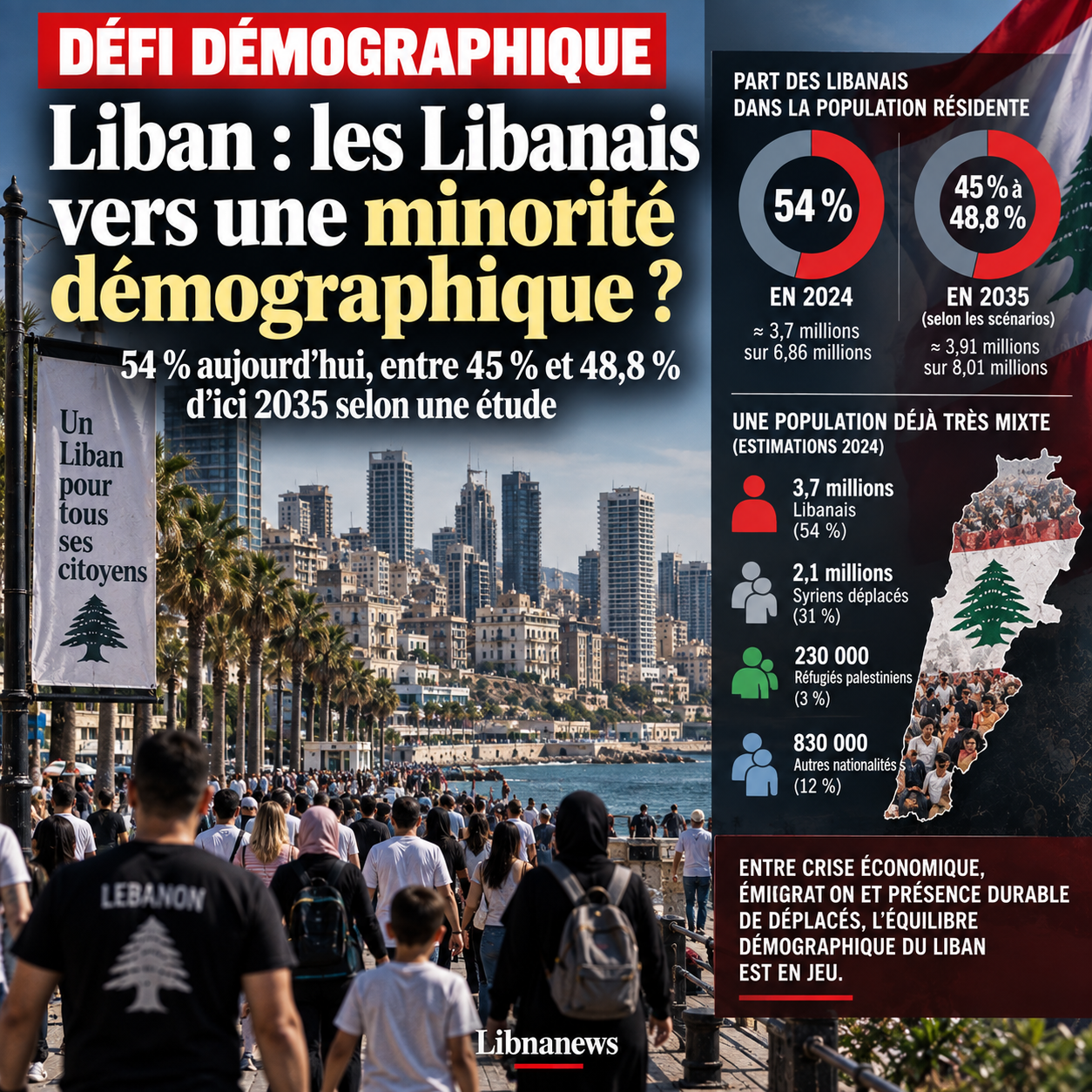
Lebanese nationals would already represent only about54% of people living in Lebanonaccording to a demographic study published in 2026, which reconstructs the population of the country from several statistical bases. More worrying for the demographic structure of the country, its projection by 2035 brings the share of Lebanese45% and 48.8% of the resident population. However, these figures should be read as estimates based on demographic assumptions, not as the results of a new national census.
A 54% threshold that would have already been met
The54 %does not describe, strictly speaking, a development that will come soon. An estimate for 2024 shows this.
The study then estimates the total population in Lebanon at about6.86 million people. It considers that3.7 millionthe number of Lebanese residents. The relationship between these two values places Lebanese citizens around 54 per cent of the population living in the territory.
The rest of the population is estimated to be about2.1 million displaced Syrians, of230,000 palestinian refugeesand about830,000 persons belonging to other nationalities.
This photograph should be interpreted with caution. Lebanon does not have a recent general census to accurately determine the number of residents according to their nationality. The different administrations and international organizations work with methods, reference periods and categories that are not always the same.
It is precisely this statistical weakness that explains the sometimes considerable differences between the figures available.
Lebanese could fall below 50% by 2035
The central element of the projection concerns the year2035. If the assumptions were made, Lebanese citizens would become a minority among the inhabitants of the country.
The study projects a total population of about8.01 million people in 2035. In the scenarios presented, the proportion of Lebanese would fall between45% and 48.8%.
The number of Lebanese would reach about3.91 millionin one of the assumptions. The displaced Syrian population could approach2.91 millionif it leaves a base of 2.1 million and progresses at the annual rate adopted by the author. Palestinian refugees would reach about283,000 personsin the same future year.
These values are not a definite forecast. They depend directly on the assumptions used: the evolution of births and deaths, the emigration of Lebanese, the return of Syrians to their country, new arrivals, departures of foreign nationals and changes in migration policy.
A significant change in one of these parameters could therefore significantly change the trajectory by 2035.
Official figures that do not give the same photograph
The difficulty is reinforced by the coexistence of several estimates.
The data published by the Lebanese Ministry of Health thus estimate the Lebanese resident population at about4.07 million in 2025. This series is based on the results of the latest reference survey of the Central Statistical Office and subsequent estimates.
The response plan for Lebanon, for its part, includes a planning figure of3.864 million Lebanese for 2026. It also considers that1.12 millionthe number of displaced Syrians present in the country.
The difference with2.1 million Syriansused as a basis in the demographic study is major. It shows why it is impossible to present the 54 per cent figure as an indisputable result.
The latest international data also indicate significant returns to Syria. In 2026, the Lebanese government estimates the number of Syrian refugees living in Lebanon at about 1.12 million. Several hundred thousand returns had already been recorded or estimated after the changes in Syria.
These movements can rapidly change the relationship between Lebanese and non-Lebanese populations. They also make it more fragile any projection based on a scenario that presupposes the sustainable maintenance of a high stock of displaced persons.
Why Lebanese Demography Retracts
Beyond the presence of foreign populations, Lebanese dynamics are the other part of the equation.
The decline in births is clear. Health statistics show that the number of Lebanese live births registered in hospitals has dropped from69 380 in 2017 to 49 859 in 2025. The decrease thus exceeds 28% in eight years for this hospital series.
The economic crisis triggered in 2019 also accelerated departures, especially among the active and young graduates. Even when emigration is not permanent, it reduces the number of Lebanese actually present in the territory at some point.
In the longer term add aging. The demographic projection studied envisages amedian age of 38 for Lebanese in 2050and a portion of the age 65 and over up to25 %.
This would have a direct impact on the labour market, health expenditure, pensions and social protection mechanisms. A smaller labour force should support a higher proportion of older people.
The demographic problem is therefore not limited to a comparison between Lebanese and foreigners. It also concerns the internal structure of the Lebanese population, its renewal and its ability to maintain its assets in the country.
The determining weight of Syrian returns
The most likely variable to upset projections remains the Syrian presence.
The scenarios developed from a high number of Syrians and a lack of massive return produce a mechanically rapid decrease in the proportion of Lebanese. Conversely, large and lasting returns to Syria would significantly change the calculation.
This dynamic has already changed since the fall of Bashar Al-Assad’s regime in December 2024. Return movements accelerated in 2025 and 2026, although the security, economic and humanitarian situation in Syria continues to determine the ability of families to resettle there in a sustainable manner.
The Lebanese Government has made the return of internally displaced persons a priority. But measuring the phenomenon remains complex. Border crossings do not necessarily represent definitive returns. Some families maintain ties, housing or income sources on both sides of the border.
Therefore, a projection until 2035 must be reviewed regularly as new data become available.
No recent census to decide
Finally, the Lebanese demographic debate suffers from an old weakness: the absence of a modern general population census.
This situation obliges researchers, administrations and international organizations to cross surveys, administrative registers and sectoral estimates. Each base meets a particular objective and does not necessarily measure the same population.
There are also three concepts that are often confused: Lebanese citizens, Lebanese residents and all those living in the territory. A Lebanese resident living abroad remains a Lebanese citizen but is not part of the resident population. Conversely, a refugee or foreign worker living in Lebanon belongs to the present population without Lebanese nationality.
The54 %is therefore relevant as a result of a determined demographic estimate, but cannot be transformed into an official and definitive proportion.
Nevertheless, the trend highlighted remains important: the low Lebanese birth rate, emigration, ageing and the long-term presence of a large non-Lebanese population can reduce the proportion of citizens among residents. The extent of this trend will now depend mainly on the departures and returns of the population, the economic development of Lebanon and the path of Syrian internally displaced persons over the next few years.