

A jar of Beit Chabab for food supplies, a dish modelled in Assia, a piece created in a workshop: Lebanese pottery covers different objects and know-how. Their transmission depends not only on the preservation of the parts. It is also based on access to land, control of cooking and learning of gestures. From family collections to university research, several documents allow us to follow these paths without reducing them to a unique tradition.
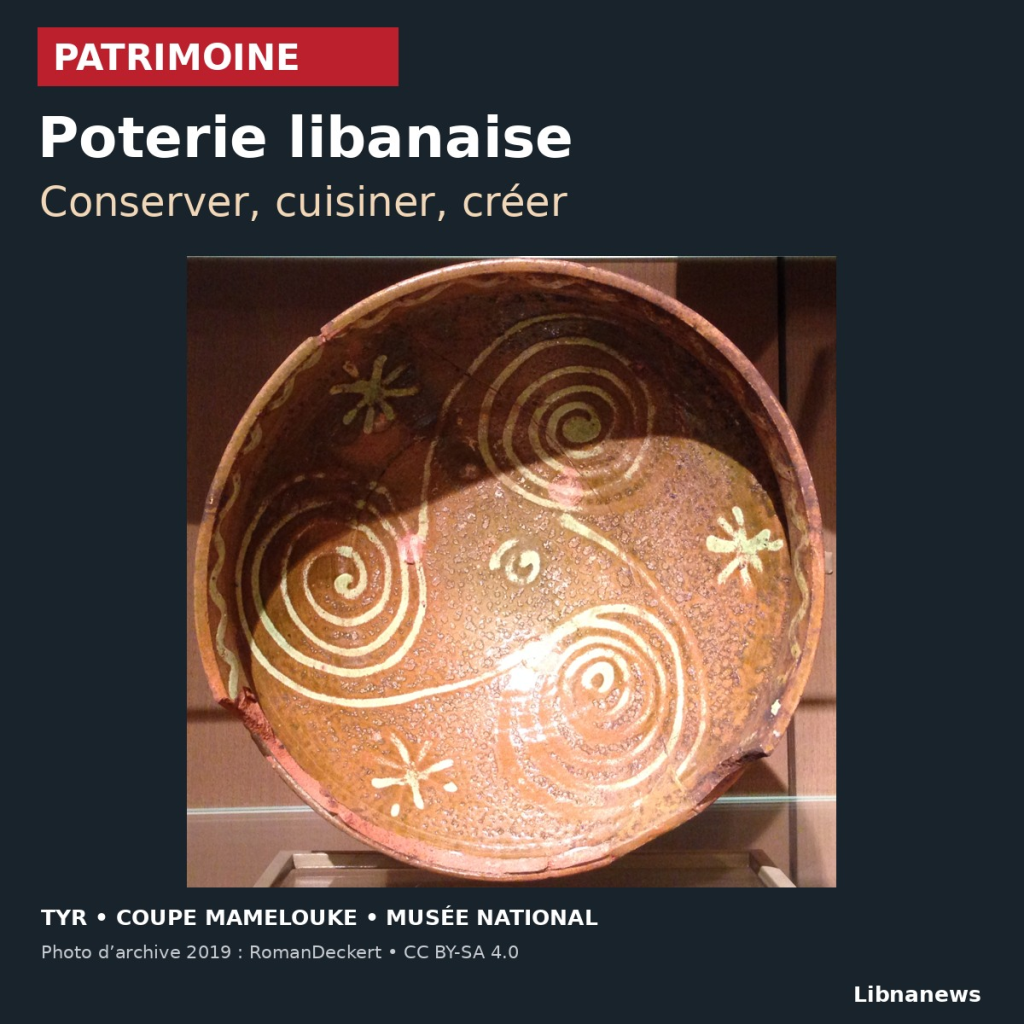
A glass of glazed terracotta from Tyre, photographed at the Beirut National Museum in 2019, recalls the archaeological dimension of this heritage. The play is attributed to the Mamluk period. It provides information on an ancient object; It alone does not demonstrate a direct connection with contemporary workshops. Distinguishing parts, their provenances and manufacturing gestures avoids turning several stories into a uniform narrative.
In Beit Chabab, a jar preserves a family history
The Lebanese Ministry of Tourism presents a dakoujeh, a terracotta jar from Christopher Ghoussoub’s collection. His great-grandfather made it in 1960. The family has been kept since that date. The young potter is now guarding it as part of his work around the tradition of Beit Chabab.
The ministerial notice places the piece at the United Nations Food and Agriculture Organization Museum in Rome. It describes a rounded body, a narrow collar and thick walls. Wood cooking traces and small irregularities distinguish this object from a uniform industrial production.
Dakoujeh belongs to a family of containers associated with domestic reserves: cereals, olives, dairy products or marinated foods. This destination explains its place in the history of kitchens. It is not a current food conservation policy. The heritage interest of this jar is also due to its documented provenance: a craftsman, a date and a family transmission.
In Assia, pottery forms without a tower
In the district of Batrun, Assia offers another example. The Mediterranean inventory iHeritage describes a manual manufacture, without potter tower. The paste combines local clay with ground quartz. Before modelling, the preparation work removes the undesirable elements present in the material.
Air drying precedes polishing with pebbles. These steps show a know-how that exceeds the only form of the container. You have to prepare a dough, judge its consistency, build the object and wait before cooking it. The manufacturing time therefore includes phases where the craftsman cannot simply accelerate his gesture.
The inventory highlights a long-overdue transmission from mother to daughter. He also describes an artisan who taught her husband and her sons this practice. This learning shift shows how a tradition can continue without exactly replicating its old family organization. However, the notice does not provide an updated census of the workshops in operation as of 18 November 2026.
Rashaya al-Fukhar, forms that have circulated
In the southwest of Mount Hermon, Rachaya al-Fukhar gives its name to a family of ceramics studied by archaeologists. The Levantine Ceramics Project describes turned, painted and glazed objects. Forms include beaked jugs, jars and bowls. Geometric decors and colours vary according to periods and pieces.
These productions did not remain confined to the village. The scientific base reports their presence in Lebanon, northern Israel and northern Jordan. It distinguishes late ensembles, particularly associated with the 19th and 20th centuries, from older forms attested to in the late 15th or early 16th centuries.
The name of this family does not guarantee the precise origin of each object. Analyses of ancient fragments identified several production workshops. A resemblance of shape or decor is therefore not enough to attribute a whole series to the same village. Researchers cross the appearance of the pieces, their discovery context and the composition of their dough.
From the kitchen object to the ceramic workshop
The International Ceramic Academy distinguishes the fakhar utility from the workshop ceramic, developed in Lebanon from the 1970s. In the first case, the forms meet the needs of the table and storage. In the second, artists can produce unique pieces without food function.
This distinction is not limited to final use. Materials and equipment also differ. The Academy notes that ceramists use imported commercial pasta, including sandstone or porcelain, for high temperature cooking.
His project on Lebanese clays brings together artists, industrial skills and laboratories from the American University of Beirut. It aims to study and adapt local resources to the needs of sculpture and workshop ceramics. This is a documented technical objective, not evidence that all workshops already have a substitute for imported products.
Transmitting a gesture implies being able to produce
A university work by Haloren Mellendorf, deposited at the American University of Beirut in 2023, examines precisely the effects of the crisis on workshop ceramics. It is concerned with the cost of imported materials, electricity expenditure and cuts that complicate the use of furnaces. Its object is also social: who can still access this practice and how do constraints transform working methods?
These issues prevent the complete separation of heritage and production conditions. Keeping a jar in a collection preserves an object. Maintaining a workshop requires other means: suitable material, usable equipment and people able to transmit their experience. Both approaches complement each other, but none replace the other.
The 1960 jar preserved by the Ghoussoub family gives a material landmark to this story. In Assia, the description of the manufacturing stages keeps another dimension. In laboratories and workshops, the work now also focuses on the possibility of adapting available land to the forms that ceramists wish to create.





Comments