

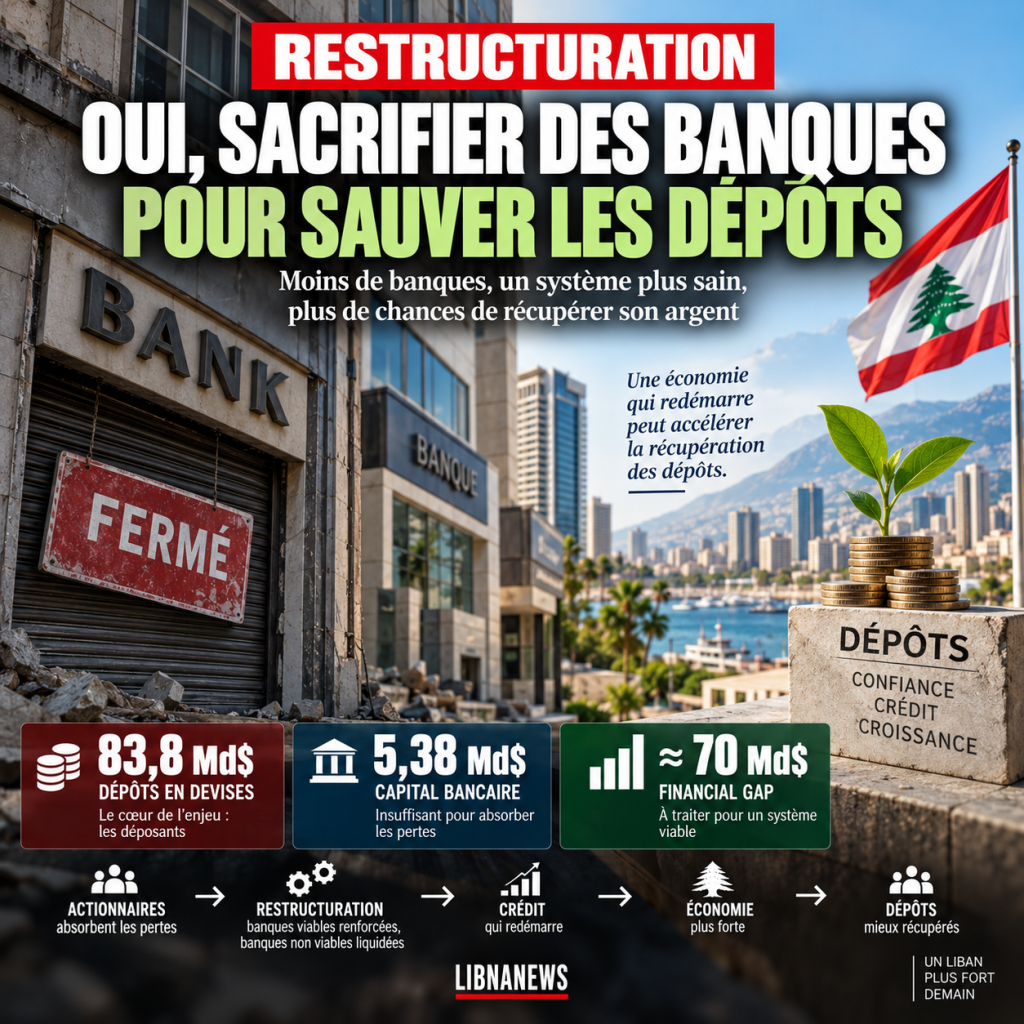
Why the bankruptcy of some banks does not mean the disappearance of deposits — and why economic recovery can speed up their recovery
Since 2019, the Lebanese debate has been trapped in an equation that seems simple: if banks fall, deposits fall with them. Banks should therefore be safeguarded to safeguard savings. Seven years later, this equation resists the facts. Banks have been kept alive, their licences have been preserved and most property structures have remained in place, but a considerable part of the old dollar deposits are still not freely available. Lebanon therefore saved the institutions without restoring the banking function that first interested the depositor: to dispose of his money.
Perhaps the problem is that we continue to ask the wrong question. A bank, the banking system and deposits are not one and the same. The bank is a company owned by shareholders. Deposit is a customer’s claim on this business. The banking system is an economic infrastructure: it provides payments, collects savings, selects projects and turns this savings into credit. Preserving a particular bank is therefore not an economic objective in itself. Preserving the financial functions essential to the economy, yes.
The real question then becomes much more uncomfortable: should all banks in 2019 be artificially maintained, or accept that some disappear if it maximizes what depositors will recover, re-circulates credit, and regains strong enough growth to increase the capacity to repay? Arbitrage may no longer be between the bankruptcy of banks and the safeguarding of deposits. It is between the preservation of banking capital yesterday and the creation of wealth that will make it possible to repay depositors tomorrow.
An overview of the crisis
As of July 2026, commercial banks still carry approximately $62.6 billion in resident deposits in foreign currencies and $21.2 billion in non-resident deposits in foreign currencies, which is close to $83.8 billion in total if Bank of Lebanon data are converted to the book rate of £89,500 per dollar. These are not dollars available in the safes. They represent a liability: what banks still owe to their customers.
On the other hand, banks have about $75.2 billion in deposits with the BDL at the same rate. It would be incorrect to mechanically put the two figures in equivalent terms: a claim on BDL n-a neither the same maturity nor the same liquidity nor necessarily the same economic value as a dollar owed to a depositor. But the order of magnitude indicates where the heart of the problem lies. A huge part of the resources collected from customers was concentrated with the central bank.
This concentration did not arise with the crisis. As of 2019, the IMF noted that approximately 55% of bank assets consisted of BDL investments and an additional 14% of public securities. Nearly 69% of the sector’s assets were therefore exposed to the public sector. The banking system had gradually moved away from its traditional profession — to turn savings into loans to businesses and households — to become largely dependent on government and central bank returns.
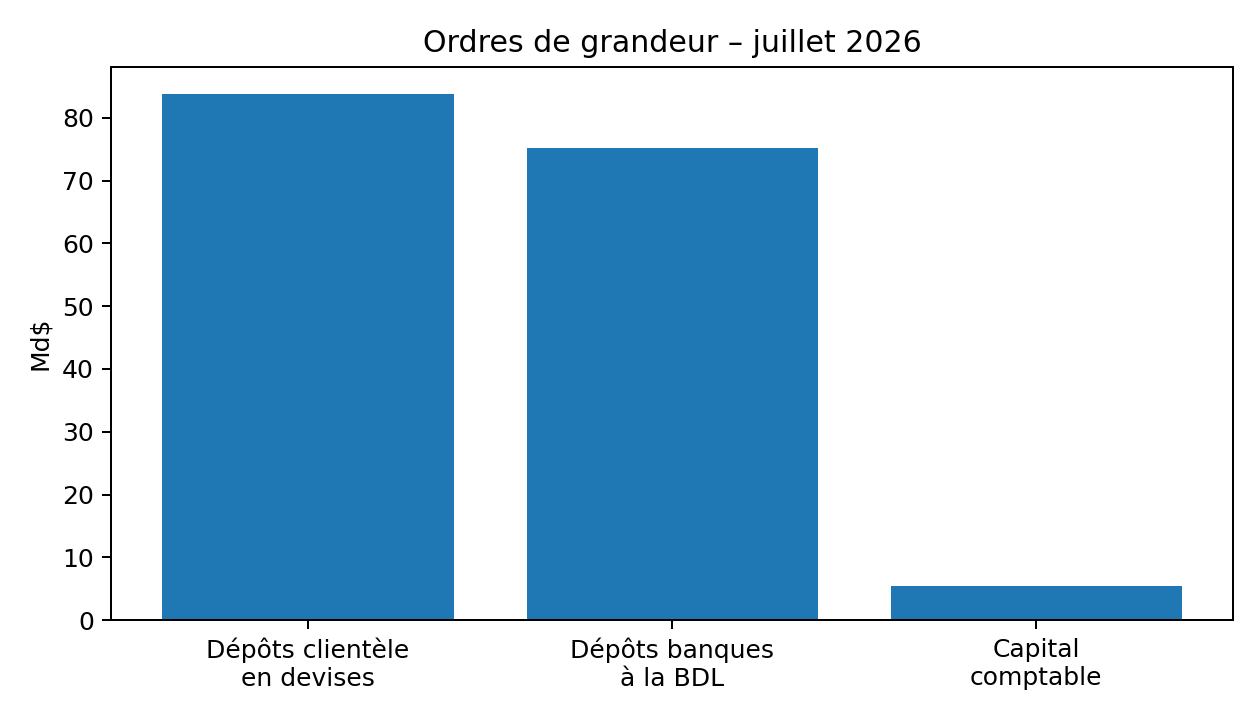
Figure 1 — BDL data, July 2026. Conversion to book rate of 89 500 LL/$.
| Indicator | Amount | Economic reading |
| Resident deposits in foreign currencies | $62.6 billion | Liabilities to residents |
| Non-resident deposits in foreign currencies | $21.2 billion | Liabilities to non-residents |
| Total customer deposits in foreign currencies | $83.8 billion | Nominal inventory recorded as liabilities |
| Bank deposits with BDL | $75.2 billion | Nominal asset to be valued economically |
| Consolidated accounting capital | $5.38 billion | First layer of loss absorption |
| Financial gap mentioned in 2026 | $70 billion | Order of magnitude reported at the end of September 2026 |
Unliquidity and insolvency: two notions that debate mixes
A bank may be illiquid while remaining solvent. It can own $10 billion in assets of good quality, but in the long run, faced with 9 billion debts. If several billion deposits are claimed immediately, it may lack cash without its net wealth being negative. The problem is then that of timing: assets exist, but cannot be quickly transformed into currency.
Insolvency is different. If the 10 billion in assets are worth only 7 billion in economic terms compared to 9 billion in commitments, the net value becomes 2 billion negative. Giving time doesn’t solve anything. Loss already exists; Only his accounting recognition was delayed. It is then necessary to determine who is absorbing, starting normally with capital.
That is exactly where the Lebanese problem lies. Banks continue to publish balance sheets in which their own funds remain positive. Bank Audi had approximately $1.15 billion in equity at the end of June 2026, BLOM had approximately 1.46 billion in the first quarter and Byblos also continued to publish positive equity. It cannot therefore be legally stated today that each of these banks is insolvent. But these figures do not yet answer the fundamental question: how much is the value of the Lebanese assets recorded in front of these own funds, and in particular the debt to the Bank of Lebanon?
Bank Audi provides a particularly telling example of the distortion of the banking profession. At the end of the first half of 2025, it had approximately $12.7 billion in customer deposits, but less than $1 billion in net customer loans, a ratio of just 7.6 per cent. At the same time, its liquidity and balances with central banks were close to $9.7 billion. In other words, the bulk of the balance sheet was no longer a bank collecting 100 to lend 60 or 70 to the economy: private credit was more than a fraction.
BLOM has the same anomaly in comparable proportions. In the first quarter of 2026, the group had approximately $15.9 billion in deposits for only $1.12 billion, or just 7% of deposits. However, the bank still issued $1.46 billion in equity. These own funds exist accountingly, but their final economic value necessarily depends on what the Lebanese assets will be worth once the financial gap is recognised and distributed. BLOM itself states that the absence of a final financial plan makes it very difficult to fully assess the impact of the crisis on its financial statements.
The case of Byblos leads to the same observation of caution. Its published accounts continue to show positive equity, but a predominant share of its assets remains cash and balances with central banks. At the end of June 2025, this item amounted to approximately £829,909 billion, while net customer loans amounted to only about $47,960 billion. Again, this is no longer the classic balance sheet of a bank whose main business would be to turn deposits into productive loans.
These examples do not allow individual decrees that Bank Audi, BLOM or Byblos today have a negative net value. They show something more important:their published solvency ratios are still based on valuations which do not constitute the definitive recognition of the system’s losses.It is precisely for this reason that a true assessment of the quality of assets, bank by bank, is indispensable. While the economic value of BDL claims is significantly lower than their book value, a few billion dollars of capital can disappear extremely quickly.
At the sector level, the calculation already gives an idea of the problem. Commercial banks have approximately $75 billion in deposits with BDL for only about $5.4 billion in consolidated accounting capital. An average depreciation of 10 per cent of this debt alone would amount to approximately $7.5 billion, more than the current total bank capital. This calculation does not prove that all banks are insolvent in the same proportions ; it shows why it is impossible to know their true solvency before having recognised the economic value of their assets.
But for illiquidity, it is no longer even necessary to do a simulation.She’s observable.
Since 2019, banks have not been able to return old dollar deposits to their customers. Even more revealing, when it comes to gradually returning a small part of these deposits under circulars 158 and 166, it is not even primarily commercial banks that provide the dollars.
The Bank of Lebanon itself recognized it in May 2026. For March alone, payments under Circulars 158 and 166 amounted to $240.4 million. The contribution of commercial banks was only 28.36 million, i.e11.8% of total. The BDL was therefore funding88.2 %protection caps (if present).
The observation is even more interesting when we look at the whole period. Until the end of March 2026, $6.109 billion had been returned to applicants under the two circulars. Of this amount, $4.183 billion had been financed by the Bank of Lebanon68.46 %against 1.926 billion, or31.54 %, financed by commercial banks. And the imbalance has worsened in recent payments.
The BDL explains that Circulars 158 and 166 now distribute more than$2.5 billion per yearand that these payments are financed from the minimum reserves of commercial banks deposited with it, which it itself describes as funds belonging « in law and in fact » to depositors. By the end of March 2026, 578,770 depositors had benefited from both devices and 266,166 had recovered the full balance from their respective special account.
This is an extraordinary economic situation. The depositor has a claim on Bank Audi, BLOM, Byblos or another commercial bank. But when the time comes to gradually return his money, most of the dollars no longer come directly from his bank’s own liquidity:the Bank of Lebanon now provides most of the disbursements.
The mechanism thus reveals the real chain of the crisis. The depositor had placed his dollars in his bank. The bank had placed a considerable part of it with the BDL. The bank is no longer able to return the deposit freely. The BDL then gradually returns part of the sums through the circulars, drawing in particular on the compulsory investments which the banks themselves had made with it.
Part of the consolidated balance sheet is therefore used.
This explains why presenting Circulars 158 and 166 as evidence that banks are gradually paying back their customers would be misleading. They effectively allow hundreds of thousands of applicants to recover dollars and play an important social role. At the same time, however, they demonstrate the continuing weakness of bank liquidity:if banks were normally liquid, they would not need the central bank to finance nearly nine dollars out of ten of the current monthly disbursements related to these schemes.
There is even an additional paradox. The BDL is gradually using resources such as minimum reserves to return to depositors a fraction of the money entrusted to it by banks. This mechanism provides essential liquidity for the economy, but it does not recreate the destroyed wealth. It gradually transforms a fixed asset with the central bank into cash delivered to the depositor.
This is why the distinction between illiquidity and insolvency becomes much less theoretical in Lebanon.Liquidity is already visible: banks cannot normally honour their deposits and the BDL provides most of the repayments organised by the circulars. Insolvency, however, will appear definitively bank-by-bank once the real economic value of the assets — including claims on the BDL — has been recognised.
And it is precisely this moment that bank restructuring cannot continue to push back.
A 10% discount would already be enough to exceed all accounting capital
The consolidated capital accounts of commercial banks reached approximately $5.38 billion by July 2026. In the face of this capital there are some $75.2 billion in deposits with the BDL. The ratio is such that a relatively low depreciation of this asset would in theory be sufficient to absorb all accounting capital.
An illustrative discount of 10% would represent about $7.5 billion in losses, already more than the 5.4 billion capital. At 20%, the theoretical loss would be around $15.0 billion; At 30%, 22.6 billion; at 50%, almost 37.6 billion. These calculations are not an estimate of final losses. A true Asset Quality Review must examine bank by bank the nature of the assets, their maturity, their guarantees and all liabilities. However, they show the extreme sensitivity of capital to the economic value of the claim on the BDL.
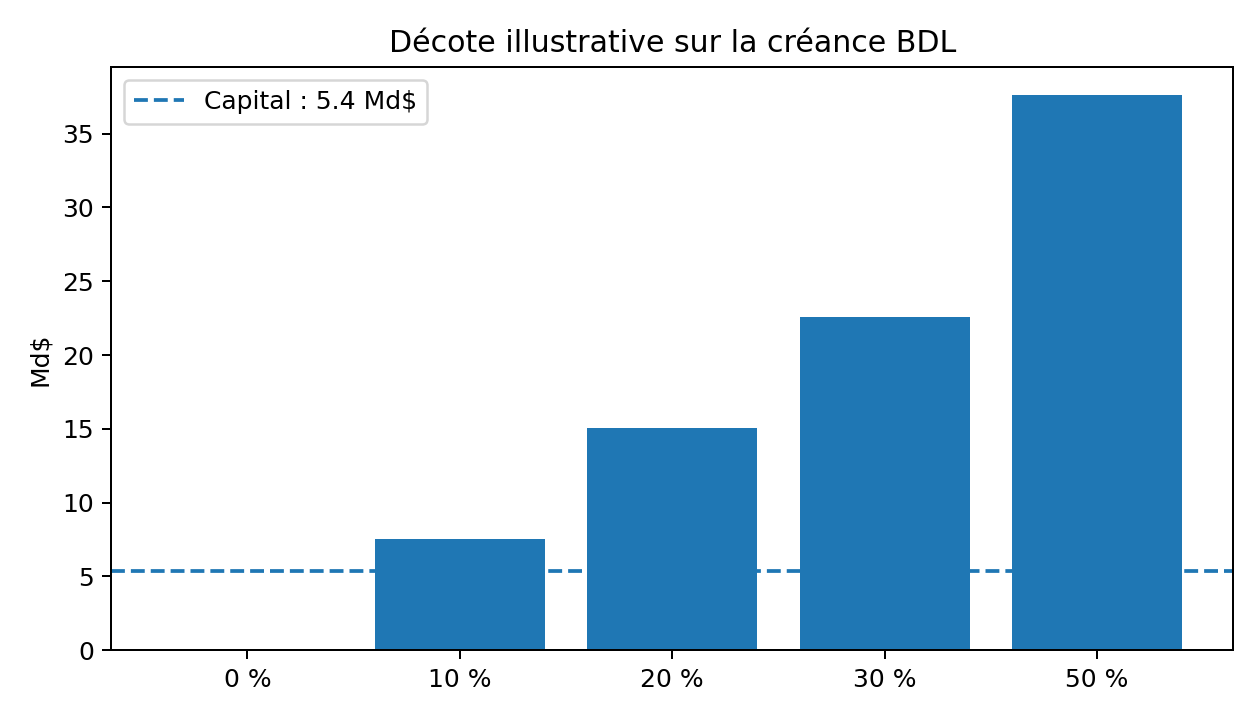
Figure 2 — Illustration simulation. This is not an estimate of definitive losses.
| Illustrative haircut | Theoretical loss | Capital ratio |
| 0% | $0.0 billion | — |
| 10% | $7.5 billion | 14 |
| 20 % | $15.0 billion | 28. |
| 30% | $22.6 billion | 4 2. |
| 50% | $37.6 billion | 7. |
Capital is precisely made to be lost before deposits
The shareholder is not a depositor. He owns the company and accepts a leading risk in exchange for the right to residual profits. When the bank earns money, it receives dividends and appreciation of its participation. When losses arise, the mechanism must operate in the other direction: capital absorbs losses before higher-ranking creditors.
The IMF reiterated this principle in September 2026: the hierarchy of claims must be respected and no depositor must absorb losses before shareholders and junior creditors. This does not guarantee that all deposits will be 100% refunded. This means that we cannot begin by reducing the depositor’s claim in order to preserve the value of the bank owner.
Real restructuring therefore raises a question of ownership. If, after revaluation of assets, a bank has negative economic capital, the former shareholders can be fully diluted. New investors can take control. A merger may occur. Healthy assets can be transferred to a relay bank and assets degraded to a resolution structure. In the extreme case, the bank can be liquidated. What then disappears is the company’s value to its owner, not automatically the applicant’s claim.
This is also what makes it possible to understand the resistance to restructuring. Any opposition to a particular plan is not necessarily sabotage: a plan can be technically bad, over-transfer losses to the taxpayer or misprotect depositors. But there is a clear conflict of interest. For the applicant, delaying the restructuring means waiting longer and facing an opportunity cost. For the shareholder of a bank whose capital could be reduced to zero, delaying the recognition of losses retains one option: to remain the owner of an asset that might otherwise escape it.
A bank can disappear without the deposit disappearing
The liquidation of a bank does not burn its balance sheet. Buildings still exist, loans to businesses and households continue to exist, participations can be sold, external assets can be recovered and claims on BDL remain receivables, even if their value has to be revalued. A resolution procedure is used precisely to separate what is still viable from what is no longer viable and then to organize the distribution of available assets according to a given hierarchy. The bankruptcy of the banking company and the loss of deposit are therefore two different events.
This is precisely why modern banking resolution systems have several instruments to protect depositors without necessarily saving their bank’s shareholders. The simplest is to transfer deposits, accompanied by a sufficient amount of assets, to another sound bank. For the customer, the name of the bank may change, the former shareholders may have lost everything, but the account continues to exist in the new establishment. Another possibility is the creation of a bridge bank, which is temporarily capitalised and responsible for taking over the deposits and essential activities while the assets of the former bank are liquidated or restructured.
At the same time, the most difficult assets to recover can be isolated in a management structure, sometimes called bad bank. This structure, for example, keeps long-term receivables, equity, real estate or receivables from other institutions and realizes them progressively, rather than selling them immediately at broken prices. The sums recovered over the years then increase what can be distributed to the creditors of the old bank. The liquidation therefore does not necessarily involve the forced sale of all the assets within a few weeks.
To this normally adds the deposit guarantee. Since 1967, Lebanon has had an institution to guarantee bank deposits, the National Institution for the Guarantee of Deposits. The problem is that the Lebanese guarantee has historically been designed for the one-time bankruptcy of a bank, not for a systemic crisis in which virtually the entire banking sector and the central bank are simultaneously affected. No reasonably capitalized guarantee fund alone can return several tens of billions of dollars. This does not make the principle unnecessary: it means that it must be integrated into a much wider resolution.
The protection of depositors can thus function in stages. Small deposits may benefit from enhanced protection or a priority refund; the capital of the shareholders is absorbed before deposits according to the hierarchy of claims ; the bank ‘s available assets are recovered ; healthy deposits and assets may be transferred to a viable establishment; long-term assets continue to produce repayments; Finally, for the part of the liability that cannot be immediately covered, long-term claims may be issued rather than immediately finding a permanent loss.
This latter distinction is important. A depositor with $500,000 in a liquidated bank is not necessarily faced with a binary choice between recovering $500,000 immediately or losing everything. It could, according to the mechanism finally adopted, recover a first instalment quickly, retain a debt on a resolution structure for a second part and possibly receive a financial instrument corresponding to the balance. The economic value of these different components will obviously depend on their maturity, yield, guarantee and the quality of the assets in front.
That is also why the issue of $100,000, which is central to Lebanon’s deposit return projects, must be properly understood. Protecting up to $100,000 does not necessarily mean that anything above must be erased. The threshold may determine the amount benefiting from a faster repayment or special protection, while the remainder remains a debt whose repayment will depend on the recovered assets and future flows. Consolidating the priority guarantee and the absolute recovery ceiling would be tantamount to considering an asset that can still produce value for 10 or 20 years.
Finally, there is an even more fundamental protection mechanism:loss hierarchy. Before asking the depositor to abandon part of his claim, it is necessary to determine what remains of the bank’s capital and subordinated instruments. The IMF insists on this point in the Lebanese case: shareholders and junior creditors must absorb losses before depositors. The protection of the applicant therefore begins not with a public subsidy, but with the normal application of the financial hierarchy.
This hierarchy also helps to avoid a particularly dangerous mistake: to use massively State money to preserve deposits and shareholders simultaneously. The state may potentially intervene in a system where financial stability so requires, but a public recapitalisation that maintains private capital intact would mean transferring losses to taxpayers. Taxpayers are, to a large extent, the same households and businesses that are supposed to be protected. The loss would not have disappeared; She would simply have changed her balance sheet.
We must therefore distinguishprotect the applicantandimmediately guarantee every dollar of each deposit with public money. These are not the same policies. Protecting the depositor is to maximize the value it will recover by successively using bank capital, recoverable assets, resolution mechanisms, deposit guarantee and future flows. Guaranteeing all deposits by the State indiscriminately could instead create a huge public debt and jeopardize future growth, which must contribute precisely to their repayment.
Lebanon has done almost the opposite since 2019. He kept the banks while immobilizing the deposits. The signs survived, but the essential function of the deposit — to be able to dispose of his money — was profoundly altered. Seven years later, this experience shows that legally preventing a bank from disappearing does not necessarily protect its depositor.
A true banking resolution would accept the opposite principle:the bank may die, its shareholders may lose their capital, but the deposit must be protected as far as possible by all available assets and mechanisms. It is precisely because the fate of the bank can be separated from that of its depositor that the disappearance of certain Lebanese establishments must no longer be presented as a synonym for the disappearance of savings.
Billions of capital on paper, but how much real capital?
Finally, there is a fundamental distinction between the bookkeeping or nominal capital displayed by a bank and its real economic capital. This is probably one of the keys to understanding why Lebanese banks can continue to publish positive equity while the issue of their solvency remains complete. Nominal capital is essentially the result of an accounting subtraction: assets recorded on the balance sheet minus liabilities. Real capital depends on whether these assets are actually worth taking into account their risk, liquidity, maturity and the likelihood that they will actually be recovered.
Let’s take a bank with $10 billion in assets, $9 billion in liabilities and a billion in equity. Accountably, its capital is positive: a billion. But let us assume that two billion of its assets consist of debts whose real economic value is only one billion. The adjusted balance sheet no longer contains 10 billion assets but 9 billion. The billion capital is gone. If these assets are finally worth only 800 million, the economic capital becomes 200 million negative while, until the depreciation has been recognised in the accounts, the bank can continue to have one billion own funds.
It is precisely for this reason that the figures published by the Lebanese banks must be handled with great caution. Bank Audi can have more than one billion dollars of equity, BLOM about 1.5 billion and other institutions positive accounting capital. These amounts are significant legally and accountingly, but they alone do not allow the actual economic value of capital to be known. This depends directly on the value to be attributed to BDL claims, public securities, other Lebanese assets and the various liabilities on the balance sheet.
The problem appears immediately when comparing orders of magnitude. At sector level, about$5.4 billion in book capitalface some$75 billion in deposits and investments with the Bank of Lebanon. This means that capital accounts for only about 7% of this exposure. An average economic depreciation of 7-8 % of this item alone would theoretically be sufficient to absorb all accounting capital in the sector, all other things being equal. At 10%, as we have seen, the loss would amount to about $7.5 billion, which is already more than the recorded equity.
This is where the whole difference betweennominal capital and real capital. The first is observable in the financial statements. The second will only be truly known after a credible assessment of asset quality and recognition of losses. As long as this transaction has not taken place, asserting that a bank owns $1 billion in capital amounts to saying that it owns $1 billion in capitalthe book values held in its balance sheet. This is not necessarily the same as having a billion dollars of net wealth immediately available to absorb losses.
A second distinction should be added:capital and liquidity are not interchangeable. Even if a bank actually owns a billion dollars of economic own funds, this does not mean that it owns a billion dollars of cash to pay its depositors. Capital theoretically measures the margin between assets and liabilities ; liquidity measures the ability to make payments when they become due. As a result, a bank can simultaneously display positive equity and be unable to return their dollars to its customers.
The current operation of Circulars 158 and 166 illustrates this difference perfectly. Large banks continue to display positive equity, but when former depositors gradually recover part of their dollars, most disbursements are not financed by banks’ own liquidity. In March 2026, the contribution of commercial banks to payments made under the two circulars represented only about11.8%against88.2 per cent for the Bank of Lebanon. As a result, we can have book capital on paper while clearly not having the necessary liquidity to normally honour our liabilities to depositors.
The situation becomes even more interesting when one wonders about the composition of capital itself. A bank may have a billion dollars of equity because its assets contain several billions of receivables recorded at certain securities. But if these claims can only be converted into fresh dollars with a significant discount or over a period of fifteen or twenty years, the present value of the capital is necessarily different from its face value. An asset of $100 repayable in 20 years is not worth $100 today, even if the debtor ends up paying in full. The future flow needs to be updated.
Let us take a voluntary, simple example. A debt of $100 repaid in 20 years is now worth only about $46 if a discount rate of 4% per year is used. At 6 per cent, its current value is around $31. At 8%, it is down to about $21. This obviously does not mean that 4%, 6% or 8% are the appropriate rates for valuing Lebanese debt; the rate would depend on the exact risk and characteristics of the instrument. The example simply shows whypromise $100 in 20 years is not economically equivalent to own $100 todayprotection caps (if present).
This issue is particularly important for the BDL debt debate. Even if it were decided politically that they would be reimbursed at 100% of their nominal value over a very long period, this would not mean that they are now worth 100% of their facial value. Their current economic value would be lower. However, it is this economic value, and not only the nominal promise of repayment, that determines the true capital of a bank.
This is also why a serious Asset Quality Review can produce much more severe results than the current financial statements. It does not only ask how many assets are included in the balance sheet ; She asks how much they really are worth. A bank with today 1 billion dollars of capital can, after revaluation, only retain 300 million. Another one can fall to zero. A third may have a negative net value and must be recapitalised or liquidated.
The nominal capital therefore protects shareholders until the losses are fully recognised.Real economic capital determines whether shareholders still own something.
This distinction also provides a much better understanding of the policy issue of restructuring. A revaluation of assets is not simply an accounting transaction. It can transform an officially capitalised bank into an economically insolvent bank. It can move a family participation worth several hundred million dollars to a value close to zero. It may impose a recapitalisation that transfers control of the bank to new investors.
That is precisely why the battle around loss recognition is also a battle around the future ownership of the banking sector.
And she brings back to the depositor. It has no economic interest in preserving purely nominal bank capital if it delays the recognition of losses, blocks restructuring and prevents the return of credit. Its interest is that the assets be valued honestly, that the capital actually available absorb its losses and that banks that no longer have economic capital be recapitalised or liquidated.
The real test is therefore not to know how many billions of own funds the Lebanese banks still have in their accounts. How many of these billions would remain if all their assets were valued at their real economic value.
Only after this operation can we really say which Lebanese banks are solvent, which must be recapitalised and which are no longer solvent.
A hole of about 70 billion against a capital of five billion
The discussions of 2026 continue to evoke a financial gap of about $70 billion to be distributed between the State, the BDL, the banks and, according to the system finally adopted, certain categories of creditors. Faced with this order of magnitude, the banks’ approximately 5.4 billion book capital seem obviously insufficient.
But this insufficiency is not an argument to protect capital. To say that shareholders cannot cover 70 billion losses does not mean that they must not absorb the first billions when their bank is insolvent. Capital is precisely there to form the first layer of creditor protection. The remainder must then be dealt with by a wider architecture: recoverable BDL assets, state capacity, possible long-term claims, asset recovery, future flows and resolution mechanisms.
Above all, it is necessary to emerge from a vision in which all banks are identical. Some may have more external assets, fresh capital or shareholders capable of remitting money. Others can be much more deeply insolvent. Good restructuring is not the one that saves everyone the same way. It is the one that quickly identifies viable establishments, recapitalizes those that can be and lets others disappear.
The real goal is not to save banks, but to restore credit
Seven years after 2019, the Lebanese banking problem can no longer be seen as a mere consequence of the economic collapse. It has become one of the main transmission mechanisms and one of the main internal brakes to recovery. A modern economy can hardly return to sustainable growth when its banking system no longer fulfils its intermediation function properly. This is precisely what has happened in Lebanon: banks still exist legally, but a large part of them operate with balance sheets over which old losses have been incurred, while bank credit to the economy has collapsed. They survive, but they no longer play the role a bank normally has to play in creating growth.
This is what is called a zombie bank: an institution that continues to exist but whose balance sheet is so fragile that it devotes most of its energy to its own survival rather than to financing the economy. The problem then far exceeds shareholders and depositors. When a bank no longer normally lends, a profitable company wishing to buy a machine, open a new factory, increase its inventory or finance its exports must find the necessary capital itself. A hotel that wants to add fifty rooms must have cash. A household that wants to buy a home can no longer rely on a real estate credit market. An SME with a good project but not enough equity may simply be unable to carry it out.
The result is an economy in which investment depends much more than elsewhere on the wealth already accumulated. Whoever owns the dollars can invest; who owns only one profitable project but needs credit remains blocked. This is exactly the opposite of what an effective financial system should allow. The economic role of a bank is precisely to shift the capital of those who have temporary savings to those who can use it productively. When this mechanism disappears, it is not only the credits that disappear: it is investments, businesses, jobs and future production that never emerge.
This situation also helps explain why the recovery in some Lebanese sectors can coexist with an economy that remains deeply constrained. Dollars flow, consumption exists, tourism and diaspora transfers bring foreign exchange, some companies invest in their own funds, but the mechanism for systematically transforming this saving into productive capital remains very weak. The economy works more on cash and self-financing. She can survive that way. She can even experience rebounds. It is much more difficult to find a real dynamic of capital accumulation.
This is where the cost of zombie banks becomes considerable. A company that is now giving up an investment of $1 million is not only losing $1 million to the economy this year. It also renounces the production that this investment would have generated next year, the wages paid, purchases made from other companies, future profits, possible exports and corresponding taxes. Part of this income would have been consumed or reinvested in turn. The initial loss therefore spreads over time. This is a potential growth problem, not just bank liquidity.
We understand why artificially maintaining insolvent banks can become much more expensive than liquidating them. Their disappearance immediately reveals a loss that already exists. Their maintenance simply makes it possible not to see it completely, but at the price of another much less visible loss: that of the wealth that the economy does not produce because its financial system remains paralysed. The first one appears in a balance sheet. The second does not appear anywhere, since it corresponds to companies that have never been established, investments that have never been made and incomes that have never existed.
It is this invisible loss that should now be confronted with the few billions of dollars of bank capital that are still being sought to preserve. The sector’s consolidated accounting capital amounted to approximately $5.4 billion as at July 2026. Even without purporting to accurately measure the potential GDP lost since 2019, the comparison of orders of magnitude raises an obvious economic question: how many billions of production, investment and income is Lebanon ready to sacrifice again to avoid recognizing the possible disappearance of some billions of bank capital?
The issue becomes even more important to the applicants themselves. A private credit economy is growing less rapidly; an economy that grows less rapidly generates less profit, less tax revenue and less savings; companies make it more difficult to repay their debts and assets remain less valued. All these phenomena reduce precisely the future resources that could be used to repay the old deposits. By seeking to preserve existing banks, Lebanon can paradoxically reduce the future capacity to repay its own depositors.
This is why bank restructuring should no longer be seen only as an operation to allocate losses in 2019. It is also a growth policy. A truly insolvent bank that disappears frees the possibility of transferring its healthy assets, bringing in new investors and rebuilding around them an institution capable of lending. A viable but undercapitalised bank can be recapitalised. Another can merge. In each case, the criterion should be the same: Is the institution that comes out of the restructuring able to finance the economy again?
Lebanon therefore did not necessarily need the same number of banks as in 2018. He needs banks that are really banks. Ten or fifteen solid, liquid and properly capitalised institutions can be much more economically useful than several dozen institutions unable to normally turn deposits into credits. The size or number of the banking sector is not a measure of its quality ; its ability to allocate capital effectively is much more.
Moreover, the IMF is reasoning in this light when it stresses the need for a viable banking system to emerge from restructuring, capable of restoring confidence and financial intermediation. The goal is not to reconstruct the banking landscape before 2019. This landscape was precisely part of the model that led to the crisis. The aim must be to build a system capable of financing the economy that will come after it.
And that is where restructuring directly links the issue of deposits. The faster the credit returns, the faster the investment can return. As investment increases, the stock of productive capital increases. The more this capital generates, the more revenue, profits and tax revenues grow. The more businesses become solvent, the more valuable the assets held by banks are. And as this value increases, the more resources available to progressively honour the old claims of depositors can increase.
Maintaining zombie banks is therefore not a neutral way to expect a better solution. Each year of waiting can destroy part of the growth that would have made this solution less painful.
It is this mechanism that must be put at the centre:bank restructuring is no longer only necessary to resolve the banking crisis. It has become a condition for exiting the economic crisis itself.
Growth is part of the deposit repayment mechanism
This is the most important and probably least well integrated point in the debate. Growth is not only after bank restructuring. It can directly accelerate the recovery of deposits. A company that owes $10 million to a bank may, in a recession economy, be able to repay only 5 or 6. If its turnover and profits increase thanks to the recovery, the same claim can gradually recover a value of 8, 9 or 10 million. Growth then increases the value of bank assets without artificial currency creation.
The same mechanism applies to real estate, equity and public debt. A more dynamic economy improves the solvency of private debtors, increases the liquidity of certain assets, broadens the tax base and improves the state’s ability to meet its commitments. The restructured banks can start generating profits again. New savings return to the system. All these flows increase, directly or indirectly, the capacity to serve the commitments inherited from 2019.
Stock and flows must therefore be distinguished. Restructuring processes a loss stock: it determines what is worth the existing assets and which absorbs the difference. Growth creates new flows: profits, wages, exports, tax revenues, credit refunds and savings. We cannot erase the losses of the past through growth, but we can greatly increase the capacity to repay what remains due.
A liability of 20 billion does not have the same weight in a saving of 30 or 50 billion
Let us take a voluntary, simple example. Suppose that, after recognition of losses, mobilization of capital and recovery of some of the assets, $20 billion of depositors’ claims remain to be fulfilled gradually. In an economy producing $30 billion a year, this liability represents two thirds of a year of production. If the economy remains at 30 billion for ten years, its relative weight changes little.
With 3% annual real growth, an economy is about 34% larger after 10 years. With 5%, it is about 63% larger. A savings of 30 billion would thus reach around 49 billion after ten years at 5%. The same nominal liability of $20 billion would then represent only about 41% of a year of production, even before taking into account repayments already made during the period.
GDP is obviously not a fund in which you can take 20 billion to pay depositors. This calculation shows something else: the ability to bear a liability depends on the size of the income that supports it. A larger economy generates more tax revenues, profits, savings capacity and loan repayments. Old liabilities become progressively easier to absorb.
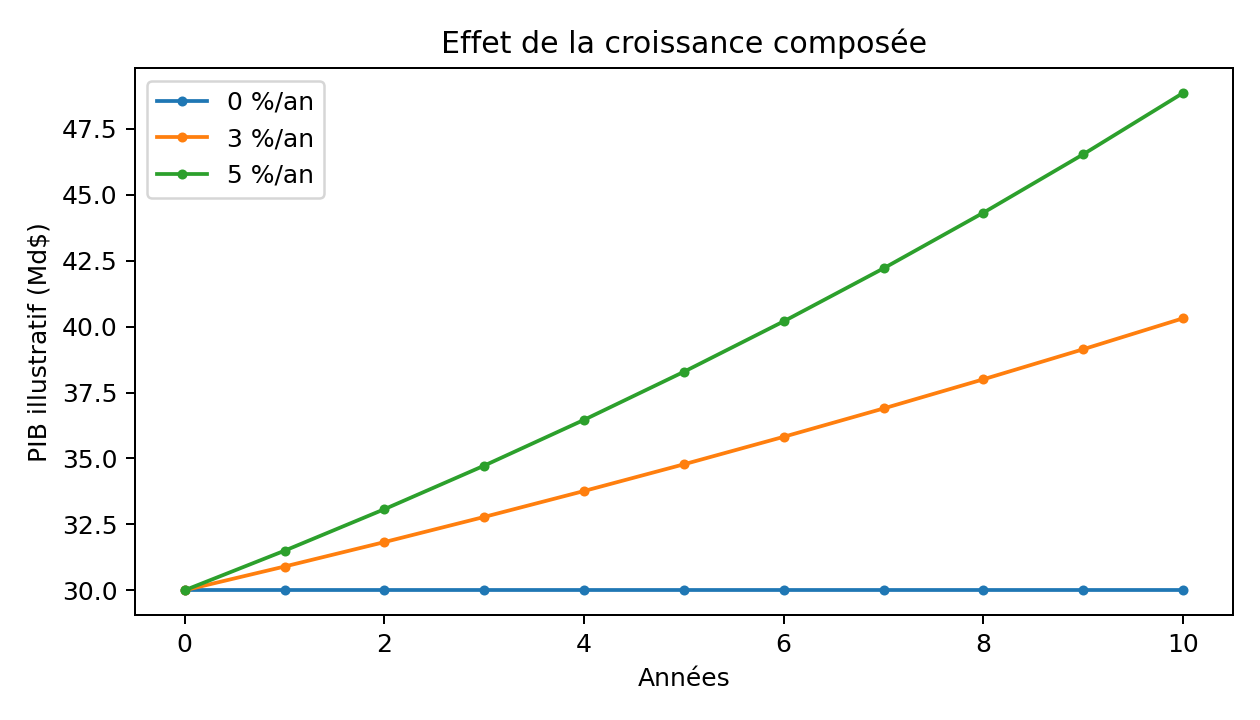
Figure 3 — Illustration simulation from an initial GDP of $30 billion. This is not a forecast for Lebanon.
| Annual real growth | GDP after 10 years (base $30 billion) | $20 billion in liabilities/GDP |
| 0% | $30.0 billion | 66.7% |
| 3% | $40.3 billion | 49.6% |
| 5% | $48.9 billion | 40.9% |
Each year of stagnation also costs depositors money
The cost of the status quo is not only measured by the number of years of waiting. A dollar recovered in 2035 does not have the same value as a dollar available today. The applicant loses the return he could have obtained, the investments he could have made and the use of his capital. Even a full nominal refund after a very long period can therefore be a substantial economic loss.
But the cost is also collective. Every year the credit remains marginal means companies that do not invest, hotels that do not grow, machines that are not purchased, housing that is not funded and projects that do not emerge. These investments would have generated future revenues that, in turn, would have generated repayments of loans, profits, savings and tax revenues.
This is where the opportunity cost of banking blockage becomes potentially huge. Some growth points lost each year do not simply add up: they are composed. By delaying the restructuring to avoid seeing certain losses today, the country can tomorrow destroy a quantity of wealth greater than that it seeks to preserve.
Saving a bank can therefore cost the depositor more
Let’s imagine two trajectories. In the first, the insolvent banks are artificially kept alive, the former shareholders are kept and the depositor is promised a high nominal recovery, but spread over 15 or 20 years in an economy where credit remains low. In the second, losses are recognized quickly, shareholders are erased when their capital is destroyed, non-viable institutions are liquidated or merged and surviving banks are recapitalized to resume lending.
The second trajectory may seem more brutal at the start. However, it may be more favourable to the applicant. Receiving 70% relatively fast can have a present value greater than a promise of 80% in 20 years. Above all, if rapid restructuring restores credit and accelerates growth, the value of recoverable assets increases and new flows appear. The relevant comparison is therefore not only 70 against 80. It is 70 today more an economy that restarts, compared to 80 hypothetical in a immobilized economy.
| Illustrative scenario | Nominal promise | Deadline | Economic reading |
| Rapid restructuring | 70% | Shorter | Higher present value possible + credit return |
| Prolonged status quo | 80% | 20 years | Potentially lower present value + lost growth cost |
New capital must finance tomorrow, not just repair yesterday
Lebanon will need new capital to rebuild its banking system. But every fresh dollar absorbed indefinitely by old losses is a dollar that does not finance a new business, a factory, a hotel, an infrastructure or a technology company. Restructuring must therefore establish a boundary between the past and the future.
Part of the assets inherited from the crisis can be isolated in vehicles that are responsible for their recovery over time. Sustainable banks have to go back on balance sheets that are clean enough to finance new projects. The country cannot wait for the repayment of the last dollar of 2019 before starting again to finance 2027, 2028 or 2030. We must simultaneously manage the stock of old losses and create new wealth flows.
The real chain of the problem: depositor, bank, BDL, State
Finally, the Lebanese problem is more complex than ordinary bank failure because there is a chain of claims. The depositor has a claim on his bank. The bank has a massive debt on the BDL. The BDL owns its own assets but also has the consequences of past monetary policies, while part of the problem refers to state financing and sovereign debt. The loss cannot therefore be properly analysed by looking only at the balance sheet of commercial banks.
This explains why a serious solution has to articulate four balance sheets: that of the depositor, that of the bank, that of the BDL and that of the State. Artificially transferring loss from one to another does not make it disappear. Making the state pay indiscriminately can turn a bank loss into a public debt and therefore into future taxes. Paying the depositor before the shareholder reverses the risk hierarchy. To recognize nothing simply maintains debts at values that do not necessarily correspond to their economic value.
The challenge is therefore to allocate losses consistently while preserving the country’s future productive capacity. A solution that pays more back today but destroys public finances and prevents growth can ultimately reduce what depositors will recover tomorrow. Conversely, a solution that protects the state and banks so much that it imposes an excessive and immediate loss on depositors destroys trust and savings. Arbitration must be intertemporal: maximize total recovery, not simply move loss to the next balance sheet.
What needs to be saved is Lebanon’s ability to create wealth
Lebanon still has a considerable diaspora, skills, services, tourism, entrepreneurs, universities and a capacity to attract capital if a credible framework is restored. These elements are not slogans. They represent the productive basis from which new flows of currencies, profits and savings can be generated.
This is why bank restructuring must be seen as a growth policy as well as a policy of loss resolution. It must free up credit, restore confidence in payments, allow capital to return and give companies sufficient visibility to invest. A sound bank in an economy that is not growing will remain limited. An economy that grows without a functioning financial system will also remain fragmented. Both must be rebuilt together.
So the choice is not between saving banks or losing deposits. In some cases, the choice can be exactly the opposite: preserving insolvent banks at all costs can prolong the immobilization of deposits, prevent the return of credit and reduce the growth that would allow them to be repaid. Accepting the disappearance of some banks, the loss of their shareholders and the arrival of new capital can instead accelerate the reconstruction and increase the value recovered by depositors.
After seven years of crisis, time must also enter the accounts. Past losses must be recognized. Shareholders must absorb those corresponding to their rank. Sustainable banks must be recapitalised and others must be able to disappear. But the ultimate goal cannot be to reconstruct the 2018 banking landscape. It must be to rebuild an economy capable of producing enough wealth so that deposits cease to be a promise frozen in a balance sheet and gradually become available money.
Ultimately, deposits will not be repaid faster by artificially retaining insolvent banks. They will be done by recovering the assets that still exist, by putting the losses first to those who had accepted the risk of capital, and then by putting credit, investment and growth back on track. If we have to sacrifice some banks to achieve this, the real question is no longer how to save them. It is about how much it costs to depositors and Lebanon to keep them alive.
Reading marks, sources and precautions
The bank data for July 2026 used in this file are derived from the Bank of Lebanon’s statistical series: residents’ deposits in foreign currency, non-resident deposits in foreign currency, banks’ deposits with BDL and consolidated capital accounts. Conversions to dollars use the book rate of LL89,500/$ adopted in monetary statistics. This rate is used here to make orders of magnitude comparable; it does not convert accounting items into immediately available dollars.
The principle of debt hierarchy is derived from IMF statements of February and September 2026, which require that no depositors absorb losses before shareholders and junior creditors and that a viable banking system emerge from the restructuring. The order of magnitude of approximately $70 billion in losses to be distributed is that reported at the end of September 2026 in the discussions on the Financial Gap Act. The discount, growth and recovery scenarios presented in the tables and graphs are pedagogical simulations, not forecasts.





Comments