

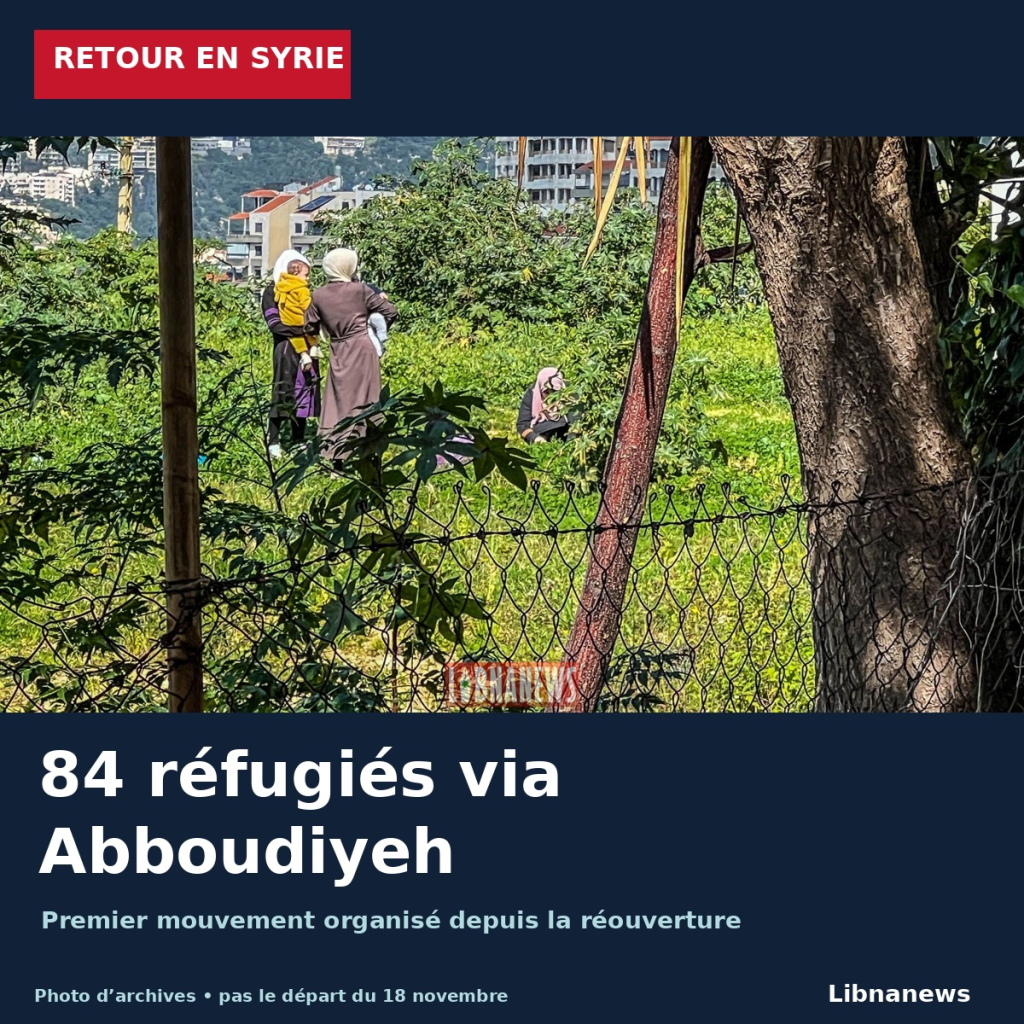
Eighty-four Syrian refugees left Lebanon on Wednesday 18 November through Abboudiyeh-Daboussiyah, according to a statement by the Delegation of the European Union. This is the first organized voluntary return from this post since its reopening, not the first return of refugees from Lebanon.
UNHCR and the International Organization for Migration organized the movement with the Lebanese General Security. The participants benefited from information, administrative and transport support.
A broader programme than this departure
The operation is part of DAR, a EUR 80 million European programme implemented by UNHCR, IOM and the International Labour Organisation. This envelope finances several aspects of return, reintegration and migration management: it does not correspond to the cost of this movement or to a sum distributed to the 84 participants.
Cumulative figures have another perimeter
The communiqué reported more than 711,000 Syrians known to UNHCR who had returned from Lebanon since January 2025, of whom nearly 100,000 had received direct assistance. This total therefore exceeds the perimeter of the organized convoys.
These three orders of magnitude are not interchangeable: 84 people concern the movement announced this Wednesday; nearly 100,000 describe a cumulative accompaniment; More than 711,000 refer to all reported returns of persons known to the Agency. The cumulative figure does not alone establish the conditions of departure or the current situation of each family. Nor is it a census of all Syrians in Lebanon.
Conditional aid, not a uniform payment
In its information to refugeesUNHCR describes an initial assistance of $100 per person, with a possible supplement of $300 for vulnerable families. A reintegration aid of $600 per family in Syria also depends on an assessment of eligibility. These arrangements do not make it possible to say that every participant in Wednesday’s movement received all the amounts.
UNHCR also recalls that the return leads to the closure of the individual file in Lebanon and the end of eligibility for assistance in that country. The family members remaining there shall retain their active records, subject to applicable conditions. The choice therefore has administrative consequences which must be explained before departure.
Voluntaryity is not a general guarantee of safety
On its information page accessed on 18 November, UNHCR continues its call not to forcibly return persons to Syria. It does not promote large-scale voluntary repatriation and insists on orderly and progressive returns, decided individually.
The reopening of a passage facilitates an itinerary and formalities. It does not demonstrate that all destinations in Syria offer the same accommodation, services or security conditions. Similarly, the material organisation of a return does not make it possible to generalize the choice of its participants to all refugees. Post-arrival monitoring remains separate from the border crossing: it concerns the ability of families to relocate sustainably beyond the route alone.





Comments