

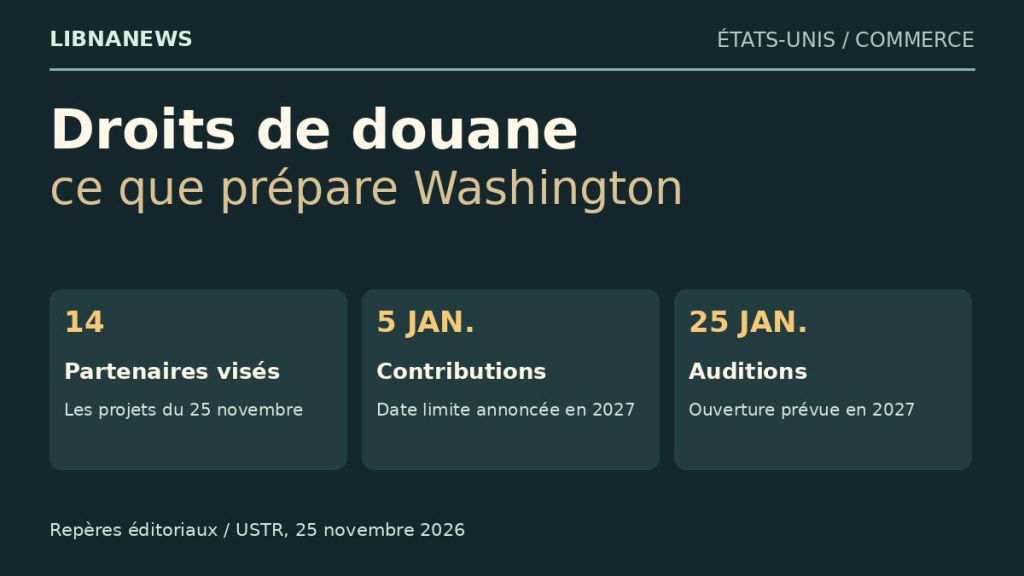
On 25 November, the US Trade Representative published draft tariffs covering 14 partners, including China and the European Union. The notices are subject to consultation. None of them, on that date, converts the rate announced into a new charge on a cargo. Importers should read the country of origin, product code, exemptions and taxes already applicable.
One product, two different calculations
For the European Union, the consultation text proposes a rate of 15% after taking into account the most-favoured-nation duty and the already applicable section 301 duties, with exceptions. For China, the project distinguishes between ordinary products, Annex A products and Annex B products: up to 20% in the first group, according to the deduction mechanism provided for certain rights related to forced labour, up to 10% for the second group and an exemption from this proposed measure for Annex B products.
Let us take, purely as an illustration, two identical handbags, with an outer leather surface and a customs value of more than $20, one of European origin and one of Chinese origin. In this example, suppose they fall within heading 4202.21.90 of the U.S. tariff. This code is not included in the EU and China Annexes consulted. The first step is identical: establish the code and value for duty. After that, the paths separate. For European goods, it is necessary to look at whether the product is excluded and what taxes exist in the calculation of the proposed threshold. For Chinese goods, the code is used to determine whether it falls under one of the two annexes and then to identify the duties that would remain applicable independently of this project. In a simplified calculation, if 9 dollars are already due per 100 dollars of value on the European bag and no other relevant levy applies, adding up to 15 per cent would add 6 dollars, not 15. For the Chinese bag, it is necessary to know the rights attached to its origin and the treatment applicable to the investigation of forced labour before calculating the supplement. This example describes the method; it does not constitute the price of actual customs clearance.
Consultation before implementation
These measures, according to the USTR, are aimed at policies that maintain industrial overcapacity and penalise US companies. The administration had opened 16 investigations in March; It announces conclusions for 14 partners and does not at this stage report on Mexico and Norway. The case is not confused with the separate procedure on imports of goods produced by forced labour.
January 5, 2027 is the announced deadline for written submissions and requests to participate in hearings. The hearings are scheduled to begin on January 25. The documents to be monitored are the final notice, the annexes selected and their instructions for application. They, and not the rate in the press release, would be the basis for calculating the input load of a given product.





Comments