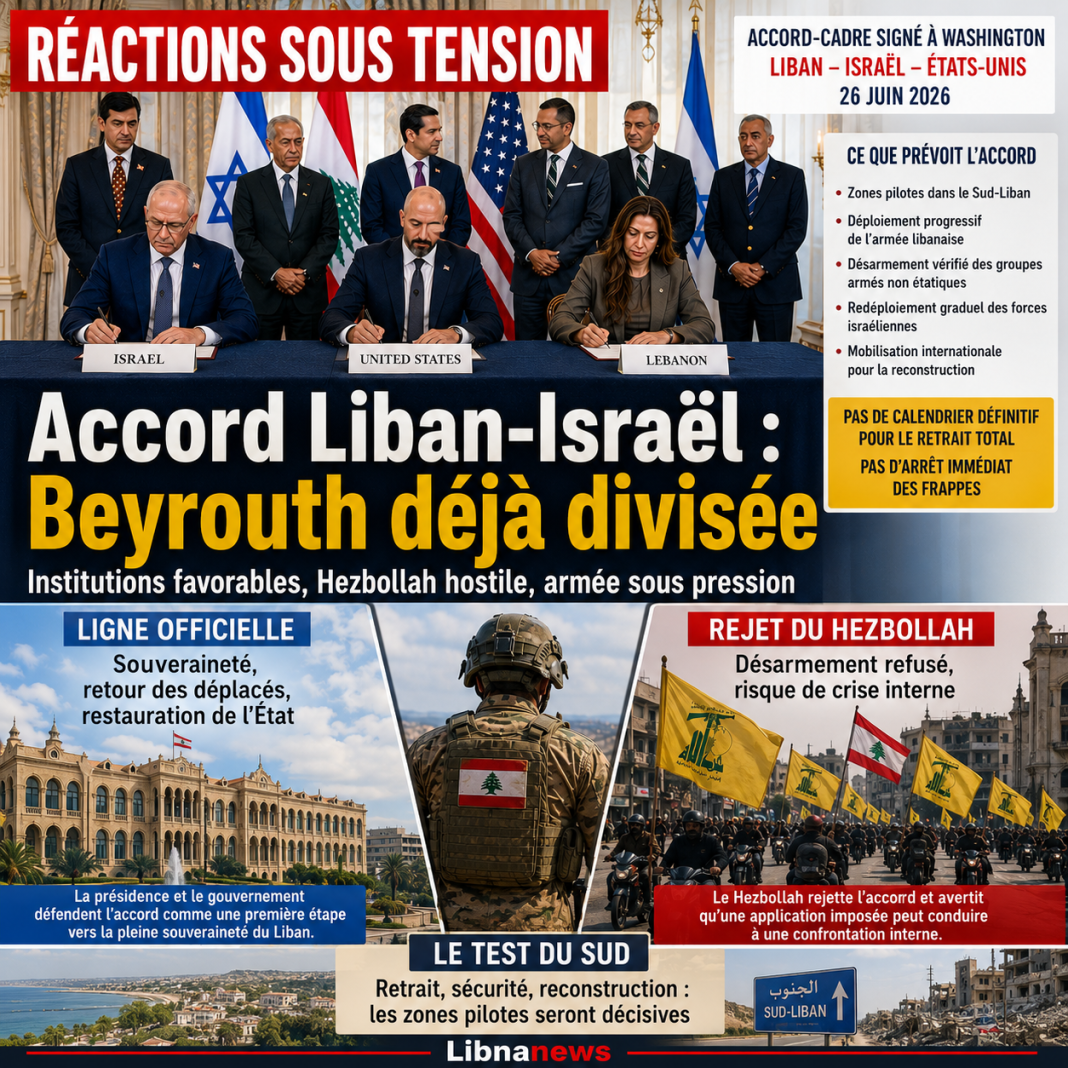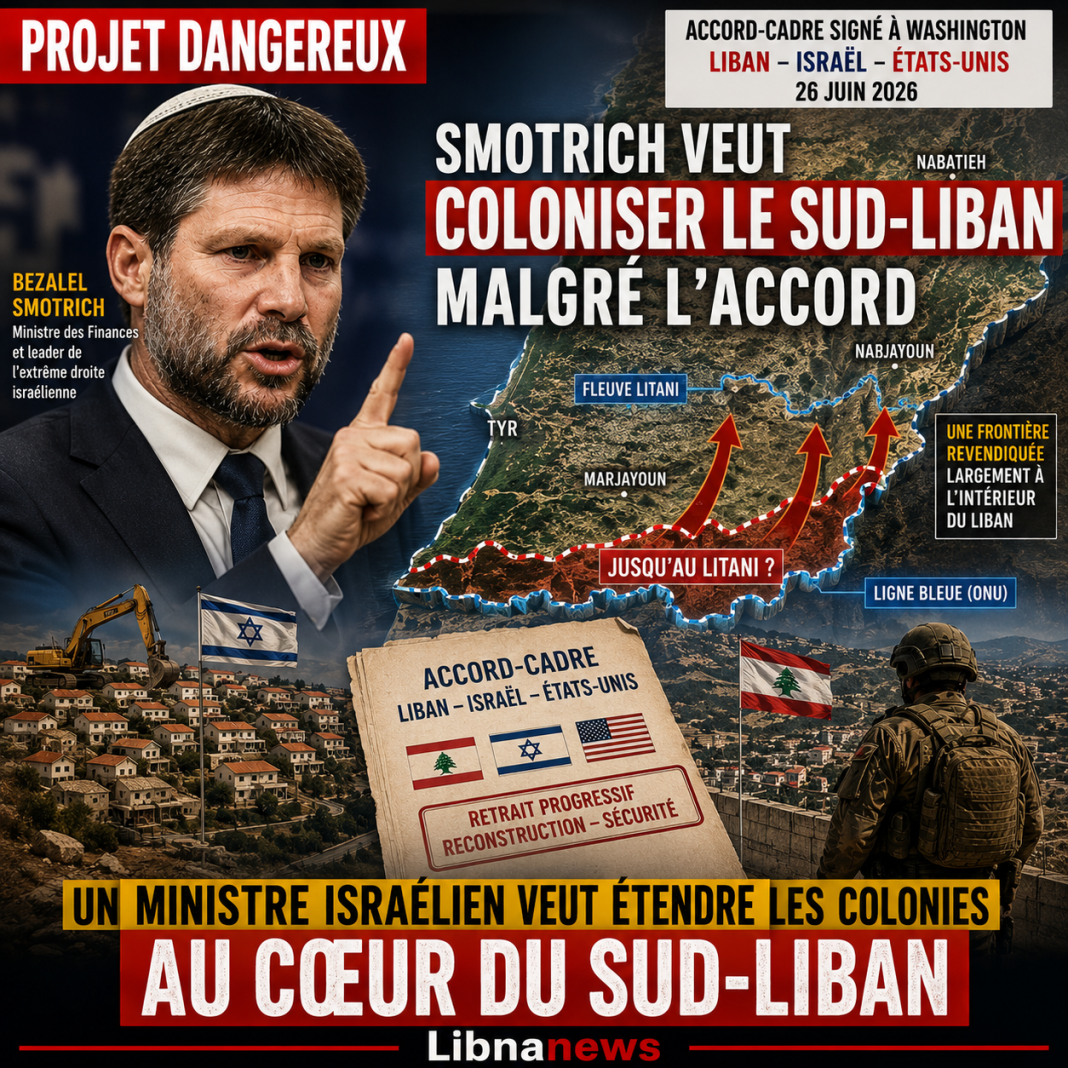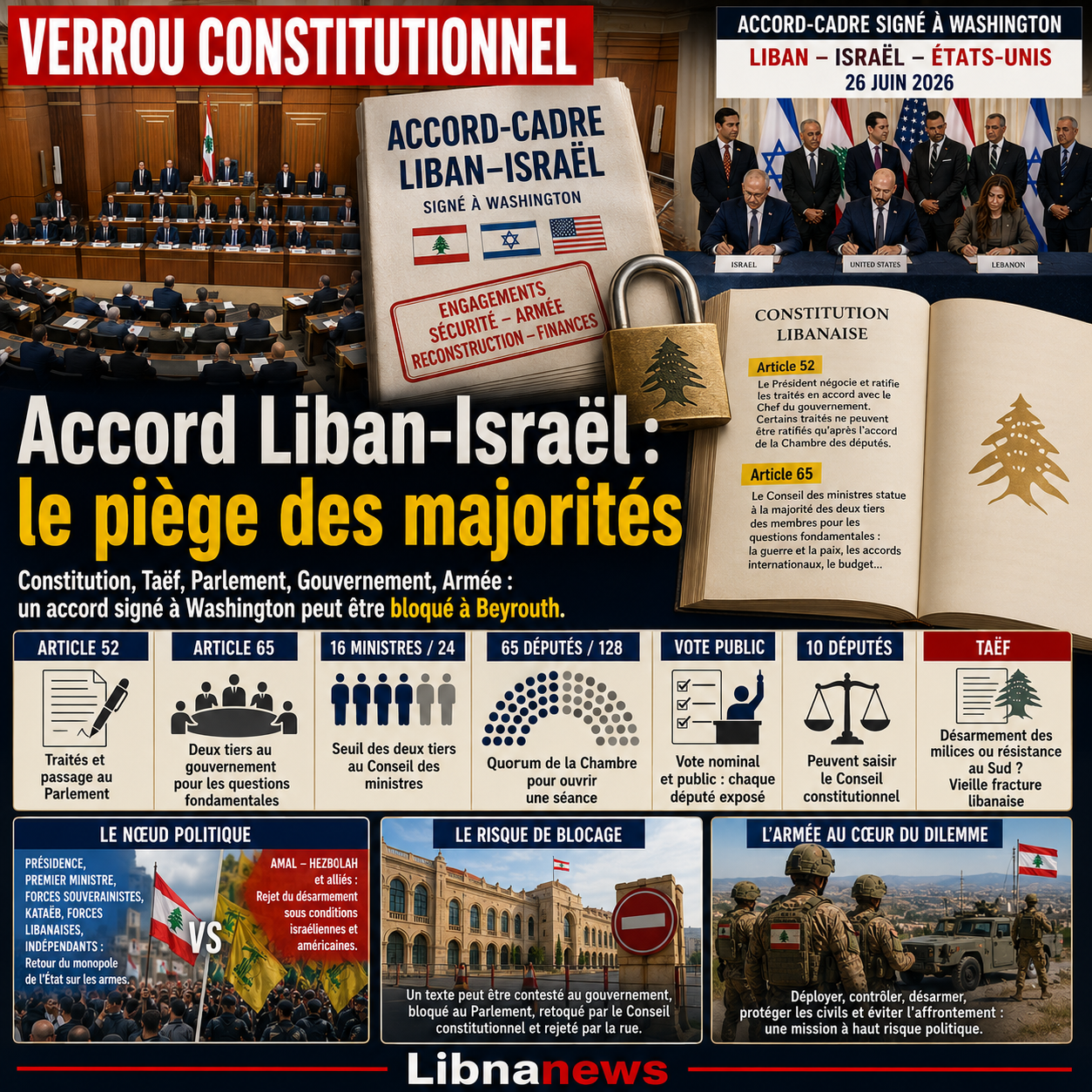
The framework agreement signed in Washington between Lebanon, Israel and the United States is not only on the southern border. It is also played in Lebanese institutions, through quorums, majorities, parliamentary and governmental power relations, as well as in the army, which is called upon to apply part of the most sensitive mechanism. The qualification of « framework agreement » is not sufficient to remove the constitutional question. If the text commits the Lebanese army, reconstruction, public finances, sovereignty or international obligations of the country, it can hardly remain outside the Council of Ministers and Parliament.
The debate begins with article 52 of the Constitution, which organizes the negotiation and ratification of treaties. It also covers Article 65, which lays down the rules for decision-making in the Council of Ministers, in particular on fundamental issues. It also concerns article 34, which determines the quorum of the House, article 36, which imposes public and nominal voting for laws, and article 19, which allows ten deputies to refer the matter to the Constitutional Council. These articles are not procedural details. They can become the concrete instruments of blocking.
The battle is also political. The Shiite tandem Amal-Hezbollah alone does not have the capacity to control the entire government or Parliament. But it has enough weight to slow down, contest, delegitimize or move the debate to the street. In front of him are the presidency, the Prime Minister, a part of the sovereignist forces, the Kataeb, the Lebanese Forces, independent deputies and blocs who want to restore the state monopoly on weapons. Between these two camps, several actors may hesitate: the Free Patriotic Current, the deputies close to Walid Joumblatt, some independents, or ministers who want to avoid internal confrontation.
The question of Taef further complicates the equation. The 1989 National Agreement Document provides for the dissolution of militias and the handing over of their weapons to the State. But it also provides for the liberation of the occupied Lebanese territories and the extension of State sovereignty to the South. In Lebanese political practice, this second dimension served to legitimize Hezbollah’s resistance to Israel, especially as long as the occupation of the South was a reality. The Washington Framework Agreement thus reopens an old divide: should we read Taif as an obligation to disarm all armed groups, or as a compromise that has left room for resistance as long as Israel occupies or threatens Lebanon?
A framework agreement that can produce obligations
The government can argue that the framework agreement is not yet a definitive treaty. This line is politically useful. It avoids the word « peace », very sensitive in Lebanon. It also makes it possible to affirm that the heaviest commitments will come later, in a security annex or in a comprehensive peace and security agreement.
But international law does not stop under the document. The Vienna Convention on the Law of Treaties defines a treaty as an international agreement concluded in writing between States and governed by international law, « regardless of its particular name ». In other words, an agreement can be referred to as « framework », « memoranda », « protocol » or « declaration » and, in spite of everything, produce obligations if States intend to commit.
The content of the Washington text is therefore crucial. It provides for the Lebanese Armed Forces to gradually assume security responsibility in pilot areas. It provides for verified disarmament of non-State armed groups. It provides for the dismantling of their infrastructure. It provides for a progressive Israeli redeployment. It includes a military coordination group with support and participation from the United States. It also provides for international mobilization for reconstruction, with conditions for monitoring funds.
These clauses can produce concrete effects. They can engage armed forces, budgets, administrations, infrastructure credits, aid distribution rules, verification obligations and international security coordination. The more they are applied, the more difficult the argument of the mere political framework becomes to defend.
The executive can save time with this qualification. But as soon as the army receives operational orders, as soon as pilot zones are activated, as soon as funding is directed according to the terms of the text, the constitutional question becomes inevitable. Blockage can then come not only from opponents of the agreement, but also from lawyers, Members of Parliament or ministers asking for a clear procedure.
Rule 52: the key to moving to Parliament
Article 52 of the Lebanese Constitution states: « The President of the Republic shall negotiate and ratify treaties in agreement with the Head of Government. These will not be considered ratified unless the Council of Ministers agrees. The Government shall inform the Chamber of Deputies when the interests of the country and the security of the State so permit. »
The same article adds: « Treaties which commit State finances, trade treaties and all treaties which cannot be denounced at the end of each year may be ratified only after the agreement of the Chamber of Deputies. This sentence is at the heart of the constitutional risk.
The framework agreement could commit state finances. Even if reconstruction assistance comes from international partners, its implementation may require public mechanisms, administrations, controls, military spending, electricity, water, telecommunications, roads, compensation or multi-year budget commitments. If the Lebanese State is to organize and finance part of this architecture, article 52 may be invoked.
Can the text be denounced at the end of each year? Nothing in its logic resembles an easily revocable annual arrangement. It is organizing a military and political transition to a peace and security agreement. It creates sequenced and verified obligations. This length of time can fuel the argument of a mandatory passage through the House.
The government could say that the framework agreement is not yet ratified in the full sense, and that Parliament will only be seized of the final agreement. Opponents will respond that the executive cannot begin to implement military, financial and security obligations pending a hypothetical future ratification. This is where the risk of blockage becomes concrete.
Article 65: two thirds in the Council of Ministers
The Council of Ministers is the first institutional lock. Article 65 provides that « the executive power shall be vested in the Council of Ministers, which shall constitute the power to which the armed forces are subject ». This sentence is central. The framework agreement assigns a direct role to the Lebanese army. The Government cannot therefore treat the case as merely diplomatic correspondence.
Article 65 states: « The legal quorum for its meetings shall be two thirds of its members. Decisions shall be taken by consensus, or if this proves impossible, by vote, and decisions shall then be taken by a majority of the present. But the text adds a stricter rule: « As for the fundamental questions, they require the approval of two thirds of the members of the Government as set out in the training decree. »
Article 65 lists the fundamental questions. He cites, inter alia, « war and peace », « international agreements and treaties », « the general budget of the State » and « global and long-term development programmes ». The Framework Agreement covers several of these matters. It concerns Israel, security, the army, reconstruction, international aid and the relationship between war and peace.
The Nawaf Salam government has 24 ministers. The quorum for the meeting is therefore sixteen ministers. For a fundamental question, approval also requires 16 ministers, i.e. two thirds of the entire cabinet. This threshold is the first real political battlefield.
The Amal-Hezbollah tandem alone does not have a formal third block. Several sources on Cabinet formation indicate that he obtained four portfolios, including the Department of Finance related to Amal, but not nine ministers. It cannot therefore block a decision requiring sixteen votes on its own. But he can block if he brings with him prudent ministers, ministers close to other blocs, or ministers refusing to hire the army without Israeli withdrawal guarantees.
Government blocking can take several forms: absence of a sitting to prevent quorum, request for postponement, refusal to approve safe annexes, requirement for prior parliamentary debate, or negative vote preventing reaching the sixteen votes. In a cabinet of twenty-four, nine ministers absent or opposed are sufficient to prevent the approval of two-thirds.
The government: a less simple balance of power than it seems
The Salam government was formed in a context of international pressure, demand for reform and post-war reconstruction. It was presented as a cabinet of twenty-four ministers, with no third party blocking granted to the Shiite tandem. This architecture was designed to limit the veto capacity of Hezbollah and Amal, while maintaining a Shiite representation indispensable for the religious functioning of the state.
But the absence of a formal third-party block does not mean lack of political power. Amal retains the Department of Finance, a strategic position in all matters relating to appropriations, disbursements and reconstruction. Hezbollah retains considerable political and community weight, even though it is weakened by war and challenged by some opinion. The tandem can also use the legitimacy of Shiite representation to challenge a decision taken without its consent.
The presidential and government line will probably seek to bring together ministers in favour of the return of the State, reforms and reconstruction. It can count on those who want to strengthen the army and meet American and international expectations. But some ministers, even non-Hizbollah-related, may fear that too fast a vote will expose the army to internal confrontation.
The most sensitive ministers will be Defence, Interior, Finance, Public Works, Energy, Telecommunications, Social Affairs and Foreign Affairs. Defence must cover the role of the army. The Interior must manage the demonstrations. Finance must process appropriations and funds. The technical ministries must organize the reconstruction. Foreign Affairs must defend the text with the partners. Each wallet can become a friction point.
The government can therefore be divided into four groups. The first will support the agreement as an instrument of sovereignty. The second will be subject to Israeli and parliamentary guarantees. The third will oppose it because of Hezbollah and the rejection of any coordination with Israel. The fourth will try to avoid a clear vote, asking for the safe annex, the maps and the timetable before taking a decision.
Articles 34 and 36: parliamentary quorum and public vote
If the agreement, annex or implementing legislation comes to Parliament, section 34 becomes central. It states: « The Chamber may validly be constituted only by the presence of a majority of its members legally constituted. Voting shall be taken by a majority vote. In the event of equal sharing, the question of deliberation shall be rejected. »
Parliament has one hundred and twenty-eight Members. The quorum is therefore sixty-five Members present. Without sixty-five Members, the sitting cannot begin. The quorum is a classic means of blocking in Lebanon. Blocks can boycott a session to prevent its opening, especially when a text touches on existential issues.
Once a quorum has been reached, the ordinary vote shall be by a majority vote. This means that an ordinary ratification law does not automatically require two-thirds of the deputies. But politically, an agreement with Israel adopted by a short majority would be very fragile. It could be legal without being accepted.
Article 36 adds a political constraint: « Votes shall be cast aloud or by sitting and lifted except in the case of elections, in which case the vote shall be secret. On all the laws and on the question of trust we always vote by roll call and aloud. A law on the agreement would therefore oblige every Member to vote publicly.
This public vote is a major element of the balance of power. A Southern MP, a Shiite elected, an independent, a sovereign Christian elected or a Druze MP will not pay the same political price according to his vote. Opponents may accuse the supporters of the agreement of yielding to Israel. The supporters will be able to accuse the opponents of protecting non-State weapons. The nominal vote transforms each position into an exposed political act.
Parliament: who could vote in favour, who could block?
The Lebanese Chamber is fragmented. Hezbollah and its allies lost their majority in 2022. Reuters estimated the bloc of forces supporting the maintenance of Hezbollah’s weapons or allied to the party at approximately 72 seats, compared to seventy-one in 2018. This figure is close to the absolute majority of sixty-five, but it does not exceed it. The pro-Hezbollah camp cannot impose a law alone. It can, however, make a broad consensus almost impossible.
The nucleus opposed to the agreement will be formed by Hezbollah and its direct allies. MP Hassan Fadllallah has already rejected the agreement and warned that forced application could lead to civil war. The Hezbollah bloc will not vote for a law that implements disarmament under Washington’s terms.
Amal occupies a more institutional position. Nabih Berri, President of Parliament and leader of the Amal movement, is the central actor. Amal shares the Shiite representation with Hezbollah and cannot easily dissociate himself from a community rejection of the text. But Berri is also the guardian of the parliamentary institution and the interlocutor of mediations. Its main lever is time: agenda, pace of meetings, committees, consultations, guarantee requirement, request for full text.
In the face of the Shiite tandem, the Lebanese Forces and the Kataeb are most likely to support the agreement if it is presented as a return to the state monopoly. Samy Gemayel praised the agreement by believing that Lebanon was winning if he dedicated the exclusive of arms and the decision of war and peace between legitimate institutions. The Lebanese Forces have long defended the end of non-State weapons. They can therefore support the principle, while demanding effective Israeli withdrawal and safeguards.
The Free Patriotic Current is one of the most uncertain actors. He is no longer in a mechanical alliance with Hezbollah, but he can refuse an agreement perceived as imposed by Washington. It could call for a national defence strategy, an Israeli withdrawal schedule and a guarantee that the army will not be placed against Hezbollah without consensus. Its Members can therefore become a pivotal group.
Members close to Walid Jumblatt can also act as arbitrators. Jumblatt criticises Iranian influence and Hezbollah’s military decision, but he is also wary of unbalanced arrangements with Israel. His camp could support a strong army, while demanding broader international guarantees, particularly European or UN. Independents and MPs who have emerged from the dispute can be divided between the requirement of state sovereignty and the refusal of an agreement that is too American.
Thus, the government cannot rely on an automatic majority. The confidence vote of February 2025, obtained with ninety-five votes out of one hundred and twenty-eight, does not prejudge a vote on Israel. Some Members can support Salam for reforms and reject a framework agreement that affects war, arms and sovereignty. The majority will be rebuilt by file.
The Constitutional Council: 10 deputies are enough
Article 19 of the Constitution allows 10 deputies to refer to the Constitutional Council to challenge a law. That threshold is low. It means that even if the government succeeds in having a ratification or enforcement law passed, the text can still be challenged.
There are many possible arguments. Members can argue that Rule 52 was violated if Parliament was not seized at the right time. They may challenge the application of Article 65 if the Council of Ministers has not approved a fundamental issue with the required two-thirds. They may invoke Article 49 if the agreement is deemed incompatible with territorial integrity. They may invoke Taëf if the text is considered to be contrary to the post-war balance of the Republic.
The constitutional remedy may not be sufficient to block definitively. But it can delay, delegitimize, politically expose and impose clarification. In such a sensitive case, judicial time itself becomes a political tool.
Taif: Dissolution of militias and exception of resistance
The Taif debate is at the heart of the crisis. The National Agreement Document provides for « the proclamation of the dissolution of all Lebanese and non-Lebanese militias and the handing over of their weapons to the Lebanese State within six months ». This sentence is the weapon of the supporters of the agreement. They say that the disarmament of non-State armed groups is not a new Israeli demand, but a Lebanese commitment of more than three decades.
But Taëf also contains a component on the South. It provides for « all necessary measures to free all Lebanese territories from Israeli occupation, extend State sovereignty throughout its territory and deploy the Lebanese army in the internationally recognized border area ». This sentence served as the political basis for the argument of resistance.
Taef does not name Hezbollah. He does not explicitly say that Hezbollah must retain its weapons. But in Lebanese political practice, the distinction between militias from civil war and resistance to Israeli occupation has allowed Hezbollah to escape general disarmament. After the Israeli withdrawal of 2000, this exception was extended by the issue of the Shab`a farms, prisoners, Israeli violations and successive ministerial statements that referred to the army, the people and resistance.
This is where the framework agreement is explosive. He does not recognize this exception. He speaks of non-State armed groups to be disarmed. It makes the Israeli redeployment conditional on that verified disarmament. For advocates of the text, this is a necessary correction of an exception that has become permanent. For his opponents, this is a contradiction with Taif’s spirit, for resistance cannot be disarmed as long as Israel retains a presence or a capacity for aggression.
The contradiction is therefore not purely legal. Taef’s letter supports the state monopoly. Taif’s political practice has legitimized, at least for a period, Hezbollah’s resistance to Israel. The framework agreement forces Lebanon to decide between these two legacies, without prior national consensus.
South Lebanon as a parliamentary argument
The perception of the South will weigh in all majorities. For some of the inhabitants, the state has not protected. The army withdrew or could not remain in certain areas. Civilians have been bombed, destroyed, displaced and service collapse. If the agreement begins with disarmament obligations without visible Israeli withdrawal, it will be seen as a concession to Israel.
Hezbollah will use this argument. He will say that the state returns to the South not to protect, but to implement an American and Israeli road map. This reading can affect Shia MPs, Amal, the elected representatives of the South, and parliamentarians who fear to vote against the feelings of the affected populations.
The supporters of the agreement will have to answer with facts. An Israeli withdrawal from a first pilot zone, stopping strikes, reopened roads, real reconstruction and an army serving civilians can change perception. Without this, the text will be defended in Beirut but challenged in the localities that must be implemented.
The Lebanese Army: the possible break-up point
The army is the most exposed actor. The agreement calls on Israel to take control of pilot areas, to prevent the return of non-State armed groups, to facilitate the return of civilians and to accompany the Israeli redeployment. This mission could turn the army into an arbiter of a political conflict that the institutions would not have resolved.
Three scenarios are possible. In the first, the army is carefully deployed in areas where a tacit local agreement exists. It controls roads, public buildings, civilian returns and visible points, without immediately seeking to dismantle all Hezbollah infrastructure. This scenario limits internal risk, but it may disappoint Israel and Washington.
In the second, the army applies more visible measures: checkpoints, prohibition of armed positions, confiscation of apparent weapons, control of access to pilot zones. Hezbollah protested, mobilized politically, but avoided direct confrontation. This is the controlled voltage scenario.
In the third, the army is ordered to dismantle Hezbollah’s infrastructure or physically prevent its fighters from returning. If the party refuses, the army must choose between retreat or confrontation. This scenario is the most dangerous. It can cause a major internal crisis or even the outbreak of localized confrontations.
The main danger is not only military. It’s symbolic. The Lebanese army remains one of the few national institutions still respected throughout the communities. If it is perceived as acting under American supervision, or as indirectly securing Israeli forces still present in the security zone, its image can be seriously damaged.
The army also lacks resources. It depends on external aid, particularly from the US and Europe. It needs vehicles, fuel, communications, intelligence, surveillance, demining and financing. To entrust him with such a heavy task without political consensus and without sufficient means would be to transfer to the military institution a crisis that civilians have not resolved.
The precedent of 17 May 1983
The precedent of 17 May 1983 is based on this debate. This agreement between Lebanon and Israel, signed under American mediation after the Israeli invasion of 1982, was to organize a withdrawal and security arrangements. It was rejected by a significant part of the country, perceived as being under occupation and repealed in 1984.
The current context is different. But political memory is alive. Any agreement with Israel signed under American guarantee, without a national consensus and without a complete Israeli withdrawal clearly dated, will be compared to 1983. Opponents will use this precedent to assert that an agreement outside the Lebanese consensus can revive internal fractures.
This memory will weigh on Members and Ministers. A nominal vote on a text related to Israel will be politically costly. Some officials will therefore seek to avoid voting, delay examination or seek guarantees. But avoiding voting can fuel another accusation: that of constitutional circumvention.
An agreement suspended from power relations
The framework agreement is suspended by a double majority. An institutional majority: sixteen out of twenty-four ministers in the Council of Ministers, sixty-five deputies present in the Chamber, a majority of votes in a public vote, and the risk of a ten-member appeal to the Constitutional Council. A political majority: a sufficient coalition between the presidency, government, sovereignist forces, centrists and independents to defend the text without breaking the country.
Amal-Hezbollah no longer controls the parliamentary majority and does not have only one third of the blockage in the government. But they have a strong institutional and political nuisance capacity. They can block Parliament by quorum, the government by two thirds, the street by mobilization, and in the South by contesting the deployment of the army. Facing them, the Lebanese Forces, the Kataeb, some of the independents and reformists can push for the application of the state monopoly. The PLC, the jumblattists and several conservative elected representatives can become arbitrators.
The question of Taif increases uncertainty. The text can be defended as an application of the disarmament of militias. It can be rejected as questioning resistance as long as Israel remains present. Both readings exist. The framework agreement forces the country to choose between them without building the necessary consensus.
The next step will therefore be decisive. If the government submits the agreement to Parliament, it risks blocking. If he does not submit it, he risks the charge of circumvention. If he advances by annexes and ministerial decisions, he risks transferring the crisis to the army. The document signed in Washington therefore does not depend solely on American or Israeli goodwill. It now depends on Lebanese majorities, quorums, Taif reading, the role of Nabih Berri, the reaction of Hezbollah, the courage of the deputies and the ability of the army not to become the battlefield for a political decision that Lebanon has not yet decided.