

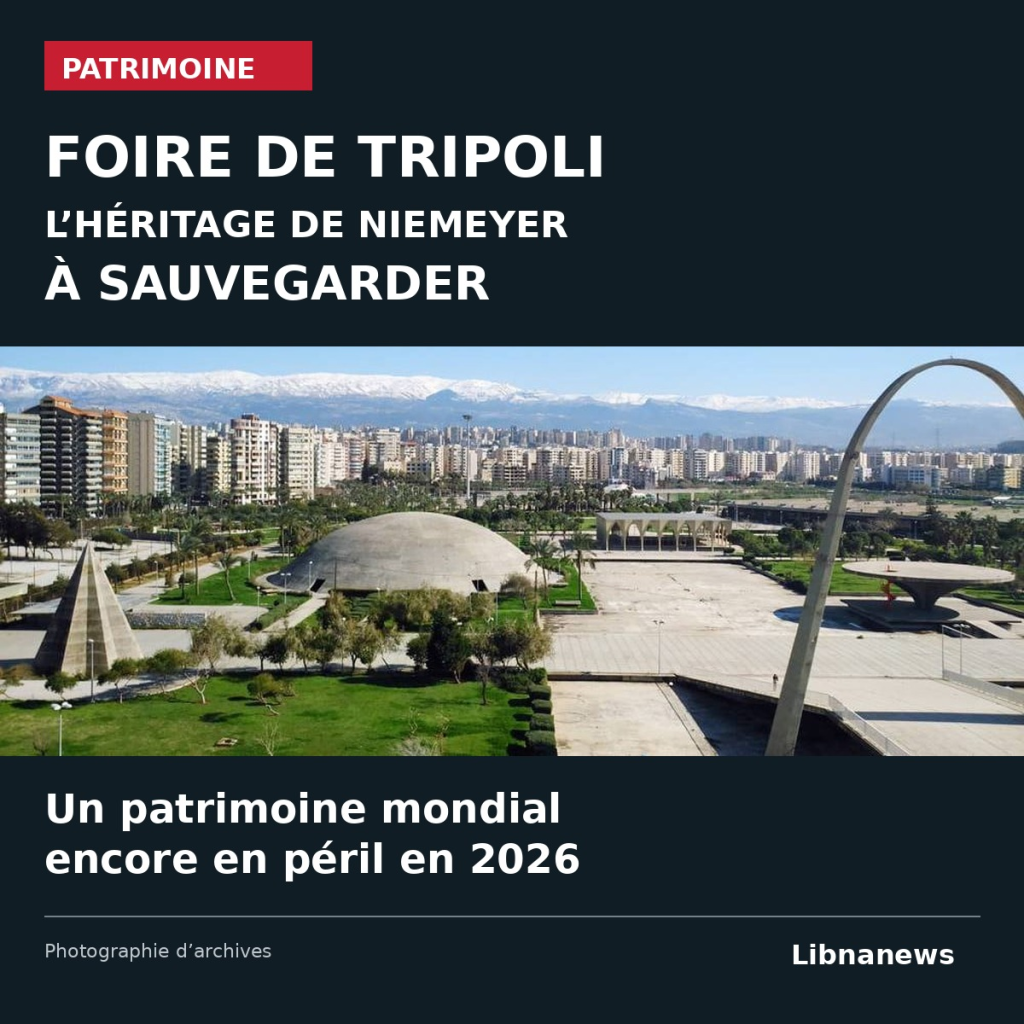
The Tripoli Fair, officially the Rachid Karamé International Fair, remains a world heritage at risk. In July 2026, the World Heritage Committee maintained this status for the ensemble designed by Oscar Niemeyer. Behind the international recognition, the emergencies are precise: stabilize structures, restore the evacuation of water and regulate new uses. Lebanon must submit a further assessment by 1 February 2027.
For this major place of modern Lebanese heritage, the question goes beyond the restoration of an isolated monument. The fair forms a set of buildings, gardens, ponds and traffic. Its preservation requires preserving their relationships as much as their silhouettes. The interventions undertaken in 2026 and the previous conversion of his guest house show two scales of work: to deal with immediate risks and to prepare for sustainable use.
A modern landscape between Tripoli and El Mina
Niemeyer drew the fair from 1962. The project continued until 1975, when the civil war interrupted its development. Between the historic centre of Tripoli and the port of El Mina, the project has a commercial, cultural and urban ambition. The world heritage area covers 72 hectares.
The large canopy organizes the site. This long cover was to accommodate exhibition pavilions in an adaptable space. Around it, ramps, basins and smaller buildings make up a journey. A monumental arch accompanies the outdoor theatre. The dome of experimental theatre introduces another geometry, more collected, into this open landscape.
This architecture also results from collaboration with Lebanese engineers and companies. It combines the formal research of Brazilian modernism with major public equipment in the Middle East. The heritage value of the site lies in the meeting, its reinforced concrete structures and its spatial organization. It is therefore not limited to the signature of a famous architect.
Tripoli Fair: the water castle in the front line
The Lebanese report of 21 January 2026 places the castle among the priorities. It describes an advanced structural deterioration. The Directorate-General for Antiquities has prepared, together with a specialist engineer, a proposal for stabilization and minimum repairs. The immediate objective is to reduce risk, before wider interventions on the whole.
This program also includes training in the conservation of historic reinforced concrete and documentation of work. The issue is concrete: the methods used on a structure must be able to inform the following operations. The backup thus requires readings, a knowledge of the materials and a precise trace of each intervention.
The initial timetable envisaged implementation in early 2026. A report published on 24 June, following a visit to the site on 2 June, still referred to ongoing stabilization work with the support of ALIPH. This evidence attests to an intervention undertaken. They alone do not allow us to announce today the completion of the restoration of the castle.
Repair concrete and clear rain
The 2026 conservation monitoring identifies other sensitive points. The underside of the outdoor theatre cover and the large canopy band require urgent intervention. The restoration of a functional stormwater flow system is also one of the measures requested.
The fair thus recalls a particular difficulty in the conservation of modern heritage. Materials that have allowed bold forms now require adequate monitoring and repairs. The ageing of the concrete and the corrosion of the frames threaten constructions whose structure contributes directly to architectural expression.
Maintaining a curve, a cover or a cover means understanding how they work. A simple repainting does not address a stability problem. Needs include diagnosis, security, repair and maintenance. On this scale, funding for a one-time operation does not replace a programme for the whole site.
The guest house, a precedent for reuse
The fair already has an example of conversion. Completed in 2018, the renovation of the Guest House by East Architecture Studio received the Aga Khan Prize for Architecture in 2022. Expertise France was the customer. The building was adapted to a design and production platform linked to the Tripoli wood industry, as part of Minjara.
The transformation links receiving materials, workspaces, workshops and exhibition. It maintains the original plan and visual relations between volumes. Glass partitions organize usages without completely closing the internal prospects. The central courtyard continues to structure the spaces and their lighting.
The decisive principle is reversibility. The new elements can be removed without damaging the restored structure. This approach allows for a contemporary activity while allowing for further use. It offers a precise precedent, without constituting an automatic solution for all the fair buildings. The dome, canopy or water castle each have different constraints.
Protect the site to its surroundings
Protection has also progressed at the national level. A ministerial decision of 15 May 2025 classified the fair as a national heritage. A new board of directors was appointed in August of that year. The report submitted in 2026 describes a work of collection of archives, planning of uses and coordination with the municipalities of Tripoli and El Mina.
The scattered archives must help to recover the design of the works and the interventions already carried out. Reuse projects also require studies. The 2026 file includes a heritage impact assessment for the rehabilitation of the experimental theatre. The challenge is to prepare the adaptations before they are implemented.
The World Heritage Committee also asks to clarify the buffer zone and urban planning rules around the fair. Protection therefore concerns neighbouring buildings as well as interior works. It must preserve the coherence of the site in a city that continues to change.
The next formal step remains the report due February 1, 2027. It will have to document the status of the structures and progress of the measures requested. For the Tripoli Fair, progress will have to be reflected in the repairs performed, the studies available and an applicable conservation schedule.
Sources and references
- UNESCO, Decision adopted 48 COM 7A.5, 2026
- UNESCO, presentation of the good and declaration of exceptional universal value
- UNESCO, conservation status 2026
- Directorate General of Antiquities, report of 21 January 2026
- ALIPH, report of the visit of 2 June, published on 24 June 2026
- Aga Khan Award for Architecture, Guest House Renovation
- East Architecture Studio, presentation of the renovation project





Comments