

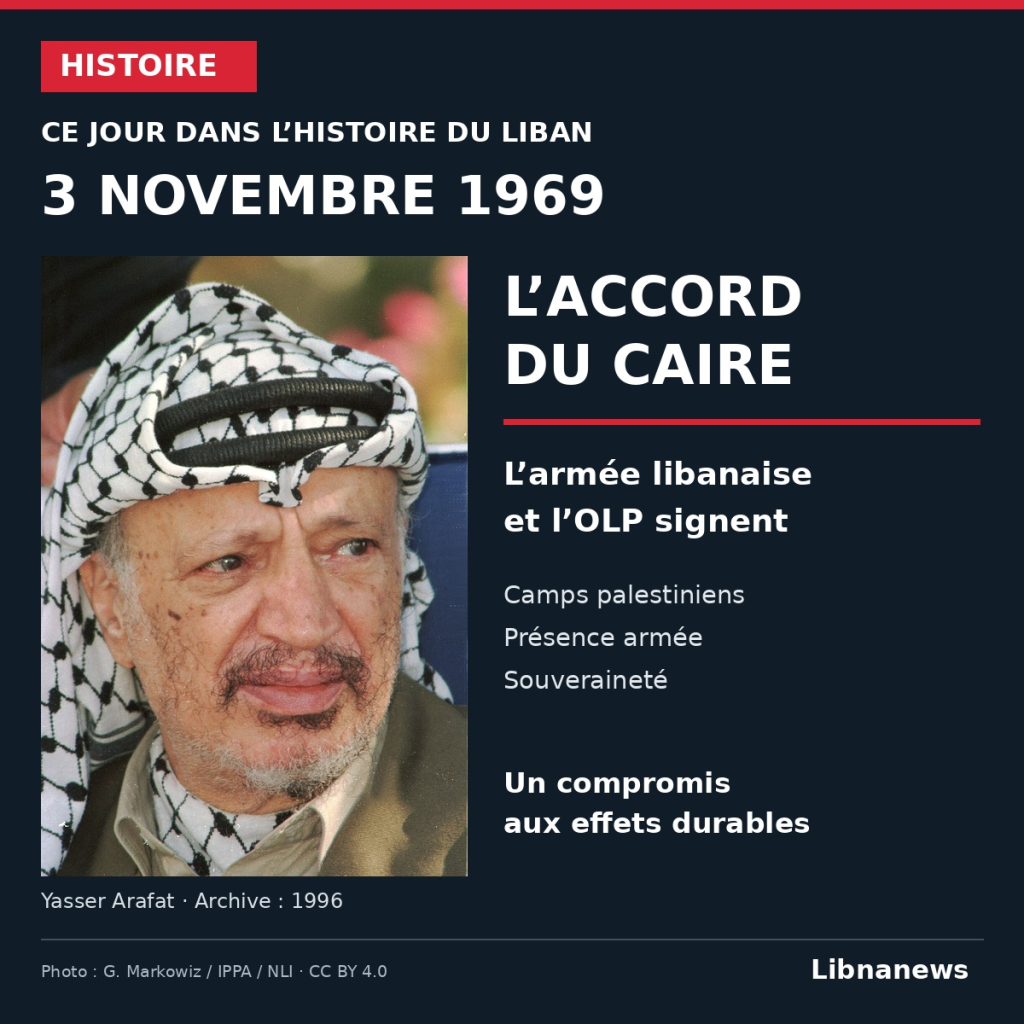
This day in the history of Lebanon.On 3 November 1969, General Emile Boustani and Yasser Arafat signed the Cairo agreement. Under Egyptian mediation, the Lebanese Army Commander and the head of the Palestine Liberation Organization are looking for a solution to the clashes. The text organizes the Palestinian armed presence in Lebanon while reaffirming the sovereignty of the country. This dual requirement will remain at the heart of its contradictions.
Fifty-seven years later, this date marks a turning point in the history of relations between the Lebanese State and Palestinian organizations. The agreement covers camps, the movement of combatants and their activities in border regions. It also provides for liaison mechanisms with the army. To understand its scope, it must distinguish between its provisions, intentions of its signatories and its application.
The Cairo agreement after months of crisis
In 1969, the presence of the fedayins, the Palestinian fighters, provoked a political and military confrontation in Lebanon. Operations against Israel from Lebanese territory expose the country to Israeli reprisals. They also divide Lebanese officials on the place to be given to the Palestinian struggle.
President Charles Hélou and the army want to preserve state control over his territory. Palestinian organizations are demanding freedom of action. Their Lebanese supporters, particularly in the left and the Arab nationalist currents, defend this claim. These positions are going through a political crisis already aggravated by regional tensions.
The fall 1969 clashes made mediation urgent. Egypt of Gamal Abdel Nasser welcomes the negotiations. In Cairo, the Lebanese delegation meets with the PLO, led by Arafat. Egyptian Foreign Minister Mahmoud Riad and War Minister Mohamed Fawzi attend the discussions.
The compromise of 3 November thus seeks to stop an immediate confrontation. It intends to organize relations between two forces that have clashed on Lebanese soil. Its purpose, however, goes beyond a simple ceasefire: it establishes rules for the Palestinian presence and for the activity of the commandos.
Civilian and military arrangements in the camps
The first part of the text concerns Palestinians residing in Lebanon. It sets out rights to work, residence and movement. It also provides for local Palestinian committees in the camps. These committees must defend the interests of the inhabitants and cooperate with the Lebanese authorities.
The document also organizes the installation of Palestinian Armed Struggle Command posts within the camps. Their mission includes supervising the presence of weapons. The text places this organization within the framework of Lebanese security and the interests of the Palestinian movement.
This provision gives Palestinian organizations a recognized place in the management of camps and their security. It creates a de facto division of responsibilities, even though the agreement reaffirms Lebanese sovereignty. Relations between local committees, Palestinian command and national authorities are therefore becoming essential to its functioning.
The text finally allows Palestinians in Lebanon to participate in the Palestinian struggle through its armed command. It adds an explicit reference to the sovereignty and security of the host country. The articulation of these two commitments is one of the central points of the compromise.
In the South, organized armed activity
The second part directly concerns commandos. It plans to facilitate their passage and to establish crossing and reconnaissance points in border areas. It also mentions access to the Arkub region in south-eastern Lebanon.
This geography counts. The Arkub is located near the Syrian and Israeli borders. It is a traffic and settlement area for Palestinian fighters. Thus, the agreement does not only deal with life in the camps. It also covers the use of Lebanese territory in the conflict with Israel.
In return, the Palestinian command must control the conduct of its members and prevent their interference in Lebanese affairs. The text provides for a joint arrangement with the army, as well as Palestinian representatives to its staff. They must contribute to the resolution of urgent incidents.
Other provisions regulate the entry, exit and movement of combatants. The military must facilitate the operation of medical, evacuation and refuelling centres related to their activities. The document also provides for the release of detainees, the return of seized weapons and the cessation of propaganda campaigns between the two parties.
Reaffirmed sovereignty, shared authority
The agreement recognizes an organized Palestinian armed activity in Lebanon. But it also specifies that the Lebanese civil and military authorities retain their prerogatives throughout the territory. These commitments place cooperation between the two Commandments at the centre of the arrangement.
The difficulty appears in the very structure of the text. The State asserts its general authority, while a separate armed organisation receives its own functions. It supervises combatants, intervenes in the camps and has facilities in the border regions. The compromise does not therefore eliminate the coexistence of several military decision-making centres.
The civil rights of refugees must also be distinguished from those of combatants. The agreement brings them together, but they do not cover the same issue. The status of the inhabitants of the camps was not confused with the military decisions taken by Palestinian organizations.
Confidentiality adds another difficulty. The text shall be made available to the authorities concerned. The provisions now reproduced in the documentary collections make it possible to examine their content, without confusing this known version with an initial official publication.
The clashes resume, then come the repeal
The compromise does not prevent further confrontation. In May 1973, the Lebanese army and Palestinian forces again clashed. The issue of arms and territorial control remains a whole, before the outbreak of the civil war in 1975.
The Cairo agreement belongs to this story, but it is not enough to explain the war alone. Lebanese political divisions, militias and external interventions intersect during the conflict. Reducing this trajectory to the 1969 signature alone would erase the following decisions and events.
On 21 May 1987, the Chamber of Deputies voted to cancel the Cairo Agreement. The decision also refers to its annexes and the resulting measures. Eighteen years after the signing, Parliament intends to end the framework negotiated between Boustani and Arafat. The effective restoration of State authority over weapons remains a separate issue from the repeal of the text.
Documentary References and Photo Credit
- DCAF, Towards Lebanon National Reconciliation, Cairo Agreement and Decision of 21 May 1987, pages 39-40.
- French Senate, Information Report No. 242, February 21, 1996, Timemarks, page 48.
- Rex Brynen, Sanctuary and Survival: The PLO in Lebanon, Chapter 2, 1990, text hosted by McGill University.
- Archives Libnanews, The end of a tumultuous Lebanese-Palestinian cohabitation, 19 June 2017.
Coverage:portrait of Yasser Arafat photographed on October 8, 1996, used as a historical illustration. This photograph does not represent the signature of the 1969 Agreement. Credit : Gideon Markowiz / Israel Press and Photo Agency (I.P.P.A.) / Dan Hadani Collection, National Library of Israel,CC BY 4.0.Photographic notice and license.Libnanews graphic editing: photo kept in its entirety, resize and add text.






Comments