

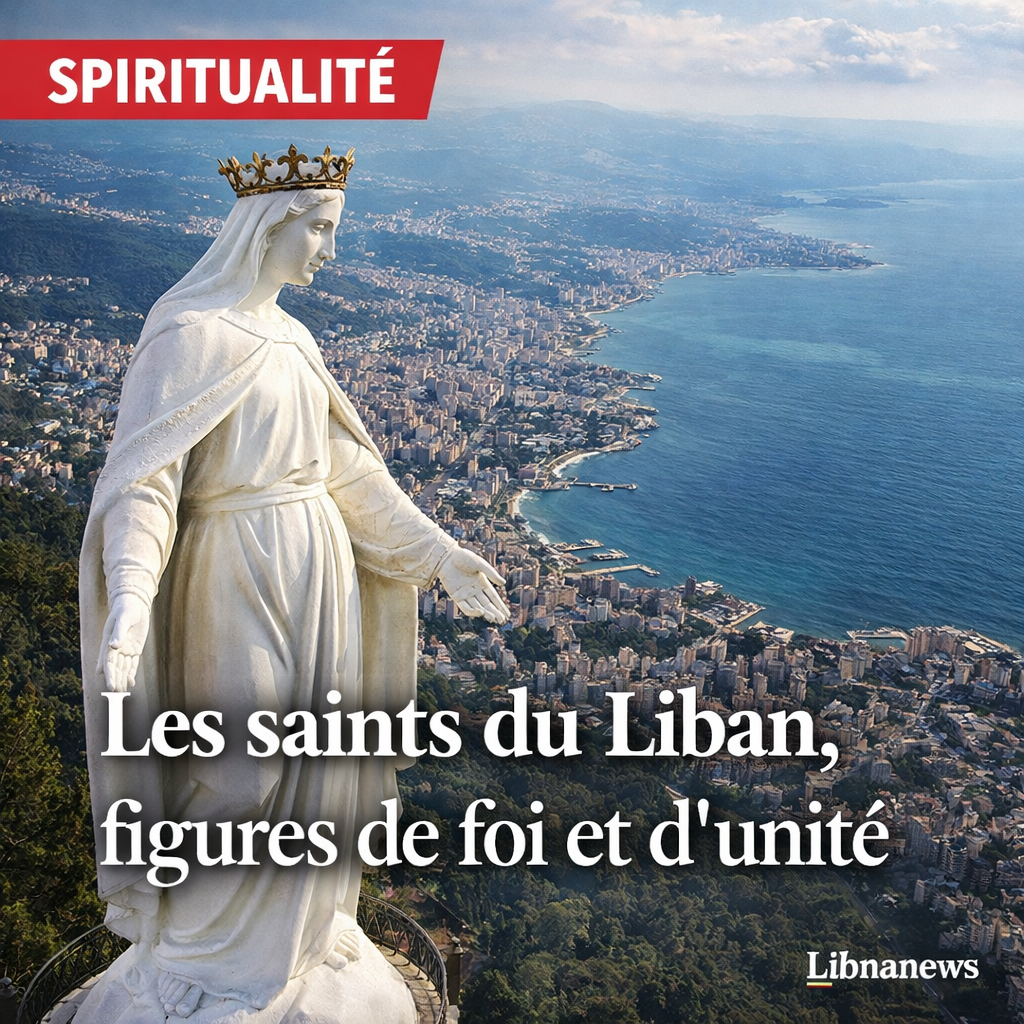
In Lebanon, a country marked by profound denominational diversity and persistent challenges, saints represent much more than a religious heritage; They embody an identity pillar that unites communities, especially Maronite Christians, in a context of economic and security crises. At the beginning of 2026, as the country sailed between inflation stabilized around 50 per cent according to the latest reports of the International Monetary Fund published in December 2025 and border tensions in the south with Israel, exacerbated by recurrent incidents such as the attack of a Merkava tank on a UNIFIL position near Kafer Shuba on 17 January 2026, the veneration of the saints offered a spiritual refuge. These figures, often from Maronite tradition, are celebrated through mass pilgrimages and ceremonies that transcend cleavages, attracting even faithful from other denominations. The Maronite patriarchate, under the direction of Cardinal Béchara Boutros Rai, recently stressed at a memorial Mass in Annaya on 24 December 2025 the importance of these saints as symbols of resilience, recalling that more than one million pilgrims visited the sacred sites in 2025 despite restrictions related to power cuts and fuel shortages. This devotion, rooted in centuries of history, adapts to current realities, with virtual processions via social networks connecting the Lebanese diaspora estimated at 15 million individuals to ancestral shrines.
The saints of Lebanon, mostly from the Maronite Church, illustrate an ascetic and missionary spirituality that has shaped the Christian identity of the country since the first centuries. Their veneration, intensified by reported miracles and recent beatifications, strengthens the social fabric in a Lebanon where Christians make up about 30% of the population according to the estimates of the Ministry of Internal Affairs in 2025. In a political landscape structured by confessionalism since the Taif Accord in 1989, these sacred figures promote a discreet intercommunal dialogue, as evidenced by the participation of Muslims in pilgrimages to Annaya to invoke the protection of Saint Charbel during the residual VOCID-19 epidemic in 2025.
The emblematic figures: From apostles to Maronite hermits
Among the saints venerated in Lebanon, some date back to apostolic origins, linking the country directly to the Gospel. Saint Bartholomew, one of the twelve apostles of Jesus, known as Nathanael in John’s Gospel, is described as a man without deceit. Originally from Cana in Galilee, he preached in ancient Phoenicia, especially in Berite, the present-day Beirut, according to Byzantine and Eastern ecclesiastical traditions. This city, a Roman commercial hub with a cosmopolitan population of tens of thousands in the first century, offered fertile ground for evangelization. Bartholomew reportedly established one of the first Christian communities, preaching to Hellenized Phoenicians, Greeks and Romans. Ancient sources mention his missions in Phoenicia, including Sidon and Tyre, where he would have converted followers of local deities such as Astarté and Baal. Associated with travels to Saudi Arabia, India and Armenia, he suffered martyrdom in Armenia, which had been skinned alive after King Polymios’ conversion. In Lebanon, pilgrimages honour its role in spreading Christianity in the Levant, celebrated on August 24.
Similarly, Saint Paul, apostle of the Gentiles, marks Sidon on his journey to Rome as a prisoner, as reported in the Acts of the Apostles (27:1-3). Escorted by the Julius centurion, he landed at Sidon, where « friends » – indicating an established Christian community – provided him with care. This stay, around 59-60 AD, highlights ecclesial hospitality in a strategic port, enlarged under Herod the Great and facilitating the trade of wine, oil and fabrics. Paul had previously visited Tyre (Acts 21:3-7), exhorting disciples for seven days. These Phoenician ports, cosmopolitan hubs under Roman rule since 64 BC, serve as bridges for the expansion of the Gospel. Archeologically, Sidon reveals the remains of the first century: harbours, necropolises, Roman theatres, with fourth century Christian mosaics and amphorae marked d The Maronites claim apostolic continuity via these ports, with mentions in the councils of Nicaea (325) and Chalcedon.
Maronite tradition is embodied by hermits like St.Charbel, born Youssef Anton Makhlouf on 8 May 1828 in Bekaa Kafra. Son of Antoun Zaarour Makhlouf and Birgitta Chidiac, he is a child in a cave to pray, following his hermit uncles at the monastery of St.Antoine Qozhaya near the valley of Qadisha. At the age of 23, in 1851, he entered the monastery of Notre-Dame de Mayfouq, then at Saint-Maron d’Annaya in 1852. Pronouncing his vows in 1853 as Charbel, he was ordained a priest in 1859. In 1875 he became hermit to Saint Peter and Paul near Annaya, leading a rigorous asceticism until his death on December 24, 1898. From his death, extraordinary phenomena surround his body: persistent blood exudation, lights around his grave. Exhumed 45 days later, his intact body was placed in a coffin in the chapel, continuing to extrude a liquid. Miracles attract Christians and Muslims. Beatified in 1965 by Paul VI, canonized in 1977, it is celebrated on 24 July and 24 December in Lebanon. Boss of Lebanon, he symbolizes spiritual unity.
Another figure was Nimatullah Kassab Al-Hardini, born in 1808 in Hardine, from a family of six children. His father Girgis Kassab and his mother Mariam Raad influence his vocation. Hardine, a village with thirty churches, nourishes her spirituality. At the age of 20, in 1828 he joined the Maronite Lebanese Order at the monastery of St.Antoine in Qozhaya, adopting the name Nimatullah. After novitiate, he studied at Saint-Cyprien and Sainte-Justine in Kfifane, excelling in manuscript binding. Ordained a priest in 1835, he became director of the scholasticate and professor of moral theology. In Bhersaf, he founded the « School under oak », teaching for free. During the wars of 1840 and 1845, he adopted the motto « The wise one is the one who saves his soul », founding sixteen altars to the Virgin Mary. Appointed assistant general in 1845, he sent monks to the Jesuit college of Ghazir, forerunner of Saint Joseph University. Among his students: Charbel Makhlouf. He died of pneumonia on 14 December 1858 in Kfifane. Beatified in 1998, canonized in 2004 by John Paul II, his remains lie in a cedar coffin in Kfifane.
Saint Estephan Nehmé, born on 8 March 1889 in Lehfed, Caza de Jbeil, from a large family. At 16, in 1905, he entered the monastery of Kfifane, adopting the name Estephan. He lived twelve years at Notre-Dame de Mayfouq, ten at Notre-Dame du Secours at Jbeil, three at Saint-Antoine de Houb. In addition to prayer, he practises crafts, field work and carpentry. Appointed master of fields, he manages the land of monasteries. His example was manifested during World War I and the Great Ottoman Famine, causing 200,000 deaths in Mount Lebanon. He died on 30 August 1938 at 49 in Kfifane. In 1951, his intact body was discovered and exposed in a glass coffin in Kfifane, alongside Saint Hardini. Miracles recognized in the 1960s led to his beatification on 27 June 2010 at the monastery of St.Cyprien and St.Justine in Batrun, presided over by Cardinal Nasrallah Sfeir.
Saint Barbe, according to legend, was born in Nicomedia, daughter of a satrap named Dioscuri who locked him in a tower. Converted to Christianity, she refused a pagan marriage, causing her father’s fury. Martyrized around 235, it is invoked against the dangers of fire and lightning. In Lebanon, its festival on December 4 is marked by culinary traditions such as the preparation of sweet boiled wheat, symbolizing protection and fertility.
The meaning for Lebanese: An identity anchor in the torment
For Lebanese, these saints embody a Christian identity that is resilient to historical and present vicissitudes. In a country where public debt exceeds 150 per cent of GDP according to the World Bank in 2025, and where Christian emigration has increased by 25 per cent since 2020 after the UN, they offer a symbol of perseverance. Saint Charbel, in particular, is perceived as a national protector, unifying beyond confessions; Muslims visit Annaya for healing vows, as at the peaks of VOCID-19 in 2025 where collective prayers increased by 30%. Cardinal Rai, in a speech in Bkerké on 15 January 2026, said that « the saints remind us of our roots in a land of faith, faced with the economic challenges that have seen the Lebanese book depreciate by 95% since 2019 ». This veneration strengthens community cohesion, especially among the Maronites who make up the majority of Christians, with about 1.5 million faithful in 2025 according to the ecclesiastical census.
The saints also symbolize cultural resistance. In the context of regional tensions, with the extension of the UNIFIL mission until August 2026 decided by the United Nations Security Council in December 2025, and incidents such as Israeli airstrikes killing two civilians in the south on 16 January 2026, the faithful invoke these figures for peace. Nimatullah Al-Hardini, an educator during the civil wars of the nineteenth century, today inspires free educational initiatives in the villages of the north, where schools bear his name and welcome children of all faiths amid the electricity cuts reaching 20 hours a day.
Saint Estephan Nehmé, with his manual engagement during the Ottoman famine, echoes the current food crisis, where 40 per cent of the population lives below the poverty line according to the World Food Programme in 2025. Its shrines in Kfifane attract farmers seeking blessings for crops, as in the summer of 2025 drought which reduced agricultural production by 20% in Bekaa.
Saint Barbe, protector against calamities, is invoked during explosions or fires, recalling the explosion of the port of Beirut in 2020 that killed 218 people; chapels dedicated to him saw an increased influx in 2025, with offerings for family safety.
The apostles like Saint Paul and Saint Bartholomew recall the biblical roots of Lebanon, promoting a spiritual tourism that supports the local economy. Excavations in Sidon in 2025, conducted by the Directorate General of Antiquities with international teams, revealed artifacts of the first century, reviving interest in these sites and generating 10% increase in visits according to the Ministry of Tourism.
Venerable Practices: Daily Pilgrimages and Rituals
The Lebanese worship these saints through annual pilgrimages and daily devotions that integrate ancestral traditions and modern adaptations. In Annaya, Sanctuary of St. Charbel, more than one million visitors in 2025, including 10 per cent Muslims according to the Maronite patriarchate, participate in masses and night watches. The residence of Saint Charbel in Beqaakafra, transformed into a church after luminous phenomena around his grave, welcomes families for offerings of bread and oil, mixing prayers and folk dances. In 2026, with gas shortages limiting travel, virtual processes on social networks connected 500,000 diaspora participants at the feast of 24 July 2025.
For Nimatullah Al-Hardini, pilgrims go to Kfifane, where his intact remains are exposed; Theological conferences are organized there, such as that of 14 December 2025 attracting 5,000 faithful, discussing its motto in the face of current crises. « Under the oak » schools inspired by his educational initiative operate in 20 villages, teaching 10,000 children free of charge in 2025.
Blessed Estephan Nehmé is honored in Lehfed and Kfifane with processions in August, bringing together 15,000 people in 2025 despite border tensions. Farmers report miracles of abundant harvest after prayers, as in Batrun during the 2025 drought.
Saint Barbe is celebrated on December 4 with sweet wheat distributions in the Christian neighborhoods of Beirut and Tripoli, involving 200,000 participants in 2025, symbolizing protection against dangers.
For the apostles, commemorations in Sidon and Beirut include archaeological excavations integrated with guided tours; In January 2026, an exhibition in Sidon on Saint Paul attracted 2,000 visitors, highlighting the Christian mosaics of the fourth century.
Cultural and social impact: Integration into Lebanese society
These saints influence Lebanese culture, with festivals mixing liturgy and folklore. At Maad, the church of Saint Charbel with 13th century medieval frescoes, superimposed on a Roman temple, attracts archaeologists and devotees; UNESCO restorations in 2025 revealed new layers, boosting tourism in Byblos by 15%.
In education, Saint Joseph University, a precursor founded by Jesuits influenced by Al-Hardini, integrates courses on these figures, teaching 12,000 students in 2025 their historical role.
Socially, shrines support communities; Annaya employs 200 people locally, generating $5 million in donations in 2025 for humanitarian aid. In times of crisis, like the strikes of 16 January 2026, collective prayers in Kfifane mobilized 10,000 faithful for peace.
Economically, spiritual tourism accounts for 10% of tourism revenues in 2025, according to the Ministry of Tourism, with investments of $2 million in preservation of sites such as Qadisha, which has been classified as UNESCO since 1998.





Comments