

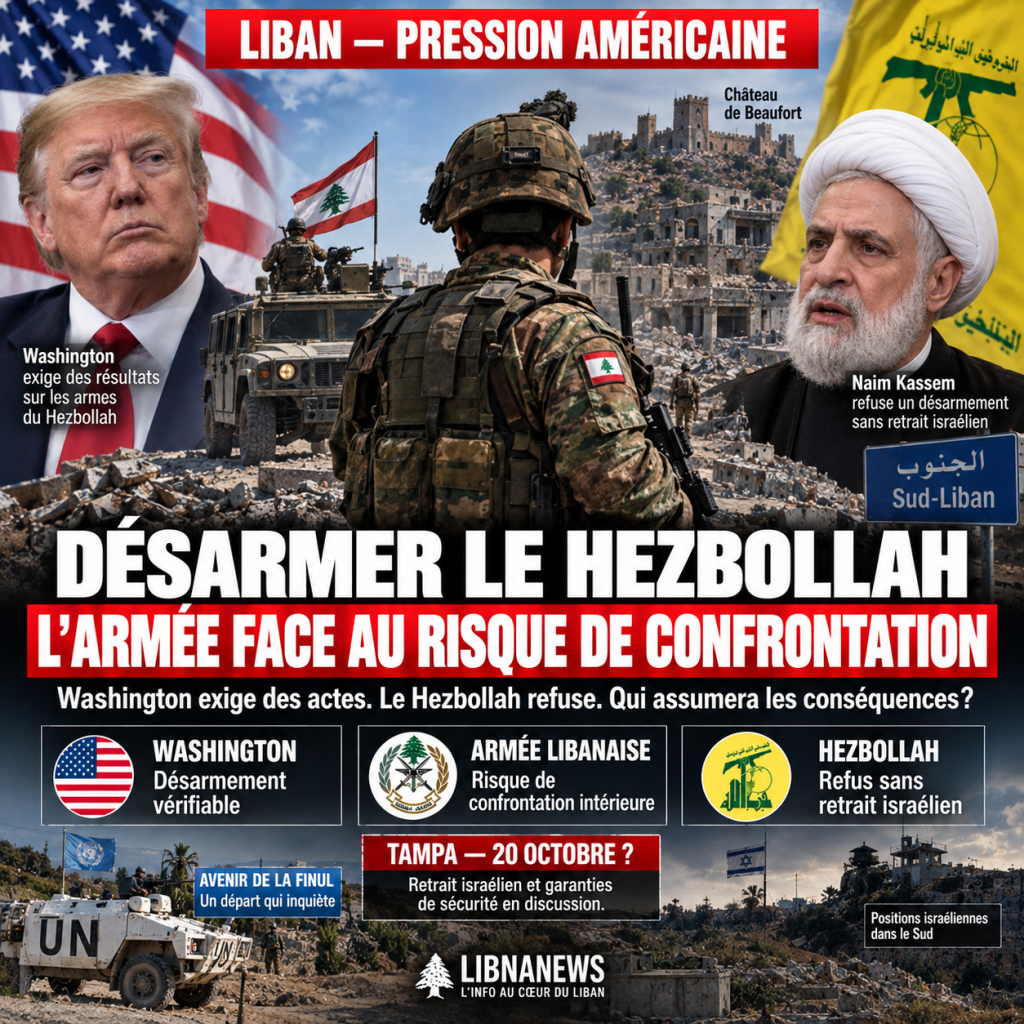
Washington demands concrete results on Hezbollah weapons
Donald Trump’s administration no longer wants to limit its action in Lebanon to monitoring the ceasefire with Israel. Washington is now seeking a lasting transformation of the military situation in South Lebanon. Its objective is to entrust the Lebanese army with effective control of the territories, military installations and weapons. This orientation places the military institution at the centre of a political confrontation whose consequences go far beyond the Israeli border.
An American official describes this strategy as a progressive process. The first step concerns the implementation of the security arrangements negotiated between Beirut and Israel. The second is to enable the Lebanese State to exercise its full authority over its territory and military decisions. The disarmament of Hezbollah is one of the main objectives of this approach.
The American position has an additional requirement. Washington no longer sees government declarations as sufficient guarantees. American officials want to see concrete measures on the ground. In particular, they call for the dismantling of Hezbollah’s military infrastructure and for its reconstruction to be prevented.
This approach transforms the mission entrusted to the Lebanese army. It is no longer just a matter of deploying units to areas evacuated by Israel. The institution should also monitor existing military facilities, prevent the return of combatants and ensure that the areas concerned are no longer used to prepare operations.
The difficulty appears immediately. Such a mission presupposes that Hezbollah agrees to renounce certain military positions and capabilities. Naim Kassem’s party refused to dissociate the issue of its weapons from the Israeli presence in South Lebanon. The American demands therefore put the army at a contradiction: to implement the commitments of the State without causing confrontation with a Lebanese armed organization.
No information available as of 8 October 2026 confirms that an American or Lebanese order has been issued to initiate a direct military operation against Hezbollah. On the other hand, Washington’s demands show that the United States is waiting more than just for the redeployment of the army.
The experimental zone mechanism at the heart of the US strategy
One of the proposals discussed in the security discussions is the establishment of experimental areas in South Lebanon. The principle is to gradually organize the Israeli withdrawal and the deployment of the Lebanese army to specific areas.
In these areas, the Lebanese military should ensure security and prevent the return of Hezbollah’s armed infrastructure. The mechanism would also include verification mechanisms to monitor the implementation of commitments.
This formula responds to a specific American concern. Washington wants to prevent an Israeli withdrawal from being followed by a rebuilding of Hezbollah’s military capabilities in the same sectors.
Former US diplomat Dennis Ross defended an approach based on verifiable results. It considers that the public commitments of the Lebanese authorities should be accompanied by concrete measures concerning weapons and military installations.
The problem lies in the conditions imposed by Israel. Israeli officials seek to maintain the possibility of military intervention when they believe that a threat is emerging. This claim could limit the authority of the Lebanese army in the areas it would be responsible for securing.
The scheme could then produce a contradictory situation. The Lebanese Armed Forces would be responsible for the security of a territory in which Israel would retain its ability to respond.
For Beirut, this issue is fundamental. The deployment of the army must restore national sovereignty. It cannot be considered a complete success if Israeli forces continue to impose their own military rules.
The distinction between territorial control and effective sovereignty thus becomes one of the main issues at stake in the negotiations.
Israel wants to prevent the reconstitution of Hezbollah’s military positions
The Israeli strategy is based on a change in its security doctrine on the northern border. Israeli military officials consider that previous arrangements have not prevented the preparation of operations against their territory.
The lessons learned from the attack of 7 October 2023 occupy an important place in this reflection. Israel claims that Hezbollah’s Radwan force had plans for infiltration into Galilee. This alleged threat is used to justify the maintenance of advanced positions and the destruction of infrastructure close to the border.
The information published on 8 October describes an Israeli desire to change the military geography of South Lebanon in a lasting way. The aim would no longer be merely to monitor Hezbollah movements, but to prevent materially the rebuilding of its offensive capabilities.
This orientation includes the strategic heights around Beaufort Castle and the Ali el-Taher sector. These positions are used to monitor several axes and localities. Their control is an important military advantage.
Israeli officials consider that certain areas must remain sufficiently clear to permit the identification of armed movements. This logic contributes to the destruction of housing and infrastructure in areas close to the border.
For the Lebanese army, the difficulty is considerable. It could be called upon to take control of deeply damaged territories, whose inhabitants could not always return.
The security of these spaces would therefore not be limited to a military mission. It would also require the restoration of roads, public services and conditions for the return of populations.
A Lebanese military presence without civilian reconstruction could maintain these areas in a situation of prolonged instability.
Beaufort Castle becomes a test of Lebanese sovereignty
The area around Beaufort Castle is one of the issues that the Lebanese authorities wish to address in the forthcoming negotiations.
Beirut intends to request Israeli withdrawal from the localities in the area. The objective is to enable the Lebanese army to deploy there and to restore State authority.
The issue also concerns villages whose homes have been destroyed or damaged. The return of residents depends on road safety and the possibility of rebuilding critical infrastructure.
The available information refers to persistent destruction in areas near Israeli positions. These operations complicate the prospects for a rapid return to normal conditions.
The military issue lies in the control of the heights. The relief allows to observe movements in the valleys and surrounding localities. Israel considers some of these positions essential to its security.
Lebanon stands for a different approach. The Israeli withdrawal must allow the national army to exercise its responsibilities without a foreign military presence.
The issue of Hezbollah’s weapons is directly involved in this negotiation. Israel called for guarantees preventing the party from returning to the evacuated areas. The United States wants the Lebanese army to control these areas.
Hezbollah believes that the Israeli presence justifies maintaining military resistance capabilities.
The Lebanese army is therefore at the centre of a disagreement that cannot be settled by a simple movement of troops.
The Lebanese Armed Forces is building capacity with several foreign partners
The information published on 8 October indicates that the Lebanese Army is participating in training programmes with more than seven countries. These activities include advanced ground and air missions.
These trainings are part of efforts to improve the operational capabilities of the military institution.
Strengthening the military’s capabilities is an important element of the US strategy. Washington believes that regular forces should gradually assume the tasks currently associated with the military presence of Hezbollah.
However, training is not enough to solve structural difficulties.
A sustainable monitoring mission in South Lebanon requires available staff, adequate equipment and monitoring capacity. It also requires transport, communication and logistical support.
Military personnel must be able to secure roads, control sensitive areas and respond quickly to incidents.
The cost of such missions depends on their duration and geographical extent. The information available does not include a detailed budget to measure the additional resources required.
The question of material resources is all the more important as the army must continue to carry out its other responsibilities in the national territory.
Excessive concentration of resources in the South could affect internal security and border control missions.
Washington therefore asks an institution faced with many constraints to assume a mission whose political and military scope continues to expand.
A 245-kg shipment of explosives reveals the difficulties of border control
An incident reported on October 8 illustrates the security challenges facing the army.
The Lebanese military discovered a shipment of explosives that was allegedly destined to enter the territory from Syria. The load consisted of 245 kilograms of trinitrotoluene, four ready-to-use explosive devices, eight detonators and electrical cables.
The transporters reportedly fled from the Syrian side on the arrival of a Lebanese patrol.
The information available does not identify the consignees of this cargo. Nor do they demonstrate a link with Hezbollah.
This distinction is essential. Discovery is an important security fact, but cannot be used to assign an operation to an organization without additional elements.
The incident, however, shows that the army’s responsibilities go far beyond the Hezbollah disarmament agenda.
Regular forces must also combat arms trafficking, monitor borders and prevent the entry of equipment that could be used in violent operations.
The Syrian authorities reportedly expressed their willingness to cooperate in identifying the persons involved and the routes used.
Such cooperation is an important element in a context of new developments in relations between Beirut and Damascus.
The discovery of explosives also underscores the need to preserve the army’s intelligence and border control capabilities, as international pressure focuses on its mission in the South.
Nawaf Salam defends the monopoly of force on behalf of the Constitution
Prime Minister Nawaf Salam reaffirmed on 7 October that decisions on war, peace and national security must be made by constitutional institutions.
His speech, delivered on the occasion of the centenary of the Lebanese Constitution, placed the debate on arms within an institutional framework.
Salam considers that the application of the Taif Agreement cannot be limited to provisions concerning the distribution of powers. It must also include reforms designed to strengthen the State.
This position is in line with the US objective of an exclusive institutional authority over military decisions. It does not mean, however, that the Prime Minister accepts all the terms proposed by Washington.
The distinction includes ways of achieving disarmament.
A political decision to strengthen the state monopoly of force does not automatically constitute an order given to the army to engage in internal confrontation.
The government must consider the possible consequences of such an operation. Hezbollah maintains a significant political and social presence, as well as military capabilities.
Direct confrontation could therefore lead to confrontations whose effects would exceed the areas concerned.
The information available does not contain a detailed government plan for a military operation against the party.
On the other hand, they show that Nawaf Salam defends an institutional evolution incompatible, in the long run, with the lasting existence of military decisions taken outside the State.
Naim Kassem refuses disarmament under external pressure
Hezbollah defends a position opposed to American demands. Under Naim Kassem’s leadership, the party believes that the issue of its weapons must be dealt with within a national framework.
Its officials refuse to dissociate the debate on the arsenal of Israeli withdrawal from security assurances.
This position is based on the idea that disarmament cannot precede the disappearance of military threats.
Hezbollah believes that its capabilities remain necessary as long as Israel maintains positions in South Lebanon and continues its operations.
The party also contests the steps that would seek to impose a timetable set by foreign powers.
This opposition complicates the military mission. The military could be responsible for controlling areas where Hezbollah refuses to renounce certain capabilities.
The problem, therefore, is not only the availability of equipment or personnel. It depends on the existence of a political agreement allowing the regular forces to carry out their missions.
Without such an agreement, a disarmament operation could be interpreted as a confrontation between the State and an armed component of Lebanese society.
The question of the future role of Hezbollah in a national defence strategy remains open.
Tampa, a negotiation where the army could receive bonds without equivalent guarantees
The discussions announced in Florida around October 20 are intended to examine several security issues.
The Lebanese authorities are seeking progress on Israeli withdrawal, the release of prisoners and the deployment of the army.
The United States favours monitoring mechanisms to verify military commitments.
Israel is seeking guarantees to prevent the reconstruction of Hezbollah’s infrastructure.
The difficulty lies in the balance between these requests.
If the Lebanese army is given responsibility for controlling arms without obtaining a corresponding Israeli withdrawal, it could be placed in a particularly difficult situation.
It should apply measures that could provoke internal tensions, even though the State would not have complete sovereignty over the areas concerned.
The problem would be even greater if Israel retained a military intervention capacity independent of the coordination mechanisms.
The Lebanese authorities are therefore seeking reciprocal commitments.
However, the exact date of the next meeting and its modalities are not definitively confirmed in the information available on 8 October.
No agreement can therefore be regarded as acquired.
The departure of UNIFIL may increase Lebanese military responsibilities
The future of the United Nations Interim Force in Lebanon is another major challenge.
The Lebanese authorities fear that the departure of international forces will create a security vacuum in a region where tensions remain high.
Several alternatives are mentioned, including a European presence or a different international arrangement.
However, no definitive solution is announced.
UNIFIL plays a role in monitoring the situation and coordinating between the various parties. Its withdrawal could reduce mechanisms for reporting incidents and preventing escalation.
The Lebanese army should then assume additional responsibilities.
This would reinforce the need for adequate monitoring, communication and intervention.
It could also complicate relations between Lebanese and Israeli forces if no sufficiently robust liaison mechanism was maintained.
The discussions on the future of UNIFIL are therefore directly linked to the debate on the disarmament of Hezbollah.
Washington wants to strengthen the authority of the army. But this transformation would also require guarantees regarding the security of the Lebanese military and the conditions for their deployment.
The risk of an internal confrontation remains a question without an operational answer
The information available on 8 October shows growing US pressure for concrete measures against Hezbollah’s military infrastructure.
They also show that the Lebanese government defends the principle of exclusive State authority over weapons and military decisions.
But they do not establish that a forced disarmament operation has been decided.
No detailed operational schedule is presented. No official order of confrontation with Hezbollah is reported. The modalities for any surrender of weapons remain undetermined.
This lack of precision is a central element of the file.
The Lebanese Armed Forces could be called upon to carry out broader monitoring missions without full political agreement on their implementation.
U.S. requirements relate to results. Israeli demands concern military safeguards. Hezbollah calls for Israeli withdrawal and refuses imposed disarmament.
Between these positions, the Lebanese authorities must define the concrete responsibilities of the military institution.
As of 8 October 2026, the army continues to build capacity and prepare its missions in the South Lebanon. Diplomatic negotiations remain open. The conditions for disarmament accepted by all parties are not met.
The question therefore remains: how can the army be entrusted with the effective monopoly of force without imposing an internal confrontation, while Israeli withdrawal and security guarantees remain under discussion?





Comments