

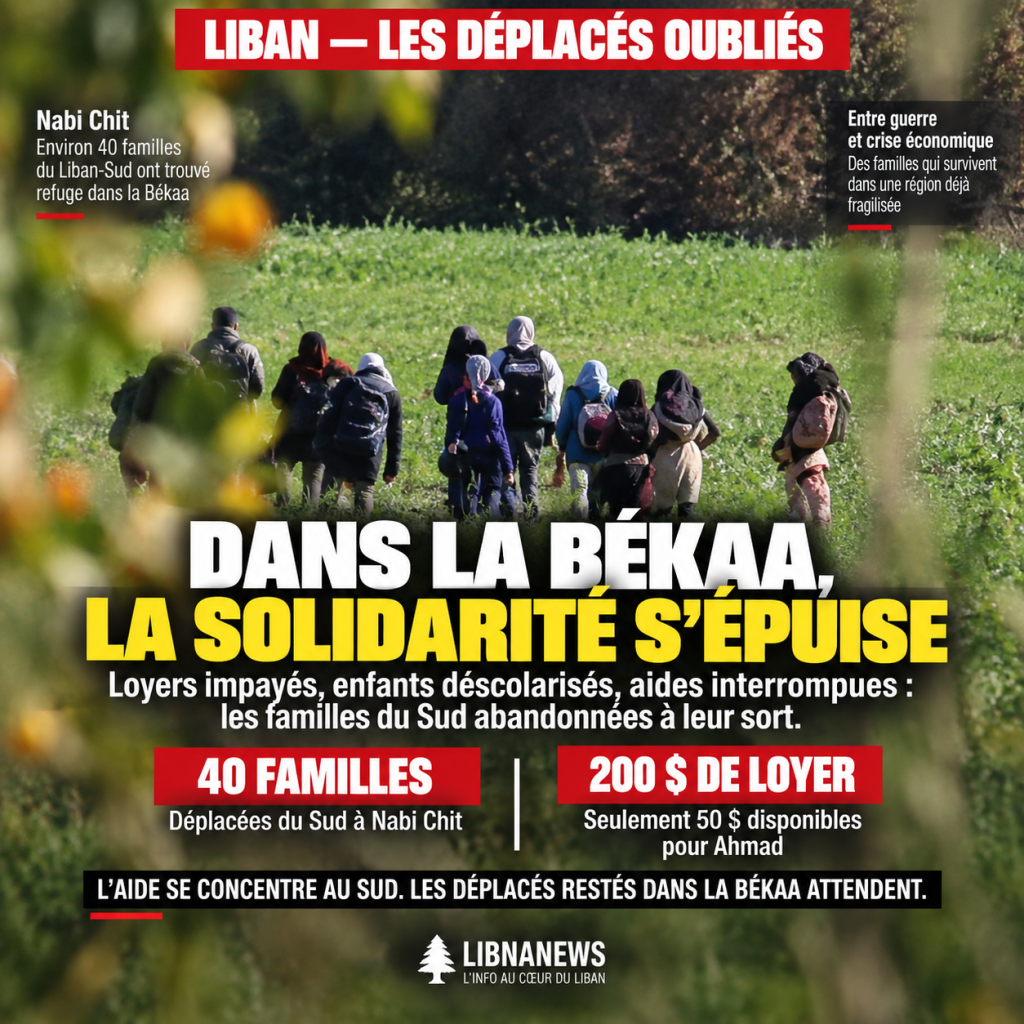
In Nabi Chit, forty families accommodated in a fragile locality
Approximately forty families from South Lebanon found refuge in Nabi Chit, Bekaa. Some have relatives, others have chosen this place for its social and political ties with their region of origin. This choice does not mean that they have regained stable living conditions. The inhabitants of the municipality themselves bear the consequences of the war and the economic crisis. The decline in purchasing power reduced commercial activity, while a portion of the local population left the region without returning. The host families therefore arrive in a locality whose resources and employment opportunities are already limited. Solidarity exists, but it does not replace an income or a sustainable care system.
The shift to the Bekaa continued as the intensity of fighting in the South fluctuated. The fragility of cessation of hostilities arrangements has deterred some families from returning. Others preferred to stay close to parents who could help them. The choice of destination was sometimes influenced by difficult experiences in other cities and localities during the exodus. As a result, the family network and the sense of security were as important as geographic proximity. This distribution of the displaced makes their situation less visible than a gathering in a collective centre: they live in dispersed housing, sometimes without adequate equipment, in the midst of communities already facing poverty.
Two hundred dollars rent, fifty dollars available: the impossible budget of Ahmad
Ahmad, who was displaced from the South, had to pay $200 at the beginning of each month to keep his home. As he describes his situation, he only has $50. The immediate shortage thus reaches 150 dollars, before even taking into account food, medicines, transport or education. He asked for help finding work so that he could pay the rent without waiting for the landlord’s reminders. Its situation shows that the emergency is not limited to the initial accommodation: a family may have found a roof and remain threatened to lose it every month. The loss of activity caused by displacement makes regular expenditure much more difficult to bear than a one-time expenditure.
The owner is not presented as a lessor with unlimited resources. He too depends on rent to live and reminds Ahmad that he has to face his own expenses. Tension thus contrasts two fragile households rather than a prosperous owner with a poor tenant. Ahmad explains that his housing benefits only from rudimentary lighting provided by the owner. This clarification, which is apparently modest, sums up the gap between the administrative concept of housing and the reality of barely equipped housing. The cost of electricity is added to the rent, without the household being able to rely on a regular income to cover the whole.
Electricity and furniture, two needs almost absent from emergency aid
In the host villages, the regulation of electrical subscriptions has become a problem separate from that of housing. A local interlocutor explained that the means available do not allow for the payment of the subscriptions of displaced families. Donors are taking steps to finance solar panels. The objective would be to reduce part of recurrent expenditure, but no amount raised or number of facilities planned is indicated. The use of solar equipment is therefore not, at this stage, a completed programme. It shows above all that local actors are seeking to replace operating aid, which has become difficult to finance, with solutions that can limit invoices.
Destitution also manifests itself inside housing. Some families have too little furniture. Mattresses used for a long period of time have become very worn out and almost ground clad. This situation reveals a often neglected angle of prolonged displacement: getting an address does not guarantee the minimum comfort or the possibility of living in acceptable conditions. Needs do not stop at food parcels. These include bedding, winter heating, access to medicines and basic equipment. However, each additional expense competes with rent. A family may be forced to choose between heating up, treating themselves and keeping their homes.
Discontinued food distributions and associations that refer to responsibility
The last food aid received by some families was about two months ago. This indication does not measure the frequency of distributions for all displaced persons, but it reveals a concrete break in assistance for the households concerned. Contacted associations describe a shift of priorities towards the South, in a context of limited resources. The displaced persons who remain in the Bekaa are then in a paradoxical position: they have left their home region because of insecurity, but are no longer necessarily located in areas that aid programmes favour.
Some associations also report obstacles and difficulties in carrying out their activities in Bekaa. They refer to a geographical distribution of interventions, with each agency expected to cover specific areas. This can facilitate coordination when it works, but it creates blind spots when needs move faster than programs. The stakeholders interviewed describe situations in which each refers responsibility to another organization. No comprehensive register of unserved beneficiaries is provided, and not all agencies are identified. It would therefore be excessive to state that the entire humanitarian system has ceased to function. The documented problem is more specific: families living in certain localities in the Bekaa no longer receive the expected assistance, while the structures requested invoke the lack of resources or the delimitation of their intervention areas.
The school sacrificed: Abu Ali’s son works for 350,000 pounds a day
The trip also interrupted school paths. Some families are unable to register their children because of the cost or lack of documentation requested by the institutions. The case of Abu Ali, displaced from Qatrani, illustrates this difficulty. He failed to register his two children. The school previously attended did not provide the necessary certification due to a former balance of unpaid school fees. The debt accumulated before or during the trip thus creates a new obstacle: without a document, the family cannot normally take the steps to register in another institution.
One of Abu Ali’s sons decided to work in a supermarket rather than continue his schooling this year. His announced remuneration is £350,000 per day. It thus contributes to the household’s expenditure, at the cost of a break in education. The daily amount alone is not enough to estimate its monthly income: the number of days worked is not specified. However, it allows us to understand the mechanism leading to this decision. A family deprived of income must arbitrate between immediate expenses and school continuity. Child employment is becoming a response to the household’s fiscal crisis, as it increases the risk of early school leaving in the longer term.
Why exile to a poor region makes solidarity more difficult
Displaced families do not settle in an economically neutral space. Bekaa and Baalbek-Hermel are themselves suffering from the decline in activity, the effects of war and the degradation of purchasing power. In the host villages, residents lost income or left their homes. Traders are seeing their sales decline. Relatives who host or assist newcomers often share insufficient resources. This reality distinguishes immediate solidarity from sustainable care. Family accommodation can avoid a few weeks of spending, but it does not create the means to finance medicine, school or electricity for months.
The situation of Nabi Chit shows this accumulation of fragility. The 40 or so families from the South add to a proven local population. The aid cannot be assessed solely by number of packages distributed. It must also take into account the ability of households to find employment, the availability of housing and access to services. The available data do not give the total number of displaced persons throughout the Bekaa. It would therefore be unjustified to extrapolate Nabi Chit’s figure to all localities. This case, however, makes it possible to observe in practice how a displacement crisis becomes a crisis of income and services in the host region.
Useful figures, but no overall measure of abandonment
Three data give an immediate idea of the crisis, without pretending to summarize it. In Nabi Chit, the survey counts about forty families from the South. Ahmad must find an additional $150 to cover his only monthly rent. Abu Ali’s son accepts a daily remuneration of £350,000 to support his home. These figures are not interchangeable: the first measure is a local presence, the second one is an individual cash deficit, the third the price at which a teenager exchanges his presence at school for an income. Their interest lies precisely in this difference. They reveal several dimensions of the same prolonged displacement, without allowing the calculation of a general poverty rate or regional average.
These include a consolidated count of displaced households living outside collective centres, a measure of the rent actually paid and a monitoring of the frequency of assistance received. There is also a shortage of children who have dropped out of school for administrative or financial reasons. These absences must not be filled by invented estimates. They prevent measuring the extent of the phenomenon and comparing localities. They complicate the identification of families that escape distribution because they reside in private housing, sometimes with relatives, and not in visible reception facilities. The problem of aid mapping is therefore also that of knowledge of real needs.
Territorially-designed assistance, while needs follow families
The greatest concern is the gap between the location of internally displaced persons and priority areas for assistance. Families have sometimes chosen the Bekaa to avoid further exposure to fighting or to reach relatives. Humanitarian agencies, for their part, explain their focus on the South. This difference does not mean that needs have disappeared in the host regions. She said that the map of interventions could no longer match that of vulnerable people. A family remains displaced even when it does not live in an official accommodation centre or when it has moved away from the most publicised areas.
The testimonies collected describe simultaneous difficulties in housing, energy, food and schooling. These needs are linked. Non-payment of rent threatens housing; lack of electricity makes daily life more expensive; Lack of income causes a child to work; The interruption of food distribution increases the pressure on an already inadequate budget. A limited response to a single item of expenditure may therefore move the problem rather than resolve it. The available information does not allow the total cost of an appropriate care to be quantified. However, they identify specific situations that should be verified by the aid agencies.
As winter approaches, heating costs may worsen these arbitrations. The families interviewed do not only describe a temporary lack of parcels. They speak of a daily in which income, housing and school no longer hold together. For Ahmad, the first deadline remains the $200 rent. For Abu Ali, she became the interrupted school of her children. In both cases, the displacement continues without sufficiently secure return horizon or clearly identified regular support. The contrast between these needs and the geographic reorientation of aid explains why some families from the South living in the Bekaa are, in fact, out of the assistance priorities.





Comments