

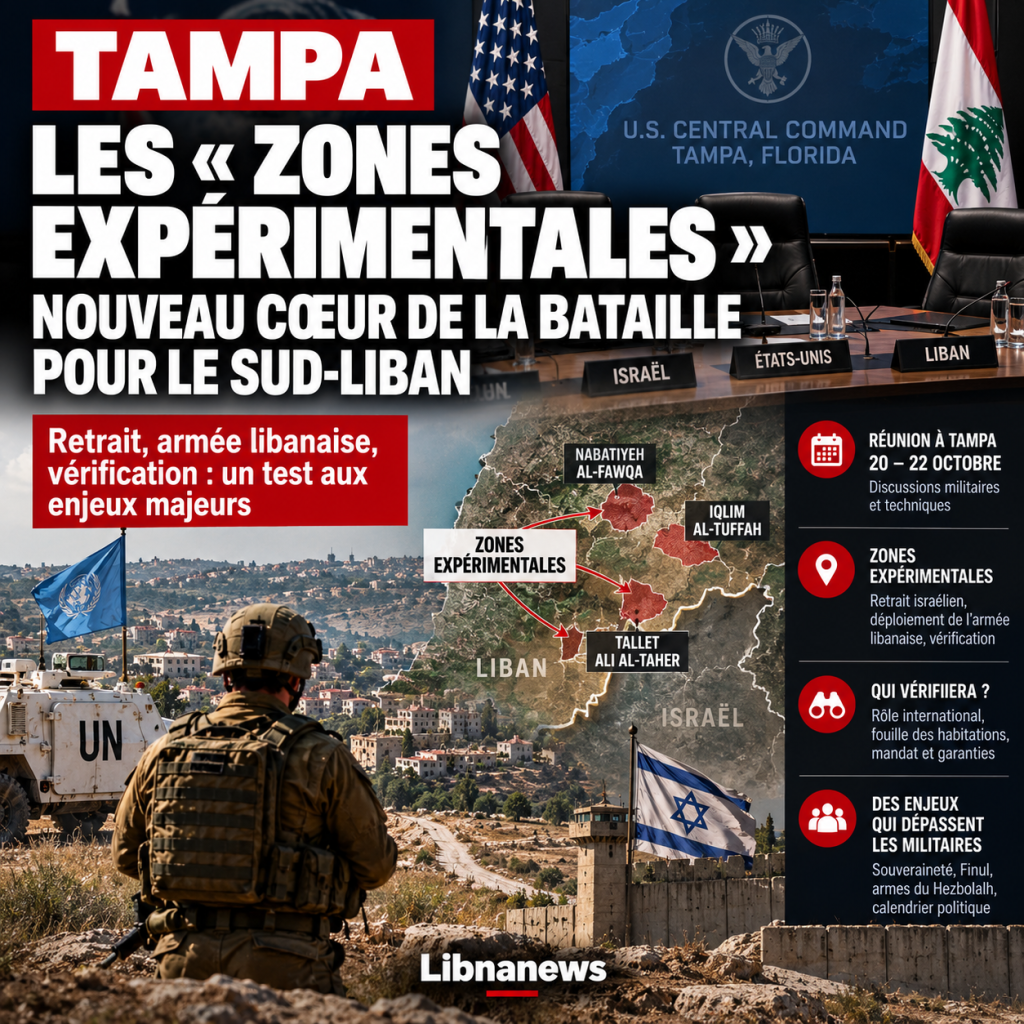
A military meeting, but issues that far exceed the military
The next meeting in Tampa, Florida, should not be read as a mere resumption of discussions between Lebanon and Israel. The appointment, envisaged between 20 and 22 October at the headquarters of the United States Central Command, should be given priority to military and technical matters. However, the issues at the heart of the discussions are directly related to Lebanese sovereignty, the Israeli presence in the South, the role of the army and the Hezbollah weapons file. The most sensitive point is a still poorly understood formula: « experimental zones ».
The mechanism envisaged is based on progressive logic. Instead of waiting for a comprehensive agreement to settle the whole dispute simultaneously, a limited area would be used as a test ground. Israel would withdraw. The Lebanese army would take a stand. A verification mechanism would then monitor the exercise of State authority and the issue of weapons. If this first experiment were considered conclusive, the same model could be applied elsewhere. The aim would therefore be to transform a general formula into concrete territorial sequences.
This is precisely what makes the case as dangerous as it is promising. It all depends on how the first experiment will be defined. If it clearly organizes the passage of an area occupied by the Israeli army under the sole control of the Lebanese army, it can become the beginning of a gradual withdrawal. If, on the contrary, it imposes a series of obligations on Lebanon in territories where Israel is not physically present, while postponing the withdrawal of the occupied areas, it completely changes its nature. It then becomes a mechanism of security conditionality applied within Lebanese territory.
The Lebanese delegation could be led by Simon Karam, with the participation of Ambassador Nada Hamada Moawad. But even this composition is not completely disconnected from the nature of the appointment. Beirut wanted to broaden the discussions and give them a diplomatic dimension. At this stage, Israel prefers to keep the meeting in a military setting. If the Israeli delegation is strictly military and the discussions do not allow any political progress, participation at the highest Lebanese diplomatic level loses some of its interest.
What is an « experimental zone »?
The expression can give the impression of an abstract concept developed by diplomats. In fact, it refers to something very concrete: a limited territory in which the different obligations of the process would be applied simultaneously to verify whether the model is working.
In its simplest version, the mechanism consists of four steps. The first is the Israeli withdrawal. The second is the deployment of the Lebanese army in the evacuated space. The third is the verification of the absence of an armed presence outside the State. The fourth is to confirm that the military and security authority has actually passed over to the Lebanese State. Once this sequence is completed, another area could follow.
The project was therefore not designed, in principle, to create separate enclaves. On the contrary, it must test a method which can be gradually extended. This is why the success or failure of the first experiment is decisive. A formula considered effective can become the model of all the following steps.
The problem arises when defining what exactly « check » means. Is it to be seen that the Lebanese army controls the roads and military positions? Should we inspect facilities suspected of belonging to Hezbollah? Can houses be searched? Who decides that a sector complies with commitments? Can Israel request an inspection from its own intelligence? And most importantly, who arbitrator when one party claims that a violation exists and the other challenges it?
The preparatory documents put precisely the question ofsearch of dwellingsamong topics that could be discussed in Tampa. This detail is sufficient to show that the meeting is not simply about lines drawn on a map. It may enter directly into the procedures for exercising authority within Lebanese villages.
Tallet Ali Al-Taher, the case that shows why the device is complicated
The sectorTallet Ali Al-Taherillustrates the difficulties perfectly. This area was referred to as one of the territories likely to enter a new experiment. But military conditions have changed. Israel is now presented as reluctant to return the hill and its environment, in particular because its position can serve as a support point for a Rihane-oriented device.
This development is crucial. An area that would eventually test a withdrawal may become an element that Israel wishes to retain for operational reasons. Thus, another hypothesis appears: instead of opening a second experimental zone around Tallet Ali Al-Taher, the first zone could be expanded by adding new sectors.
Geography thus becomes the real language of negotiation. A hill, road or village is not just an area. Their altitude, visibility, access and proximity to other positions determine their military value. Ceding a high position does not have the same meaning as leaving an area without strategic depth. Similarly, allowing the Lebanese army to take control of a village does not necessarily resolve the issue if the surrounding heights remain under Israeli control.
The choice of each area therefore already contains part of the final result. That is why Lebanon cannot regard experimental territories as mere technical details left to the military. They determine the order in which sovereignty can be restored and, above all, where this recovery may be delayed.
Nabatiyah Al-Fawqa and Iqlim Al-Tuffah: another Israeli concept
Another development appears in the conditions attributed to Israel. It would no longer be just to use the territories currently occupied as experimental areas. Areas not occupied but subject to Israeli fire might also be affected.Nabatiyah Al-Fawqaand positions inIqlim Al-Tuffahare cited in this logic.
The difference is great. In an occupied area, the mechanism logically begins with an Israeli withdrawal. In an area where the Israeli army is not deployed, the process can begin directly with obligations imposed on the Lebanese army: entering Hezbollah positions, inspecting infrastructure, preventing combatants from staying in or returning to certain localities.
This design practically reverses the initial order. Israeli withdrawal would no longer necessarily be the first movement. Lebanese action against Hezbollah’s military infrastructure could become the condition for subsequent progress on withdrawal.
This is one of the most sensitive points for Beirut. The State affirms its objective of arms monopoly. But it refuses to allow the exercise of this sovereignty to become a mechanism in which Israel would dictate, locality by locality, the operations that the Lebanese army must carry out. The exclusive control of the State in its territory also implies that the State itself decides how its forces are organized and used.
The army thus refuses any interference in the composition of its units and in its operational methods. Coordination to avoid accidental confrontation is not equivalent to coordination to enable Israel to direct Lebanese Army missions.
The real knot: who will check?
Even if an agreement was reached on the map, the problem of control would remain. Lebanon refuses to allow verification to be exclusively Israeli. To accept such a system would be to give one of the parties the power to decide on its own whether or not the other fulfils its commitments.
Let us take a concrete scenario. Israel claims to have information about a weapons cache in a dwelling. The Lebanese army inspects the area and finds nothing. Who slices? Can Israel consider that the inspection is insufficient? Can he demand a new operation? Does a third party have to attend the search? And if this third party exists, what mandate does it have to intervene within a private property in Lebanon?
The search for an international component addresses this problem. A third party could see the operations and reduce the risk that a technical disagreement will immediately become a justification for a new strike. But finding this actor is far from simple.
Italy was mentioned among countries that could participate in a mechanism. However, it appears very cautious. An official of his intelligence services returning from Lebanon reportedly did not obtain the necessary guarantees regarding the security of the personnel or the conditions for carrying out the requested missions. Sending observers to an area where strikes remain possible requires rules of engagement, guarantees of protection and an extremely precise definition of their role.
To this difficulty is added a political contradiction. Israel is presented as unfavorable to an international presence that would limit its freedom of action in the South. Hezbollah, for its part, refuses an international presence outside the framework of the United Nations and a mandate clearly attached to Resolution 1701. Between these two positions, the space available to invent a new mechanism becomes very narrow.
The Finul, the absente that remains at the center of everything
The question of verification cannot therefore be separated from the future of theFinish. For decades, the international presence in the South has provided a well-known framework. Even when challenged or deemed insufficient, it has a mandate, a chain of command, identified contingents and Security Council legitimacy.
His departure would create a vacuum at the very moment when the future withdrawal mechanism would need a third party capable of observing what was happening. It is this paradox that explains the political efforts to maintain Finul or to imagine an international alternative formula.
Four scenarios must be distinguished. The first would be the maintenance of Finul in a form close to the present. The second would be a new international force under United Nations mandate. The third would be a European or multinational military assistance mission. The fourth would be to directly strengthen the Lebanese army without deploying a comparable international force.
These options are not interchangeable. An assistance mission can train, equip and finance the army without having the right to find a violation on the ground. An international force may have an observer mandate but not necessarily inspection powers. A European structure may be politically acceptable to some actors and rejected by others if it is not under the authority of the United Nations.
The battle around the Finul is therefore directly linked to Tampa. On the day an area is to be moved from Israeli control to Lebanese control, someone will have to see that the withdrawal has taken place, that the army has deployed and that the planned commitments have been implemented. Without a third party accepted by both parties, each incident may produce two incompatible narratives.
The agenda of 27 October weighs on the discussions
To all these difficulties is added the Israeli political calendar. The Knesset elections are announced for the27 octobera few days after the proposed Tampa meeting. Benjamin Netanyahu is therefore entering the final phase of his campaign at a time when his government should eventually accept the withdrawal of certain positions.
This schedule greatly reduces the possibility of a spectacular concession. A withdrawal can be presented by Netanyahu’s opponents as a setback. On the contrary, the Israeli Prime Minister seeks to maintain an image of firmness and control over the security issue. Electoral considerations do not mechanically determine all military decisions, but they set a political ceiling on possible compromises before the election.
Washington seems to take that into account. The American objective would not necessarily be to reach a major agreement before 27 October. Rather, it would prevent the negotiation channel from disappearing during the election period and the subsequent formation of power. A military meeting with limited results would keep the mechanism alive.
This logic also explains why Lebanese requests to extend the meeting to a diplomatic component are met with resistance. A military discussion on a map and procedures is politically less costly than a posted negotiation on withdrawal and sovereignty.
For Lebanon, this temporality is dangerous. Waiting for the end of the Israeli elections may seem rational if no major concessions are possible before. But each additional week also allows Israel to strengthen its positions on the ground. Diplomatic and military time therefore do not necessarily work in the same direction.
Hezbollah at the centre of American and Israeli demands
The meeting is also expected to address Beirut with requests directly related to Hezbollah weapons. Theprecise schedules and operational commitmentsfor their withdrawal are mentioned. The challenge would therefore no longer be simply to reaffirm the principle of State monopoly of arms, but to show how it should be applied in practice.
This pressure is accompanied by Israeli reports that Hizbullah is relocating certain capabilities to deeper areas, including Iqlim Al-Tuffah, Jabal Al-Rihan and Jabal Safi. These claims come from the Israeli side and do not constitute independent evidence alone. However, they have an obvious political function: to justify the idea that an Israeli withdrawal limited to the border sector would not suffice to eliminate what Israel presents as a threat.
The risk for Lebanon is that the scope of the negotiations will gradually expand. If every alleged redeployment of Hezbollah moves the verification area further north, the mechanism originally intended to organize the withdrawal could become a means of imposing security conditions on an increasing depth of the territory.
That is exactly why the geographical definition of areas must be linked to a timetable. Experience can only make sense if its consequences are known in advance. If the first area is declared compliant, the second area shall follow a specified procedure. Without this, each step can become an opportunity to fully reopen negotiations.
Searching houses: the question that can rock the mechanism
Among all technical subjects, the search of dwellings is probably the most explosive. It affects both security, private property, local confidence and the legitimacy of the army.
In southern villages, asking the army to check houses on the basis of foreign information is not a neutral operation. The necessary level of evidence, the authority ordering inspection and the applicable legal procedures must be defined. Without precise rules, the system can create direct tensions between the army and the populations it is specifically responsible for protecting.
There is also an operational risk. If Israel claims that a house contains weapons and the Lebanese army does not confirm this information, a subsequent Israeli strike could be justified on the grounds that the mechanism failed. Conversely, if every Israeli intelligence automatically initiates a search, Israel would indirectly have a means of directing security operations inside Lebanon.
The presence of an international observer does not automatically resolve this contradiction. It can only provide one additional witness. The real question remains that of authority: who makes the final decision on Lebanese territory?
Tampa is only valid if each step leads to the next
The main danger of the experimental zones would ultimately be that they would cease to be experimental. An area could be evacuated and stabilized without the next one. The mechanism would then become a mosaic of territories subject to different statutes, with areas controlled by the Lebanese army, others occupied by Israel and others under permanent surveillance.
To avoid this scenario, three elements are essential in any road map: a territorial order, deadlines and a procedure for resolving disagreements. It is important to know which zone follows the first, how long the steps are separated and what happens if one of the parties states that the commitments have not been met.
Without these guarantees, Lebanon could fulfil its obligations in an area without automatically obtaining Israeli withdrawal from the next. At each stage, new requests may emerge. The negotiations would then turn into an indefinite process.
Conversely, refusing a gradual approach also entails a cost. As long as no withdrawal mechanism exists, Israeli positions can be consolidated. Military installations become more sustainable, access roads are improved and a presence initially presented as provisional gradually acquires the characteristics of a long-term settlement.
Tampa therefore lies between two risks. The first is to accept a mechanism that indefinitely conditions Israeli withdrawal. The second is to let the lack of agreement turn a temporary occupation into a lasting reality.
The real question will not be whether participants have accepted the « experimental zones » principle. It will be to know the details that accompany these two words: where the first zone begins, who controls it after withdrawal, who checks, with what powers, according to what rules, for how long and which zone comes immediately after. It is in these answers, much more than in a final communiqué, that Tampa’s real scope will be played.





Comments