

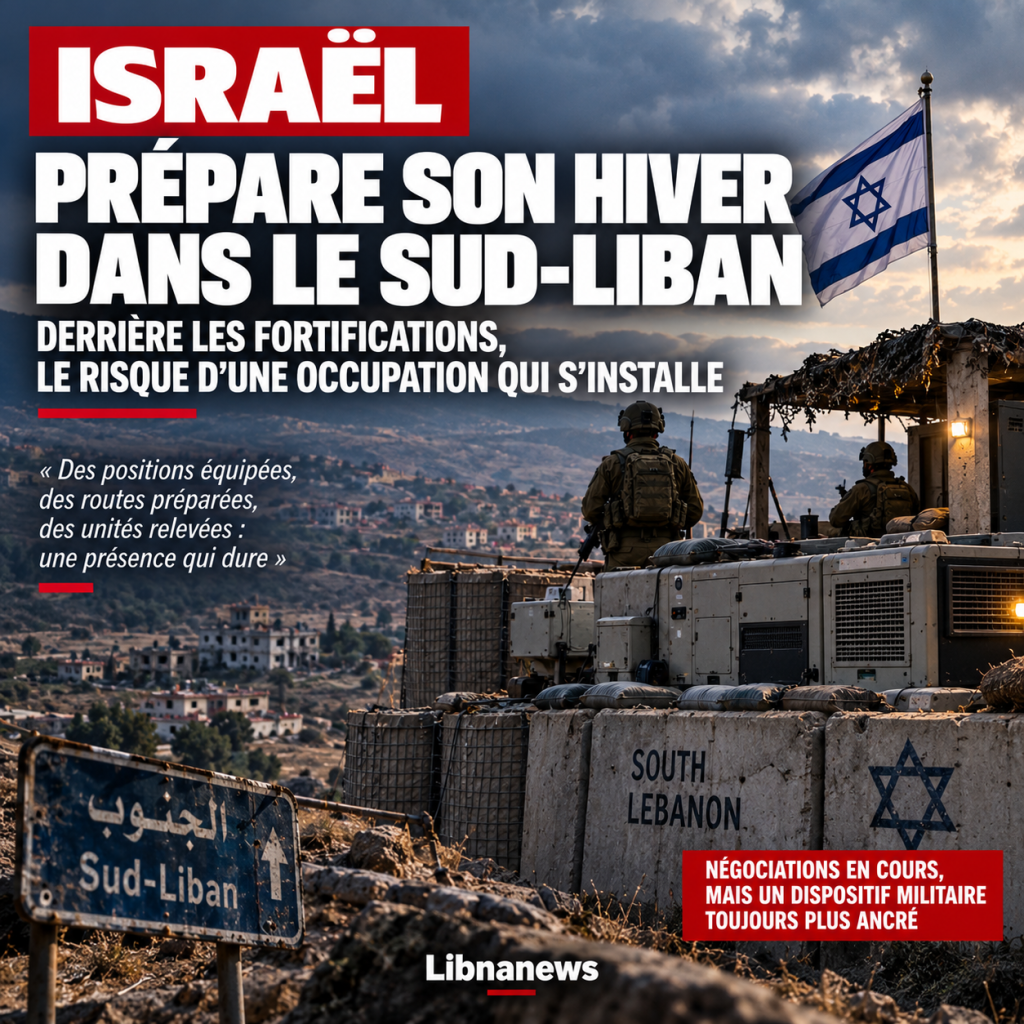
Buildings equipped to spend the winter
The most revealing change is not in a diplomatic statement, but in logistics. The available information describes Israeli soldiers who will spend the winter in protected groups inside villages in southern Lebanon. Buildings were reportedly prepared during the summer with electrical generators, air conditioning systems, sanitary facilities and pre-developed access roads. Taken separately, each of these elements may be within the normal protection of a deployed force. Together, however, they describe an organization designed to last beyond a few days or weeks.
The device no longer resembles that of units entering an area on an ad hoc basis to conduct an operation. A force that prepares electricity, sanitation, road access and the living conditions of its soldiers for the winter anticipates a continuous presence. This does not make it possible to determine its exact duration or to state that it will become permanent. On the other hand, this shows that the assumption of a rapid withdrawal is not the one on which all Israeli military planning is based.
This development comes as discussions on an Israeli withdrawal and the deployment of the Lebanese army remain open. At the diplomatic level, negotiations include withdrawal mechanisms and a gradual transfer of control to the Lebanese State. On the ground, the available information describes an army that improves its positions, organizes its rotations and prepares materially for the following season. Both dynamics do not necessarily exclude, but this preparation gives Israel the ability to stay if negotiations fail.
Brigade 55 leaves, but positions remain
The rotation of units provides a second important index. The Reserve Parachute Brigade number 55 completed a period of approximately 100 days of mobilization, including nearly eighty days of operations in Lebanon. His departure does not correspond to the abandonment of the occupied positions. These must be handed over to alternative forces. Elements of the B Islamach Brigade and the Gefen Battalion, attached to the training of officers, are mentioned among the units taking over.
This distinction is essential. When positions are transferred to another training, it is a rotation, not an evacuation. The device changes without disappearing. New forces drive trainings and improve locations for fire observation and fire control in deeper areas.
The duration of the mobilization of Brigade 55 also allows us to measure the transformation of the theatre. Eighty days of operations in Lebanon no longer correspond to a brief incursion. The soldiers worked in a space presented by the Israeli army as extending from the border to what it calls the « yellow line », with a depth of up to 12 kilometres in some areas. This Israeli name does not constitute a border recognized by Lebanon.
Twelve kilometres: a depth beyond the border strip
The figure of about 12 kilometres is one of the most sensitive of the file. It does not mean that the Israeli army uniformly occupies a continuous strip of this depth throughout the South. Instead, the available information describes an area of operation and control whose depth varies by sector. It is therefore necessary to avoid turning this figure into a new continuous geographical line. But its existence shows that military logic is no longer necessarily limited to the few positions directly adjacent to the border.
This depth makes it possible to observe traffic routes, monitor localities and exercise fire control over areas where soldiers are not always physically present. An army may not hold every house or road while preventing the inhabitants from returning or quickly striking any activity that it considers a threat.
For a resident prevented from returning to his village, the distinction between the permanent presence of soldiers and the area controlled by fire has a military and legal scope, but far less effect on his daily life. Reconstruction cannot normally begin in a locality where construction equipment, residents or municipal teams remain exposed.
Roads, fortified positions and fire control
Road works are less spectacular than strikes, but they are strategically decisive. Improving an access lane allows for faster refuelling, evacuating an injured person, moving heavy vehicles and maintaining a logistical link with the rear when weather conditions deteriorate. Combined with equipped buildings and fortified sites, a military road reduces the daily cost of an extended presence.
Alternative forces are also described as improving positions that provide fire observation and control capabilities in areas in depth. The value of a location is therefore not only defensive. A few well-chosen points can help monitor several roads, valleys or localities and explain why some heights become so sensitive in the negotiations.
The more work a site requires, the more its future dismantling becomes a visible decision. A summary position can be evacuated quickly. A combination of protection, electricity, sanitation and logistics is a larger investment. This investment does not make withdrawal impossible, but it indicates that retention is seriously considered.
Villages under pressure as positions consolidate
Consolidation occurs in parallel with an extension of areas subjected to shelling, artillery fire, destruction and movement restrictions. In early October, significant blasting was carried out in Al-Mansouri, with detonations heard far away. Another took place near Baraachit. Houses were set on fire in Zawtar Al-Sharqiya. Shots and strikes involved Kafartibnit, Wadi Al-Hujair, Mifdoun, Wadi Al-Saluki, Al-Ghandouriya, Al-Qantara and other areas.
The bombing also spread to Wadi Hassan, on the outskirts of Majdal Zoun, while fire hit areas around Hadatha and Haris. Other reports include operations in Houla and destruction of buildings, including schools. The picture that comes out is therefore not that of a perfectly fixed front line. Military pressure affects communities at different depths and helps keep part of the population away from its villages.
Local sources describe this evolution as an extension of the empty spaces of their inhabitants. This interpretation must be distinguished from the material facts themselves. But the territorial effect is visible: the more exposed areas expand, the more the return of civilians, the repair of networks and the resumption of economic activity become difficult.
Majdal Zun and Al-Mansuri in the Israeli military story
Brigade 55 operations include Majdal Zoun and Al-Mansouri. In the Israeli account, Hizbullah reportedly used the post-ceasefire period to prepare or reuse infrastructure in these areas. The Israeli army claims to have destroyed more than six hundred Hezbollah-related sites and infrastructure, including eight tunnel openings, as well as explosive devices, launching devices and weapons depots.
Israeli officials also claimed to have discovered large quantities of weapons in searched houses, some containing, according to their accounts, between twenty and thirty weapons, in addition to grenades, vests and helmets. These figures and descriptions come from the Israeli side. They cannot therefore be presented as the result of an independent audit. Their importance lies in their function: they are the security argument used to justify the continuation of operations and the depth of the device.
The Israeli army also claims to have killed about ten Hezbollah members in attempts to cross the line it controls, including using tanks and drones. Again, this is a balance sheet claimed by the Israeli army. In an environment where independent access to certain areas is limited, caution is required to maintain this allocation.
If Israel considers that Hezbollah’s infrastructure can be rebuilt as soon as an area is evacuated, it will seek either to delay its withdrawal or to impose a very intrusive control mechanism after it. For Beirut, the question is the opposite: can an Israeli security concern justify a military presence without a clear deadline within Lebanese territory?
An occupation that can change form
Long-term occupation does not necessarily resemble the features of the past. It can be based on a limited number of fortified positions, linked by roads, protected by surveillance and able to control by fire much larger areas. Drones also reduce the need for a dense human presence. A force can monitor a valley, identify movements and trigger a strike without physically holding each locality.
This evolution makes territorial control more complex. The number of soldiers or fixed posts is no longer sufficient to measure the military right of way. Access routes, heights, monitoring capabilities, range of weapons and restrictions on civilians must be looked at. A village evacuated by the soldiers but where the inhabitants still cannot return freely has not returned to a normal situation.
However, it would be excessive to conclude, on the basis of these elements alone, that Israel has already decided on a permanent occupation. The available information establishes long-term preparations and a mechanism capable of crossing the winter. They do not provide an official calendar setting out several years of presence. The preparation of a scenario is not proof of an irreversible decision. But in a territorial case, infrastructures are gradually creating their own inertia.
Winter becomes a bargaining factor
The timetable gives these preparations immediate scope. Military discussions in Tampa should address withdrawal, the deployment of the Lebanese army, experimental areas and verification mechanisms. At the same time, the Israeli elections of 27 October reduce the political margin available for a significant withdrawal before the election. The army is preparing the winter season while diplomacy is still trying to determine the conditions for evacuation.
This simultaneity puts Lebanon before a difficulty. The longer negotiations take, the more Israeli positions are adapted to a sustainable presence. But accepting an agreement too fast and unbalanced could turn withdrawal into a succession of endless security conditions. Beirut must therefore obtain a timetable sufficiently precise to ensure that temporary measures do not become a new normality.
A presence that lasts until spring is no longer measured in days. It affects an entire agricultural season, a school year, reconstruction work and the return of the inhabitants. Each month of additional ban or insecurity can increase damage to homes, land and infrastructure. The projects concerning schools, hospitals, water and electricity are then faced with a simple reality: a territory that remains under fire is not normally rebuilt.
The Lebanese Army, an indispensable part of a possible withdrawal
Any exit scenario is based on the ability of the Lebanese army to take over immediately. An evacuated Israeli position must be able to pass under the effective authority of the State. But the transfer is not just about soldiers and flags. It presupposes that the army controls the roads, secures the villages, treats any military infrastructure and has the human and material means necessary to stay on a sustainable basis.
The disappearance or transformation of the Finul complicates this perspective. For decades, the international presence has provided a mechanism for liaison, observation and reduction of incidents. If this architecture disappears at a time when the Lebanese Armed Forces must resume more territory, it will be necessary to determine who will accompany the process and how the allegations of violations will be dealt with.
The stake is double. The Israeli withdrawal must be sufficiently clear to ensure that the evacuated positions do not remain under permanent indirect control. At the same time, the Lebanese deployment must be robust enough to prevent Israel from justifying a reoccupation by the emergence of new military activities. Without these two guarantees, the mechanism can circle.
From temporary presence to fait accompli
A temporary military presence can become sustainable without a specific day marking the changeover. The change occurs by accumulation: an improved road, a fortified building, a rotation of units, a prolonged prohibited area, and then a new season spent on site. None of these acts alone is enough to create a new border. Together, they can make a fait accompli much harder to reverse.
It is this accumulation that must be observed in the South. Generators and sanitary facilities indicate a preparation for daily life. Roads improve logistics. Rotations maintain positions without exhausting the same unit. The means of surveillance and fire extend the military effect beyond the physically occupied places. At the same time, destruction and restrictions slow down the return of civilians. The set produces a more stable architecture than a simple incursion.
So the question is not just how many Israeli soldiers are now in the South. It is to know what infrastructure is being built around their presence and how much territory can be controlled from these points. A reduced presence in number can retain a significant territorial effect if it has roads, dominant positions, drones and freedom to strike.
The real indicator will be the winter pass. If the installations remain occupied, if the rotations continue and if the prohibited areas do not decrease despite the negotiations, the thesis of a provisional presence will become increasingly difficult to support. On the other hand, a timetable for verifiable withdrawals would show that such preparations were a matter of military precaution and not of building a new status quo.
What the preparations already say
There is no evidence that a formal decision on permanent occupation has been taken. On the other hand, they make it possible to see something more precise: the Israeli army prepares materially to be able to stay in southern Lebanon during the winter. It replaces units that have reached the end of their mobilization, improves positions, prepares buildings, maintains access and retains control over deeper areas.
This preparation alters the balance of power of the negotiations. The one who can stay for a long time can better bear the failure or delay of the discussions. For Lebanon, each additional week therefore increases the importance of obtaining not only an agreement in principle on withdrawal, but a timetable, a succession of zones and a mechanism capable of verifying that the positions evacuated are actually so.
The file is no longer only about words used in Tampa or capitals. It is also played in generators installed in buildings, sanitary facilities prepared for soldiers, improved roads and units taking over. These logistical details are less visible than a strike or political declaration. Yet they are the ones that allow an army to transform an emergency presence into a lasting one. It is precisely for this reason that the coming winter is now a political as well as a military test for southern Lebanon.





Comments