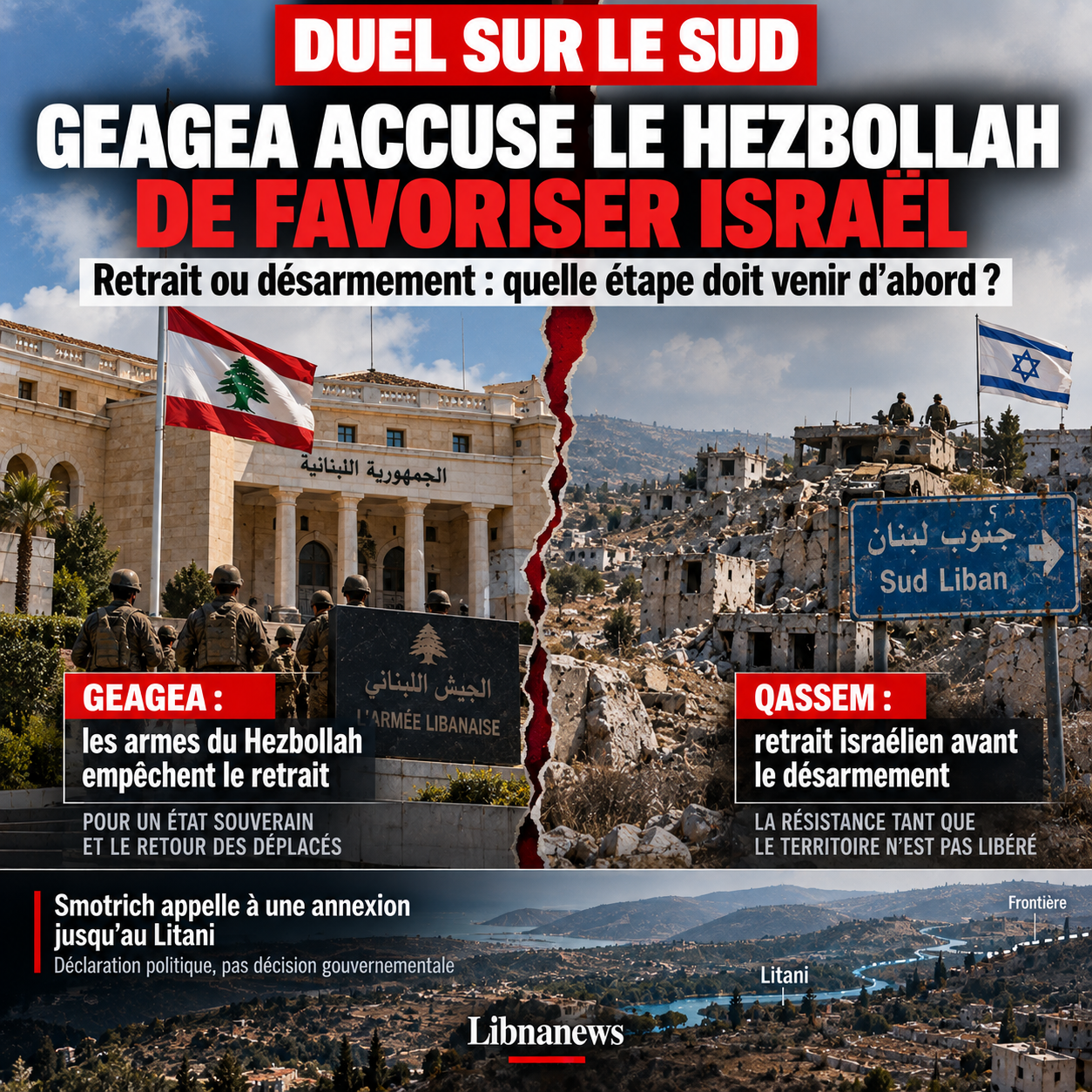
The Chief of the Lebanese Forces,Samir Geagea, replied strongly Monday 28 September to the Secretary General of Hezbollah,sheikh Naim Qassemby accusing him of having contributed, by maintaining his party ‘ s military apparatus, to the current Israeli occupation of part of the South Lebanon. This confrontation occurred in the aftermath of a Qassem speech denouncing the framework agreement with Israel and accusing the Lebanese authorities of serving the « Israel-American project ». On the contrary, Geagea defends the State’s strategy and affirms that the disarmament of Hezbollah is a necessary condition for Israeli withdrawal, the return of displaced persons and reconstruction.
Geagea responds directly to Naïm Qassem
Samir Geagea’s reaction directly targets the speech delivered on Sunday by Naïm Qassem on the occasion of the second anniversary of Hassan Nasrallah’s death.
Hezbollah’s Secretary General had accused the Lebanese authorities, through the framework agreement with Israel, of helping the Israeli-American project rather than fighting it.
Geagea overturns this accusation.
According to him, it is up to the Lebanese State to face Israel. He called on Hezbollah to give it the means to act and considered that the maintenance of an independent military force prevented the institutions from fully resuming the initiative.
« The Lebanese state is the one that has to face Israel, provided you step aside and give it a chance, » Geagea said in addressing Qassem.
The leader of the Lebanese Forces believes that Hezbollah cannot simultaneously request the State to release the territory and maintain a military apparatus that escapes its authority.
In its argument, the continuation of this arsenal provides Israel with a reason to continue its military presence and operations in Lebanon.
This analysis constitutes the line defended by the Lebanese Forces for several months. The party calls for the application of the principle of the State monopoly on arms and calls on the authorities to speed up its implementation.
« You caused the occupation of the South »
Samir Geagea goes further by assigning the military choice of Hezbollah a political responsibility in the current situation in South Lebanon.
He claims that the « resistance » produced the opposite result of the one claimed by the Shiite party.
According to him, Hezbollah has helped create conditions that have enabled Israel to reoccupy part of Lebanese territory. This is a political accusation made by the Lebanese Forces Chief.
Israel effectively maintains forces in an area that it presents as a « security zone » in South Lebanon. This presence extends in places up to about ten kilometres within Lebanese territory.
The Israeli army also continues to carry out strikes and operations in the South.
Israel justifies its military maintenance by the need, according to its authorities, to prevent Hezbollah from rebuilding its capabilities near its border. Beirut is calling for Israeli withdrawal from Lebanese territory.
The controversy now concerns the order in which the two main steps must be taken: the Israeli withdrawal and the disarmament of Hezbollah.
For Naïm Qassem, Israel must first leave Lebanon and allow the return of displaced inhabitants.
According to Samir Geagea, the reasoning must be reversed: the maintenance of Hezbollah’s weapons prevents Lebanon from achieving Israeli withdrawal.
Disarmament of Hezbollah at the heart of disagreement
The issue goes beyond the military situation in the South.
Geagea accuses Hezbollah for decades of circumventing the Taif Constitution and agreement by maintaining a military and security power independent of the state.
He also blames him for influencing the country’s strategic decisions according to its own priorities.
Hezbollah challenges this reading. The party historically presents its arsenal as an instrument of resistance against Israel. Since the new Israeli military operations in Lebanon, he claims that the presence of his weapons remains necessary until the territory is fully liberated.
This divergence has increased since the ceasefire of November 2024 and the new hostilities of 2026.
The Lebanese authorities have embarked on a process of placing weapons under the exclusive control of the State. Hezbollah’s military activities were subsequently banned by the authorities.
However, the party refused to consider disarmament as a prerequisite for Israeli withdrawal.
Naïm Qassem again defended this position on Sunday.
He also warned against any use of the Lebanese army as a « tool » directed against Hezbollah.
The framework agreement crystallises confrontation
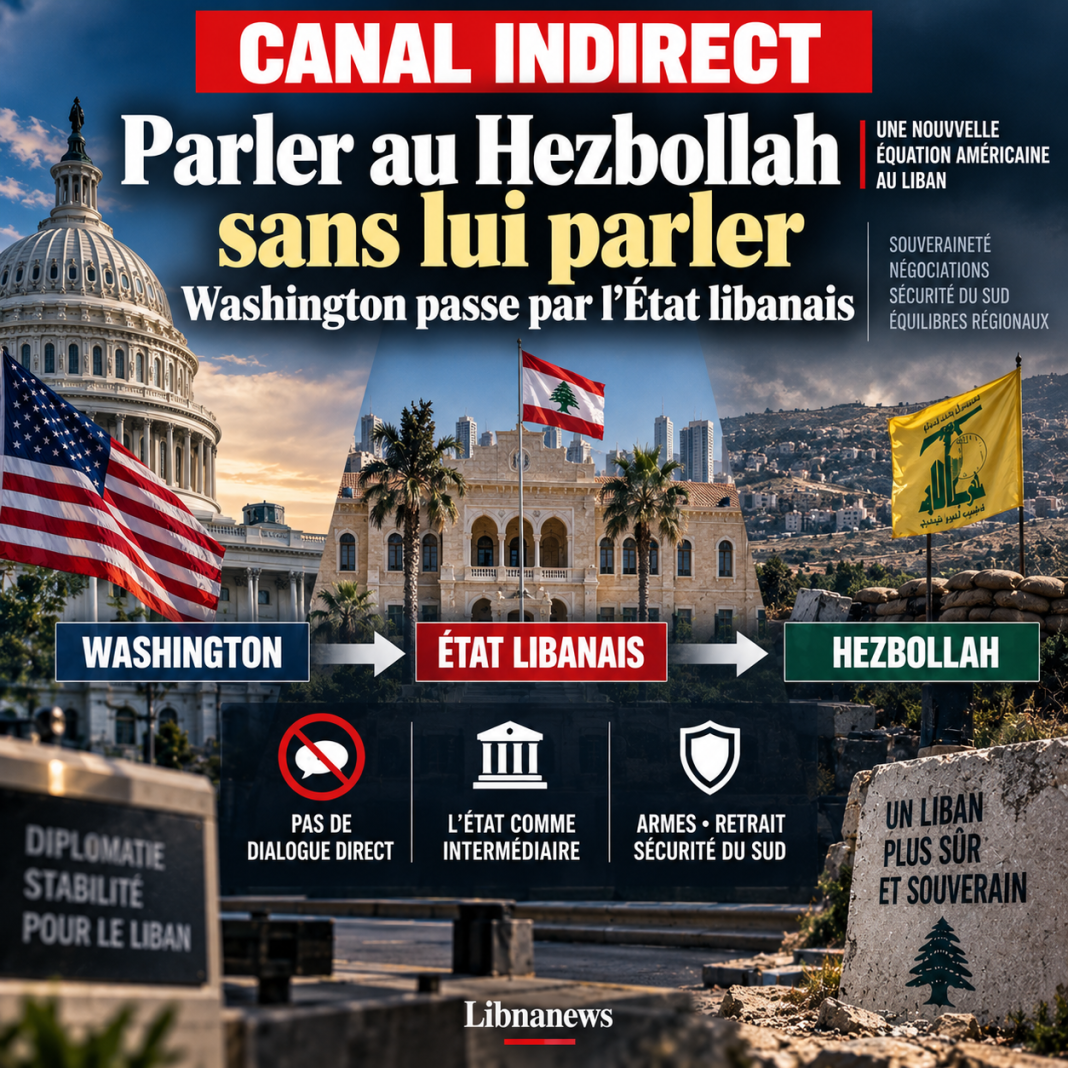
The dispute between Geagea and Qassem now deals directly with theframework agreement between Lebanon and Israelconcluded under american mediation in june 2026.
The scheme provides for a process combining Israeli withdrawal, the deployment of the Lebanese army and the dismantling of Hezbollah’s military capabilities in the sectors concerned.
Pilot areas have been selected in South Lebanon to test this formula.
The principle is to allow the Lebanese army to regain control of the territories evacuated by Israeli forces. At the same time, it must prevent the restoration of an independent military infrastructure.
Implementation, however, faces difficulties.
Israel believes that the measures taken against Hezbollah remain insufficient and affirms that it will retain its positions as long as the movement poses a threat.
The Lebanese authorities also consider that the continuation of the Israeli presence and operations complicates the deployment of the State and the return of the inhabitants.
It is in this impasse that the confrontation between Qassem and Geagea takes place.
The first considers that the agreement imposes concessions on Lebanon that serve the interests of Israel and the United States. The second sees it as an instrument enabling the Lebanese State to gradually recover its territory and sovereignty.
Qassem first demands Israeli withdrawal
Sunday, September 27, in front of his supporters gathered in the southern suburbs of Beirut to commemorate Hassan Nasrallah, Naïm Qassem reaffirmed that Hezbollah had not been defeated.
The leader of the party stated that he was ready for dialogue and discussion, but he laid down a precondition: the liberation of South Lebanon and the return of the inhabitants.
He also claimed that the maintenance of military positions was not the main objective of Hezbollah.
This declaration comes after extensive destruction by Israel on the strategic ridge of Ali al-Taher. The Israeli army claims to have destroyed Hezbollah’s infrastructure there.
Qassem believes that today’s pressure on Lebanon seeks to obtain politically what Israel would not have been able to obtain militarily.
He therefore promises to pursue the Hezbollah line.
Geagea replied that this strategy is precisely preventing the target announced.
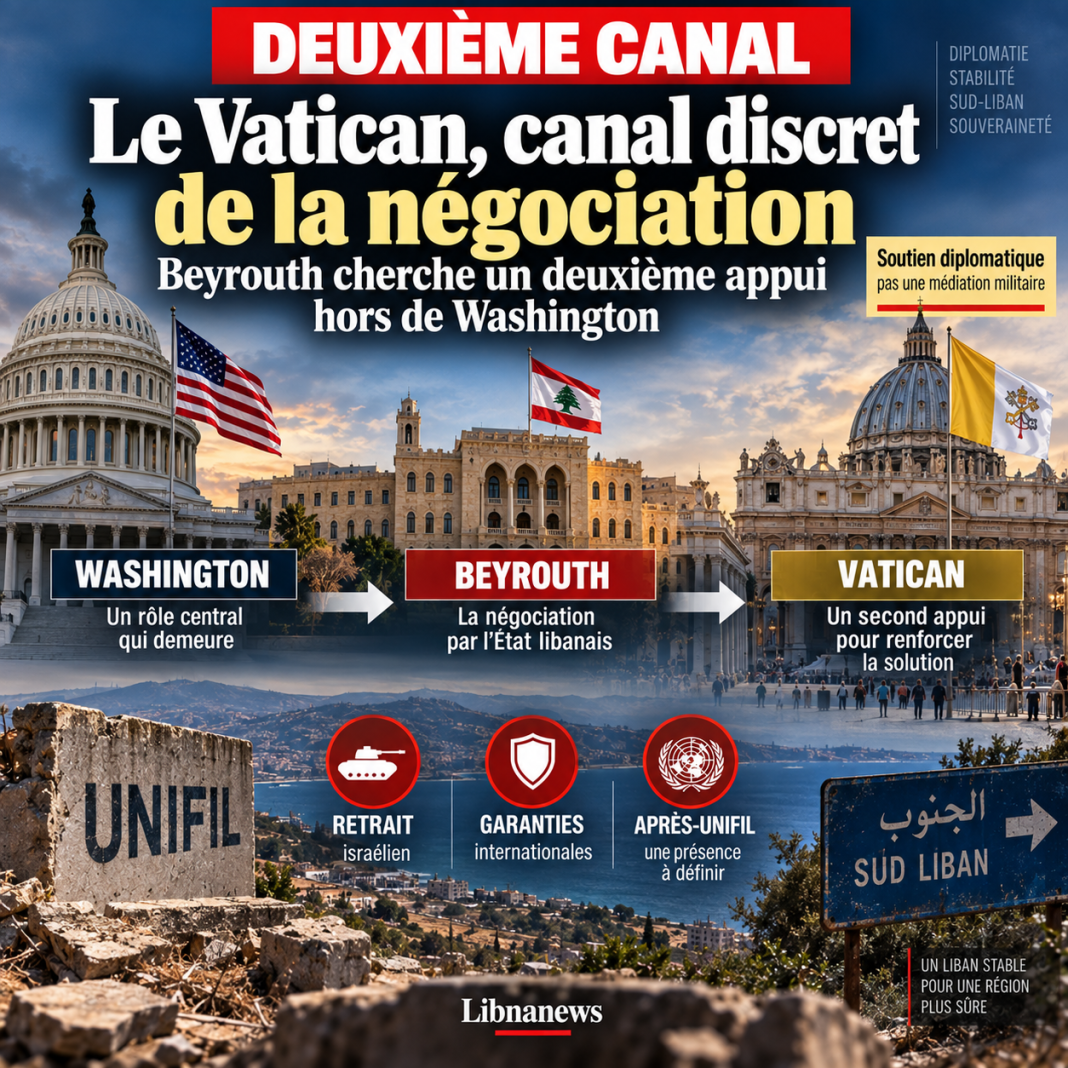
Geagea builds on Lebanon’s international partners
The leader of the Lebanese Forces is also developing a diplomatic and economic argument.
In his view, Lebanon alone does not have the means to secure Israeli withdrawal, rebuild destroyed areas and finance its recovery.
He cited Saudi Arabia, the Gulf States, European countries and the United States among the partners that Beirut needed.
Geagea states, however, that these countries are not prepared to fully engage their support until the issue of Hezbollah weapons is resolved.
This position joins its central argument: Lebanon’s ability to mobilize its partners would depend on the restoration of the State’s exclusive authority.
On the contrary, Hezbollah considers that the disarmament called for under international pressure would deprive Lebanon of a means of resistance while Israeli forces remain on its territory.
The two sides therefore start from the same observation — part of South Lebanon remains under Israeli military control — but propose opposite sequences to get out of it.
Smotrich’s statements reinforce tensions
The controversy arose as a member of the Israeli government formulated a much wider territorial claim.
Sunday, the Israeli Minister of Finance,Bezalel Smotrich, figure of the Israeli far right, called for annexation of territories from the South Lebanon to thelitani River, located about 30 kilometers from the border.
This declaration alone is not an official decision of the Israeli Government to annex this area.
However, it is fuelling concerns in Lebanon while Israeli forces are already maintaining positions within the territory.
It also provides an argument to the opponents of Hezbollah’s disarmament, which underscores the ambitions expressed by some Israeli officials.
However, Geagea defends a different reading of the response to these threats.
For him, resistance no longer consists of maintaining an armed organization parallel to the state. It must involve the consolidation of Lebanese institutions, the strengthening of the army and the mobilization of the country’s international partners.
The political confrontation between the Lebanese Forces and Hezbollah thus focuses on an immediate question:what step must be taken first to secure Israeli withdrawal from South Lebanon?
Naim Qassem demanded Israeli withdrawal before any discussion leading to disarmament. On the contrary, Samir Geagea claims that this withdrawal will remain unattainable as long as Hezbollah retains its military apparatus.
On the ground, this divergence remains complete, while the June framework agreement is progressing hard and Israeli forces remain present in part of the South Lebanon.