





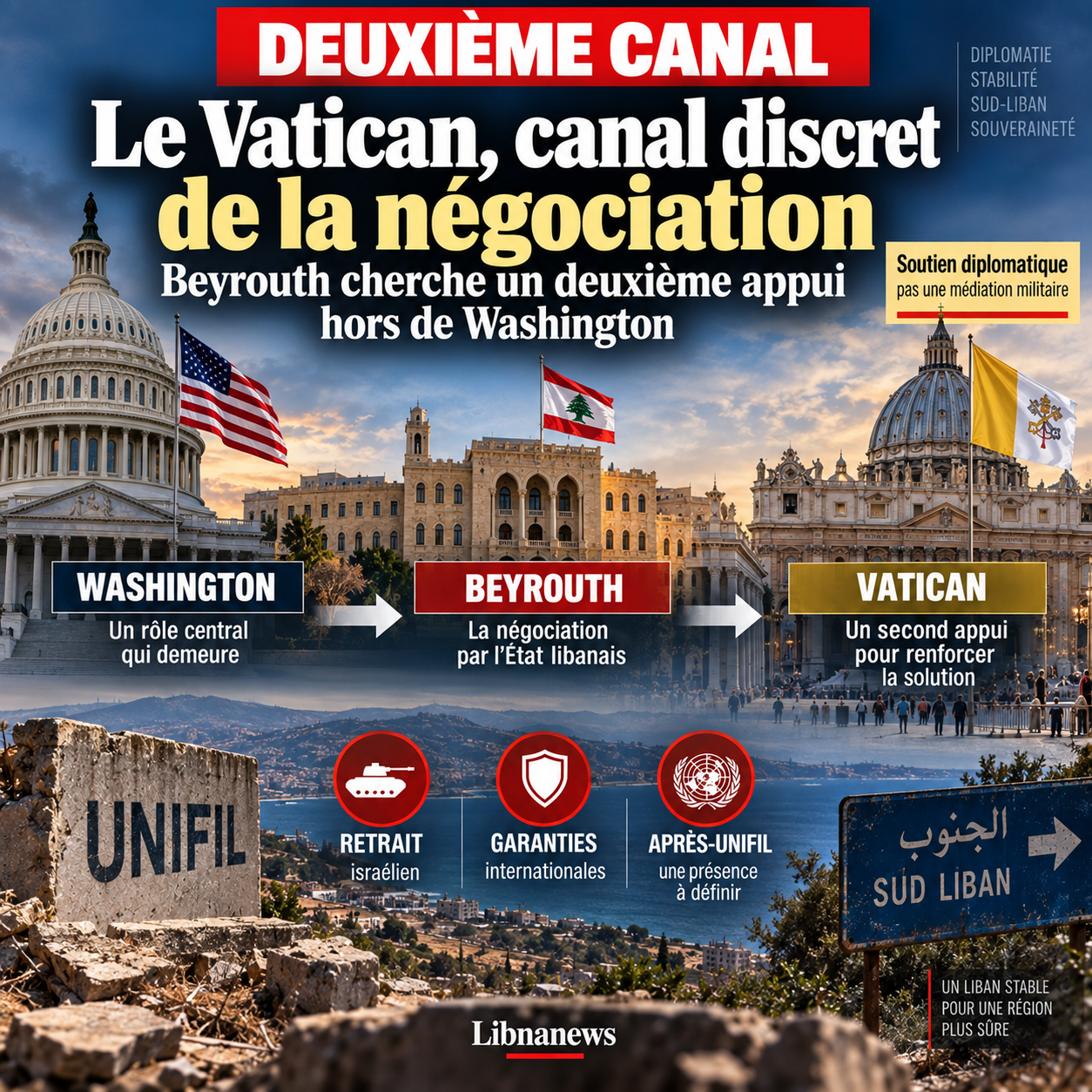
Lebanese diplomacy no longer relies solely on Washington to try to unblock the southern issue. After the steps taken by the American administration, a second channel emerged much more discreetly in Rome. Simon Karam, who leads the Lebanese delegation involved in the negotiation process with Israel, is to visit the Vatican for a series of talks on the same issue. Two meetings give this mission a special significance: a meeting with Cardinal Pietro Parolin, Secretary of State of the Holy See, and another with Paul Richard Gallagher, in charge of relations with States.
Displacement is not a parallel mediation to replace the United States. There is no more reason to say that the Vatican would be called upon to negotiate directly the military parameters between Lebanon and Israel. The objective seems more subtle. Beirut seeks to broaden the circle of actors capable of supporting the negotiation, defending Lebanon’s stability and accompanying a solution at a time when the American-led process is taking precedence. The process also extends the discussions initiated by President Joseph Aoun during his recent visit to Rome. It reveals above all a concern: not to let the future of the South depend on a single channel whose priorities are now largely absorbed by the regional confrontation with Iran.
Simon Karam in Rome, a mission less protocol than it seems
Simon Karam’s choice for these consultations already gives an indication of their purpose. This is not a general visit devoted to relations between Lebanon and the Holy See, but to the displacement of the head of the Lebanese delegation involved in the negotiation process. His talks should focus on the state of the discussions and the contribution that the Vatican could make to their progress.
The chosen interlocutors confirm this dimension. Pietro Parolin is at the heart of the diplomatic apparatus of the Holy See. Paul Richard Gallagher deals directly with relations with states. The discussions are therefore at the level where the Vatican addresses international crises, not just in the context of ecclesiastical relations with Lebanon. For Beirut, the interest is to directly expose the obstacles encountered in the negotiations and to seek support capable of weighing on the diplomatic environment of the case.
This approach comes at a time when the Lebanese-Israeli process is slowed down. A new session is not yet assured, while several proposals continue to be discussed on military ground. Lebanon calls for a timetable for withdrawal, guarantees against an Israeli return to potentially evacuated areas and an international presence to accompany the deployment of the army. Israel, for its part, calls for guarantees on the control of the areas concerned and on the inability of Hezbollah to rebuild its capabilities there. Between these demands, the United States remains the central intermediary, but it is no longer necessarily the only actor that Beirut wants to defend its positions.
Washington remains indispensable, but Washington looks elsewhere
The rapprochement with the Vatican must first be read in the light of American evolution. The United States did not close the Lebanese case. Contacts continue and military discussions continue, including on scenarios for a progressive Israeli withdrawal with the deployment of the Lebanese army. The meeting between Nawaf Salam and Marco Rubio itself confirms that Washington remains a must.
But the intensity of American engagement seems to have diminished. Lebanon is now integrated into a much broader regional equation, dominated by confrontation with Iran, the Strait of Ormuz, Israel’s security and negotiations that could lead to de-escalation. The Lebanese case did not disappear; He lost part of his autonomy in the hierarchy of American emergencies.
This evolution places Beirut in an uncomfortable position. The government chose the negotiation precisely because it considers the diplomatic route less expensive than a new confrontation. But a diplomacy-based strategy becomes fragile when its main sponsor slows down the pace. As the discussions continue, Israeli operations continue in the South and the fear of consolidating certain positions remains.
Seeking Vatican support therefore amounts less to bypassing Washington than avoiding total diplomatic dependence on it. Lebanon wants to maintain the American channel while building a broader international environment around negotiation.
What the Vatican can do, and what it cannot do
The Holy See, of course, has neither military means nor the American capacity to exert pressure on Israel. It cannot guarantee withdrawal by force, finance the deployment of the Lebanese army alone, or impose a security mechanism at the border. Its influence belongs to another register: diplomacy, international relations, capacity for dialogue with antagonistic actors and particular political weight when it comes to defending Lebanon’s stability.
This limit is also what can make its intervention useful. The Vatican is not intended to replace military negotiators. On the other hand, it can help consolidate the principles around which a solution must be built: State sovereignty, protection of the population, refusal of a new war and preservation of Lebanese territorial integrity.
Lebanon also has a special place in the diplomacy of the Holy See. Its religious diversity and coexistence system give it a dimension that exceeds its demographic weight. A profound destabilization of the country would not be seen in Rome as merely an additional border crisis in the Middle East. It would affect a political and community model to which the Vatican has traditionally paid particular attention.
Beirut can precisely seek to turn that attention into diplomatic capital. The government does not ask the Holy See to draw army positions on a map. He may ask him to defend with his international interlocutors the need for a settlement that does not transform the South into a zone permanently amputated by the Lebanese authority.
Joseph Aoun’s Previous
Simon Karam’s mission does not start from scratch. It follows on from the discussions conducted by Joseph Aoun in Rome. The Lebanese President has already discussed the situation in the country and the stakes of the South with the Vatican officials. The new step is to move this relationship from the level of principles to concrete monitoring of negotiations.
This continuity is important. A diplomatic approach rarely produces results when it is limited to an isolated visit. Repetition of contacts allows, on the contrary, to build a file, to transmit new information and to ask the contact person to act with his or her own partners. The Karam mission can therefore be understood as the technical phase of a political opening initiated earlier by the Head of State.
It also allows the Vatican to present Lebanese reasoning in detail. Beirut does not dispute the principle of strengthening the army and returning the security decision to the state. However, it calls for this process to be linked to Israeli obligations: withdrawal, cessation of operations and guarantees in areas under Lebanese control. It is this notion of reciprocity that Lebanon seeks to place at the heart of its international efforts.
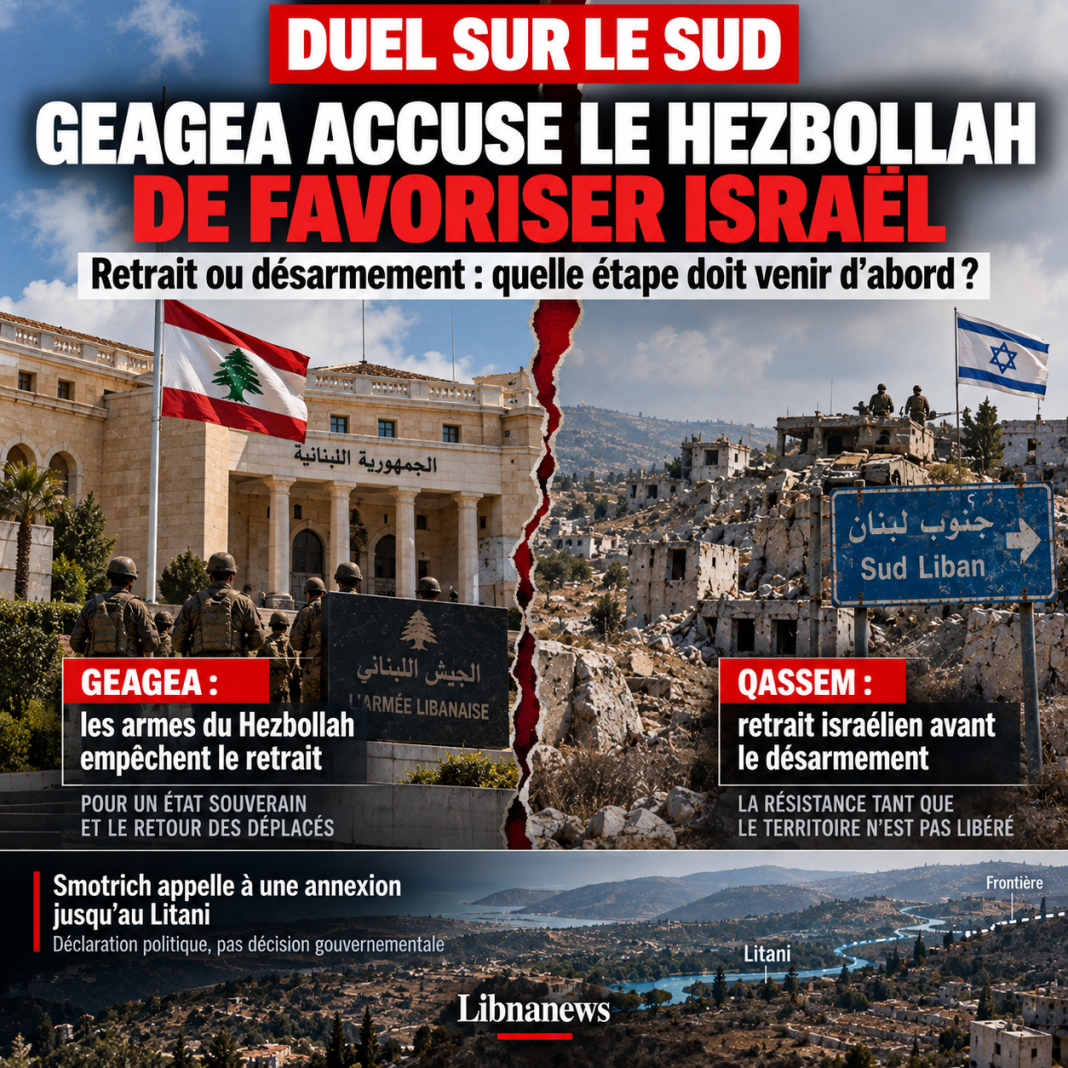
The government wants to avoid the negotiation being summed up in one question: what will Beirut do with Hezbollah weapons? He hoped that the other half of the equation would be posed with the same force: what would Israel do, according to what timetable and under what international guarantee?
Guarantee diplomacy rather than power diplomacy
It is probably on the question of guarantees that the Vatican can bring the most political value. The current blockage largely results from a confidence deficit. Lebanon fears that a concession will not be followed by any lasting Israeli counterpart. Israel expresses concern that a withdrawal will allow Hezbollah to return to the evacuated areas. Each therefore asks for proof before completing the stage which the other considers as a prerequisite.
The United States can offer some of these guarantees because it has a strategic relationship with Israel and a regional military presence. The Vatican does not have the same instruments. But an international guarantee is not only based on the ability to impose a sanction. It also depends on the number and quality of actors who engage politically around an arrangement.
The more diversified international support for the settlement, the greater the political cost of its violation. An agreement supported only by Washington remains largely dependent on the current US priorities. An agreement also defended by several European capitals, Arab countries, the United Nations and the Vatican acquires another diplomatic density.
Lebanon is precisely trying to build that density.
The Holy See can also speak to actors that Beirut does not control
Another useful feature of Vatican diplomacy is its relationship with a wide range of states and officials. It can therefore carry messages in areas where Lebanon has less weight.
This function should not be confused with secret mediation, the existence of which is not established by any available evidence. Rather, the Vatican’s interest lies in its ability to multiply diplomatic conversations around the same principle. A message sent to Washington, European capitals or other partners can help keep the Lebanese issue on their agenda.
For a small state, this function is far from secondary. Lebanon cannot impose its priorities on the major Powers. He must convince other actors to take them back.
Diplomacy then becomes an amplification exercise. Beirut makes a request. An international partner relays it. Several actors are beginning to regard it as a reasonable condition of the settlement. What was initially a Lebanese position can gradually become part of the international consensus sought.
Simon Karam’s displacement must be read in this way.
After UNIFIL gives the Vatican another dossier to follow
Negotiations with Israel are not the only deadline. The planned end of the UNIFIL mission requires Lebanon to quickly prepare a new security architecture in the South. The risk of emptiness is now explicitly mentioned by those responsible for the international force.
The problem is considerable. UNIFIL is not limited to the visible presence of peacekeepers on southern roads. It participates in the monitoring of the Blue Line, ensures contacts between the parties and accompanies the Lebanese Army. Its disappearance without a replacement mechanism would remove several functions at the same time.
A new international presence is therefore envisaged around more targeted missions: monitoring, communication and support to state authority. But the creation of such a mechanism requires political agreement, a mandate and countries ready to participate.
The Vatican will not decide on this architecture. However, it can support the principle of international continuity to prevent the end of UNIFIL from creating a space immediately occupied by confrontation. In this area too, its role would be that of a diplomatic facilitator rather than an operational actor.
Rome also offers an American-Iranian head-to-head trip
The enlargement of the diplomatic channel finally has a regional dimension. The Lebanese case increasingly depends on the relationship between Washington and Tehran. Hezbollah is closely linked to Iran, while the United States is Israel’s main international support. The more this polarisation increases, the more the risk exists that Lebanon will be treated as a variable of regional bargaining.
Beirut seeks precisely to defend the opposite idea: Lebanese issues must be negotiated by the Lebanese State according to its own interests. Nawaf Salam said in his international exchanges. The government refuses to allow others to speak on behalf of the country or use its territory as a space for transmitting regional messages.
Bringing the Vatican into the diplomatic environment of the case serves this strategy. The Holy See is neither a party to the American-Iranian confrontation nor a military actor in the Middle East. Its involvement therefore provides an external point of support for this bipolarization.
This, of course, does not guarantee that regional decisions will cease to affect Lebanon. But this allows Beirut to recall that its file cannot be fully absorbed by them.
Vatican facing the Hezbollah issue
The difficulty arises when negotiations reach the subject of Hezbollah’s weapons. The Vatican naturally supports the authority of the Lebanese State and the strengthening of its institutions. But the problem cannot be solved by an external injunction. Any attempt at forced disarmament could open an internal crisis whose consequences would directly affect the coexistence that the Holy See wishes to preserve.
This situation places Rome in a particular position. Defending State sovereignty means supporting the idea of a single military authority. Defending Lebanon’s stability simultaneously requires that a brutal application of this principle should not lead to internal confrontation.
The preferred path can therefore only be gradual and political. It involves internal dialogue, the strengthening of the army, Israeli withdrawal and the construction of a defence strategy capable of gradually placing military decisions in institutions.
This approach is partly in line with that which Beirut seeks to defend. The government wants to show that the state monopoly is not directed against a community, but is a normal condition for the country to function. The credibility of this statement, however, depends on the existence of external safeguards that are sufficiently strong to leave the issue of security to each group.
Moral mediation will not be enough
However, there is a risk to overestimate the Vatican channel. The diplomatic stature of the Holy See does not replace power relations. Israel will make its security decisions based on its own calculations, relations with Washington and the military situation. Hezbollah will determine its position according to its Lebanese interests, its relationship with Iran and its assessment of the Israeli threat.
The Vatican can help build an environment conducive to an agreement. It cannot produce this agreement against the will of the main players.
Simon Karam’s displacement will therefore be useful if he is able to obtain something specific: support for a withdrawal schedule, defence of an international guarantee mechanism, European mobilisation around the post-UNIFIL era or relay Lebanese requests to Washington and other capitals. While it is limited to a general declaration on Lebanon’s stability and sovereignty, its impact will remain essentially symbolic.
This is all at stake in this discreet diplomacy: turning a historical relationship with the Holy See into a concrete instrument in a contemporary negotiation.
Beirut builds a network rather than a new mediator
Finally, the Lebanese approach seems less to seek a replacement in the United States than a network around them. Washington would retain the central role in negotiations with Israel. The Vatican would bring its diplomatic weight. The United Nations would remain indispensable for any new international architecture in the South. Arab countries could contribute to the support of the State, the army and reconstruction. European partners would be asked for international presence and funding.
This increase in support responds to Lebanon’s structural weakness. Beirut does not have the means to guarantee the enforcement of a regulation alone. Its strategy is therefore to ensure that a sufficient number of actors have an interest in its functioning.
Simon Karam arrives at the Vatican with this equation. He did not ask Rome to replace Washington, nor could he ask him to settle the issue of Hezbollah’s weapons. Its mission is to add a piece to an incomplete diplomatic architecture.
For Lebanon, the bet is clear: if the ratio of military force is unfavourable to it, the ratio of diplomatic force must be broadened. The Vatican cannot move a front line. But it can help prevent the Lebanese voice from disappearing when the great powers begin to decide what will come after it.