





A sale project that was reportedly stopped after the mobilisation
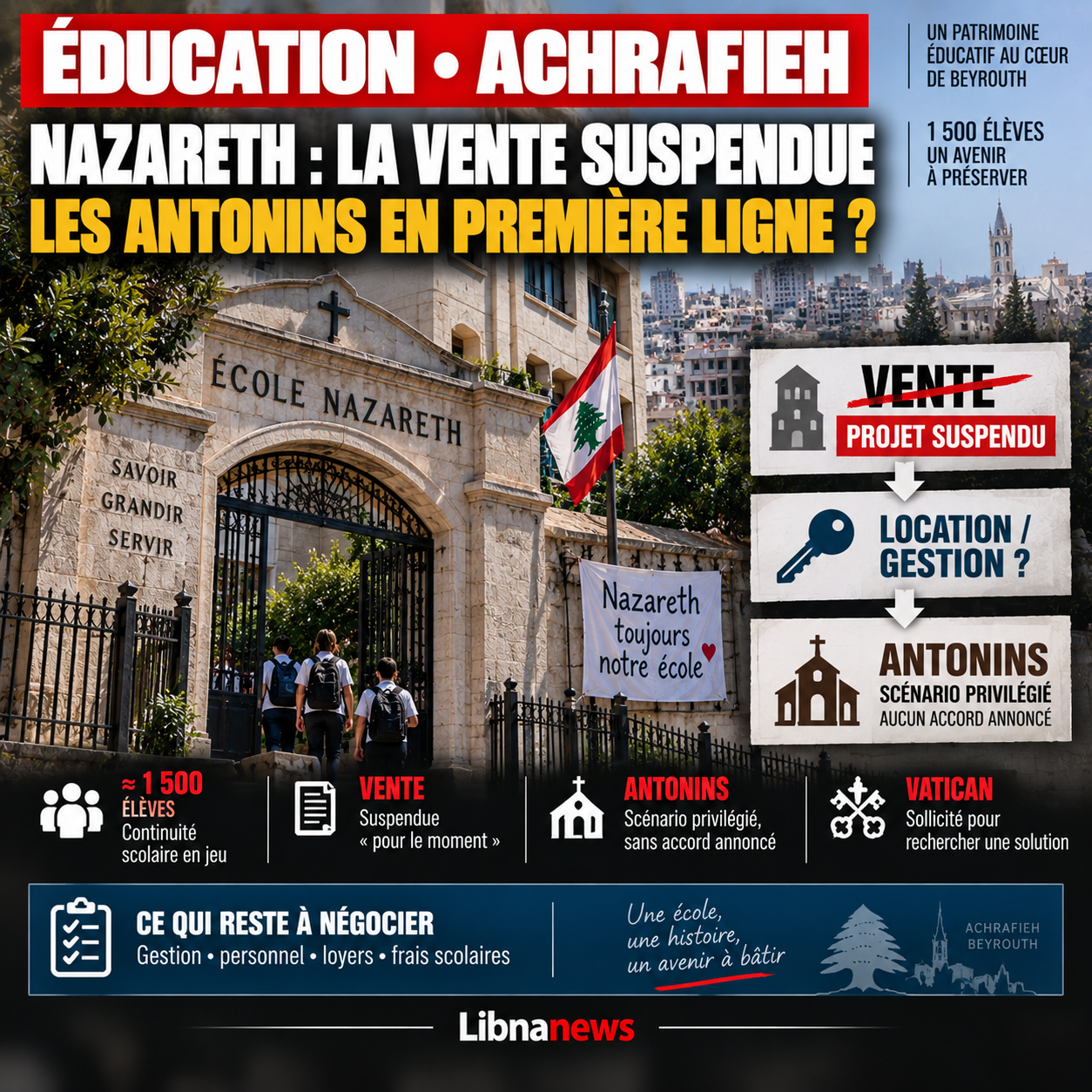
The Nazareth school in Ashrafieh would have undergone a significant change. While the prospect of a sale of the institution had raised concerns among families, teachers and those attached to this historic institution, this option would have been excluded, at least temporarily. According to an internal administrative source cited in the information of 23 September 2026, the decision to sell was annulled « for the time being ». Final decisions on the future of the school would be postponed to the next school year.
This formulation remains important. There is no question of giving up any possibility of sale once and for all. Rather, it is a freeze of the scenario that triggered the challenge.
In the meantime, another solution would be explored. It would be to maintain the institution while entrusting its operation or management to another congregation. The Antonine congregation appears, in the information available, as the main candidate for this resumption.
This scenario would profoundly alter the nature of the file. The question would no longer be who could acquire the buildings and land in Nazareth, but under what conditions a new authority could resume an existing school, maintain its activity and ensure its financial viability.
The issue directly concerns about 1,500 students, according to available data, but also teachers, employees, families and the real and educational heritage associated with the institution.
Antonins appear as the preferred scenario
The most interesting information therefore concerns the Antonine congregation. She would be considered as a candidate to take over the institution through a rental rather than acquisition formula.
However, the sources do not provide draft contracts or rent. Nor can they say that an agreement has already been signed or even that formal negotiations have come to an end.
We must therefore talk about a privileged scenario, not an acquired recovery.
The distinction is essential for families. A rental can take several forms. The congregation can simply operate the school. She can take charge of her staff and pedagogical management. It can also conclude a much broader agreement on building maintenance and necessary investment.
Each of these options would have a different impact on tuition fees, teacher status and institutional identity.
None of these are specified in the information currently available.
The real subject thus becomes that of the conditions of recovery.
Why the Vatican would have been seized
Another element gives the file a dimension far exceeding an ordinary real estate transaction: a letter would have been sent to the Vatican to intervene in the search for a solution.
This approach suggests that the religious authorities consider that the fate of Nazareth cannot be treated solely as that of a real estate asset.
In Catholic religious structures, the sale or change in the allocation of certain goods may require internal procedures and authorizations, which depend in particular on the nature of the owner, the value of the heritage and the applicable canonical rules.
The information available does not specify which organ of the Holy See was seized or who sent the letter. Nor can they tell whether Rome has already responded.
However, these elements would be decisive.
A Vatican intervention could serve to preserve the educational vocation of the site. It could also facilitate a transfer of management between congregations, which would be institutionally very different from a sale to a private investor.
Finally, recourse to Rome may reflect the impossibility of finding a satisfactory solution locally between property interests, possible financial difficulties and the need to keep the school open.
Behind the sale, what is the real financial situation of Nazareth?
This is where the file remains incomplete.
If the sale was actually planned, why was it?
The information of 23 September does not provide detailed accounts. They do not give the amount of any debts of the institution, its annual deficit, the cost of operating or the investments necessary to maintain the buildings.
These figures are indispensable.
A school with about 1,500 pupils has a priori a significant activity. But the number of pupils is not enough to determine its financial balance. Wages, pensions, social security contributions, energy costs, wealth maintenance and possible debts can weigh heavily on its budget.
The Lebanese crisis has also profoundly destabilized the economy of private institutions. Schools must pay their teachers in an environment where costs are largely indexed to the dollar, while maintaining bearable costs for families whose incomes have not all followed the same pattern.
The Nazareth file should therefore be treated from the accounts and not only from the value of the land.
Without these data, it is impossible to know whether the proposed sale was in response to a financial situation that has become untenable or a desire to value a particularly important real estate asset in Ashrafieh.
Real estate is the other issue
The location of the establishment necessarily gives the file a real estate dimension.
Ashrafieh is one of Beirut’s areas where land value can make large institutional properties particularly attractive. Schools, convents and religious establishments sometimes occupy land formed at a time when real estate pressure was inconsequential with that of today.
The issue of the value of the Nazareth site is therefore becoming a must.
However, the information available does not give a reliable estimate of the land or buildings. Any numerical valuation would therefore be speculative.
Before talking about a real estate transaction, you should know the exact property structure. Do all schools, buildings, land and any dependencies belong to the same legal entity? Are there any restrictions on use? Are certain properties subject to special rules relating to their religious or educational character?
These questions determine what could actually be sold or rented.
It would also help to determine whether the antonin scenario is solely for the management of school activity or the whole site.
1,500 students at the centre of a potentially complex transition
For families, the most immediate issue is educational continuity.
The postponement of final decisions to the next school year would help to avoid a sudden breakdown. It would also provide time to prepare for a possible transition.
But a resumption by another congregation is not simply about changing the manager’s name.
It is necessary to determine whether the programmes remain the same, whether teachers are maintained, whether teachers retain their contracts and whether tuition fees are changing.
The religious and educational identity of the institution is also an issue.
A congregation that resumes a school has its own structures, management methods and priorities. The continuity of the name Nazareth therefore does not automatically guarantee the continuity of all existing practices.
For parents, a multi-year commitment would probably be more important than just a guarantee of opening for the next year.
If the Antonins actually become managers, the duration of the lease agreement will therefore be a central element. A solution of a few years would have a very different scope for a long-term commitment.
What would teachers and employees become?
Staff represent one of the main blind spots of available information.
A change in management may result in several scenarios. Contracts can be transferred. The new manager may retain all staff. It may also reorganize.
The status of teachers is all the more important as Lebanese private schools have been experiencing tensions over wages and social benefits for several years.
A successful resumption will therefore have to address three issues: possible arrears, acquired rights and future conditions of remuneration.
It will also be necessary to determine which entity will remain legally responsible for previous commitments.
If the old administration retains the debts while the new congregation resumes only exploitation, the contractual structure can become complex. If the recovery includes existing bonds, its cost increases considerably.
It is precisely these details that will make it possible to determine whether the Antonin project is a real financial solution or only a way of repelling difficulties.
Other religious institutions would face similar difficulties
The Nazareth dossier could finally be only the visible part of a wider problem.
The information available indicates comparable difficulties in other educational establishments dependent on religious congregations. These problems would still not be visible publicly, including the organisation and financial situation of some schools.
However, no sufficiently documented name is provided to designate these establishments.
This absence requires that information not be transformed into a speculative list of schools at risk.
However, it raises a structural question.
A significant part of Lebanese private education is historically based on congregations that have both a considerable real estate heritage and institutions that are becoming increasingly expensive to operate.
The paradox is obvious: an institution can own land worth millions of dollars while encountering difficulties in financing its daily school activity.
In such a situation, the temptation to sell real estate becomes strong.
But every sale will permanently reduce the educational heritage.
The crisis could lead to transfers between congregations
The scenario envisaged for Nazareth offers another possibility: to transfer management rather than sell the heritage.
This could become a model for other institutions.
A congregation that no longer wishes or can no longer directly manage a school could retain its ownership while entrusting its operation to another structure with more resources or a larger school network.
This would theoretically preserve three elements: the heritage, the school vocation and the continuity of the institution.
But the model only works if the activity can return to a financial balance.
A new congregation cannot permanently resume a deficit school without changing its functioning, obtaining additional funding or increasing its revenues.
The Nazareth dossier could therefore serve as a test for a wider restructuring of private denominational education.
Sales suspended, but fundamental issues remain
The mobilization around Nazareth seems to have produced a first result: the sale would no longer be the immediate option.
This does not mean that the crisis is resolved.
The postponement to the next school year leaves several months to negotiate a solution, but it also rejects the most difficult decisions.
The first concerns the owner: does he wish to preserve the heritage for a long time?
The second concerns the Antonins: are they really ready to take over, and under what conditions?
The third concerns Rome: will the Vatican support a formula to preserve the educational vocation of the site?
The fourth concerns finance: what is the real situation of the institution and what amount would be required to ensure its viability?
Finally, the fifth concerns families and staff: what guarantees will be given to them?
It is on these five questions that the future of Nazareth will really be played out.
The most important information is therefore not simply that the sale would have been suspended. It lies in the change of model that prepares behind the scenes:instead of giving up the institution, its officials would now explore a management transmission to another congregation, with the Antonins on the frontline and the Vatican to intervene in the search for a solution.
If this formula succeeds, Nazareth could remain a school without remaining under the same administration. If it fails, the issue of sales could reappear as soon as next year. And if the information about other religious institutions in difficulty is confirmed, the case of Achrafieh could announce a much broader restructuring of the Lebanese private school landscape.