





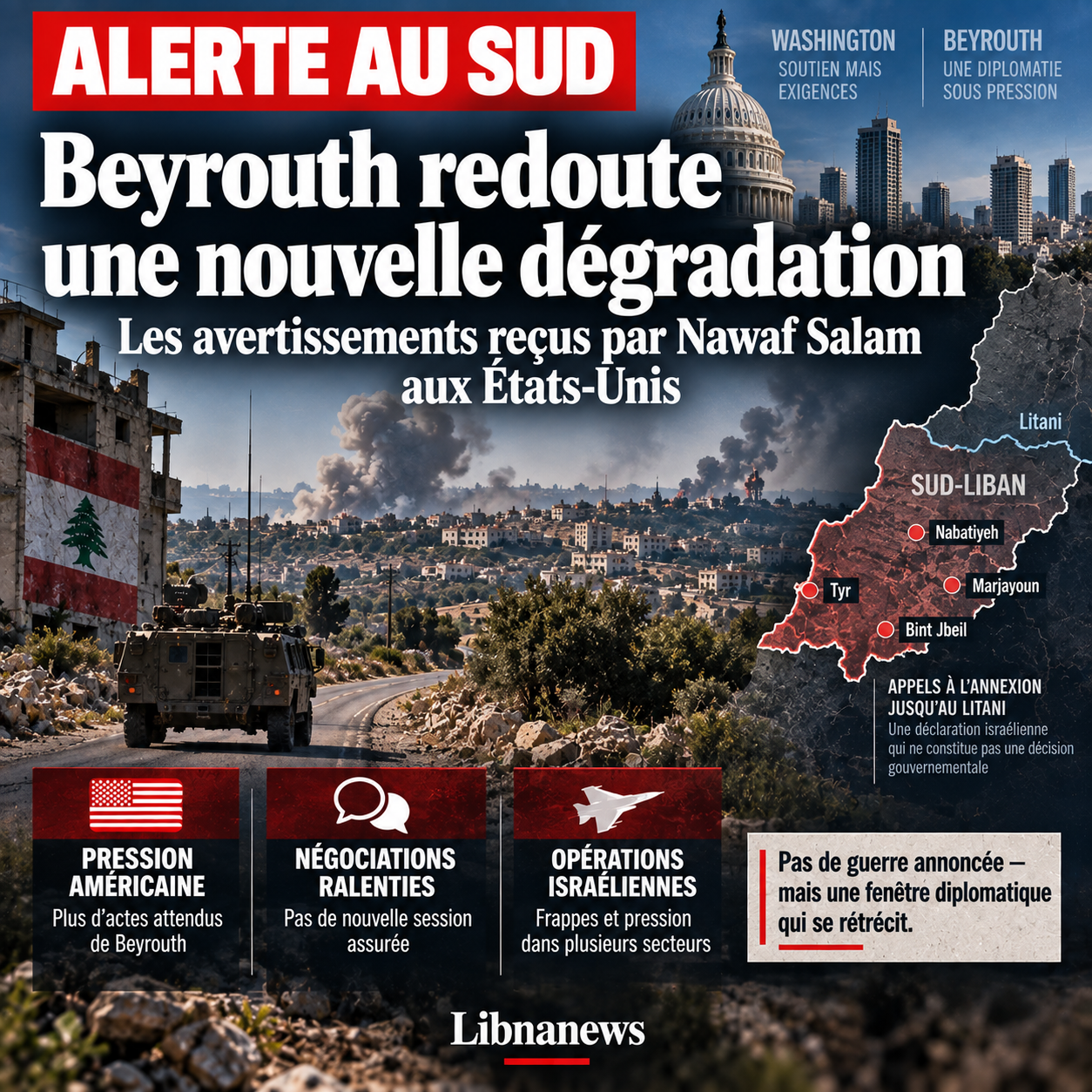
The messages received by Nawaf Salam in the United States would have been significantly more worrying than public diplomacy suggests. In the course of his meetings, the Lebanese Prime Minister was said to have observed a tightening of the American approach and to have received warnings from Arab and international interlocutors that the situation in the South might further deteriorate. This assessment comes at a time when negotiations with Israel are slowing down, Israeli operations are continuing and a number of Israeli officials are making an increasingly offensive speech about the future of border territories.
However, the picture is not that of a war announced on a fixed date. There is no evidence to conclude that a general offensive would have been decided. Rather, the warnings concern an accumulation of adverse factors: the absence of a significant Israeli withdrawal, the difficulty of reviving negotiations, the American pressure on Beirut on Hezbollah weapons, the Israeli electoral deadlines and the persistence of a regional confrontation that now links Lebanon with Iran and the Gulf. For the government of Nawaf Salam, the challenge is therefore to turn a period of great uncertainty into a diplomatic sequence before military facts themselves set the new rules of the game.
In Washington, a harsher climate than in New York
The passage from New York to Washington marks a change of registry. Before the United Nations, Nawaf Salam was able to defend the principles of the Lebanese position: sovereignty, state monopoly over strategic decisions, Israeli withdrawal and the search for a diplomatic settlement. In the United States, the debate is becoming much more concrete. It focuses on what Beirut can actually achieve in the South and on the guarantees Washington considers necessary before pushing Israel towards further concessions.
The information gathered around the Prime Minister’s meetings indicates an American « hardening ». The term does not necessarily mean that Washington would have abandoned the Lebanese government or chosen to fully support all Israeli demands. Rather, it reflects growing impatience at the gap between the state’s political commitments and their translation on the ground. United States officials continue to place the issue of Hezbollah weapons, the role of the army and the effective control of the territory at the centre of their expectations.
This development is all the more important as Lebanon hoped to use diplomacy to achieve Israeli results in parallel with the progress made by the State. Beirut defends a logic of reciprocity: Israeli withdrawal, deployment of the army, verification mechanism, then progressive extension of public authority. Part of the American approach now seems to place more emphasis on the actions expected from Lebanon before Washington could get further steps from Israel.
The problem is then almost mechanical. The more Washington asks Beirut to act first, the more the government must convince an opinion and political forces that Israel continues to occupy positions and conduct operations. The more Israel maintains this pressure, the more Hezbollah has arguments to present its weapons as still necessary. The US strategy to strengthen the state can thus have the opposite political effect if it is not accompanied by Israeli counterparts.
Arab and international warnings on the South
It is in this context that the warnings received by Salam become more important. Arab and international interlocutors told him that the situation in the South could « weaken ». The wording is broad enough not to be transformed into a precise military prediction. However, it indicates that several Lebanese partners do not consider the current status quo to be stable.
The available signals are in this direction. Israeli operations continue in several areas of the South. Strikes hit the areas of Tyre, Nabatiyah, Marjayoun and Bint Jbeil. Apache helicopters have been used in some attacks, a development noted precisely because this type of aircraft was not previously associated with the daily operations reported in this phase of the conflict. In addition, land-based destruction and interventions continue to maintain a high level of uncertainty in border villages.
The Israeli political discourse adds another dimension. Bezalel Smotrich called for annexation of sectors from South Lebanon to Litani. Such a declaration, of course, is not by itself a decision of the Israeli Government. However, it shows that, as elections approached, maximalist territorial scenarios can be publicly defended by important coalition members.
For Beirut, the danger lies less in an isolated statement than in the encounter between this discourse and military reality. The longer an Israeli presence continues on certain points, the more Lebanon fears that what was presented as a temporary need for security will gradually become a new de facto situation.
The dreaded scenario: a security zone that expands in stages
The main Lebanese concern is precisely about the possible extension of the Israeli-controlled area. The process would not necessarily take the spectacular form of mass invasion. It could develop in stages: maintaining existing positions, increasing operations in depth, destroying infrastructure considered to be related to Hezbollah, creating new constraints for the inhabitants and then gradually consolidating a band where the return to complete Lebanese sovereignty would become more difficult.
This scenario explains why the government insists so much on a withdrawal schedule. An occupation without deadlines gradually transforms the debate. At the beginning, the question relates to the conditions necessary for the departure of Israeli forces. Over time, it can become one of the conditions in which Israel would agree to abandon a military situation that it now considers useful for its security.
Lebanese diplomacy therefore seeks to prevent the provisional from becoming structural. It wants to obtain American guarantees over areas eventually handed over to the army and to prevent the Israeli forces from returning after their evacuation. The discussions around Ali al-Taher illustrate this concern: Beirut would like to see a return of territory to the Lebanese army accompanied by a strong enough commitment to ensure that the withdrawal is sustainable.
Israel, however, poses its own condition. Before abandoning more positions, he wants to be able to verify that Hezbollah will not resettle military infrastructure in the evacuated areas. Each therefore requires a guarantee concerning the future behaviour of the other. It’s this circle Washington is trying to break.
Negotiations slow down at the worst moment
The deterioration of the climate would be less worrying if the diplomatic channel progressed rapidly. But it is the reverse that happens. The next session of the negotiations was postponed and no immediate resumption of negotiations appears to be assured. The proximity of the 27 October Israeli elections further reduces the margin available.
An election campaign obviously does not prohibit any negotiation. However, it alters political incentives. A territorial concession, withdrawal or security compromise can become arguments used by government opponents. Conversely, a demonstration of firmness can be politically valued. This dynamic does not mean that any Israeli decision would be electoral, but it complicates the search for an agreement for an already tense period.
Lebanon thus faces an unfavourable timetable. He wants rapid progress before the Israeli campaign closes political space. But the more urgent it is, the less leverage it has to impose the pace. Washington remains the only actor able to exert a decisive influence on Israel, precisely as US priorities move towards other regional crises.
This combination explains part of the pessimism transmitted to Salam. The danger lies not only in an Israeli military decision. It is possible that no diplomatic decision will be taken while the military situation continues to evolve.
Lebanon has receded in the American hierarchy
Another fact weighs on Beirut calculations: Lebanon seems to occupy a less central place in the immediate agenda of the White House. The lack of reference to the country in Donald Trump’s speech to the UN General Assembly was interpreted by some observers as a sign of this setback.
It would be excessive to conclude that the United States is disinterested in Lebanon. The meeting with Marco Rubio, the continuation of military contacts and the American role in the negotiations show the opposite. The change seems to be more about the method. Washington would have moved from a phase of strong political impetus to a phase of pressure, waiting and managing blockage.
The war with Iran partly explains this development. The Strait of Ormuz, oil exports, discussions with Tehran and the security of American allies are now mobilizing much of the strategic attention. Lebanon remains important, but is increasingly being treated as one of the pieces of this regional architecture.
This development is problematic for Nawaf Salam. His Government’s strategy was based on the idea that the international community could help the State to obtain through negotiation what a new war would make even more costly. If U.S. diplomatic investment declines before the mechanism is consolidated, the government may find itself engaged in a strategy whose main guarantor slows down its involvement.
Washington expects more on Hezbollah weapons
The American hardening is particularly evident on the issue of weapons. The Lebanese argument that hasty action could threaten civil peace is understood, but it no longer seems sufficient to justify indefinite postponement. From the American point of view, what is now a prudence related to internal risk could eventually weaken the very principle of sovereignty that the government claims to want to restore.
This critic places Nawaf Salam in a delicate position. He cannot accept that the State should give up its military monopoly on a lasting basis without contradicting its own programme. But neither can he treat Hezbollah as a mere organization that the army could disarm administratively. The party maintains an important political, social and military base, particularly in areas directly exposed to Israeli operations.
The government is looking for a sequence. The Israeli withdrawal must produce a space in which the army can exercise its authority. The deployment of the army should reduce the justification for a parallel armed presence. International verification must reassure Israel. Then the internal dialogue must deal with the rest of the file.
Washington now seems to be asking for faster evidence than this sequence actually started. It is probably one of the elements of the hardening perceived by Salam.
Naim Kassem responds with exactly the opposite logic
Naim Kassem’s speech shows how far the positions remain. Hezbollah’s Secretary-General refuses to treat weapons before the Israeli withdrawal. He called for the freezing of direct negotiations and the return to an indirect formula. He accuses the authorities of having offered Israel concessions too quickly in the course of the discussions.
For Hezbollah, resistance would have prevented Israel from achieving all its military objectives. The party therefore considers that abandoning its means before obtaining a complete withdrawal would be tantamount to abandoning the lever that would have prevented a greater defeat. This reading is rejected by its opponents, but it structures its position.
The government is then caught between two opposing pressures. Washington is calling for progress on the state monopoly. Hezbollah calls for Israeli progress before any substantial discussion of its weapons. Israel demands guarantees against the return of Hezbollah before continuing its withdrawal.
Each one therefore waits for the other to provide the initial proof of good faith.
This impasse is not only diplomatic. The longer it lasts, the more military actors can seek to change the balance of power on the ground in order to improve their position in future negotiations.
The risk of a new war exists, but it is not the only one
The warnings received by Salam should not be reduced solely to the assumption of a general war. A deterioration can take several forms. Israel can intensify its strikes without launching a massive land offensive. It can expand the sectors in which it regularly intervenes. It can multiply destruction to prevent the rebuilding of Hezbollah’s capabilities. It may also extend the occupation of positions considered strategic.
For southerners, the difference between these scenarios is important militarily, but sometimes much less in everyday life. A family that cannot return to their village, an inaccessible farm or a house regularly exposed to strikes are already suffering the effects of a conflict that does not need to be officially declared to prevent a return to normal.
This is also why reconstruction and the presence of the state are becoming security issues. The more people remain displaced, the emptyer the territory. The emptyer the territory, the more difficult it becomes for Lebanese institutions to demonstrate normal sovereignty.
The government is precisely preparing a visit to Nabatiyah and plans in and around the city to help the inhabitants stay in their localities. This initiative is not alien to the diplomatic issue: maintaining the population and restoring services is also a way of asserting the presence of the State.
Nabatiyah as a political response to military pessimism
The prospect of a government meeting or official trip to Nabatiyeh takes, in this context, a dimension that far exceeds the symbol. Yassine Jaber is working on the preparation of this sequence and the launching of projects to consolidate the presence of the inhabitants in their towns and villages.
In this way, the government seeks to respond on the ground to the risk of degradation. It does not have the military means to change the balance of power with Israel alone. It can, however, strengthen local institutions, support infrastructure and show that the South is not abandoned to a confrontation between Israel and Hezbollah.
This approach also includes an internal policy dimension. Hezbollah has its own aid networks and has announced new initiatives for housing, repairs and reconstruction. If the state is slow to intervene, these partisan structures naturally occupy the space left vacant. If the government comes back with concrete projects, it can restore a direct relationship with the people.
The battle of the South is therefore not only on the hills and at military posts. It also plays a role in maintaining an open school, repairing a road, rebuilding a house or allowing a family to stay in their village.
Arab partners also fear crisis beyond Lebanon
Arab warnings to Salam must also be seen in the regional context. Further degradation in Lebanon would not remain confined to the border. It could affect discussions with Iran, the stability of the Gulf and all efforts to avoid further confrontation.
The Arab States therefore had an interest in preventing the Lebanese front from becoming a major theatre. But this interest does not mean that they all have the same means or willingness to intervene. For example, Saudi Arabia favours support for institutions, the economy and the army rather than direct military involvement in the South.
This caution illustrates the Beirut problem. Many actors want to avoid a new war, but few want to become the military guarantors of a settlement. The United States therefore remains indispensable at a time when its attention is dispersing.
The warnings received by Salam can be understood as reflecting this contradiction: the risk is identified by several partners, but the diplomatic coalition capable of reducing it is not yet sufficiently structured.
Diplomatic window shrinks
The government thus has a few particularly sensitive weeks. He must keep Washington engaged, get Arab and European partners to support a security architecture in the South, prepare for the post-UNIFIL and convince Lebanese actors that a state strategy can produce results.
At the same time, he must prevent the American pressure on Hezbollah’s weapons from turning into an internal confrontation. It must also prevent requests for Israeli safeguards from becoming a pretext for an occupation without a deadline.
None of these tasks can be performed separately. A withdrawal without a safety device may be fragile. Unresolved disarmament would be politically explosive. An international presence without real State authority would not solve the sovereignty problem. Unsafe reconstruction would expose the same villages to further destruction.
It is this accumulation that explains the tone of the warnings received by Nawaf Salam. The risk does not come from one imminent event, but from several calendars that are approaching without a common solution yet being found.
In Washington, the Prime Minister was looking for guarantees and a way to relaunch the negotiations. He would have discovered above all that several of his interlocutors now regard time as an adversary. The more the weeks pass without withdrawal, without verification mechanism and without internal compromise, the more the ground produces its own realities.
For Beirut, therefore, it is no longer only urgent to get a new meeting. It is to prevent that, when the negotiators end up around a table, part of what they had to negotiate has already been decided elsewhere, by force.