





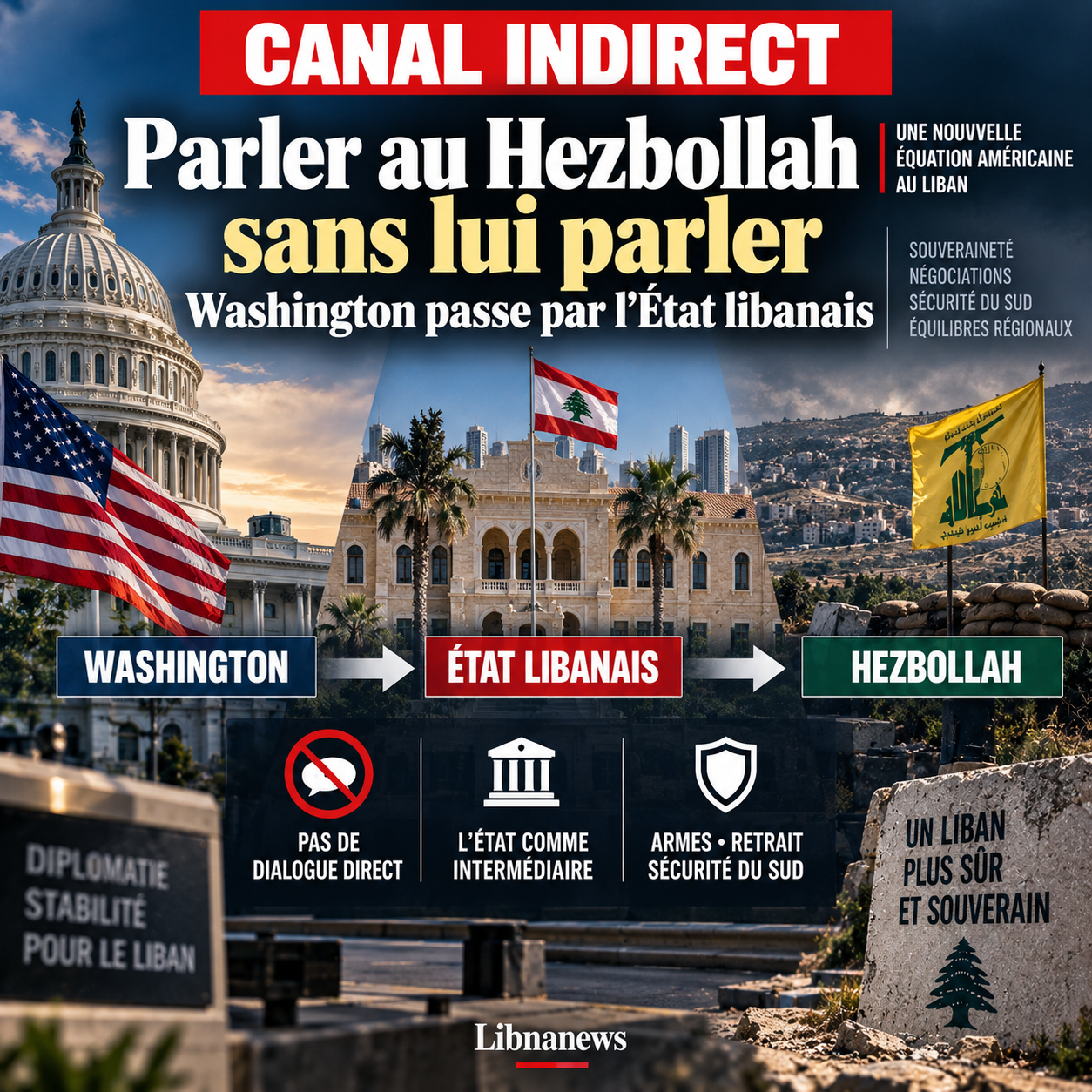
A sentence delivered on 8 September by the American ambassador to Beirut, Michel Issa, sheds some light on the method that Washington might prefer in the face of Lebanon’s most difficult case. The United States would be willing to negotiate with Hezbollah, but through the Lebanese state. The shade is considerable. It does not mean the announced opening of a direct dialogue with the party or its recognition as an autonomous diplomatic interlocutor. Rather, it suggests that Washington now distinguish two issues: its refusal to bypass Lebanese institutions and the practical need to address a political and military problem in which Hezbollah remains indispensable.
This formula comes at a time when the negotiations on the South are specifically addressing the issue of arms. The government of Nawaf Salam claims to want to restore the state monopoly on security and the decision on war and peace. Hezbollah refuses to allow disarmament as a prerequisite for an Israeli withdrawal. Israel requires safeguards before further reducing its presence. The United States does not want a new open war in Lebanon, nor does it want to push Israel towards a withdrawal that they consider insufficiently guaranteed. The state channel would allow, in this equation, to speak of Hezbollah without assigning it its own diplomacy and to negotiate the conditions for a settlement without consecrating the existence of two parallel Lebanese authorities.
A sentence that changes the question without solving the problem
The scope of the statement lies first in the choice of words. To say that Washington can negotiate with Hezbollah « through the Lebanese state » is to recognize that a solution can probably not be built by ignoring the party. But this means simultaneously that the official interlocutor of the United States must remain Beirut. Hezbollah thus becomes one of the objects and actors of domestic negotiations, while the state remains the external channel.
This distinction responds to an ancient difficulty of Lebanese policy. When foreign powers deal directly with political or military organizations, they can achieve a one-time result while weakening the institution they claim to support. In the case of Hezbollah, the problem would be even more acute: opening an autonomous diplomatic channel with the party would indeed mean recognizing that an armed organization has a distinct negotiating capacity on issues of national sovereignty. Washington would therefore seek to avoid this paradox by making the state the mandatory intermediary.
The formula also allows Americans to maintain a firm political line without condemning themselves to immobilism. Refusing direct contact does not prevent the Lebanese State from transmitting a proposal, collecting a response, and then returning to the mediators. The mechanism may be cumbersome, but it preserves a hierarchy: the government negotiates outside; the government dialogue within the forces concerned; The Lebanese response must then be formulated as a State position.
The difficulty of course is whether this architecture can work when the disagreement is not about a detailed application, but about the very definition of the role of Hezbollah.
Hezbollah refuses to start with weapons
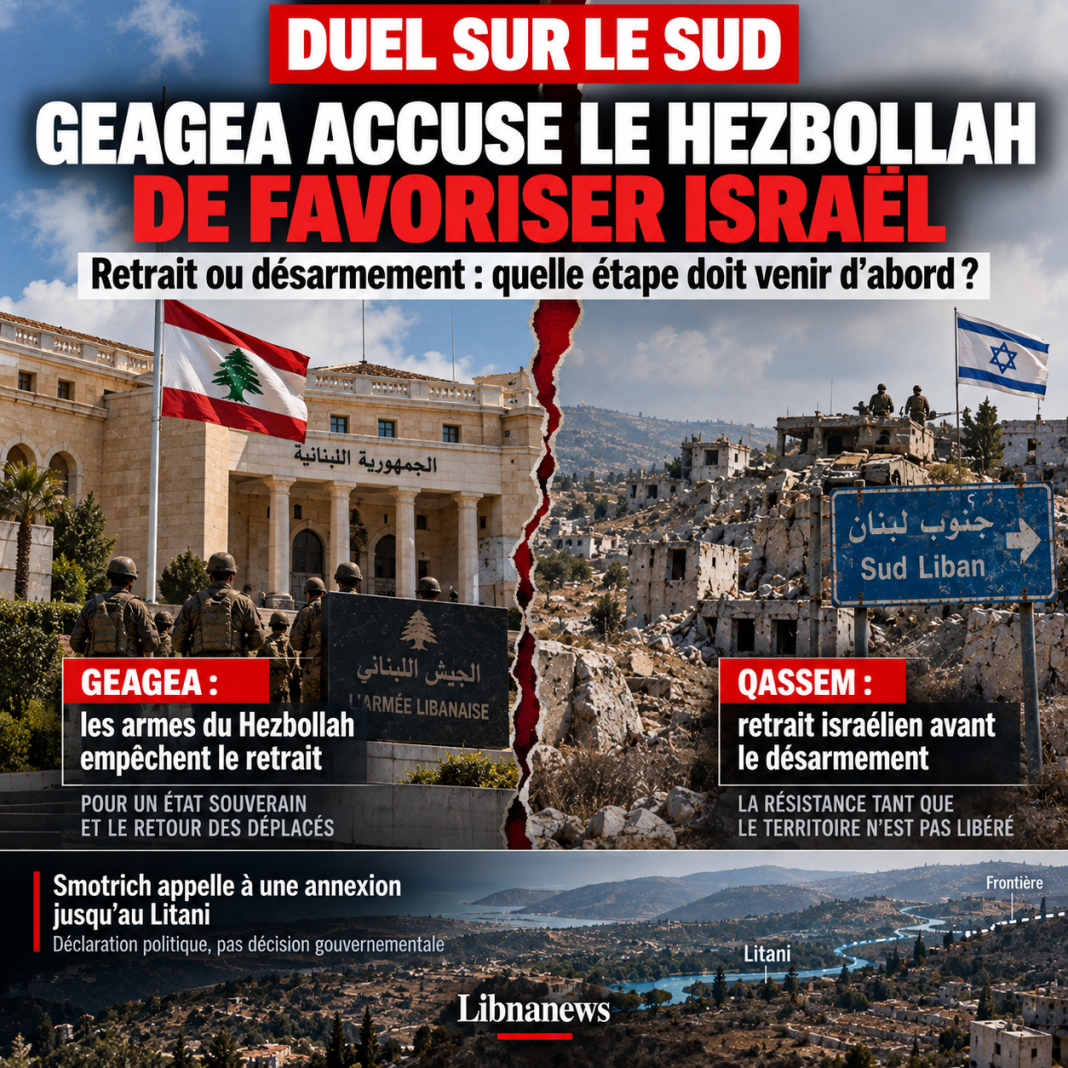
Naim Kassem reaffirmed this line with great clarity during the commemoration of the second anniversary of the death of Hassan Nasrallah and Hashem Safieddine. Hezbollah’s secretary-general said he was ready for dialogue and discussion, but refused to ask the question according to the sequence defended by his opponents. For him, we must first obtain Israeli withdrawal, allow the return of the inhabitants of the South and deal with the consequences of the war. The internal discussion on defence and weapons would then come.
The party also challenges direct negotiations with Israel and calls for a freeze in favour of a return to indirect discussions. It accuses the authorities of having granted essential elements too quickly in the negotiated framework and considers that the State has renounced pressure before obtaining sufficient guarantees. This criticism is directed directly at Nawaf Salam’s strategy, which focuses on the diplomatic path and aims to include Israeli withdrawal, military deployment and territorial control in a negotiated mechanism.
The difference is therefore deeper than a disagreement on the timetable. For the government, the strengthening of the state must lead to more international support and guarantees. For Hezbollah, abandoning its military assets before these guarantees have produced results would be tantamount to depriving itself of the main lever it still considers to have. The party wants to transform the debate from « when to give up arms? » into « what defence strategy after the Israeli withdrawal? ».
The channel proposed by Washington does not remove this contradiction. It only creates a way to treat it.
Washington does not want to choose between war and status quo
The American position itself seems to have evolved under the pressure of events. After several months of negotiations, Washington is facing an uncomfortable equation. A new large-scale Israeli war in Lebanon poses significant regional risks. But American pressure on Israel to secure a speedy withdrawal is also difficult to defend if the evacuated areas must, from an Israeli point of view, enable Hezbollah to rebuild its capabilities.
Between these two options, the US administration seems to favour a form of controlled blocking management. Negotiations are not abandoned, but their pace is slowing. Military discussions continue. More limited territorial scenarios are discussed. The Lebanese Army remains at the centre of the proposed solutions. At the same time, Washington expects the Lebanese authorities to demonstrate their ability to transform their political commitments into effective control of the ground.
This strategy explains the value of indirect dialogue with Hezbollah through the state. If Washington refuses to speak to the party and simply demands Beirut’s disarmament, the Lebanese government finds itself alone in a potentially major internal confrontation. If the United States deals directly with Hezbollah, it weakens the doctrine of sovereignty they defend. The passage through the State offers a third possibility: to circulate proposals without formally changing the nature of the interlocutors.
This method may seem purely procedural. It is in reality political. It obliges Hezbollah, if it wants to influence negotiations, to do so through Lebanese institutions rather than in parallel with them.
Government becomes mediator in its own country
However, this architecture places Nawaf Salam in a delicate position. The Prime Minister is not a neutral mediator between Washington and Hezbollah. His Government had its own doctrine: a military decision concentrated in the hands of the State, a strengthening of the army and a diplomatic settlement of the conflict with Israel. It is precisely several of these guidelines that Hizbullah challenges.
Beirut should therefore play three roles simultaneously. The government would negotiate with the United States and international mediators, discuss with Hezbollah inside and finally try to turn the outcome of these two exchanges into a national position. The difficulty is not only the transmission of messages. It lies in the legitimacy of the final answer.
If Hezbollah refuses an American proposal, should the government consider it rejected by Lebanon? If the executive accepts an arrangement that the party refuses, can it really apply it on the ground? Conversely, how far can the state integrate Hezbollah’s demands without giving the party the right of veto over a negotiation conducted officially on behalf of the Republic?
The problem of the indirect channel appears here in all its complexity. It formally strengthens the state, but it can also reveal its dependence on an agreement with an armed actor who retains an autonomous capacity. It will therefore depend on how the internal dialogue is organized.
The central issue is no longer just disarmament
One of the most interesting effects of this approach would be to gradually move the vocabulary of negotiation. The term « disarmament » immediately concentrates all resistance. He suggests a unilateral and definitive operation, with a winner and a loser. The debate can become different if it is broken down into concrete functions: who controls such a zone? Who has the right to deploy armed men? Who’s watching the borders? Who decides a response? What happens to military installations? What guarantees accompany the Israeli withdrawal?
This decomposition does not address the issue of weapons, but it can address some of its consequences before reaching the core of the problem. This is precisely the logic of the territorial scenarios studied for the South. In a given area, Israel withdraws, the Lebanese army deploys and a mechanism checks that agreed conditions are met. If the device works, it can be extended.
Hezbollah would then face a different choice. He would no longer be asked to accept his disarmament abstractly. It should decide whether it allows the army to become the only organized force in areas gradually evacuated by Israel. The difference may seem subtle, but it turns an ideological debate into a series of operational decisions.
Another advantage for Washington is that it measures actions. A political declaration on sovereignty can be interpreted in several ways. An area handed over to the army, controlled for several months and free from military relocation from Hezbollah, is an observable result.
The previous one of Ali al-Taher shows the limits of the formula
However, discussions around the Ali al-Taher area illustrate why this method remains extremely difficult. There are proposals to make it a new experimental zone, after an Israeli withdrawal and a Lebanese army deployment. Beirut wants a clear American guarantee preventing the Israeli forces from returning once the area has been handed over to the army. Israel would like, before expanding its withdrawal, to see that the army effectively controls the area and that Hezbollah cannot rebuild a military presence there.
The circle is almost perfect. Lebanon explains that its army cannot fully exercise its authority as long as the occupation continues. Israel replied that he could not withdraw without confidence about the authority that would succeed him. Washington is therefore looking for a sufficiently precise sequence for both movements to occur in a coordinated manner.
It is precisely here that indirect dialogue with Hezbollah can become useful. If the party agrees, through the state, not to reinvest a given area militarily, an Israeli withdrawal guarantee becomes more possible. If Israel simultaneously accepts a verifiable withdrawal, the government can present Hizbullah with a concrete outcome rather than a promise.
The problem remains that of trust. Everyone fears that the other will turn the first concession into an irreversible advantage without fulfilling his own.
Army at the center of all the answers
Whatever the formula, the Lebanese army appears as the pivot of the system. The United States wants a more robust and structured deployment to prevent the emergence of new armed positions in areas under its control. The Lebanese government also presents the army as the institution called upon to exercise sovereignty over the entire territory.
This convergence is important, but it does not solve the problem of means. A military deployment is not limited to sending soldiers to a few villages. Units must be able to remain on the ground on a sustainable basis, monitoring capabilities, communications, logistics and a chain of command adapted to an area where the risk of an incident remains high.
Above all, it requires a political authority capable of supporting the army when it encounters resistance. The real test will not come when the soldiers patrol a quiet area. It will come if an unauthorized facility is discovered, if combatants seek to return or if an Israeli operation challenges the arrangements. At this point, the army will need a clear political decision.
Dialogue with Hezbollah through the State could serve precisely to reduce this risk by obtaining upstream political commitments that the army would not then impose by force.
Avoid the scenario of a Lebanese confrontation
Fear of an internal conflict remains one of the main reasons for Beirut’s prudence. The Government is aware that a brutal attempt at disarmament could produce a crisis that no one can control. Washington acknowledges the existence of this concern, while considering that it cannot justify indefinitely the lack of progress.
This tension explains the search for a gradual method. The American objective is not necessarily to obtain in a single decision the surrender of the entire Hezbollah arsenal. It is to create a trajectory in which the territory under the exclusive control of the State is gradually expanding, while the party’s autonomous military function is being reduced.
For Hezbollah, however, accepting such a trajectory would be tantamount to initiating a process with a predictable outcome. Once the army was installed as the only force in several areas, it would become more difficult to defend the existence of a parallel military apparatus elsewhere. It is therefore in the interests of the party to obtain sufficient compensation from the early stages: Israeli withdrawal, guarantees, reconstruction and definition of a national defence strategy.
Indirect dialogue could thus become less a negotiation on the immediate surrender of weapons than a negotiation on the political conditions for their gradual loss of function.
After UNIFIL makes the calendar more urgent
The planned end of the UNIFIL mission adds another urgency. Lebanon wants to avoid a security vacuum in the South. A new international presence is envisaged, but its mandate remains to be defined. Several functions are mentioned: monitoring of the Blue Line, communication between the parties and support for the State authority.
Again, the issue of Hezbollah is at the centre of the problem without necessarily appearing in the title of the mechanism. An international force cannot replace the army to politically resolve the presence of non-State weapons. It will be able to observe, document and facilitate contacts, but the fundamental choice will remain Lebanese.
Washington therefore has an interest in starting the internal dialogue before the new mechanism is established. An international mission can accompany a security architecture. It alone cannot create the political agreement that gives it meaning.
Michel Issa’s formula takes its full scope here. Negotiating Hezbollah « with » across the State may mean above all that international arrangements must be preceded or accompanied by commitments obtained within Lebanon.
Iran, invisible presence of any negotiations
Another question remains: how far does Hezbollah have the flexibility to conclude such an arrangement? The Lebanese government insists on the need for State-to-State relations with Iran and refuses Tehran to intervene in Lebanon’s sovereign decisions. Hezbollah, for its part, maintains a deep strategic relationship with Iran that goes beyond Lebanese domestic policy alone.
Any negotiation on its military role therefore necessarily has a regional dimension. This does not mean that every decision of the party would be dictated from Tehran, but it would be difficult to completely isolate the Lebanese issue from the evolution of the confrontation between the United States and Iran.
This is probably contributing to the US slowdown. Washington is currently focusing much of its attention on the war with Iran, Ormuz and discussions about a possible exit from the crisis. An evolution of the American-Iranian relationship could change the room for manoeuvre in Lebanon much faster than a series of meetings in Beirut.
The state channel nevertheless has an advantage in this configuration: it allows the Lebanese file to be kept open without necessarily waiting for a large regional agreement.
Recognition of the problem, not party recognition
It would therefore be excessive to see in the American statement the announcement of a rapprochement between Washington and Hezbollah. There is nothing in the available evidence to conclude that a direct dialogue is open, let alone standardization. The distinction is precisely the opposite: the United States would accept Hezbollah as part of the equation to be settled, while refusing to recognize it as a diplomatic channel distinct from that of the state.
However, this may be significant. It marks the transition from a logic in which the problem is simply formulated — Hezbollah must give up its weapons — to a logic in which one seeks a mechanism to achieve a result without causing an internal confrontation.
Success will depend less on the words used by diplomats than on Beirut’s ability to build a sufficiently credible internal dialogue to serve as a bridge. If the State cannot obtain any commitment from Hezbollah, the channel will not transmit anything. If Washington is not able to obtain verifiable counterparts from Israel, the government will have nothing strong enough to offer the party.
The American formula therefore rests on a demanding bet: to strengthen the state by entrusting it with the negotiation of a problem that reveals precisely the limits of its authority. It can become an instrument for institutional restoration if commitments gradually shift from armed actors to institutions. It can also expose the weakness of the State to a greater extent if it merely conveys messages between forces that continue to decide in its place.
Everything will be played out in this difference. Talking to Hezbollah across the state is of interest to Washington only if, at the end of the process, there remains more state and less parallel diplomacy.