

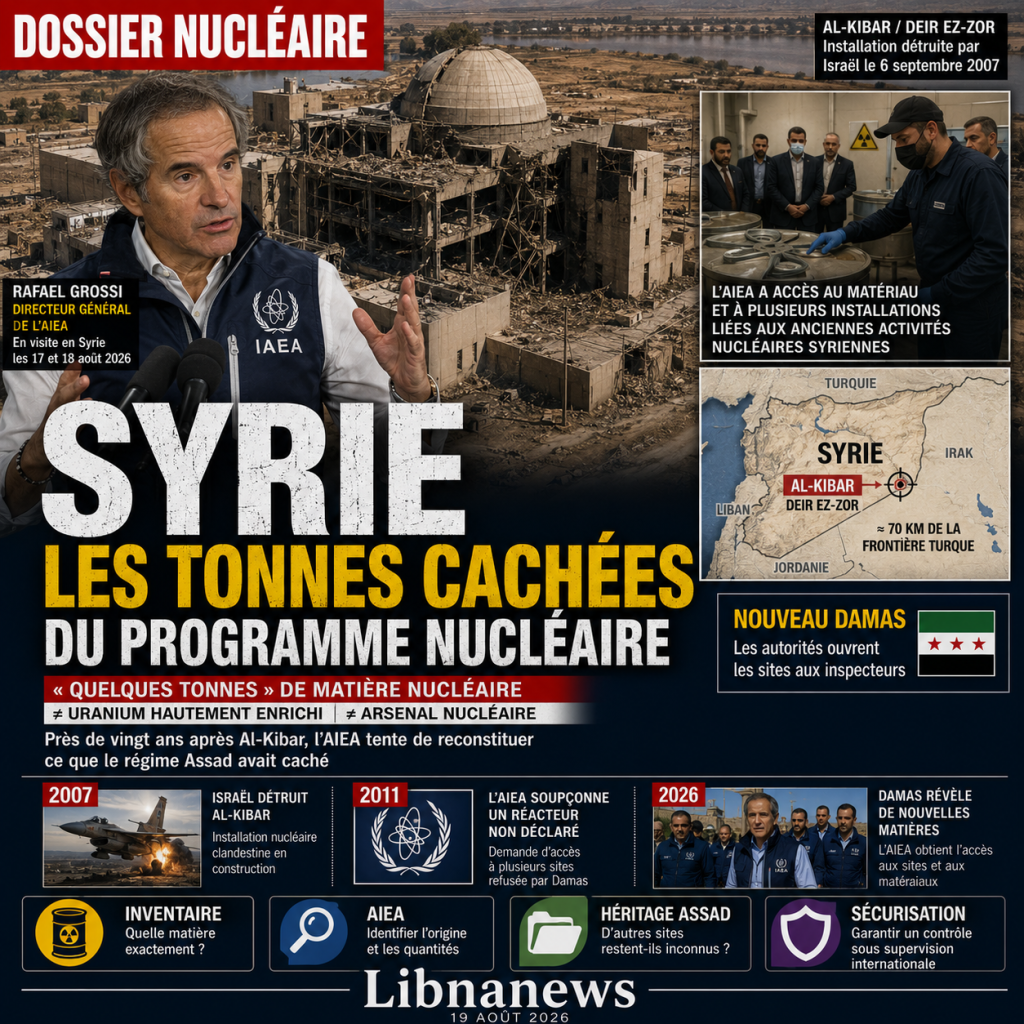
The new Syrian authorities revealed to the International Atomic Energy Agency the existence of several tons of nuclear material at a site that had never been declared under Bashar Al-Assad. Inspectors now have access to material and facilities related to former Syrian nuclear activities. The discovery does not mean that Damascus possesses several tons of material that can be used directly to make an atomic weapon. On the other hand, it reopens an almost twenty-year-old case: the clandestine programme associated with the Al-Kibar reactor, destroyed by Israel in 2007. For the new Syrian power, the challenge now is to identify, secure and declare this legacy while convincing the IAEA that there is no longer any hidden nuclear activity.
Several tons. The figure is enough to attract attention, but it may also mislead the exact nature of what has just been revealed in Syria.
The Director General of the International Atomic Energy Agency (IAEA), Rafael Grossi, confirmed during his visit on 17 and 18 August 2026 that the new Syrian authorities had reported the existence of a significant amount of nuclear material on a site that had not been declared to the Agency under the Bashar Al-Assad regime.
Damascus had officially informed the IAEA of this discovery on17 july 2026. The Syrian authorities then invited the Agency to examine the site and material. A month later, inspectors have access to determine precisely the nature, quantity and origin of the materials concerned.
Rafael Grossi mentioned « a few tons ». The Syrian Foreign Minister, Asaad Al-Shaibani, assures him that these materials do not pose a danger and that they will remain in Syria under the international safeguards of the IAEA.
The wording requires a first essential distinction:nuclear material does not mean material immediately usable in a nuclear weapon.
The information available does not make it possible to talk about several tons of highly enriched uranium, let alone a stock of material that can be used directly to make bombs. Media reports refer to uranium metal retained for more than 20 years and likely to be linked to former Syrian clandestine nuclear activities. Full characterization is now the work of the IAEA.
The news of 19 August is therefore less the discovery of a « nuclear arsenal » than the appearance on the open day of a material part of a program that Damascus had for years refused to deliver all the keys.
Syria itself declared nuclear material
This detail profoundly alters the political reading of the case.
The material was not discovered following an inspection of the new Syrian authorities. Damascus informed the IAEA of its existence and requested the intervention of its inspectors.
This initiative is part of the policy change initiated since the fall of Bashar Al-Assad in December 2024. The new Syrian power seeks to resolve international disputes inherited from the former regime, whose nuclear issue is one of the most sensitive.
During Rafael Grossi’s visit, Damascus reaffirmed its commitment to the Treaty on the Non-Proliferation of Nuclear Weapons and its safeguards agreement with IAEA. The authorities describe their cooperation as a break with the practices of the old regime.
The Agency now has access to the site where the newly declared materials are located. She is also working on facilities associated with the old questions about the Syrian program.
In Deir ez-Zor, Rafael Grossi was able to observe excavations at a site related to past nuclear activities. These operations must be able to identify elements that could illuminate what was going on there before it was destroyed.
The aim now is to rebuild a chain that the IAEA had never been able to establish completely: what materials did Syria have, where were they stored, what facilities were to use them, and what remains of it today?
Why a few tons don’t mean a few tons of fuel for a bomb
The nature of the material is the most important point to avoid misinterpretation.
The word « uranium » covers extremely different realities.
Natural uranium contains mainly uranium 238 and a small proportion of uranium 235. For most reactor technologies and, more importantly, to make a weapon using uranium, additional technical steps are needed.
The degree of enrichment is therefore decisive.
However, the authorities and IAEA have not announced the discovery of several tons of highly enriched uranium. The information available evokes a matter whose composition and history still need to be verified.
This does not make it insignificant.
A number of tons of undeclared nuclear material is a major problem for the international non-proliferation system. The IAEA must know where it came from, why it had not been declared, what facilities it was destined for and whether the entire stock had now been identified.
The issue is therefore both accounting and strategic.
In the nuclear safeguards system, a material should not simply be physically secure. It must be declared, characterized and followed so that the agency can verify that it is not diverted to prohibited uses.
That’s why the Syrian inventory becomes central.
The shadow of Al-Kibar reappears
To understand why this discovery causes such attention, we must go back to6 september 2007.
That night, Israeli aircraft destroyed a Syrian facility in the Deir ez-Zor area. For several months, Israel officially remained silent on the operation.
The site then becomes known as « Al-Kibar », or « Dair Alzour » in IAEA terminology.
International investigations will gradually increase suspicion. In 2011, IAEA estimates that it isvery likely that the destroyed building was a nuclear reactor that should have been declared to the agency.
Syria had rejected that conclusion.
One of the most important questions was the resemblance of the installation to a North Korean reactor. Suspects concerned a project likely to produce plutonium after irradiation and reprocessing of fuel.
But the destruction of the building prior to its international control complicated the investigation.
The IAEA had also detected uranium particles of anthropogenic origin in its investigations and requested access to several sites considered potentially related to Deir ez-Zor’s activities.
For years, the case remained unfinished.
It is precisely this legacy that the inspectors are now trying to reconstruct.
Uranium traces had already revived the investigation
The file had begun to evolve even before the revelations of August 2026.
In 2024, the Syrian authorities had allowed IAEA to visit three sites suspected of having had a functional link to the Deir ez-Zor site. Environmental sampling was then carried out.
Analysis then revealed at one of these locationsa significant number of natural uranium particles of anthropogenic origin.
This formulation is important.
« Anthropogenic origin » means that the material was subjected to human activity or industrial process. Therefore, its presence could not simply be assimilated to uranium naturally contained in the soil.
The agency had carried out additional samples to determine the significance of these particles.
The fall of the Assad regime then changed the conditions of the investigation.
By June 2025 Rafael Grossi had obtained a commitment from the new Syrian authorities to resolve the remaining issues. Then, on 17 July 2026, Damascus took an additional step by declaring itself the presence of nuclear material on an undeclared site.
The events of 17 and 18 August therefore constitute the provisional conclusion of a sequence begun well before the present visit.
A second radioactive record was discovered in Homs
The revelation comes a month after another event that could easily be confused with it.
The16 july 2026the Syrian authorities had announced that they had secured an armoured container containing radioactive material on the outskirts of the Al-Waer neighbourhood in Homs.
The container was externally deteriorated. Specialized teams of the Syrian Atomic Energy Authority had established a security perimeter and carried out radiological measurements.
According to the authorities, no significant radioactive leakage had been detected. The measured levels did not pose a threat to the population or the environment. The container was then transferred to the central laboratories of the Syrian atomic authority.
The two cases must therefore be clearly separated.
The Homs container was a problem ofradiological safetyconcerning a source discovered in a civilian environment.
The dossier revealed to the IAEA concerns:,undeclared nuclear material and Syria’s international safeguards and non-proliferation obligations.
The difference is fundamental.
Not all radioactive material is covered by a military nuclear programme. Radioactive sources are used in medicine, industry, research and many technical equipment.
The current dossier has a strategic scope because it could be linked to clandestine nuclear activities under the former regime.
The IAEA must now determine what Damascus really has
The work of the inspectors therefore begins with an apparently simple operation: to identify the material precisely.
Its isotope composition can provide information on its origin and treatment. Experts must also determine its condition, packaging, exact mass and available history of storage.
This data may then be confronted with the information collected at former Syrian nuclear sites.
The issue is whether the different elements tell a coherent story.
If several tons of material have been retained for more than 20 years, the IAEA must include their source and initial destination. It must also determine whether other stocks or equipment related to these activities could still exist elsewhere.
The new Syrian government says it wants to provide the necessary information.
Rafael Grossi considers this cooperation to be the most important progress achieved so far in resolving the guarantee issues left by the undeclared activities of the former regime.
But political cooperation does not replace technical verification.
The closure of the case can only occur when the Agency considers that there are sufficient elements to explain the materials, sites and past activities.
Why Damascus Wants to Keep Materials in Syria
Asaad Al-Shaibani indicated that the materials would remain on Syrian territory.
This position introduces another dimension of the file.
Syria does not renounce the principle of the peaceful use of nuclear energy. Like other States parties to the Treaty on the Non-Proliferation of Nuclear Weapons (NPT), it claimed the right to develop civilian nuclear activities in compliance with its international obligations.
Damascus therefore presents the discovered material not as a stock that should necessarily be disposed of, but as a material that can be kept under control.
This involves obligations.
The IAEA will have to be able to apply its safeguards, verify the inventory and monitor future uses. Materials should also be protected from theft, traffic or unauthorized use.
This issue is particularly sensitive in a country that is emerging from more than a decade of war and whose institutions are still under reconstruction.
The problem therefore lies not only in what the old regime wanted to do with these matters. It also concerns their safety today.
Israel remains directly concerned by the case
The past of the program also explains Israeli attention.
Israel demonstrated in 2007 that it was prepared to use force to prevent the appearance in Syria of a nuclear capability that it considered threatening.
However, the situation of 2026 is different.
The new Syrian authorities have chosen to inform the IAEA and open the sites to the inspectors. This internationalization of the file provides a verification mechanism that did not exist under the same conditions when suspicions surrounded Al-Kibar.
Media reports referred to discussions involving the United States, Israel, Syria and IAEA on the security of materials. Damascus, however, challenged the existence of an Israeli role in the current process.
There is therefore a need to distinguish between confirmed and diplomatic information.
What is established is that Damascus cooperates with the IAEA, that inspectors have access to the locations concerned and that the United States is closely following the file.
The level of Israeli involvement in material arrangements remains subject to differing versions.
For the new power, pay the Assad legacy
The affair finally has an internal and international political dimension for President Ahmed Al-Charaa.
His Government inherited a series of disputes left by the former regime: chemical weapons, sanctions, missing persons, detentions, security archives and now a nuclear file.
The nuclear strategy is to separate the new Syrian State from the previous ones.
Damascus presents the 17 July declaration as a voluntary initiative. The message from the outside is clear: the new authorities do not want to protect Bashar Al-Assad’s nuclear secrets and accept that the IAEA should rebuild past activities.
This cooperation can contribute to Syria’s international normalization.
But there is also a political risk: the more inspectors advance, the more they can shed light on the real scope of the clandestine programme.
The announced transparency will therefore be judged not on the first visit, but on what will happen if the IAEA requests new documents, new samples or access to other locations.
The mystery is now moving to inventory
The discovery of several tons of nuclear material therefore does not close the Syrian file. On the contrary, it gives it a new material dimension.
For nearly twenty years, the central question was what Bashar Al-Assad had sought to build in Deir ez-Zor and what other sites had participated in the project. The IAEA now has a possibility that it had never achieved under the same conditions: to confront the traces left on the ground with nuclear material declared by the successor authorities.
Three questions still need to be answered:what material exactly is this, why was it stored on an undeclared site and are there any other quantities or facilities still unknown?
Damascus claims that there is no danger to the population and wants to keep the material under international safeguards. The IAEA must now verify the inventory and continue its investigations in Deir ez-Zor. Future analyses will determine whether the few tons revealed in July constitute the last missing element of the Syrian nuclear issue or only the first part of a legacy that the new power is beginning to open.




