

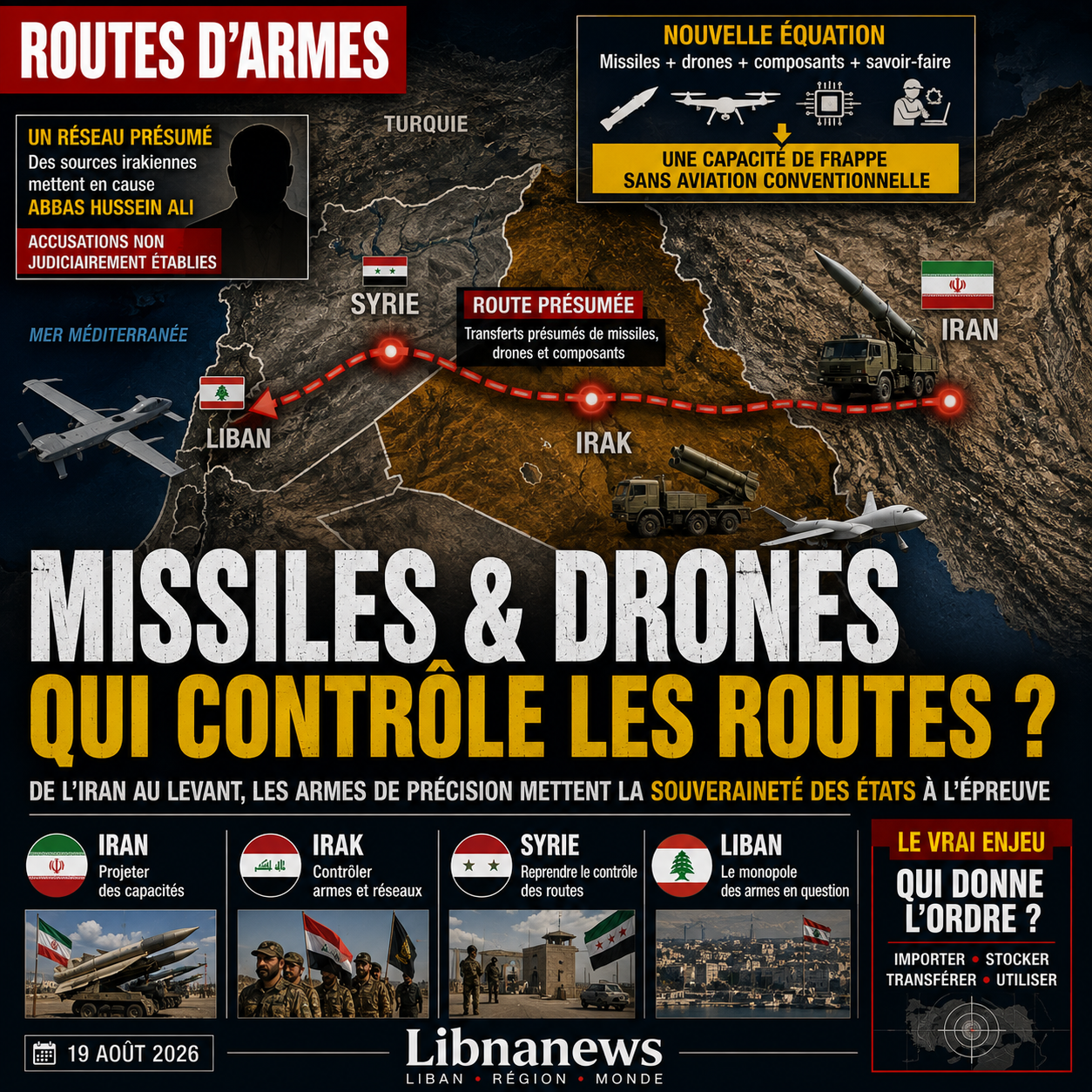
An alleged missile and drone transfer network from Iran to Iraq, with possible extensions to Syria and Lebanon, puts a central issue in the Middle East at the forefront: who really controls the flow of precision weapons between states? Iraqi sources cited on 19 August 2026 involved Abbas Hussein Ali, who was presented as one of those responsible for the scheme. These claims are not judicially established facts. However, they shed light on a broader strategic transformation: missiles and drones are now building regional strike capabilities without conventional aviation or moving entire armies.
The case first appears to be that of a man and an alleged network. It quickly leads to a much larger map, ranging from Iran to Iraq, then potentially to Syria and Lebanon. According to reports attributed to Iraqi sources and published on 19 August, Abbas Hussein Ali is reportedly involved in the organization of arms transfers including missiles and drones from Iranian territory.
The same sources refer to shipments entering Iraq and the possibility that some may then be sent to other territories in the region, including Syria and Lebanon. At this stage, these charges must remain presented for what they are:statements from sources cited by a media, not the findings of a court decision establishing the liability of Abbas Hussein Ali or the existence of each of the transfers described.
This precaution does not reduce the strategic interest of the case. On the contrary, it separates two questions. The first concerns the existence and exact responsibilities of the network referred to, which require evidence and judicial proceedings. The second is already documented at the regional level: the circulation of missiles, drones, components and associated technologies has become one of the main security issues between Iran, Iraq, Syria, Lebanon and Israel.
A suspected network between Iran, Iraq, Syria and Lebanon
The published information describes Abbas Hussein Ali as an alleged leader of a network to transport Iranian military equipment to Iraq. Missiles and drones would be at the heart of these transfers. Extensions to Syria and Lebanon are also mentioned by the Iraqi sources mentioned.
The distinction between these levels is essential. The possible entry of Iranian weapons into Iraq, their storage on Iraqi territory and their subsequent transfer to a third country are three different operations. Each requires logistical means, relays, routes and a specific degree of territorial control. Therefore, the possible existence of a stage does not automatically allow the following to be regarded as established.
But geography explains why the hypothesis gets attention.
Iran shares a land border of over 1,400 kilometres with Iraq. To the west, Iraq has a border with Syria. Syria then gives access to Lebanon. This geographical continuity offers, at least theoretically, a land road linking Iran to the Mediterranean without using maritime transport.
This card is not new. What has changed is the nature of the weapons likely to circulate and the strategic value of a relatively limited transfer.
Missiles and drones change the logic of military networks
Combat aviation requires considerable infrastructure. It requires aircraft, air bases, pilots, mechanics, fuel, spare parts, command systems and sufficiently protected runways. An air force is expensive, visible and difficult to move clandestinely from one territory to another.
Missiles and drones follow a different logic.
Some systems may be transported as components and then assembled or adapted near their area of use. The simplest drones require much lighter infrastructure than military aviation. Although more sophisticated systems require significant technical capabilities, they are generally easier to disperse and conceal than combat aircraft.
The scope then changes their value.
An armed group does not need to control airspace to threaten a target several tens or hundreds of kilometres away. A missile or drone can provide a strike capability beyond the front line without requiring the deployment of a squadron.
This fact explains why the issue is no longer limited to the number of weapons transferred.Technology, precision, range and local production capacity can count more than volume.
The transfer of components, engines, guidance systems or technical knowledge can thus produce lasting military effects. An organization that learns how to assemble, maintain or modify a system becomes less dependent on the delivery of complete weapons.
As a result, regional military networks are no longer used solely to move arsenals. They can also transfer skills.
Iraq, geographical transition and the centre of a political problem
Iraq occupies a particular position in this architecture.
Its border with Iran is long and goes through very different environments. Trade and human exchanges between the two countries are considerable. Several official crossing points provide for the movement of goods, while monitoring of remote areas remains more complex.
Geography, however, does not explain everything.
Iraq has a particular security landscape resulting from successive wars, the struggle against the Islamic State organization and the rise of Shia armed groups. The Popular Mobilization Forces, or Hashd al-Shaabi, have been integrated into the state security system, but their various components do not all have the same degree of dependence on the central command.
Some formations have historically maintained close ties with Iran. Others follow more closely the Iraqi authorities or national political and religious references. So speaking of the Hashd as a single block under Iranian command would be inaccurate.
This diversity is precisely the problem for Baghdad.
The State must control its territory and the weapons circulating there while managing formations that have a legal or institutional existence but can maintain their own command structures, political networks and external relations.
When a recognized force retains its own chain of allegiance
This creates an ambiguity that the Iraqi authorities have been trying to reduce for several years.
Training may be formally part of the security apparatus while maintaining an independent political identity. Its members can receive a public salary and legally take over from Iraqi institutions while maintaining historical relations with a foreign power or regional movement.
The problem becomes particularly sensitive when it comes to missiles and drones.
If a conventional weapon is registered, stored in an official facility and placed under an identifiable chain of command, the State can theoretically know who authorizes its use. When a system circulates through parallel networks or remains under the control of an organisation with its own decision-making chain, this responsibility becomes much more difficult to establish.
For Baghdad, therefore, sovereignty does not consist solely in preventing a shipment from crossing the Iranian border illegally.
It implies knowingwho can import a weapon, who can store it, who can move it inside the country, who can send it out of Iraq and especially who has the authority to order its use.
It is this chain of decisions that turns a smuggling problem into a state problem.
Syria is no longer the same transit space
The possible extension of the roads to Syria also deserves to be placed in the political context of 2026.
Under Bashar Al-Assad, Syrian territory was an essential link in military relations between Iran and its regional allies. The Iranian presence, that of Hezbollah and that of armed groups supported by Tehran had grown considerably during the civil war.
The fall of the Assad regime changed this architecture.
The new Syrian authorities are seeking to restore State control over borders, military installations and armed groups. However, they do not immediately have the means to control each route built for more than a decade of war.
The old networks do not necessarily disappear with the government that had tolerated or supported them. Roads, contacts, warehouses and logistics skills can survive political transformations.
That is why suspicions of transfers from Iraq to Syria remain closely followed, even in a Syrian environment that is profoundly different from that of the Assad period.
Lebanon as a strategically more sensitive destination
Lebanon is the other potential end of these networks.
The issue of Hezbollah’s missile and drone capabilities has been central to the confrontation with Israel for years. The military value of these weapons includes their ability to achieve remote targets and impose significant investments on Israel in detection, interception and air defence.
In the context of 2026, any suspicion of further transfers to Lebanese territory is therefore of immediate significance.
This does not mean that every cargo reported in Iraq is destined for Hezbollah or that it will necessarily reach Lebanon. Such a deduction would be precisely the methodological error that must be avoided.
But from the Israeli point of view, the possible existence of a chain linking Iran to military capabilities in Lebanon is a reason for surveillance and, potentially, for action.
This is where the consequences of intelligence or suspicion go beyond the judicial reality of the network concerned.
A suspected transfer may be sufficient to cause a strike
In this confrontation, States do not always have the time to wait for legal proceedings.
Israel has regularly justified strikes in Syria by the need to prevent the transfer of advanced weapons to groups it considers threatening. The convoys, warehouses, airports and facilities associated with Iranian networks have been targets for years.
The reasoning is preventive: a weapon considered dangerous must be destroyed before reaching its destination or before becoming operational.
This doctrine creates a particular regional risk.
Information about an alleged transfer may trigger increased surveillance. If deemed sufficiently credible by an intelligence service, it can lead to a military operation. The country on whose territory the target is located may then be hit by a cargo that his Government sometimes claims is unknown.
The circulation of missiles and drones thus becomes a factor in the violation or contestation of several sovereigntys simultaneously.
Washington also puts pressure on Baghdad
The United States is following the case from another angle.
Washington maintains close military relations with the Iraqi State and seeks to prevent its territory from serving as a platform for operations carried out by groups aligned with Iran. Attacks on American forces or interests have regularly placed the Iraqi government in a delicate position.
The U.S. authorities therefore call on Baghdad to strengthen control over armed groups and capabilities that could be used outside the State chain of command.
However, this pressure can produce internal tensions.
A brutal action against an armed formation with a political basis, institutional representatives or a status in security structures can cause a crisis. Conversely, inaction exposes the government to the accusation of not controlling its own territory.
Baghdad must therefore solve a difficult equation: to strengthen the State monopoly on weapons without turning that policy into an internal confrontation with part of the security and political system.
Networks become more important than borders
The case attributed to Abbas Hussein Ali finally illustrates a deeper evolution of regional power.
For a long time, the most visible measure of a state’s military force was its armies, tanks, aircraft and bases. These elements remain decisive. But the conflicts in the Middle East have added another infrastructure: networks capable of circulating weapons, components, technologies and specialists across several territories.
Iran has developed for decades relations with armed organizations in several countries. Political transformations in Syria, pressure in Lebanon and Iraqi debates over the control of armed groups are now forcing these networks to adapt.
Missiles and drones further enhance this evolution because they allow the ability to partially dissociate the strike from the presence of a conventional army.
A State may therefore consider that a threat is being built hundreds of kilometres from its border, in a warehouse or workshop located in another country.
This perception partly explains the proliferation of preventive doctrines.
A sovereignty issue for four States
The central issue thus goes beyond the alleged network described by Iraqi sources.
For Iran, the ability to maintain regional military relations is an instrument of influence and deterrence.
For Iraq, the issue is whether its territory and security institutions can be used for transfers decided outside the national chain of command.
For Syria, the aim is to regain control of roads and networks built or consolidated during the war years.
Finally, for Lebanon, the debate is directly linked to that of the State monopoly on arms and the possibility for a non-State organization to have strategic capabilities that could engage the entire country in confrontation.
That is why information about Abbas Hussein Ali must remain strictly attributed. The sources cited describe him as a leader of a suspected missile and drone transfer network. Such responsibility must be established by evidence and, where appropriate, by judicial proceedings.
The regional importance of the case does not depend on the fate of a single man. It is concerned with the question that the Governments of Baghdad, Damascus and Beirut now meet in different forms:is a State fully sovereign if it controls its administrative borders but does not control the strategic weapons that cross them?
The forthcoming Iraqi decisions concerning armed groups, borders and chains of command will show whether Baghdad can transform this issue of principle into effective control of the roads linking Iran to the rest of the Levant.




