

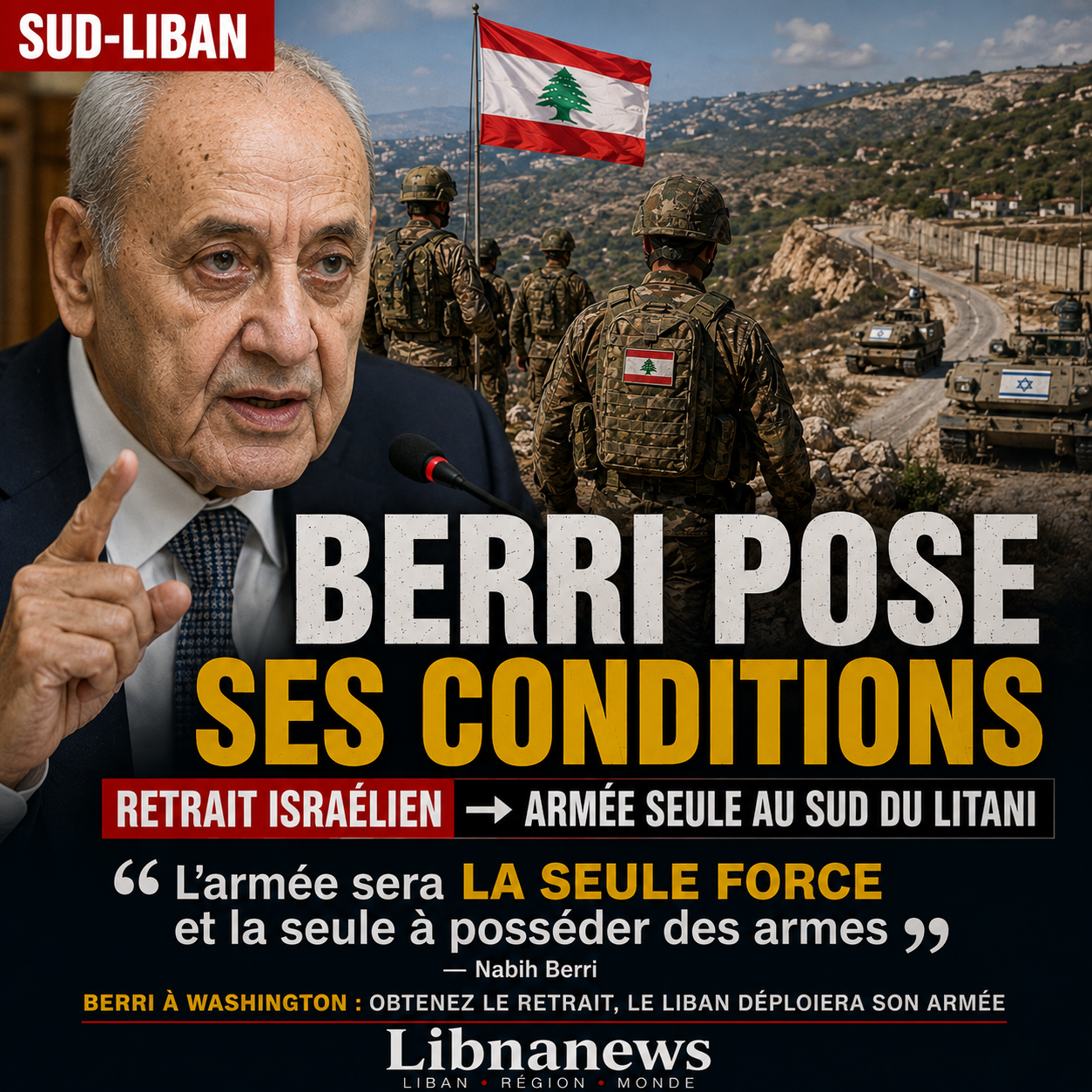
Nabih Berri placed on Wednesday 19 August 2026 a precise sequence for southern Lebanon: stop Israeli operations, cease-fire and withdrawal to the international border must, according to him, precede the immediate deployment of the Lebanese army south of the Litani. The President of the Chamber then states that he can guarantee that the army will be the only security force and the only one holding weapons in the area. By addressing this proposal directly to an American delegation, Berri places Washington in front of what he presents as his responsibility: to obtain from Israel the conditions allowing the Lebanese State to exercise its authority in the South alone.
Nabih Berri not only denounced the situation in southern Lebanon on Wednesday. In front of a delegation from the American Task Force on Lebanon (ATFL), he formulated a political and military chain that directly affects the most sensitive issue of the current negotiations: the arms monopoly and the deployment of the Lebanese army south of the Litani.
His message is based on a simple principle. Lebanon, he said, is ready to secure this area by its army, but Israel must first stop its war, cease fire and withdraw to the international border.
Berri goes further by personally speaking on the next step. » Only then can I guarantee the immediate deployment of the Lebanese army in the area south of the Litani », he said.
He adds that the army would then be« the only force »to maintain security and« the only one to possess weapons in this region ».
The wording is politically cumbersome. The President of the Chamber is also the leader of the Amal movement and remains one of Hezbollah’s main interlocutors in the Lebanese political system. When he claims to American interlocutors that the army must be the only armed force south of the Litani, it is not merely an abstract reminder of the role of the state.
The issue becomes one of the conditions for making this commitment applicable.
Berri proposes a sequence: Israeli withdrawal, then Lebanese army
The heart of the declaration lies in the order of the stages.
Berri does not reject the principle of a state monopoly on arms south of Litani. It explicitly links it to the end of Israeli operations and the withdrawal of Israeli forces to the international border.
This position allows us to understand part of the disagreement that has been going through the discussions on southern security for months.
Lebanon’s Western partners demand that the State extend its authority, that the army control the territory and that the weapons that escape its command disappear from the area. On the Lebanese side, the question is reciprocity: how can we ask Beirut to implement its commitments if Israel continues its operations and retains positions on Lebanese territory?
Berri responds by proposing a chronology.
Israel stops its attacks. A cease-fire becomes effective. Israeli forces withdrew to the border. The Lebanese Armed Forces deploys immediately in the sectors concerned. It then becomes the only security force and the only possessor of weapons in the area south of the Litani.
This chronology is not a technical detail. It determines who must do the first step.
This is also where part of the current diplomatic power ratio lies.
« The only force » and « the only weapons »: an unambiguous formula
The precise terms used by Berri deserve attention.
The Speaker of the Chamber did not limit himself to asking for a reinforcement of the army or an extension of its deployment. He claims that this will have to bethe only security forcein the region and should bethe only one with weapons.
This formulation directly affects the military presence of Hezbollah south of the Litani River.
Since Security Council resolution 1701, adopted in August 2006 after the war between Israel and Hezbollah, the area between the Litani and the Blue Line must be subject to a particular security regime. The text provides that it is free of armed personnel, goods and weapons other than those of the Lebanese Government and the United Nations Interim Force in Lebanon.
The application of this provision has remained incomplete for almost twenty years.
Hezbollah retained military infrastructure in the South, while Israel continued to violate Lebanese airspace and several territorial points remained contentious. After the opening of the front on 8 October 2023 and the ensuing conflicts, the previous balance was deeply disrupted.
The Berri declaration therefore amounts to explicitly accepting, for the area south of the Litani, the principle ofstate military monopoly.
The consideration it demands is equally explicit: Israel must leave Lebanese territory and cease its operations.
Why Berri says he can « guarante » deployment
The choice of verb is also important.
Berri says not only that he « wanted » or « supported » the deployment of the army. He claims that he canguarantee immediatelyafter the israeli withdrawal.
Institutionally, the Speaker of the Chamber does not command the Lebanese Armed Forces. Their deployment is the responsibility of the State, the Government and the military command.
Its guarantee must therefore be understood politically.
Berri has a major influence in the Lebanese system and in the South. Amal is deeply implanted in the southern Shia regions. The Speaker of the Chamber also maintains an old alliance with Hezbollah and has repeatedly played the role of political interlocutor in the indirect negotiations on the conflict with Israel.
His statement thus suggests that an exclusive deployment of the army south of the Litani could benefit from the necessary political coverage in the Shia environment if the conditions it poses are met.
This dimension is essential.
The application of the arms monopoly does not depend solely on the number of soldiers available. It also requires a broad enough political agreement to prevent the deployment of the army from being perceived as an operation directed against a part of the population or as the unilateral application of Israeli demands.
Berri is precisely trying to build another reading: the army would deployafter israeli withdrawalto restore lebanese sovereignty.
Message sent directly to Washington
The second major element of the declaration concerns the United States.
Berri claims that Washington is« the only country »able to force Israel to stop the war and Donald Trump is« the only »leadership able to achieve this result.
The formula is voluntary and direct.
It assigns responsibility to the United States in proportion to its influence on Israel. In Berri’s view, it is not enough for Washington to ask Lebanon to take measures concerning the arms or security of the South. The Trump administration must use its own leverage to get Israel to stop operations and withdraw.
The choice of contact person reinforces this message.
The American Task Force on Lebanon is an American organization that maintains contacts with policy-makers in the United States and Lebanon and advocates, among other things, support for Lebanese institutions.
In addressing his delegation, Berri knew that his remarks were intended to circulate in Washington.
His argument can be summarized as follows:if the United States wants the Lebanese army to be alone south of the Litani River, it must create the territorial and security conditions that allow this deployment.
A situation in the South deemed « unbearable »
This proposal is based on the continuation of Israeli operations.
Berri used exceptionally harsh terms on Wednesday to describe the situation. According to him, what southern Lebanon is experiencing has become « unbearable » and could even exceed, in some respects, « the crimes and massacres committed in Gaza ».
This comparison is part of his political assessment and does not constitute a factual equivalence between the balance sheets of the two conflicts.
However, it reflects the level of pressure felt by southern leaders in the face of destruction, displacement and reconstruction difficulties.
For Berri, therefore, the question of military deployment cannot be separated from that of inhabitants.
He insists on their right to return to their villages and rebuild their homes. The army, he says, must precisely become the force that protects this return.
Security is no longer presented solely in terms of disarmament. It is linked to a civil purpose: to allow the inhabitants to find their localities.
The return of the inhabitants becomes a condition of stabilization
This dimension is important because territorial control only makes sense if the areas concerned can regain civilian life.
In several sectors of the South, destruction has affected homes, roads, agricultural infrastructure and utilities. The continuation of military operations prevents or slows down reconstruction and keeps part of the population in a state of uncertainty.
Berri thus links three cases often dealt with separately: Israeli withdrawal, the deployment of the army and the return of the inhabitants.
According to this logic, withdrawal allows deployment; deployment creates security conditions; security allows return and reconstruction.
This sequence also gives an additional dimension to the future international conference in support of the Lebanese Armed Forces, a preparatory meeting of which is scheduled for 17 September in Paris.
If the army is to become the only force present south of the Litani, its needs will be considerable. It will have to hold long-term positions, monitor the territory, secure the axes, accompany the return of the inhabitants and have the necessary logistical means.
The question of the international financing of the army is therefore directly connected with that raised by Berri.
The Hezbollah problem is not solved
However, the Speaker’s statement does not resolve all questions.
Affirming that the army will be the only armed force south of the Litani does not yet state how Hezbollah’s infrastructure and weapons will be treated, according to which timetable or by what verification mechanism.
Geographical distinction is also important.
Berri speaks explicitly about the areasouth of Litani. His statement, therefore, does not in itself constitute a general settlement of the issue of Hezbollah weapons throughout Lebanon.
This limit must be retained.
It does not detract from the importance of the formula used, but it defines the exact scope of the formula: the Speaker of the Chamber offers a political guarantee concerning a given region, in exchange for an Israeli withdrawal and the cessation of operations.
Subsequent discussions will need to determine how this formula is aligned with the broader government’s objective of state monopoly of arms.
A proposal that moves pressure to the United States
The Berri statement finally tries to change the question asked of Lebanese officials.
For months now, part of the international pressure has been on what Beirut must do: deploy the army, control the territory and settle the Hezbollah weapons file.
Berri now responds with a conditional commitment.
He claims that the army can deploy immediately and become the only armed force south of the Litani. But he previously asked the United States to get what Lebanon was demanding of Israel: an end to operations, a ceasefire and withdrawal to the border.
The proposal therefore does not delete the debate on arms. It seeks to integrate into a logic of simultaneousity and reciprocity.
It is this formulation that Washington will now have to evaluate. If the Trump administration obtains the conditions requested by Berri, the President of the Chamber will have committed his political weight on a verifiable consequence:an immediate deployment of the Lebanese army and the absence of any other armed force south of the Litani.
The next step will thus test both sides of this equation: the American ability to get Israel a withdrawal and Berri’s ability to enforce, on the ground, the guarantee he has publicly given.




