

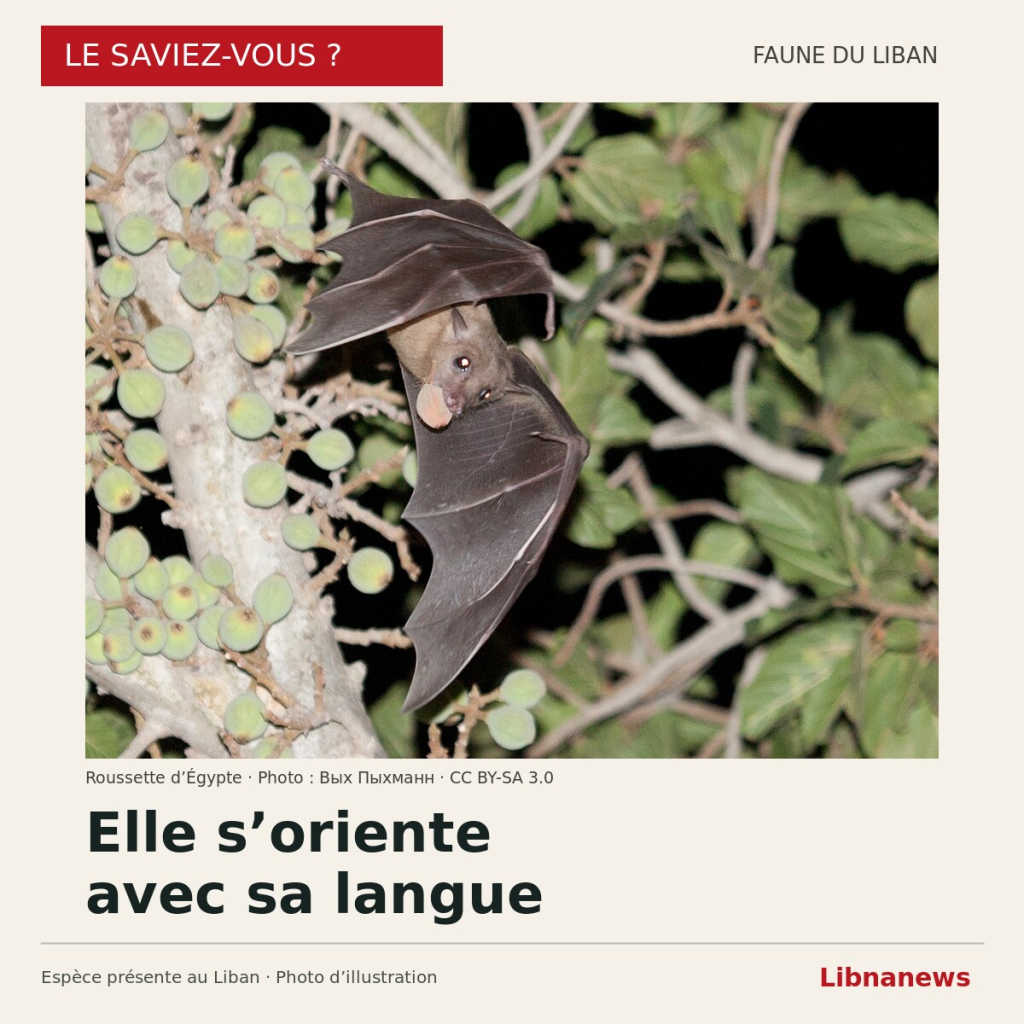
Did you know that?A bat in Lebanon has a sonar whose transmitter is not the larynx, but the tongue. The russette of Egypt,Rousettus aegyptiacus, produces short taps and listens to their echoes to explore its environment. This fruit eater does not just send sounds in front of her: she can direct their beam very precisely. The sonar of the russette reveals a much more elaborate sensory system than a simple obstacle detector.
Egypt also present in Lebanon
His current name must not be misleading. The species is not limited to Egypt. In Lebanon, its presence is documented on the west coast and slopes of Mount Lebanon. A scientific synthesis published in 2016 by Petr Benda and his colleagues, with the participation of Lebanese researchers, identified at least 41 known observational localities and described the species as widespread in western Lebanon.
This figure covers reporting sites collected in a study, not 41 colonies still identified today. It is also not a population estimate. This precaution counts: knowing the historical distribution of an animal and measuring its current abundance are two different approaches. The experiments that explain his amazing sonar were conducted outside Lebanon. They concern the same species, without being measurements made in Lebanese caves.
The sonar of the russette starts in his mouth
The principle of echolocation is that of a sound return. The animal emits a signal; part of this signal meets a surface and returns to its ears. The time, intensity and characteristics of echo provide information on what is around it. Many bats produce their echolocation signals in the larynx. In Egypt’s russette, language movements generate the clicks used for this acoustic exploration.
The phenomenon therefore does not consist of tasting air or pulling the language towards a target. The sound produced in the mouth spreads through its opening. The clicks are extremely short and can follow in pairs. Their organization allows the animal to alternately probe different directions, rather than acoustically illuminate all space in a uniform way.
The image of a flashlight helps to understand the issue. A beam directed towards a specific area highlights what is in it and limits the importance of returns from elsewhere. But an ordinary lamp requires that its light source be turned. The russette has another possibility: to change the direction of its sound emission without necessarily accompanying every change of a visible movement of the head.
A beam oriented without turning the whole head
A study by Wu-Jung Lee and his colleagues, published in December 2017 inPLOS Biology, examined this capability from the recording of in-flight roosts and a physical model. The researchers measured emissions alternately to the left and to the right, with an acoustic structure that varies according to frequency.
Their explanation involves the position of the language in relation to the opening of the mouth. The sound does not reach exactly at the same time the different points of this opening. The waves that come out of it reinforce in some directions and mitigate in others. Moving the source inside the mouth can thus move the outer beam.
This physics recalls that of the phase-controlled antenna networks used in certain detection technologies. The analogy describes a result, not an electronic equipment hidden in the animal. The researchers recorded the beams and proposed a mechanism capable of explaining them; they did not film every language movement inside the mouth during the flight. This distinction between measurement and model avoids turning a scientific explanation into excessive certainty.
Useful eyes, even with a sonar
Having echolocation does not mean being blind. In experiments published in June 2019 inScience Advances, the rossettes combined vision and acoustic information, giving them different importance depending on the task.
For some learning about the shape of an object, vision dominated when both senses were available. During navigation, it weighed more in the initial choice of a direction. As an obstacle approached, echolocation gained more weight. Animals could also distinguish objects through echoes under suitable experimental conditions.
So there’s no sense that would always be the « true » pilot and the other a simple rescue. The distance to the obstacle and the question posed to the animal change their respective contribution. The sonar completes a visual perception, instead of permanently replacing it.
Clicks from birth, before the first flight
Another surprising result is the development of young people. A study published in October 2021 inProceedings of the Royal Society Bfollowed their sound productions from birth and examined their hearing responses. The newborns already issued very short clicks characteristic of the species and responded to the sounds in the main adult hearing range.
Their emission also showed a paired organization and beam orientation. An essential part of this sensory equipment was therefore operational well before the first flights, observed around seven to eight weeks in the study. This does not mean that a newborn had all the performances of an adult: the rhythm of clicks and other features were still evolving during development.
The language also mobilizes a specialized brain organization. In 2022, a team mapped the movements triggered by the stimulation of the russet motor cortex. She identified an important representation of the language, with subregions associated with different movements. The result is consistent with the fine control required for this sonar. It does not measure a general intelligence or superiority of the animal over other species.
The sound precedes the turn
An experience published in July 2026Journal of Comparative Physiology Astudied twelve redheads of Egypt and eight frugivore bats of another species,Carollia perspicillata, in an arranged corridor. Scientists have recorded their trajectories and emissions during turns.
In both species, the acoustic beam could be directed towards the continuation of the course before the body took that direction. Animals were also slowing down to negotiate turns. This « acoustic look » ahead of the movement shows a coordination between sensory exploration and flight control, despite different sound production mechanisms.
The device remains a laboratory corridor, not a reconstruction of the vegetation of Mount Lebanon. It helps to isolate a specific problem: how to prepare a change of direction in flight. Between the clicks of a newborn, the language adjustments and this sound scan before a turn, the russette offers researchers several scales to study the same question: how an animal turns echoes into motion.





Comments