


Does the Lebanese public surplus resist unpaid invoices? The cash balance reached £108,698 billion in the first half of 2026. However, Parliament is still considering a credit to pay part of the public debt to Electricity in Lebanon. The review of social transfers and announced payments shows why these two realities can coexist, but also why the figures available do not allow a hidden « real deficit » to be calculated.
On 9 November, the Finance Committee approved an envelope equivalent to $100 million for EDL. It must finance part of the invoices of administrations and public bodies. The vote in the general meeting will remain due on Thursday, 12 November. The opening of a credit, its final authorisation and the receipt by EDL are three different steps.
This raises a broader question than electricity financing. A State can improve its cash flow through more revenue, less expenditure or delayed payments. These mechanisms do not have the same consequences or duration. To distinguish them, you must follow what enters the fund, but also what becomes due without being paid.
What the government surplus really measures
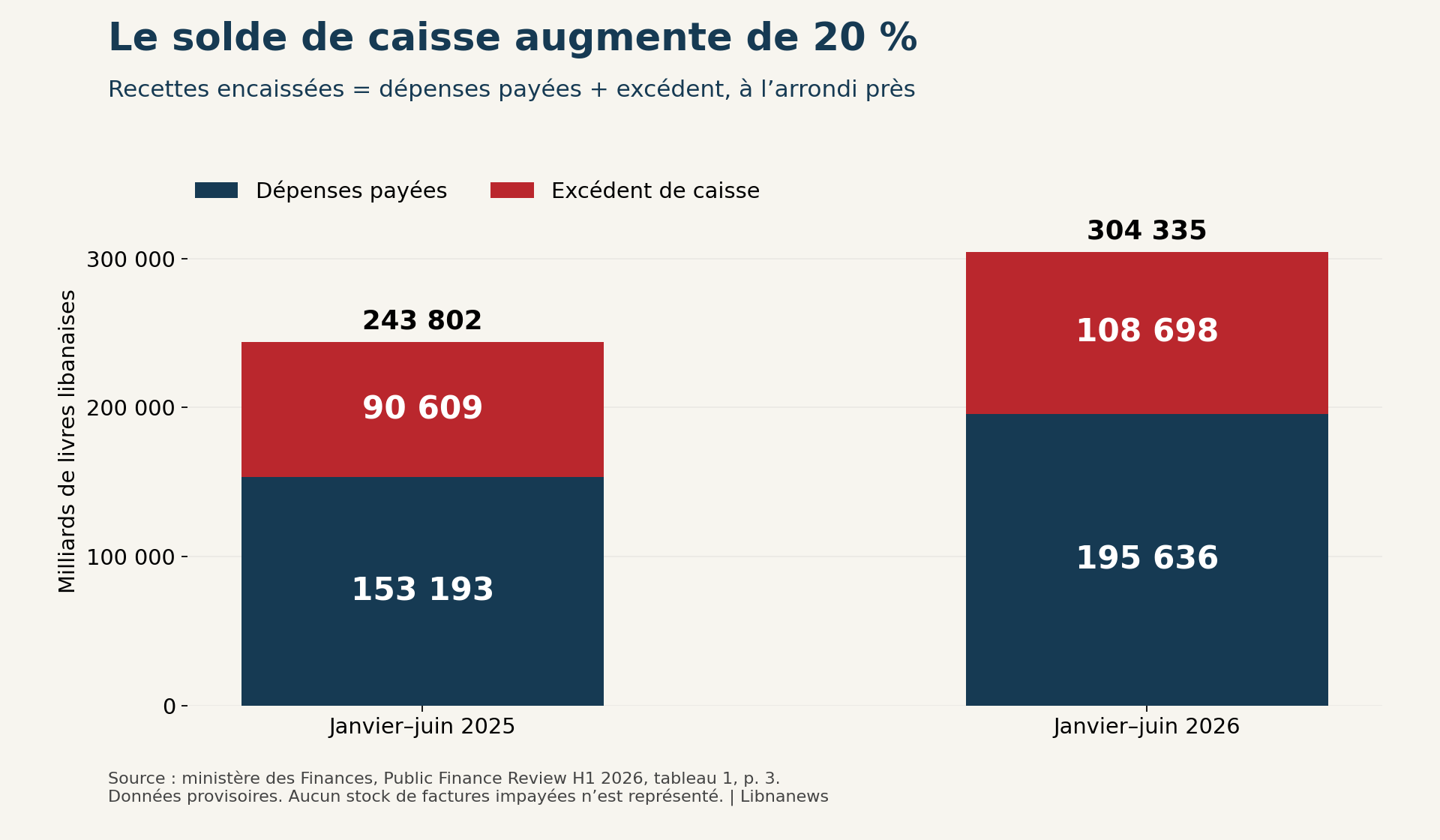
The half-yearly Finance report includes £304,335 billion in revenues and donations and £195,636 billion in expenditures. The published surplus reached 108,698 billion, compared with 90,609 billion a year earlier. The rounded amounts show a difference of one unit between the subtraction and the published balance.
Payments therefore increased by 27.7%. Their increase exceeds that of revenue in percentage, but not in amount. The additional revenue exceeds the additional expenditure of approximately Pound18,089 billion. This difference accounts for the increase in the balance.
The document, announced on 22 October, states that it describes cash flows. Its figures remain provisional, pending reconciliation and reclassification. It does not present final accounts or a complete inventory of public liabilities.
An invoice can thus correspond to a service already provided without appearing among the payments of the semester. Conversely, a settlement made in 2026 may result in a benefit of 2024. To measure the activity financed this year, payment dates are not sufficient.
The missing data: the change in debts payable
The correct reconciliation does not involve subtracting all known unpaid payments from the six-month surplus. A constant perimeter and two inventories are required: 31 December 2025 and 30 June 2026. The final stock only mixes old and new debts.
In a simplified presentation, the expenses for the period correspond to the payments, plus the change in the corresponding debts. When debts become larger, the cash balance appears to be more favourable than the balance of these expenses. When a State repays old debts, its fund degrades without an equivalent increase in services consumed during the period.
This relationship requires several corrections. Advances paid before delivery are not expenses already incurred. Disputed claims, cancellations and changes in value must be isolated. Revenues receivable also require reconciliation. Finally, an invoice that has not been paid constitutes a backlog only after its maturity has expired.
The IMF’s diagnosis of governance, dated October 2025 and published in April 2026, accurately describes this weakness. It notes the difficulties in defining and quantifying arrears. The information system does not properly determine when a payment becomes late. This institutional finding does not provide an amount of tax paid for June 2026.
The documents reviewed do not deliver the two necessary stocks. They help to establish the existence of scattered debts and settlements. They do not allow an accurate fraction of the six-month surplus to be attributed to the accumulation of arrears.
Two transfers absent, a measurable but limited effect
Two lines of the report attract attention. Transfers to the Civil Servants’ Cooperative increased from £7,200 billion in the first half of 2025 to zero in 2026. Those in the National Social Security Fund rose from 1,203 billion to zero. Their cumulative reduction is 8,403 billion.
This difference is equivalent to 46.5% of the surplus increase between the two semesters. This is an arithmetic contribution of two payment lines to an overall change, not a measure of arrears. The report does not say that $8,403 billion was due during the semester and remained unpaid.
Nevertheless, a test allows the order of magnitude to be located. If these two transfers had simply kept their nominal amount of 2025, all other transactions remaining the same, the surplus 2026 would have reached £100,295 billion. It would still be 10.7 per cent higher than in 2025.
This calculation does not reconstitute the budget that should have been implemented. It does not take into account new fees, contributions or the actual needs of organizations. It only shows that these two absences alone are not enough to erase the improvement in the balance. They remain important enough to ask for a detailed explanation of their timetable.
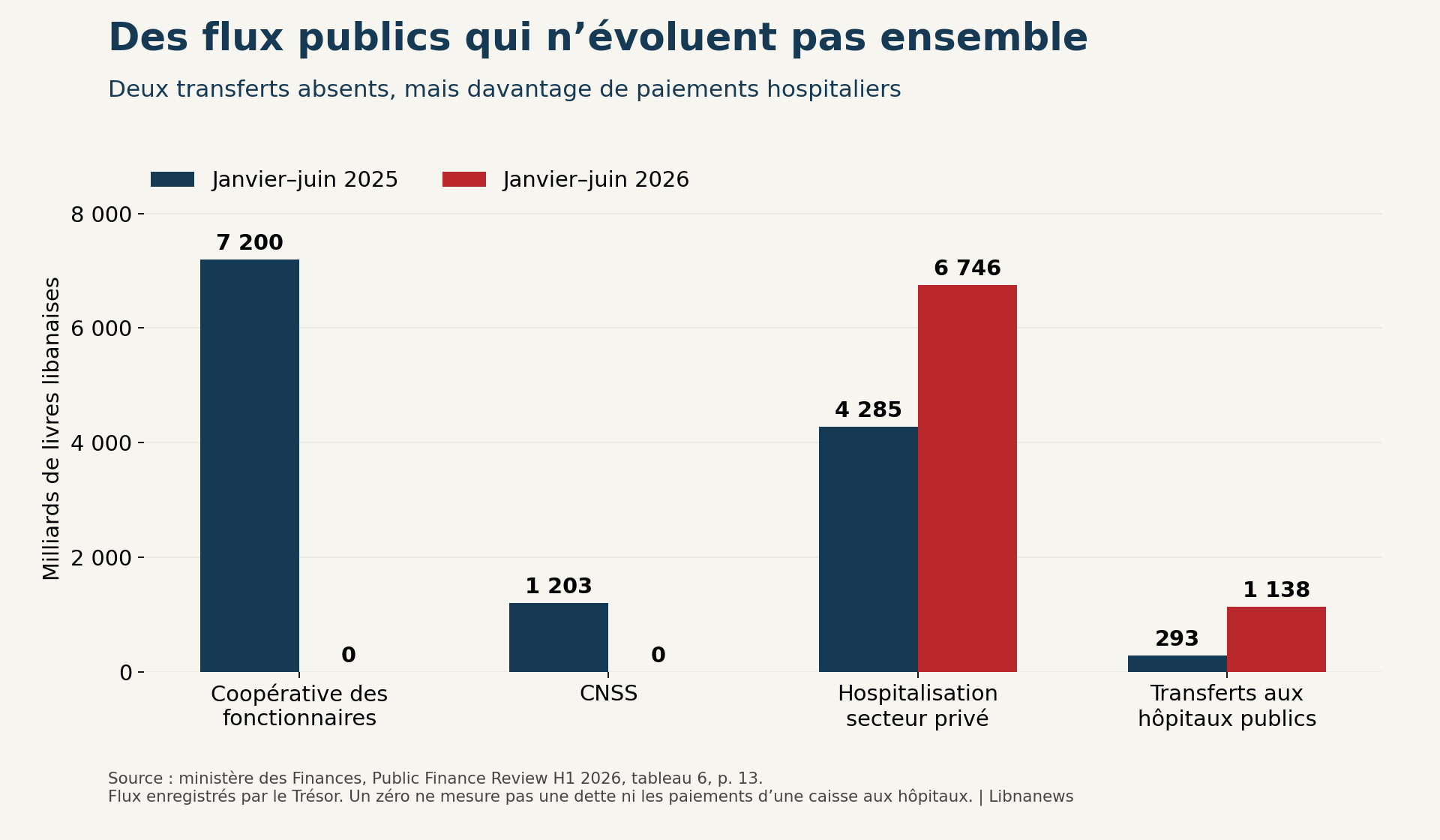
Not all health expenditures are decreasing. Private hospital payments increased from £4,285 billion to £6,746 billion. Transfers to public hospitals increased from 293 billion to 1,138 billion. These two increases total 3,306 billion. A uniform reading of austerity would therefore mask opposing movements.
These figures describe the flows of the Treasury. They don’t say if all the medical procedures charged have been settled. Nor do they measure the payments made by each social organization with its own resources.
Why zero transfer does not mean zero care paid
Two financial relationships must be distinguished: that of the State with a fund and that of the fund with its beneficiaries. The latter also depends on contributions, available reserves, advances and the timing of the settlement. Consolidating the two leads to a declaration of unpaid invoice which has sometimes already been paid.
On 9 September, the Civil Servants’ Cooperative reported that it had no arrears to its contracted hospitals. It announced over £2,600 billion in advance payments since the beginning of the year. These advances were based on outstanding receivables and invoices.
This is a management statement, not an independent audit. It covers a longer period than the first semester. It therefore does not resolve the question of the possible obligations of the Treasury to the Cooperative. But it prohibits the mechanical transformation of the absence of a semi-annual transfer into a non-payment to health care facilities.
The CNSS provides another example, more specifically documented. On 23 September, it announced the settlement of approximately Pound14 billion at Rai and Bellevue hospitals. The files concerned benefits accrued prior to 2024, including medical fees. The communiqué shall mention settlement agreements and settlements, after validation by the competent authorities.
These payments reduce CNSS’s old debts to two institutions. They do not measure the total government debt to the CNSS or that of all organizations to hospitals. Adding them to a Treasury envelope would create a risk of double counting.
EDL: a credit voted in committee is not a payment
The electrical record shows the same calendar differences. The appropriation examined on 9 November amounts to £8,950 billion, or $100 million to £89,500. Its purpose is to settle part of the public sector debt owed by EDL. The Commission also calls for an audit of the overall amount.
Therefore, the $100 million cannot be deducted from the balance from January to June. Credit is subject to a November procedure. The invoices concerned are not broken down by date in the advertisements examined. And no receipt of this envelope is confirmed at this stage.
The situation also varies among debtors. In a press release dated October 25, the Ministry of Defence states that it has paid all of its arrears to EDL, approximately $11.43 million, more than two months earlier. He recalled the thanks of the Minister of Energy during a visit on 21 August.
This declaration does not apply to the general inventory of EDL claims. However, it requires the date of the debtor lists. An amount valid before a settlement does not necessarily describe the following situation. Partial payments and staggering agreements must also be distinguished from full clearance.
Another precaution concerns consolidation. The payment of one administration to EDL is one exit for one and one entry for the other. At the public sector level, this internal transfer should not be counted twice. It remains decisive for EDL, which must finance its purchases and suppliers with liquidity actually received.
The economic cost of an invoice left on hold
A delay does not remove the cost of a service already provided. He moves his funding towards the claimant. He must pay his employees, buy his inputs and cover his maturities before receiving public money. If there is little cash or credit, the delay becomes a production constraint.
The IMF’s diagnosis describes an additional mechanism: suppliers can integrate the risk of late pricing. The immediate cash economy can then increase the following purchases. The selection of suppliers can also change in favour of those able to endure long delays.
In health, cash pressure can affect the conditions of support. In electricity, it weighs on the institution’s ability to pay its own bills. These channels explain why the examination of public finances should go to the service rendered. They do not allow, without contract and payment data, to quantify a current national additional cost.
There is also a need to separate delays from expenditures that have never been incurred. Waiver of a maintenance operation preserves the caisse, but does not automatically create an unpaid invoice. Another economic problem is the future wear and tear of equipment. Adding to arrears would give a total without consistent definition.
The currency of the debt also changes the incidence of the delay. A debt fixed in pounds may lose purchasing power while waiting. The creditor then bears part of the cost, even if the State ends up paying its nominal amount. A claim indexed or denominated in dollars follows another logic. Converting all old invoices to the current rate without verifying their clauses would not restore their due value.
This is why the decrease in the dollar value of some arrears, as reported in the IMF’s diagnosis, does not necessarily mean their repayment. For the supplier, receiving a depreciated amount and receiving on time the contractually expected value produce different economic results. Individual files should specify which rule applies.
What a status of unpaid payments should make visible
To verify the quality of the surplus, a usable statement should identify each class of creditor, the currency of the contract and the relevant dates. It should separate invoices received, validated amounts, amounts due and disputes. A disputed debt cannot be treated as a definitively recognized obligation.
The reconciliation should then explain the change from stock to new invoices, payments, cancellations and revaluations. A breakdown by seniority would make it possible to distinguish the current treatment from sustainable accumulation. It would also make the priority given to certain creditors visible.
Finally, the accounts must identify the perimeter of each digit. The Treasury, municipalities, public institutions and social funds are not a single fund. Their financial relations require reconciliation, with the elimination of internal debts and debts when a consolidated package is presented.
The EDL credit offers a concrete next test. After the vote due on 12 November, the decisive information will be the adopted text, the bodies concerned, the invoices covered and the date of receipt. It is this follow-up that will enable us to move from budgetary authorisation to a verifiable reduction in unpaid payments.





Comments