

When families flee the bombings, the first emergency is to find a roof. Very quickly come water, medicines, transport and information on the help available. In Lebanon, these services are based on a chain linking national coordination with municipalities, relief workers and associations. Its operation depends as much on material means as on the flow of data on needs.
The experiences of Saida, Damour and several communes in Bekaa or Akkar show how this preparation is organized. They also reveal strong local differences: here municipal vehicles can be put back into service; elsewhere, people are first seeking first aid training for lack of civil defence services.
Protection of civilians begins with coordination
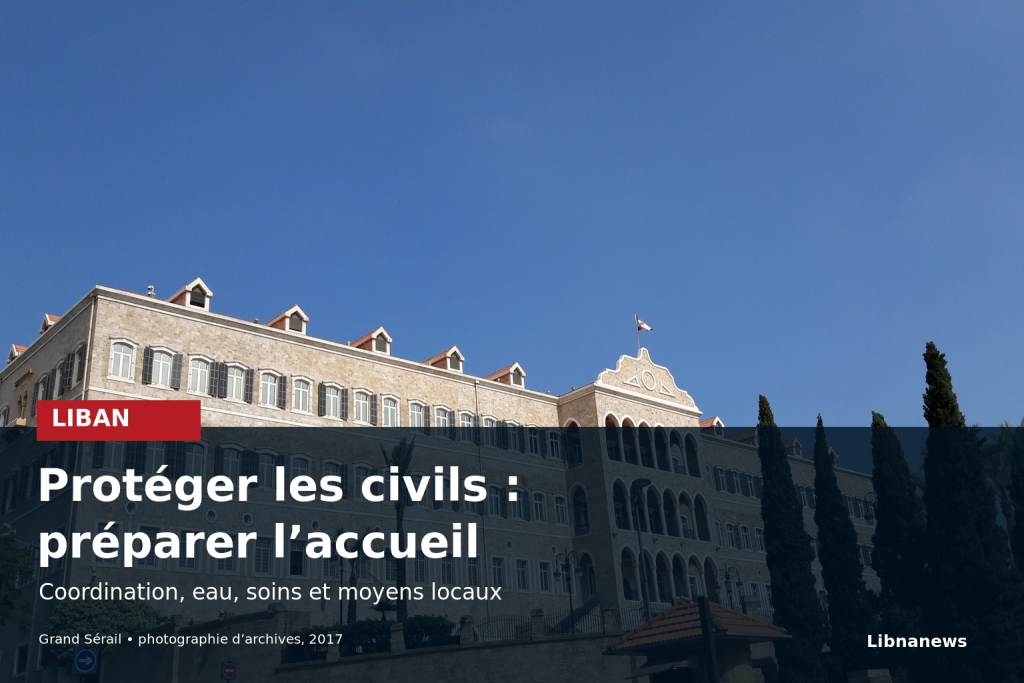
In the Grand Sérail, the National Emergency Operations Room was activated on 2 March 2026. The United Nations Development Programme described its ongoing operation in a report of 19 March. It is based on the Disaster Risk Management Unit established in 2010 under the Presidency of the Council of Ministers.
The Ministries of Health, Social Affairs, Education and the Interior work with the Civil Defence, the Lebanese Red Cross, the National Council for Scientific Research and aid partners. Travel and hospitality information is used to define priorities. The governorate units and municipalities provide the local relay.
This organization provides a common focal point. It then depends on the vehicles, buildings, equipment and personnel available in each territory. Identifying saturation does not create additional places; However, the signal allows resources to be directed before the situation deteriorates further.
In Saida, data lead to water deliveries
In Saida, the urban observatory identified insufficient water storage capacity in collective centres. The municipality repaired and reassigned firefighting vehicles to deliver approximately 300,000 litres per week, according to a review published by UNDP on 25 September.
The estimate of the number of internally displaced persons in the city during the reporting period was 30,000. The observatory had about 11,500 people in 25 collective centres. These numbers are those of this sequence, not an updated count as at 9 November.
The system centralizes the needs for food, water, hygiene and medicines. It also integrates disability and chronic diseases. This allows teams to direct specialized assistance, particularly to pregnant women or young mothers, without requiring families to register repeatedly with each participant.
Different responses by municipalities
In another programme, UNDP assisted 38 communities with training, exercises and work on division of responsibilities. The report published on 31 July mentions more than 440 local actors involved.
Participants in Maghdouché focused on identifying vulnerabilities and resources. In Maqneh, Bekaa, the lack of civilian defence services directed discussions towards first aid and firefighting. In Damour, municipality and local organizations together prepared a response plan, based on the difficulties encountered in 2024.
In the union of the municipalities of Joumeh, the process brought together schools, religious leaders, associations and young people. Preparing contacts, clarifying roles and sharing information reduces the risk that several teams will cover the same need while another team will remain unanswered. This preparation must precede the arrival of families, when municipal services no longer have the same time to organize.
Housing and healing, two inseparable links
A collective centre provides accommodation and services; It is not necessarily designed to withstand shelling. The reception of internally displaced persons and their physical protection therefore pose distinct problems. The ability of a building to receive families is not sufficient to establish its structural resistance or security of access.
Continuity of care is another immediate need. The World Health Organization’s operational plan for March to August 2026 combined coordination, epidemic surveillance, essential services and preparedness for the influx of victims. It provided for stocks, mobile teams and referral circuits to structures capable of receiving patients.
An displaced person may need to continue dialysis, pregnancy follow-up or diabetes treatment. The interruption or absence of a medicine then turns an evacuation into an additional health risk. Preparing for reception also means knowing which institution can provide the relay and how the patient can reach it.
The resources involved in these programmes do not cover the territory uniformly. Their contribution is nevertheless concrete: an identified water demand, a vehicle mobilized, a continued treatment, a contactable person. At this local level, national coordination becomes a service for families.





Comments