

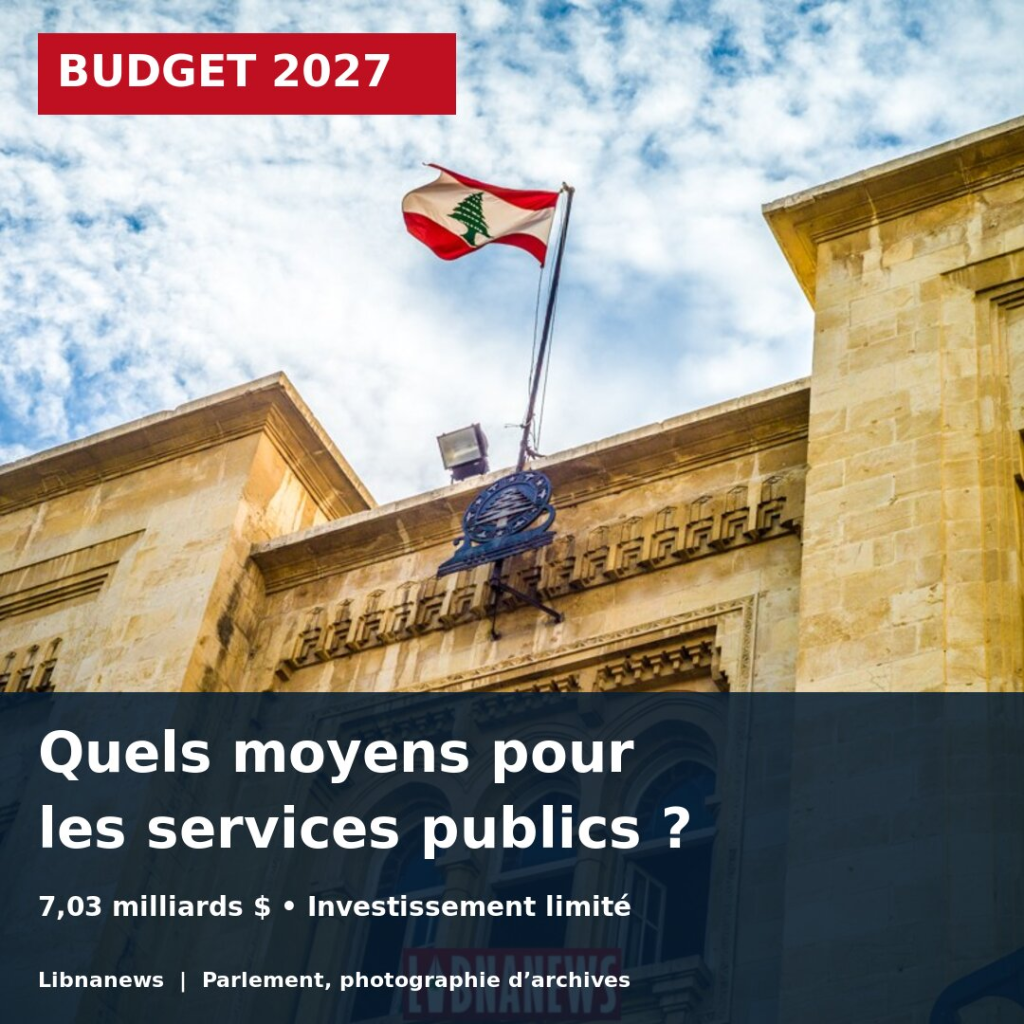
The Lebanese budget for 2027 provides for approximately $7 billion in expenditures. But its increase does not guarantee a better functioning of schools, administrations or infrastructure. As Parliament deals with the examination of appropriations, the allocation of resources and their implementation become decisive for public services.
In a contribution published this November 9, Mazen Abboud proposes to judge the budget on its ability to restore the state. His argument is about the use of money: improving collection is not enough if governments remain unable to provide the expected benefits. It calls for investments in electricity, digital, education and fiscal capacity.
The parliamentary calendar gives practical relevance to this issue. On 4 November, the Finance Committee concluded its examination of the articles, while reserving several provisions. Its president, Ibrahim Kanaan, announced the opening of the credit review the following week, beginning with the President of the Republic. This step still allows discussion of spending priorities. The bill is not a final finance law.
Lebanese budget for 2027: an increase to read in detail
The government’s project brings spending to £628,868 billion, compared to £538,415 billion in Budget 2026. The increase is about 16.8%. At the conversion rate of £89,500, the envelope represents some $7.03 billion. Planned revenues are equal.
These comparisons cover two budget envelopes. They do not measure the increase in actual expenditure. An administration may have a credit and may not be able to use it. On the other hand, deferred payments may weigh over one year without corresponding to new services.
The project retains a structure dominated by current expenditure, at 90.7% of the total. Investment is 9.3%. Compensation, pensions, social benefits and associated positions together account for 61.4%. The share available to build or equip therefore remains a minority.
This allocation does not qualify any current expenditure as unproductive. A school needs teachers, a tax agency and a maintenance network. Rather, it requires examining how wages, purchases and equipment work together. Financing a building without staff does not produce more service than paying a team without equipment.
Education progresses, Public Works declines
Ministerial envelopes follow contrasting trajectories. The amounts below compare Budget 2026 to Government Project 2027, before final parliamentary arbitrations.
| Ministry | £2026 billion | Project £2027 billion | Nominal change |
|---|---|---|---|
| Education and higher education | 54 859 | 64 949 | +18.4% |
| Public health | 47 266 | 55 262 | +16.9 % |
| Public Works and Transport | 23,710 | 19 716 | -16.8% |
| Telecommunications | 20,384 | 19 612 | -3.8 per cent |
These appropriations comprise several types of expenditure. The increase in education cannot therefore be seen as an equivalent increase in school construction. The decline in Public Works alone does not measure the total financing of infrastructure: other agencies and funding may be involved.
However, the contrast raises a specific question for Members. What services will each envelope maintain or improve? A verifiable response requires separation of remuneration, maintenance, supplies and projects. It must also specify the external funding allocated to the same objectives.
The Commission has announced that it intends to examine the appropriations according to health, education, defence and development priorities. This control will be more useful if it brings the amounts closer to operational requirements. A department cannot justify its budget only by comparison with the previous year.
Inflation reduces the scope of nominal increases
Abboud uses a 3% growth and 10% inflation hypothesis to discuss the project. The return to growth of close to 3% is also reflected in the budget documentation. It remains a forecast, particularly dependent on the security situation and reforms. Its 10 per cent inflation assumption remains a scenario, not a recorded result.
As a test, an increase of 16.8% with prices up by 10% would gain about 6.2% in volume. The calculation compares indices 116.8 and 110, not both rates of increase. It does not measure the actual purchasing power of the budget, as not all public costs follow the household index.
Medicines, imported equipment, work and remuneration are subject to different mechanisms. A national average does not allow the number of salaries or kilometres of road financed to be deducted. Comparisons should cover prices and quantities specific to each programme.
The same reasoning applies to recipes. Their growth may reflect better collection, but also higher prices or shifting deadlines. It does not automatically demonstrate an expansion of production. Abboud pointed out precisely the risk of a fiscal effort that would weaken the activity on which future revenues will depend.
Balance leaves several charges out of field
The zero deficit presented in the project does not cover all public transactions. In particular, the budgetary documentation states that advances and other transactions in the Consolidated Revenue Fund remain outside this calculation. Interest on Eurobonds is also not included in the amounts announced.
A distinction must therefore be made between the balance of the budget area and all the financial obligations of the State. The first is a management constraint. It does not prove that old commitments are being met or that all reconstruction needs are being funded.
This limit explains the importance of the multiannual financial framework. During its September mission, the IMF called for better integration of investment and social protection needs. He also called for tracing externally funded expenditures. The aim is to make annual budgets compatible with future commitments.
Accounting closing documents are equally important. On 4 November, Kanaan indicated that the final 2025 account had not yet been transmitted. Without reconciliation between forecasts and achievements, the debate may compare successive authorisations without measuring what they actually produced.
Services are played between credit and payment
Abboud focuses on the administrations that support the activity. He cited tax and customs services, digitization of procedures and public procurement. The challenge is to reduce administrative costs and improve controls, while linking expenditure to measurable results.
The November 4 discussion provided an immediate example of the problem. Kanaan has denounced the interruptions of services related to the unpaid electricity from public bodies. He pointed out, however, that funds had been included in their budgets. Therefore, an expense authorization may coexist with an outstanding invoice and an interrupted service.
Between the vote of a credit and the operation of the service, the cash flow and the actual settlement of invoices may block execution. Thus, an increase in the envelope does not solve delays in payment alone.
Parliamentary arbitration remains to be completed. Several articles on royalties remain under discussion with the administrations concerned, while the review of credits begins. The amounts of the project will have to be reconciled with the selected changes, then with the payments and services actually provided in 2027.





Comments