





Gas returns above 80 euros and recalls the European fragility
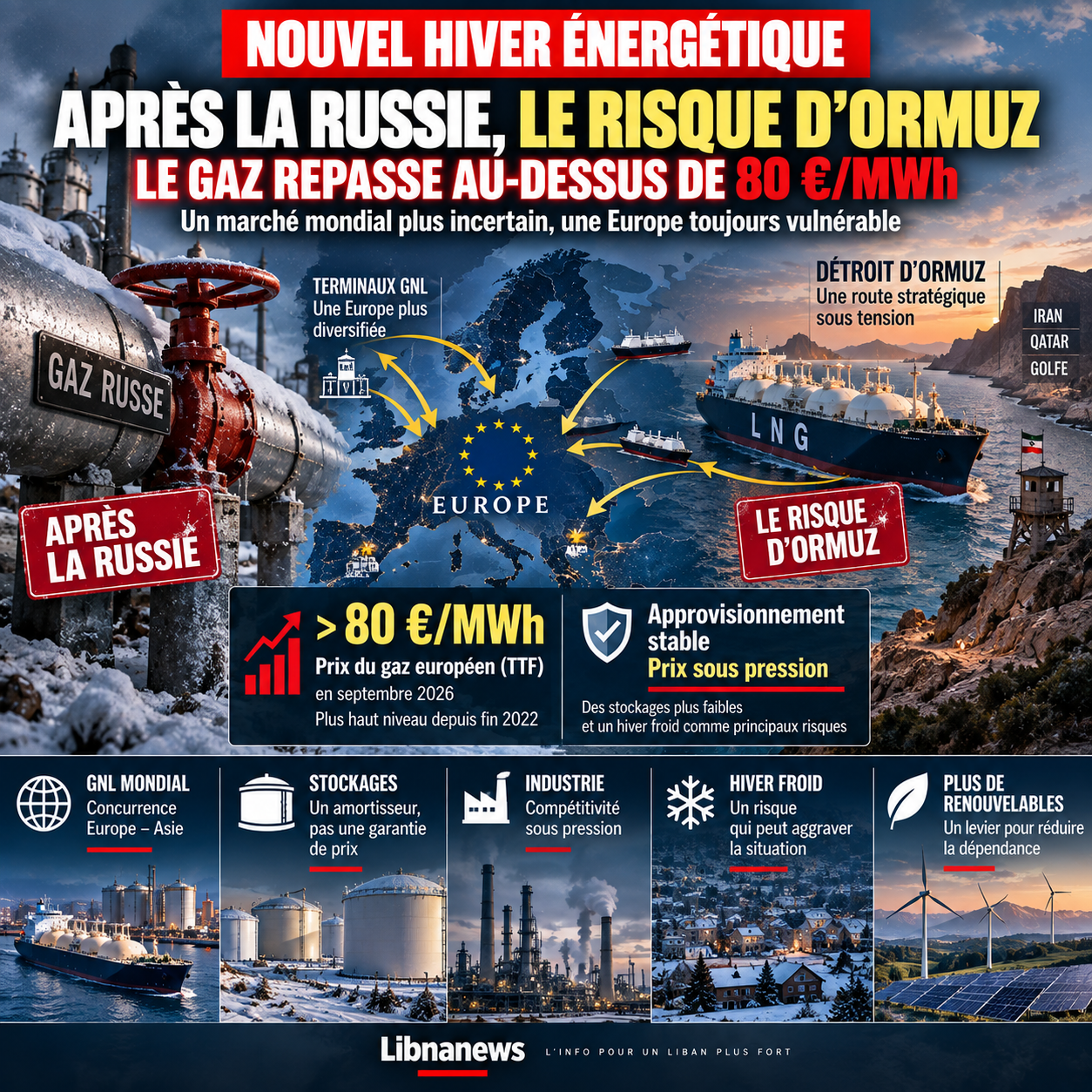
The European energy market is approaching the winter of 2026-2027 under pressure which governments thought had partly controlled after the great crisis caused by the break with Russian gas. In September, the price of European gas exceeded 80 euros per megawatt hour, a level that has been the highest since the end of 2022. This recovery comes in a very different context than the one that had upset the continent four years earlier. Russia is no longer the only centre of gravity of European energy vulnerability. Tensions around Iran and the Strait of Ormuz now pose a direct risk to liquefied natural gas and oil shipments linking the Gulf to world markets. The crisis thus reveals a transformation of the problem rather than its disappearance. Europe has reduced a major geographical dependence by diversifying its supplies, expanding maritime imports and building new reception capacity for liquefied natural gas. But this diversification has made it more dependent on the uninterrupted operation of shipping routes and a global market where a cargo can be redirected to the buyer offering the highest price. Under these conditions, the Strait of Ormuz becomes a European risk, even if no border of the Union is near.
The tension is all the higher as the energy works in anticipation. There is no need for all flows to stop in order to raise prices. The possibility of closure, traffic limitation or attacks on infrastructure is sufficient to increase the risk premium. Traders must integrate the likelihood of a delay or interruption. Insurers reassess their conditions. Shipowners may modify their decisions. Buyers are looking for alternative shipments before they even know if they will be necessary. The increase in prices becomes a form of protection against uncertainty. This mechanism explains why the negotiations between Washington and Tehran around Ormuz are followed so closely by European markets. The issue goes beyond the relationship between the two countries. It concerns the operation of an artery through which major volumes of energy flow. The Iranian authorities have linked the full reopening of the Strait to certain conditions in discussions with the United States. They also warned that if Iran could not export its oil and ensure its own security, regional infrastructure would not necessarily be sheltered. These statements reinforce volatility, even when mediators simultaneously seek a diplomatic outcome. For Europe, therefore, the first threat of winter is not yet a widespread physical shortage. This is the return of a gas price that is sufficiently high and unstable to weigh on households, industry and public finances.
After Russian gas, Europe has changed its dependence rather than removed the risk
The crisis opened in 2022 forced Europe to change its supply system as a matter of urgency. Russian imports by pipeline had long provided a considerable share of the gas consumed on the continent. Their sharp reduction has prompted European states to look for other suppliers, to fill their storage quickly and to import more liquefied natural gas. New infrastructure has been built or accelerated, including floating terminals. The United States has become a much larger supplier. Qatar and other producers have also become more prominent. This transformation helped to avoid the scenario of a major supply disruption. It also gave Europe greater flexibility than a system dependent on a few pipelines. A LNG tanker can theoretically change its destination. A cargo can be purchased on the international market. Several suppliers may be competing.
This flexibility, however, has a price. Liquefied natural gas further links Europe to the world market. As Asia increases its purchases, European consumers may have to pay more to attract cargo. When conflict threatens Gulf roads, the risk is quickly passed on to European prices. Dependence is therefore no longer based solely on the political will of a supplier. It is based on a broader set: LNG availability, strait operation, liquefaction capabilities, Asian competition, port infrastructure and weather conditions. This development does not necessarily constitute an increase. Having multiple suppliers remains more secure than depending almost exclusively on a source. But it changes the nature of the risk. Europe has become more resilient to the decision of a single player and more exposed to global market disruption.
Ormuz perfectly illustrates this changeover. A significant part of the Gulf’s energy exports must go through this path. Qatar, a major player in liquefied natural gas, depends directly on this route to ship its shipments. A lasting disturbance would therefore have an effect that would far exceed the volumes directly destined for Europe. Asian buyers would also look for alternatives. The cargo available elsewhere would become more expensive. European states are expected to compete more with China, Japan, South Korea and other major importers. A regional crisis would thus turn into a global competition for the same molecules.
Stocks protect against a break, not against all prices
However, Europe has an essential instrument: its storage facilities. Reserves allow a shift in consumption and limit the immediate consequences of import disruption. They act as a shock absorber between the international market and the consumer. But their existence is sometimes overinterpreted. Storage is not a permanent source of energy. It contains a finished volume that must be reconstituted. Its efficiency depends on the level of filling at the beginning of winter, temperature, industrial consumption and the duration of any interruption.
A mild winter can significantly reduce pressure. A cold winter produces the opposite effect. Several weeks of low temperatures increase residential heating and accelerate sampling. If this period coincides with a disruption in Ormuz, Europe must buy more at a time when the world market is already tense. The problem then becomes less that of the physical existence of the gas than that of its price. Countries with significant financial resources can continue to attract cargo. More fragile economies and some importing countries outside Europe may be ousted or reduced. European energy security can therefore have indirect consequences for other regions.
The increase above 80 euros per megawatt hour should be included in this context. It does not mean that European reserves are exhausted or that a general shortage is already in place. It indicates that the contract attributes a much higher value to risk. This price is then transmitted in a differentiated manner. Households with fixed-price contracts may be temporarily protected. New contracts gradually integrate market conditions. Energy-intensive companies, on the other hand, experience faster variations when they have to renew their purchases. Governments may decide to subsidize certain invoices, but this protection transfers part of the cost to public budgets. There is therefore no mechanism for the sustainable removal of expensive energy. The cost is ultimately paid by the consumer, the taxpayer, the company or a combination of the three.
European industry risks paying for the energy crisis a second time
For industry, the rise of gas comes at a particularly delicate time. Energy-intensive sectors have already had to adapt to rising costs since 2022. Chemistry, fertilizers, glass, metallurgy, ceramics and other activities use gas either as a source of energy or directly as a raw material. When its European price remains lastingly higher than that borne by competitors in other regions, the gap becomes a problem of competitiveness. A company can absorb an outbreak for a few weeks. It can hardly build an industrial strategy over several years if it ignores its energy cost.
This uncertainty can produce effects even before a factory closure. Investments are deferred. New capabilities can be built elsewhere. International groups compare the cost of producing in Europe with the cost of an establishment in the United States, the Middle East or Asia. Energy then becomes an industrial policy issue. European governments must no longer only guarantee that households can heat up. They must provide companies with sufficient visibility to continue to invest.
The Ormuz crisis is particularly problematic because it reminds us that liquefied natural gas, used to reduce Russian dependence, is not necessarily cheap energy. It offers strategic diversification, but its chain is expensive: extraction, liquefaction, shipping, regasification and then routing. As global competition increases, prices can rise rapidly. Europe must therefore avoid turning a security solution into a structural dependence on the spot market. Long-term contracts may reduce some of the volatility, but they create other commitments as the Union seeks to gradually reduce its consumption of fossil fuels. The continent must secure enough gas for the next decade without blocking volumes that are incompatible with its climate targets. Ormuz makes this balance even more difficult.
Qatar becomes simultaneously supplier and mediator
Qatar’s position illustrates the intersection between diplomacy and energy. Doha plays a mediation role in the discussions between Washington and Tehran. At the same time, its energy economy depends on the free passage of LNG tankers through the Strait. The country therefore has a direct interest in preventing an escalation that would threaten Gulf exports. The mediators are working to bring American and Iranian positions closer together around a formula for restoring normal circulation. Discussions focused on Iranian conditions concerning Ormuz, while Washington maintained strong economic pressure on Tehran.
For Europe, this mediation has an immediate economic dimension. Every step that can reduce the risk on the Strait can ease expectations. Conversely, a break in discussions can quickly be passed on to markets. This situation shows how much European energy security now depends on diplomacy in which the Union is not always the central player. Washington, Tehran, Doha and Gulf producing states can directly influence the price paid by a German factory or an Italian household.
This diplomatic dependency poses a strategic question. Europe has invested heavily in infrastructure to import gas from different sources. However, it has little capacity to control maritime routes and political crises affecting these suppliers. Physical diversification must therefore be accompanied by geopolitical diversification. This means maintaining supplies from several regions and developing interconnections between European countries. This implies, above all, a gradual reduction in the amount of gas needed by the economy. Each unit of avoided consumption reduces exposure to Ormuz, the global market and future crises.
Renewables protect Europe but not yet replace all gas
The rapid development of renewable energies is in this context a security policy as well as a climate policy. A megawatt hour produced by a wind turbine or solar panel does not require the passage of a LNG tanker through a strategic strait. The more the electrical system relies on domestic sources, the less an external crisis can directly affect its cost. But this protection still has limits. The sun and wind are variable. The network must have storage, interconnection and piloting capabilities capable of taking over. Gas continues to play this role in several countries.
The energy transition therefore reduces dependence without removing it immediately. Heat pumps, building insulation and industrial efficiency can reduce gas consumption more structurally. These investments are less visible than a new LNG terminal, but they have a major advantage: they reduce demand in every future crisis. A well-insulated dwelling consumes less than any gas source. A more efficient plant remains less exposed regardless of the supplier.
Winter 2026-2027 could thus speed up a change already underway. The crisis of 2022 showed the danger of excessive dependence on Russian gas. The tension around the Ormuz shows that changing supplier is not enough. True security consists of having several sources while reducing the total amount required. This evolution takes time. During the transition, Europe will remain exposed to global market crises.
A cold winter would turn the price risk into a political test
The most unpredictable variable is the weather. If winter is mild, storage will decrease more slowly and demand will remain under control. Markets could absorb a temporary disruption of Ormuz without a major supply crisis. If the temperatures are low, the situation changes. Heating increases consumption at the same time as cargo becomes more difficult or more expensive to obtain.
The problem would then become political. Governments should decide how far to protect households and businesses. The energy support mechanisms put in place in previous crises have shown that massive protection can be very costly for public finances. Too general aids also subsidise consumers who could absorb part of the increase. Over-targeted aids leave the middle classes exposed to hard-to-support invoices. Each country then adopts a different response, which can create gaps in the European market.
Industry would pose a comparable dilemma. Is it necessary to subsidise a plant’s gas to preserve employment if its economic model is no longer more competitive with sustainable energy? Or accept a reduction in certain activities at the risk of accelerating deindustrialisation? These questions go well beyond winter. They determine the European economic model for the next decade.
The threshold of 80 euros per megawatt hour therefore acts less as an absolute border than as a warning. He pointed out that energy prices could quickly become a central political issue again. A new sustainable surge could reactivate debates on purchasing power, public aid and industrial competitiveness at a time when several governments already have limited budgetary margins.
Ormuz reveals the new geography of European dependency
Europe has undoubtedly strengthened its resilience since the crisis of 2022. It has more capacity to import liquefied natural gas, more suppliers and a new experience of rapid consumption reduction. It is therefore not in the same situation as at the beginning of the breakup with Russia. But the current crisis reveals the counterpart of this transformation. Risk has become global.
In the past, the main question was whether the gas would arrive through a specific pipeline. Today, it deals simultaneously with maritime routes, Asian prices, terminals, LNG carriers, tensions in the Middle East and the availability of American cargo. Dependence is less concentrated, but more complex.
The Strait of Ormuz thus becomes a symbol of the new European energy security. Europe does not depend exclusively on this passage. It depends sufficiently on the global market influenced by this transition to bring about an immediate price rise. Difference is essential. It explains why a partial closure can affect the continent even if no LNG tanker destined for a European port is directly blocked.
The preparation of winter is therefore no longer just filling the storage. It consists of maintaining several supply routes, preserving import capacity, reducing consumption where possible and accelerating investments that structurally reduce the need for gas. The negotiations around Ormuz will determine part of the pressure in the coming months. But they will not address the underlying vulnerability. After learning to live with much less Russian gas, Europe discovers that it must now learn to live with a global market where a crisis of thousands of kilometres away can make its bills jump again.