

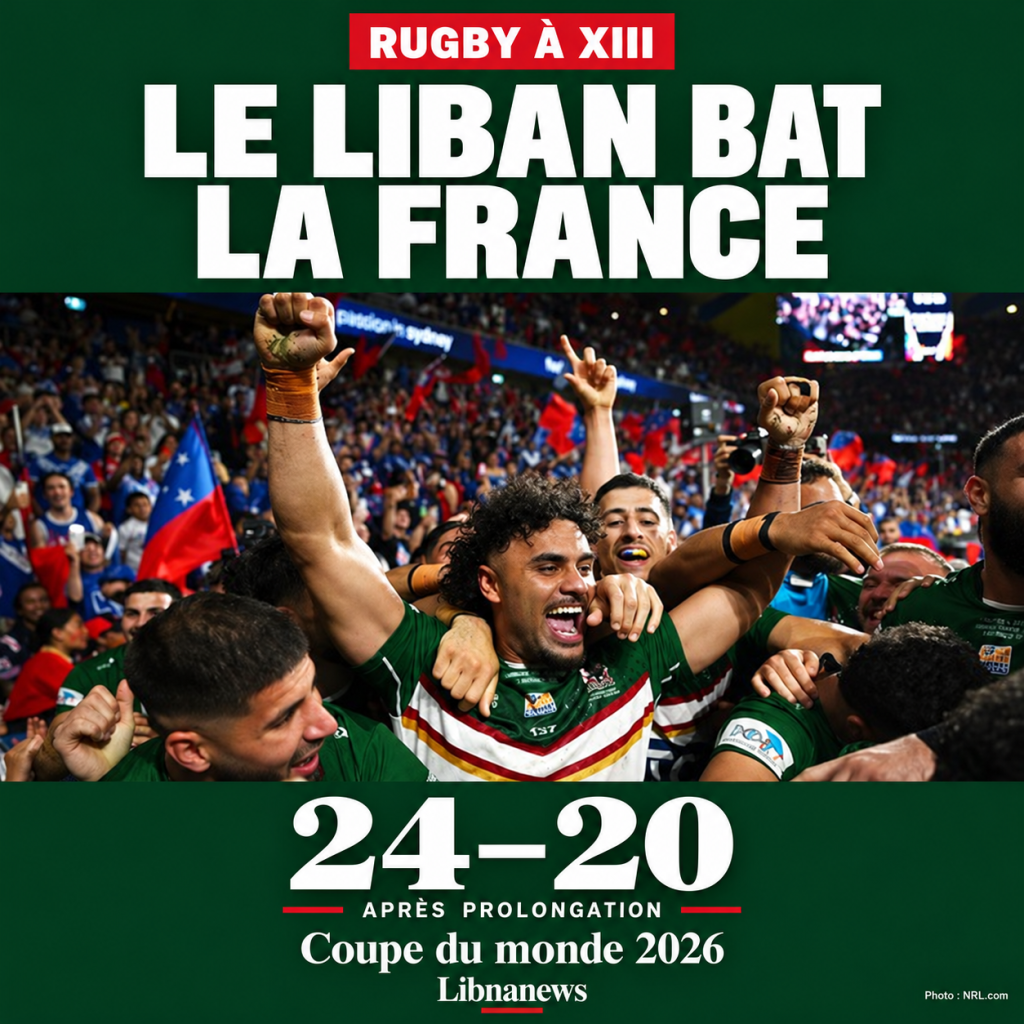
Lebanon defeated France 24-20 after an extension on Sunday 1 November 2026 at the CommBank Stadium in Parramatta, Sydney. Abbas Miski entered the decisive test at the end of a meeting marked by a cancelled French drop. Already eliminated from the Rugby World Cup in XIII, the cedars finished their tournament with a victory.
Lebanese success was played around the 85th minute. After a missed penalty by Alex Conti, Arthur Mourgue recovered the ball near his line. The French rear tried a small kick over the defense to pursue the action itself. Miski intercepted the ball and scored, immediately ending the game.
A few minutes earlier, the French had celebrated a victory they believed they had won. César Rougé had spent a drop in overtime, before his cancellation for an obstruction of Thomas Lacans. Lebanon thus survived two critical moments: French legalization at the end of the regulatory time, and then this point refused.
Rugby to XIII: Miski decides the fate of the game
Miski’s essay set the score at 24-20 in an extended dispute based on the gold point principle. In this sequence, the first team to score points wins the match. The Lebanese turned a recovery near the French beginning into decisive action.
For Mourgue, this last initiative erased the benefit of a remarkable gesture a few minutes earlier. While France was led 20-18, he had managed a long-distance drop in the last seconds. This two-point attempt had given the teams a tie and extended the meeting.
The outcome, however, is not limited to the error of the French rear. Miski had already participated in the first Lebanese essay, serving Conti. Present at the beginning and at the end of the story, he concluded a meeting during which the cedars resumed several times in advance.
Alex Conti launches the cedars and organizes their attack
Lebanon had opened the score in the first few minutes. After an exchange with Miski, Alex Conti crossed the French line. Its transformation had brought the mark to 6-0. A successful penalty later in the first period then gave the Lebanese eight points in advance.
This advance did not allow the Cedars to take control for a long time. The loss of bullets slowed their progress and offered opportunities to the French. They eventually came back with a penalty trial awarded to Amir Bourouh, after an intervention by Mustafa Dirani’s foot in the beginning.
Mourgue added the transformation. At the break, Lebanon was only 8-6. France therefore remained within reach despite its initial delay. For the cedars, the challenge of the recovery was to find precision with the ball.
Conti again played a central role after the break. His razing kick enabled Michael Gabrael to register the second Lebanese test. With the transformation, the cedars increased their lead to 14-6. They then found the eight-point gap built in the first period.
France returns to every Lebanese acceleration
The French response came from Guillermo Aispuro-Bichet. The center recovered a balloon lost by Jordan Samrani after a Lebanese interception. He then joined the beginning. Mourgue’s transformation brought France to two points on the 14-12 score.
Lebanon found another opening around the hour of play. Served offshore by Conti, Tony Francis scored around the corner. This time, transformation has not passed. The gap remained limited to six points, at 18-12, allowing the French to equalize with a transformed test.
That’s what they did as they approached the last ten minutes. Rougé took advantage of Jacob Kiraz’s poorly controlled balloon to score. Mourgue succeeded in his third transformation and brought the two selections back to 18-18.
The six tests entered so far were therefore not sufficient to separate the teams. With each new Lebanese advance, France had found an answer. A penalty from Conti finally gave the cedars the advantage, 20-18, in the last minutes of the regulatory time.
A drop cancelled after the French celebrations
The tension has risen at the end of the meeting. Lebanese captain Alex Twal and the French pillar Julian Bousquet received a temporary exclusion after an altercation. Both teams discussed the extension to twelve, after Mourgue’s distant legalization.
France then thought it would win the tournament. Well placed in front of the poles, Rougé managed a drop. The French bench joined the players on the lawn to celebrate. But the examination of the action led the arbitrators to sanction Lacans’ obstruction.
The score remained blocked at 20-20. The French had to retake the game, while the Lebanese retained a new chance to win. The penalty then attempted by Conti did not find the target. His trajectory, however, preceded the recovery of Mourgue, then Miski’s victorious intervention.
A first victory to finish the World Championship
This match was the last group match of both selections. Both had lost their first two meetings and could no longer join the phase of direct elimination. The result of Sunday did not therefore decide on a qualification.
Lebanon remained on defeats against Papua New Guinea, 42-18, then Tonga, 36-0. He finished his World Cup with a success and two setbacks. France finished with three defeats, after his heavy failures against Samoa, 78-4, then to England, 82-0.
Conti received the player distinction of the game. He entered the first Lebanese test, passed two transformations and two penalties, twelve points. He also prepared the essays of Gabrael and Francis. Miski signed the fourth, the one who stopped the meeting and raised the Lebanese total to 24 points.





Comments