

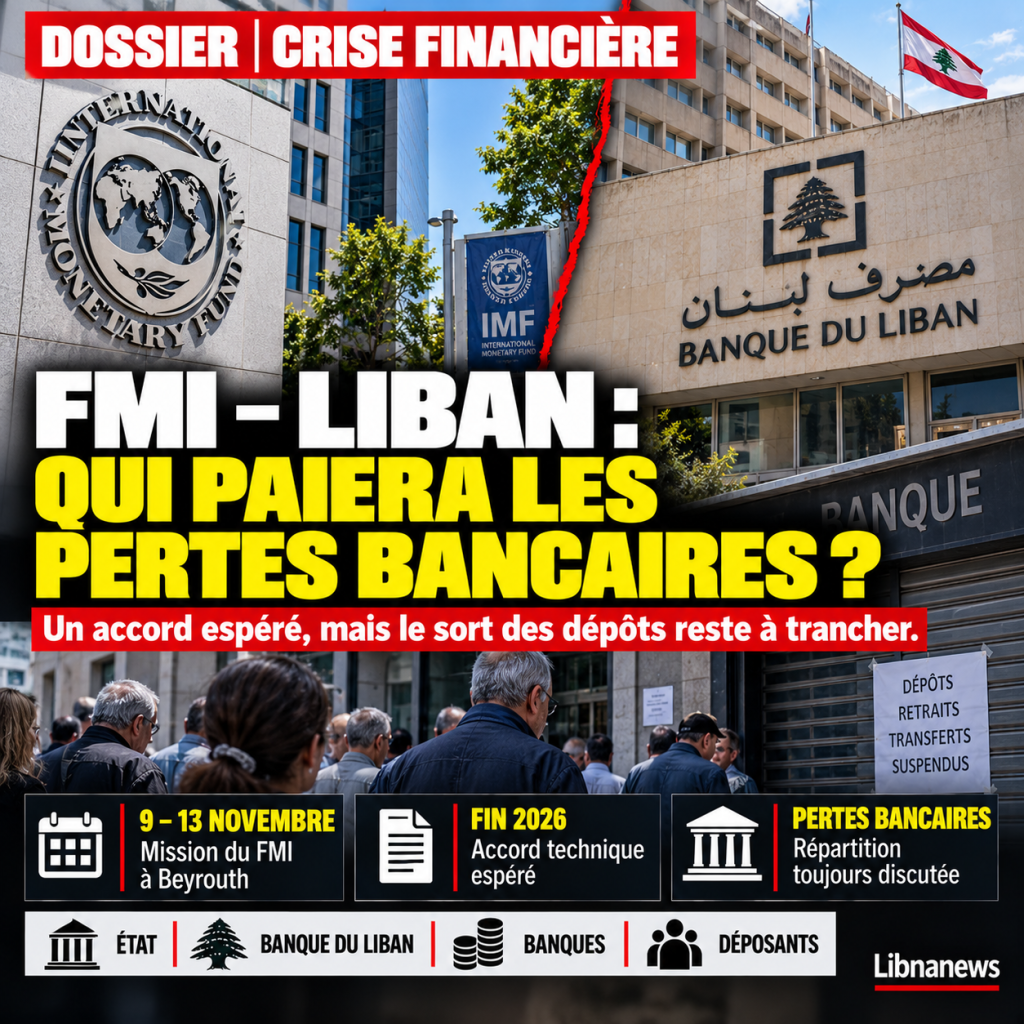
A delegation expected from 9 to 13 November to speed up negotiations
Lebanon could take another step in its negotiations with the International Monetary Fund before the end of 2026. A delegation from the financial institution is expected in Beirut from 9 to 13 November to continue discussions with the Lebanese authorities. This visit takes place in a context where the government seeks to advance the financial reforms needed to conclude an assistance programme. The main issue remains the allocation of accumulated losses in the banking system, the settlement of which largely conditions the prospects for recovery in the sector.
Samir Hammoud, advisor to the Minister of Finance and former Chairman of the Banking Supervisory Commission, confirmed the schedule of this mission in statements made public on 23 October. He also reported serious work between the Lebanese authorities and representatives of the Fund. The aim is to make sufficient progress on the issues still under discussion to reach an agreement before the end of the year. This perspective represents an ambition of negotiators, not the announcement of an agreement already reached.
The exchanges concern several Lebanese institutions. The Ministry of Finance, the Bank of Lebanon and representatives of the Fund participate in the discussions on measures necessary to restore financial stability. Negotiations include banking reforms, imbalances accumulated since the crisis and conditions under which the country could regain normal financial relations with international institutions.
The November mission thus appears to be an important deadline. It should allow further consideration of the measures undertaken and determine whether the progress made is sufficient to bring positions closer together. However, the calendar is tight. Between the announced visit and the end of the year, the authorities will have to deal with financial issues that have been the subject of differences for several years.
The Financial Loss Act at the centre of the discussions
The Act on the allocation of financial losses is one of the main obstacles to the conclusion of an agreement. The text should define the modalities for dealing with imbalances accumulated in the Lebanese banking system. It concerns relations between the State, the Bank of Lebanon, commercial banks and their depositors.
The financial crisis has profoundly altered the functioning of the banking sector. Restrictions on withdrawals and transfers have prevented many depositors from freely disposing of their assets. Banks have faced asset degradation and liquidity difficulties. The Bank of Lebanon has also accumulated significant financial imbalances. The resolution of this situation requires clarification of losses and liabilities.
The purpose of the bill is precisely to determine how these losses will be recognized and distributed. This step is essential to define the conditions for possible bank restructuring. It also has direct consequences for applicants, whose rights depend on the mechanisms ultimately adopted.
Samir Hammoud presented the progress of this issue as a central element of the negotiations. According to his statements, the discussions seek to bring the positions of the Lebanese authorities and the Fund closer together in order to enable a coherent financial framework to be adopted. However, the text cannot be considered as definitively approved until the necessary institutional procedures have been completed.
The difficulty lies in the economic and social consequences of the various options. Any allocation of losses involves determining which institutions will have to bear the costs and to what extent. It also requires clarification of the mechanisms to protect applicants. These choices can have lasting effects on the functioning of banks and confidence in the financial system.
Depositors at the heart of bank restructuring
The issue of deposits is one of the most sensitive aspects of the recovery programme. Since the onset of the crisis, banking restrictions have affected households, businesses and institutions holding assets in financial institutions. Difficulties in accessing accounts have contributed to reduced confidence in banks and to a profound change in economic habits.
The distribution of losses is therefore not limited to financial balances. It will also determine the conditions under which depositors may recover their assets. The terms of repayment, possible delays and the treatment of the different categories of deposits are major issues.
The information available as at 23 October does not allow for the presentation of a definitive reimbursement schedule or for specifying the amounts that would be guaranteed by a future scheme. No general timetable for the return of deposits can be considered as acquired on the basis of the declarations of negotiations alone.
The challenge for the authorities is to find a formula for recognizing losses without further compromising financial stability. Credible restructuring also involves clarifying the situation of banks and determining the conditions under which they can continue to operate.
For depositors, the adoption of a text alone will not be sufficient to restore access to funds. The consequences will depend on the implementation mechanisms, available resources and decisions taken on each asset category.
A technical agreement before a possible financing programme
Samir Hammoud mentioned the possibility of reaching agreement at the technical team level before the end of the year. Such a step would be an important signal for relations between Lebanon and the International Monetary Fund.
A technical agreement means that the negotiating teams have come to a common understanding of the main measures needed to implement a programme. However, it does not automatically correspond to the release of funding. The approval procedures and the conditions laid down by the institution must still be complied with.
This distinction is essential to assess the scope of the ongoing discussions. Lebanon is seeking a framework to facilitate its financial recovery. But the conclusion of an agreement will depend on the ability of the authorities to move forward with the reforms and to meet the commitments made.
In his statements, Samir Hammoud presented a technical agreement as a step to show that the country was moving in the right direction. It believes that such progress could pave the way for a more structured financial relationship with the Fund, notably through a loan programme and support for reforms.
The prospect of an agreement before the end of 2026 is therefore based on developments in the discussions and on future institutional decisions. It does not mean that Lebanon already has an approved programme or that funding is available.
The Ministry of Finance and the Bank of Lebanon in the face of the demands of recovery
The involvement of the Ministry of Finance and the Bank of Lebanon in the discussions underlines the institutional dimension of the issue. Banking restructuring cannot be treated independently of public finances and monetary policy. Decisions on losses, assets and financial liabilities affect the economy as a whole.
The Governor of the Bank of Lebanon, Karim Suaid, heads the monetary institution in this phase of negotiations. Trade must take into account the responsibilities of the central bank, the situation of commercial institutions and the objectives of financial stabilisation.
The Ministry of Finance, for its part, is involved in discussions on State commitments and budgetary measures. Coordination between the various institutions is an important condition for presenting a coherent programme to Fund representatives.
The negotiations seek to articulate several objectives: to clarify losses, to restructure the banking sector, to restore more stable monetary conditions and to create a favourable framework for economic recovery.
However, these objectives remain dependent on political decisions. The authorities must transform the guidelines discussed into applicable measures. In particular, the November mission will assess progress and issues that still require arbitration.
Samir Hammoud also discusses regional economic prospects
Beyond the financial negotiations, Samir Hammoud developed a reflection on the possibilities of economic cooperation between Lebanon, Syria and Iraq. It believes that better coordination between these three countries could promote investment and support growth.
This perspective is based in particular on their geographical and economic complementarity. Lebanon has port infrastructure and services that can participate in regional trade. Syria occupies an important position in land routes, while Iraq represents a potential market and economic partner.
Hammoud also stresses the importance of maritime routes. Tensions in the Straits of Ormuz and Bab al-Mandeb highlight the risks to some commercial channels. In this context, it believes that Lebanese infrastructure could play a role in a more diversified regional trade organization.
He referred to the possibility of substantial investment and of improving the prospects for growth if the three countries managed to strengthen their cooperation. This assessment constitutes an economic perspective defended by the former bank manager. It does not correspond to an investment programme already funded or to an official International Monetary Fund forecast.
Such projects would depend in particular on security conditions, available infrastructure, trade agreements and political stability. It would also involve investments whose amounts and modalities are not set out in the declarations examined.
November, an important deadline for financial reforms
The visit announced from 9 to 13 November is now the next deadline for discussions between Lebanon and the International Monetary Fund. In particular, negotiators will have to review the progress of the framework for financial losses and the measures necessary to continue bank recovery.
The timetable envisaged by Samir Hammoud leaves open the possibility of a technical agreement before the end of the year. This perspective will depend on the ability of Lebanese institutions to bring their positions closer together and advance the decisions expected.
For depositors, banks and businesses, the concrete consequences can only be assessed on the basis of the provisions finally adopted. Clarification of the allocation of losses remains the main immediate issue.
As of 23 October 2026, Lebanon therefore has a new negotiating timetable and an agreed target before the end of the year. The outcome will depend on the November discussions and the translation of financial commitments into institutional decisions.





Comments