

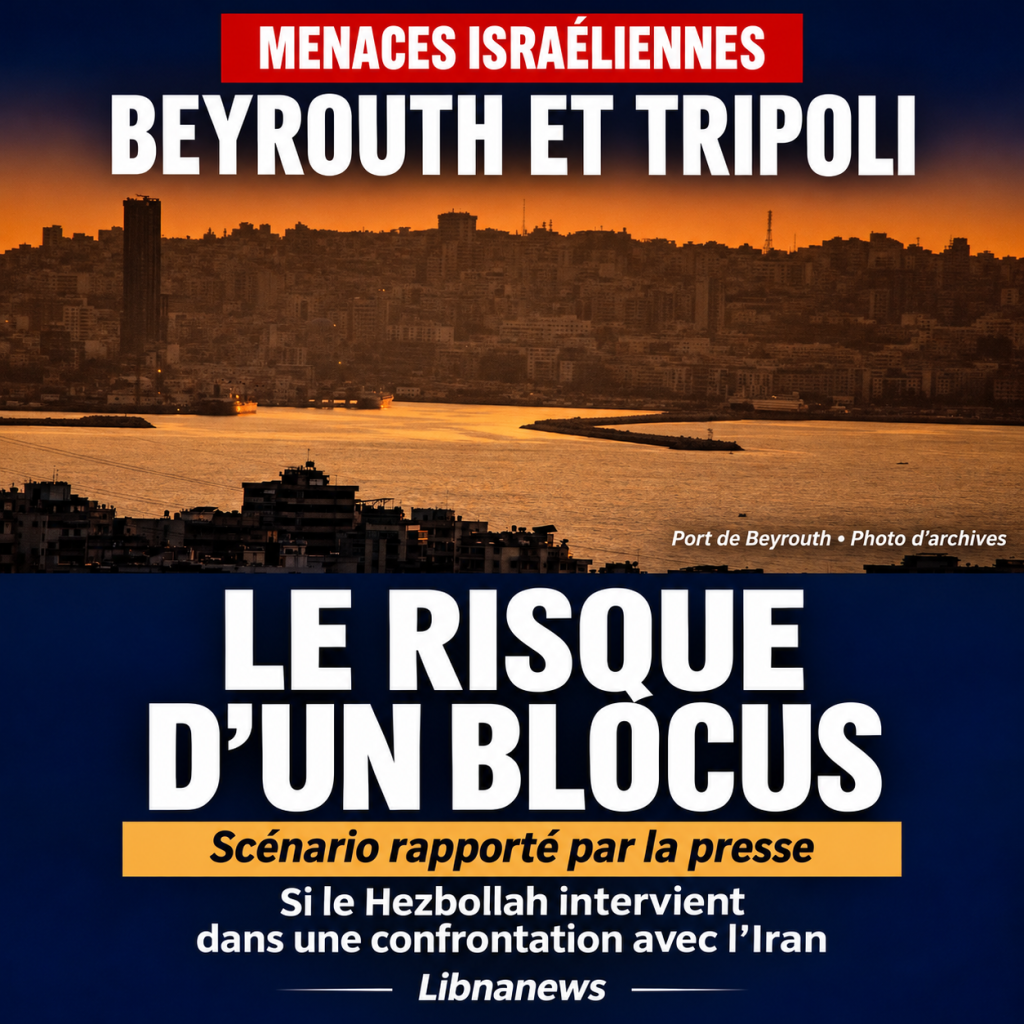
A possible blockade of the Beirut and Tripoli ports is one of the military scenarios attributed to Israel in reports broadcast on Sunday, 1 November 2026. These Israeli threats also concern the southern suburbs of Beirut and the cities of Tyre, Saida and Nabatiyah. They are a hypothesis of Hizbullah intervention in a new confrontation with Iran.
According to the Israeli press, relayed by several Lebanese and regional media, the navy could play an increased role in this eventuality. The mechanism referred to would include preparatory bombardments, strikes inside Lebanese territory and restrictions on maritime access.
This information describes military preparations and options. They do not present a timetable for execution or official announcement ordering the closure of both ports. However, their scope lies in the places mentioned: cities of the South, but also the commercial access of the capital and the Northern Lebanon.
Israeli threats: Beirut and Tripoli in scenario
The maritime dimension is one of the central elements of the published information. The Israeli navy could impose a blockade on the ports of Beirut and Tripoli if Hezbollah intervened against Israel. The threat would thus go beyond areas of terrestrial confrontation.
Beirut and Tripoli are two entry points for Lebanese maritime trade. Putting them under blockade simultaneously could disrupt deliveries and complicate the organization of imports. Their activities concern companies, carriers and distribution channels serving several regions of the country.
The consequences would, however, depend on the modalities of a possible scheme. A general closure, selective restrictions or controls on ships would not have the same effect. The information available does not specify the intended scope, duration or categories of goods concerned.
It would therefore be premature to deduce an impending interruption in supplies. The risk mentioned concerns the possibility of an obstacle to trade, with potential consequences for delivery times and transport costs. No figures for these effects are included in the items consulted.
Increased naval role if aviation intervenes in Iran
The scenario described is based on the distribution of Israeli military assets among several fronts. In the event of attacks against Iran, part of the air capabilities would be mobilized in that theatre. The navy would then take more place in operations targeting Lebanon.
The information provided gives him two separate tasks. The first would concern bombing and support to operations. The second concerns the control of maritime access through the planned blockade of both ports.
The southern suburb of Beirut appears to be one of the areas likely to be hit intensively. The same information also refers to operations in the depth of Lebanese territory. However, they do not provide a detailed list of buildings or installations.
This lack of precision counts to appreciate the nature of the alert. This is a general scenario reported by the press. The information consulted does not constitute an operational opinion to the inhabitants or a notification to the shipping companies.
Tyre, Saida and Nabatieh also mentioned
The land section would cover three cities: Tyre, Saida and Nabatiah. According to reports from the Israeli daily, the army would consider taking it if Hezbollah opened a new front against Israel.
Tyre and Saida are on the coast, while Nabatieh is an urban centre in the interior of the South. Their mention draws a perspective of operations affecting several poles of population and traffic.
The capture of cities would be a different operation of point strikes. It would involve a ground presence and raise the issue of civilian displacement, access to neighbourhoods and the functioning of services. These consequences remain those of a hypothetical scenario.
Media coverage does not allow for the determination of the planned number of staff, the progress or the duration of a possible occupation. They do not further specify whether these options have been given political authority to implement.
Previous statements on the extension of the occupation
This information comes after several public warnings by Israel’s Defense Minister, Israel Katz. On 14 October, Hizbullah threatened further territorial losses if he participated in an Iranian attack against Israel.
He cited the Nabatiyah and Litani areas. He had claimed that additional territories could join what Israel presents as its security zone. He also threatened the southern suburbs of Beirut with evacuations and strikes.
These statements are public statements by a government official. They must be distinguished from the operational details now attributed to the Israeli press. The two sets, however, deal with the same hypothesis: an extension of the confrontation in Lebanon if Hezbollah engaged alongside Iran.
On 20 October, Katz again threatened to strike the southern suburbs in response to gunfire against Israel. The publication of 1 November adds a maritime dimension to these warnings, specifically citing the ports of Beirut and Tripoli.
A conditional threat, modalities still unknown
The condition in the information disseminated remains decisive. The operations described would depend on a Hezbollah intervention in a confrontation involving Iran. Their publication does not demonstrate that such an intervention has been decided or that the operations announced will begin.
Nor does the multiplication of the repeats constitute several independent confirmations. The alerts and articles consulted refer to the same Israeli press story. They establish the flow of this information, without allowing direct verification of the military plans mentioned.
For Lebanon, the locations mentioned give this threat a national scope. The South would be affected by land cover, the southern suburbs by bombardments and the coastline by maritime restrictions. There is still a need to clarify the existence of an operational order, the modalities of a possible blockade and the political decisions that could trigger this scenario.





Comments