






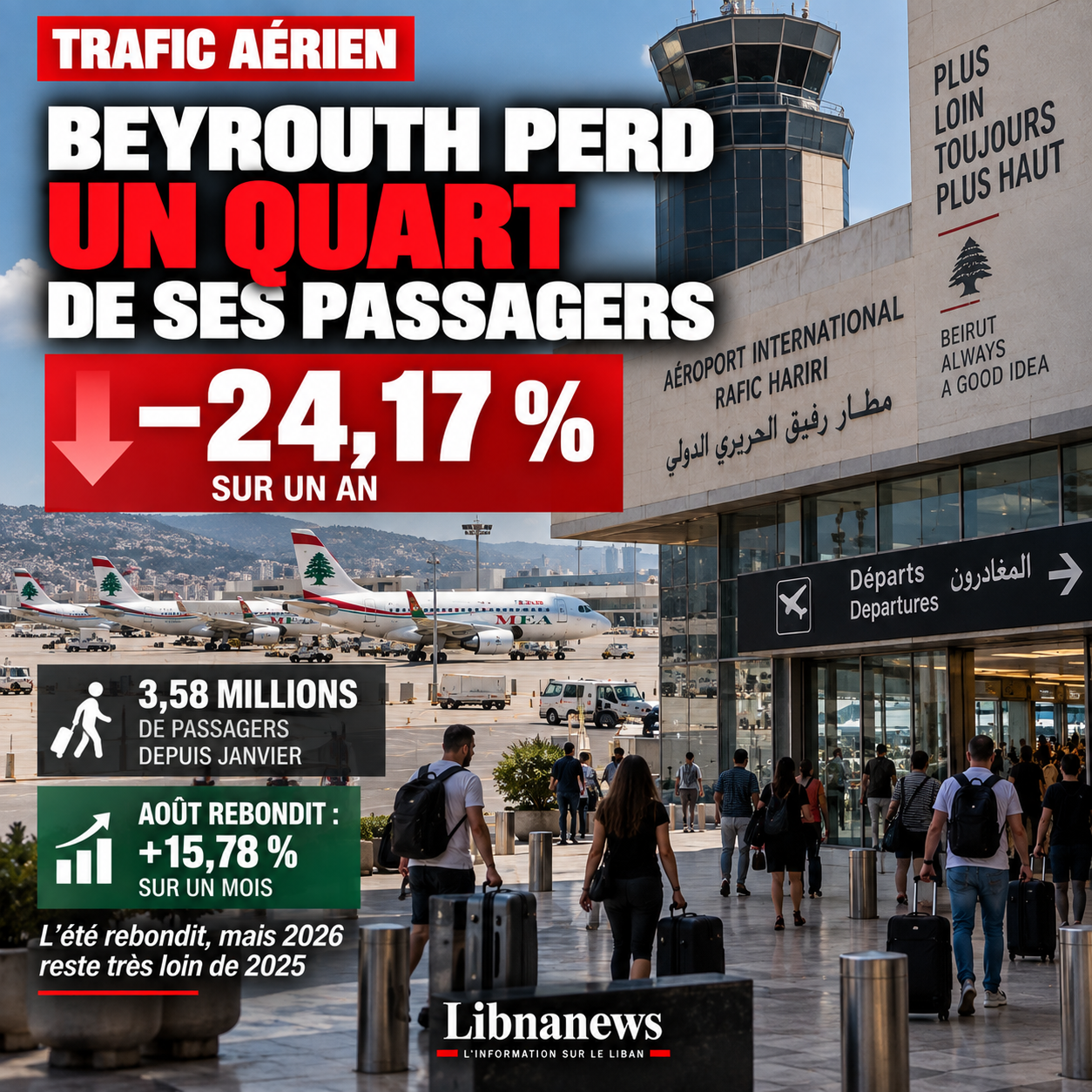
Passenger traffic at Rafic Hariri International Airport in Beirut has declined sharply since the beginning of 2026. Between January and August, 3,581,861 travellers were registered, a decrease of 24.17 per cent over the same period of 2025. Arrivals decreased by 26.57 per cent and departures by 21.54 per cent. The month of August, however, showed a recovery from July, with 835,903 passengers and a monthly increase of 15.78 per cent.
Nearly a quarter fewer passengers since January
In the first eight months of 2026, Beirut airport recorded 1,814,097 passengers on arrival. Their number is down 26.57 per cent over a year. Departures reached 1,766,630 passengers, a decrease of 21.54%.
This contraction therefore affects the two main passenger flows. It reflects the disruptions that have affected air transport since the beginning of the year, in a context marked by the resumption of hostilities between Israel and Hezbollah.
Transit traffic remains very limited. It reached 2,553 passengers in the first eight months, up 45.14% over one year. However, this significant increase in percentages is based on a particularly low basis and does not alter the overall traffic trend.
For Lebanon, this decline is an important economic indicator. Beirut airport remains the main international gateway for travellers. Its activity directly influences diaspora movements and tourist flows, with repercussions on hotels, restaurants, transport and several commercial activities.
Beirut airport rebounds in August
The situation improved during the summer. In August 2026, 835,903 passengers used the airport, up 15.78 per cent from July.
This monthly increase is accompanied by the gradual resumption of air operations and the improvement of conditions of travel after the mitigation of hostilities. However, it remains insufficient to return to previous year’s levels.
Compared to August 2025, the total number of passengers is still down 10.04 per cent. Arrivals reached 369,812 travellers, down 6.61% year-on-year. Departures were 465,804 passengers, a decrease of 12.59%. Transit accounted for 287 passengers, down 25.07 per cent.
Comparison between July and August also reveals a change in traffic composition. Arrivals decreased by 15.39 per cent over one month, while departures increased by 63.68 per cent. The number of transit passengers decreased by 20.28%.
This sharp increase in departures occurred at the end of the high summer season. It coincides with the return abroad of some of the expatriates and visitors who came to spend the summer in Lebanon.
Summer rebound does not compensate for 2026 losses
The increase recorded in August reduces part of the backlog since January, without reversing the annual trend. With 3.58 million passengers over eight months, the airport remains close to a quarter below its level in the same period of 2025.
This difference between monthly and annual developments is essential to measure the situation. In the short term, air activity recovered. Over the course of the year, however, it remains deeply affected by the disturbances in the previous months.
August is thus a month of recovery rather than a complete return to normal. The 15.78 per cent increase over July shows that passenger flows can leave quickly when more flights are insured and travel conditions improve.
However, the decline in arrivals since January remains particularly marked. With an annual decline of 26.57 per cent, Lebanon received significantly fewer air travellers than in the first eight months of 2025.
This has affected activities that depend on foreign visitors and Lebanese expatriates. However, the exact economic effect cannot be inferred from airport statistics alone, as these do not systematically distinguish between tourists, residents, expatriates and business travellers.
Air traffic remains safety sensitive
The 2026 data again illustrate the high sensitivity of Lebanese air transport to security developments. The renewed conflict between Israel and Hezbollah has disrupted demand and flight programmes.
Even after the announcement of a cease-fire in mid-April, the return of air links was made gradually. Companies may reduce their frequencies, suspend certain services or modify their programs when the security situation deteriorates.
These decisions have an immediate effect on the capacity available. They also influence the behaviour of travellers, who may delay their stay when they fear interruption of connections or rapid deterioration of the situation.
The recovery observed during the summer shows inversely the speed with which improved conditions can sustain traffic. But a few months of recovery is not necessarily enough to compensate for the losses accumulated during periods of disruption.
At the end of August, the figures therefore describe a contrasting situation. Beirut airport recovered a more sustained activity during the summer, with more than 835,000 passengers in August alone. In the first eight months of 2026, however, it still fell by 24.17 per cent over a year. Fall data will measure whether the resumption of air operations continues after the end of the high season.