





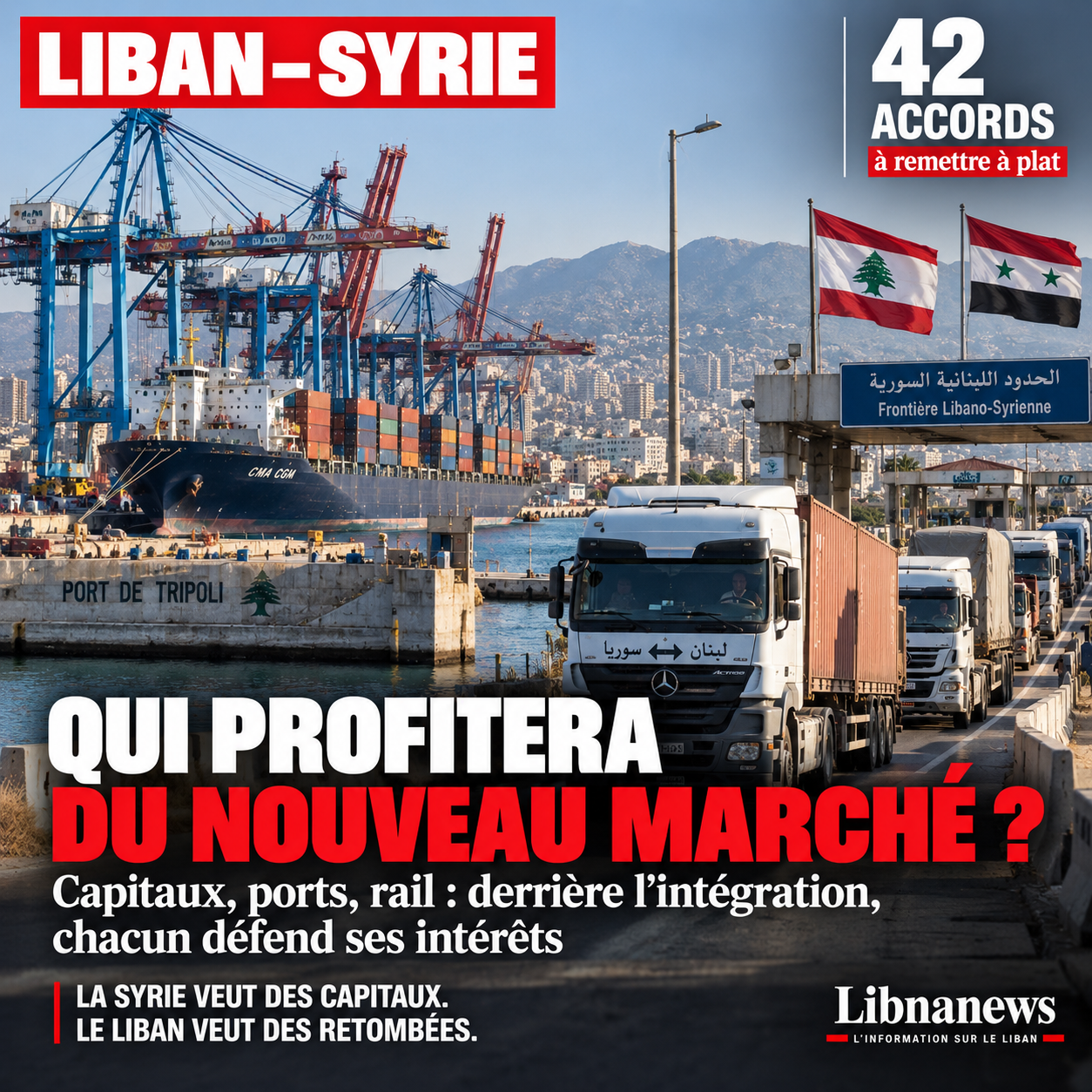
The figure alone sums up the distance between discourse and reality: forty-two agreements and protocols between Lebanon and Syria remain to be reviewed while the two countries are already talking about a new economic era. Trucks still face obstacles. The customs rules remain contested. The movement of businessmen and experts must be facilitated. Bank financing is insufficient. Damascus protects its industry while asking Lebanese entrepreneurs to invest in its reconstruction. And Lebanon, itself running out of capital after years of financial crisis and war, must determine what it would really gain from sending its money, businesses and skills across the border.
This is where the real stake of the Lebanese-Syrian Investment Forum lies. The presence in Beirut of six Syrian ministers and investment, aviation, oil and sovereign funds officials gave the event an exceptional dimension. But behind the formulas on complementarity appears a much harder negotiation. Everyone wants to use the other’s assets without sacrificing their own interests.
Syria is seeking capital, services, skills, ports and an opening to the Mediterranean. Lebanon is seeking more fluid land access to Arab markets, opportunities for its businesses and a place in the Syrian yard. These two ambitions can be complemented. They can also compete directly.
Forty-two agreements, but still trucks blocked by the rules
The first paradox is legal.
Both countries do not start from scratch. They already have42 agreements and protocolswhich frame different aspects of their relations. However, these texts do not today constitute a sufficiently operational set to operate without friction.
The planned work is therefore to resume these 42 agreements one by one.
Joint commissions must determine which may be retained, which require modification and which no longer correspond to the new political and economic situation.
The issue is not theoretical.
The success of the rapprochement will depend on extremely concrete questions: how long does a truck wait at the border? What fee does he pay? Do you need prior authorization? Does a Lebanese commodity actually benefit from the same treatment as a Syrian commodity? Can a Lebanese manager or technician easily visit a construction site in Syria?
Until these issues are resolved, the 42 agreements remain more a legal legacy than an integrated market.
In particular, the Lebanese economic representatives call for the abolition of the prior authorisation mechanism, better equal treatment of goods and more favourable conditions for carriers.
Road transport is an almost perfect indicator here.
Lebanon depends on Syria for its land access to Arab markets. An increase in transit costs or a slowdown at border crossings directly affects the cost of Lebanese goods sold in Jordan or the Gulf.
For an exporting company, a few extra hours at the border and a few hundred dollars of expenses can count more than a major speech on economic integration.
Damascus wants Lebanese capital but does not promise a market without protection
The second contradiction is even clearer.
Syria calls on the Lebanese private sector to participate in its restart. The sectors presented as being open to investment include industry, agriculture, tourism, transport, health, education, energy and infrastructure.
But Damascus does not intend to abandon mechanisms designed to protect its own production.
When the duties and restrictions imposed on Lebanese products were mentioned, the Syrian response was to recall that they were not specifically directed at Lebanon. They are part of a general policy of protecting Syrian industry.
The argument is consistent from the Syrian point of view.
However, it sets out the limit of the word « complementarity ».
When it comes to attracting money, skills and businesses, Lebanon is presented as the natural partner. When it comes to protecting Syrian producers from competition, Lebanese proximity does not necessarily give rise to privileged treatment.
Syria therefore wants to attract capital without giving up rebuilding its own productive base.
Lebanon must do exactly the opposite: take advantage of Syrian openness without further weakening its own businesses.
It is here that the interests of both economies cease to be automatically complementary.
Lebanese capital no longer has the luxury of going to adventure
The issue is all the more important since the Lebanon of 2026 is no longer the one that could view Syria as a natural extension of its market.
Years of banking and financial crisis have profoundly changed the behaviour of investors.
Available capital has become scarcer. The recovery of the money invested and legal certainty now count as much as the expected return.
To this is added the reconstruction of Lebanon itself.
The country must finance its infrastructure, businesses and war-affected areas. It must restore public services and attract foreign investment.
In these circumstances, asking a Lebanese entrepreneur to commit his capital in Syria poses a very simple question: why there rather than here?
To say that Syria needs electricity, hospitals, factories, hotels, roads or services is not a sufficient response.
A country emerging from war offers almost by definition immense needs. But a need is not automatically an investment.
For it to become so, it requires an executable contract, financing, guarantees, the possibility of repatriating profits, stable regulation and a credible dispute resolution mechanism.
Part of this architecture is still under construction.
Amer Bisat inadvertently revealed the central problem
One of the most revealing interventions of the forum came from the Lebanese Minister of Economy Amer Bisat.
It has defined the role of governments in a traditional way: to pave the way for economic activity, to remove obstacles and to provide a clear and stable legal framework. But he then invited investors to look at possibilities, look for projects and report to both Governments what obstacles, guarantees and procedures they would need to be addressed by the Government.
The logic is pragmatic. It also shows that the ground is not yet fully prepared.
The investor is almost invited to take the road, identify the obstacles himself, and then ask the States to remove them.
For an entrepreneur with abundant capital and able to assume the risk, this can be acceptable.
For a Lebanese investor emerging from a major banking crisis, it is much less so.
He will probably want to know about the guarantees before committing his money, not after discovering the problems.
This reversal of the sequence of stages is one of the most concrete weaknesses of the current offer.
The banking sector is missing precisely at a time when we want to boost investment
The question of financing is a must.
Both economies are emerging from deep crises in their financial systems. It is difficult to talk about large bilateral investments without banks capable of financing operations.
The Syrian Minister of Economy Mohammad Nidal al-Shaar himself acknowledged that geography does not automatically produce economic integration.
We need reliable institutions, clear rules, effective borders and a banking system capable of accompanying trade.
This is particularly significant.
Lebanon has historically had financial and commercial expertise that could give it a role in Syrian reconstruction. But its own banking system remains deeply affected by the crisis.
Syria, for its part, is still working on the reform of its financial sector.
The two countries therefore want to launch a new wave of investment, while the traditional instrument for transforming an opportunity into financing remains fragile on both sides of the border.
This explains why the private sector can show a lot of interest without necessarily immediately signing large cheques.
Tripoli-Syria rail finally gives an example where interests can really converge
However, not all projects are equally ambiguous.
The railway project linking the port of Tripoli to the Syrian network offers a much more concrete example of potential benefits for both parties.
The route studied would represent approximately35 kilometres in Lebanon and 5 kilometres in Syria.
A joint delegation has already reviewed the course. Initial findings would indicate that it is technically feasible and that no major obstacles have been identified at this stage.
A Lebanese consulting company still has to determine the cost and duration of the work.
Syrian Minister of Transport Yaarob Badr has put this project back into a broader ambition: to build logistics corridors linking the Gulf with the Mediterranean.
It is here that the concept of complementarity takes on a specific economic meaning.
Syria obtains rail access to the port of Tripoli.
Tripoli gets a Syrian commercial hinterland and, potentially, a function in regional flows going further to Iraq or the Gulf.
Lebanon is therefore not content to send capital to Syria. An infrastructure located in its territory is becoming more active.
This is exactly the type of project where profits can be distributed on both sides.
René Moawad completes a possible logistics hub in the North
The interest expressed around René Moawad airport must be read in the same logic.
Taken in isolation, the airport can appear as an old file regularly placed on the table.
Combined with the port of Tripoli, the railway project and the Syrian road network, it takes on another dimension.
The North could theoretically become a platform combining maritime, land, rail and air transport.
For Syria, this would increase access to the Mediterranean.
For Lebanon, this could shift part of the economic activity to Tripoli and the North, provided that the necessary investments are actually made.
But again, the forum did not provide definitive funding.
It revealed a possible architecture.
Between architecture and construction, studies, financing, contracts and political decisions remain.
Iraqi oil and Jordanian gas: Lebanon can gain by becoming a corridor
The same reasoning applies to energy.
The discussions concern Iraqi oil, pipelines, Jordanian gas and electrical interconnections.
The gas project envisages transit from Jordan through Syria to Lebanon. Discussions would be advanced, but the technical teams still need to identify the necessary equipment and address existing obstacles.
The power lines linking the two countries must also be evaluated and rehabilitated before considering electricity supply.
Syria also wishes to be able to examine the use of certain Lebanese oil infrastructure.
Again, Lebanon’s potential benefit depends on its place in the chain.
If it becomes only the final customer of energy passing through Syria, the relationship remains relatively classical.
If it becomes a logistics node using its ports, storage facilities and infrastructure for regional flows, the economic value changes completely.
That is where the Lebanese negotiation should focus.
The question is not just what Lebanon can invest in Syria. It is to determine which Syrian activities can create trafficking, income and employment in Lebanon.
Syrian reconstruction can also aspire to the skills Lebanon needs
Another risk remains little discussed: competition for human resources.
Syria will need engineers, doctors, finance specialists, tourism professionals, entrepreneurs and technicians.
Lebanon has precisely these powers.
But he also needs it for his reconstruction.
A massive opening of the Syrian market can therefore produce two opposite effects.
It can offer contracts to Lebanese companies and generate income.
It can also attract to Syria some of the skills and capital Lebanon needs on its own territory.
The difference will depend on the model chosen.
If a Lebanese company obtains a contract in Syria, employs teams in Lebanon, uses Lebanese ports and repatriates its profits, the Lebanese economy can benefit.
If capital goes, the professionals settle in Syria and the activity is entirely carried out on the spot, the national profit becomes much more limited.
The forum talked a lot about opportunities. The mechanism for ensuring these benefits was much less specified.
The real test will therefore not be the number of investors present
The forum demonstrated real interest from the private sector. It also made it possible to put around the same table officials who had not worked together in this framework for a long time.
But the indicators of success are already identifiable.
The first will be the fate of42 agreements and protocols. If they remain under review for months, the new relationship will remain largely declarative.
The second will be border crossing time.
The third will be the cost of transit of trucks.
The fourth will be the ability of entrepreneurs and experts to travel between the two countries.
The fifth will be clarification of customs rules.
The sixth will be funding.
The seventh will be the transition from an emblematic project, such as the rail between Tripoli and the Syrian network, from technical study to a funded decision.
These criteria are much more useful than the number of speeches delivered in Beirut.
The question that the forum did not decide: what does the Lebanese economy gain after the investor’s profit?
It is finally the central point.
A Lebanese entrepreneur can make money in Syria. This does not automatically mean that Lebanon wins with him.
The real challenge is to transform individual investment into economic flows that also benefit the country: port use, subcontracting, financial services, jobs, exports, transport, engineering and repatriation of profits.
Without this architecture, Syrian reconstruction can become a formidable opportunity for some Lebanese entrepreneurs while having little effect on the national economy.
With her, the calculation changes.
The port of Tripoli can gain traffic. Rail can create a corridor. René Moawad can acquire an economic function. Carriers can find Arab markets. Service companies can sell their expertise. Lebanese energy facilities can be integrated into regional networks.
That is precisely why the economic relationship with Syria cannot be thought of as an act of solidarity with a neighbour in reconstruction.
Each State has its own interests.
Damascus wants to attract capital while protecting its industry. Beirut must gain access to the Syrian market while protecting its businesses and demanding that major corridors also go through its infrastructure.
Geography brings the two economies closer together. It does not guarantee the balance of their relationship.
The real partnership will begin when the 42 agreements become applicable rules, trucks cross the border under predictable procedures, banks can finance operations and the first major joint project will produce measurable revenues on both sides of the border. Until then, opportunities are real, but integration remains above all a promise.