

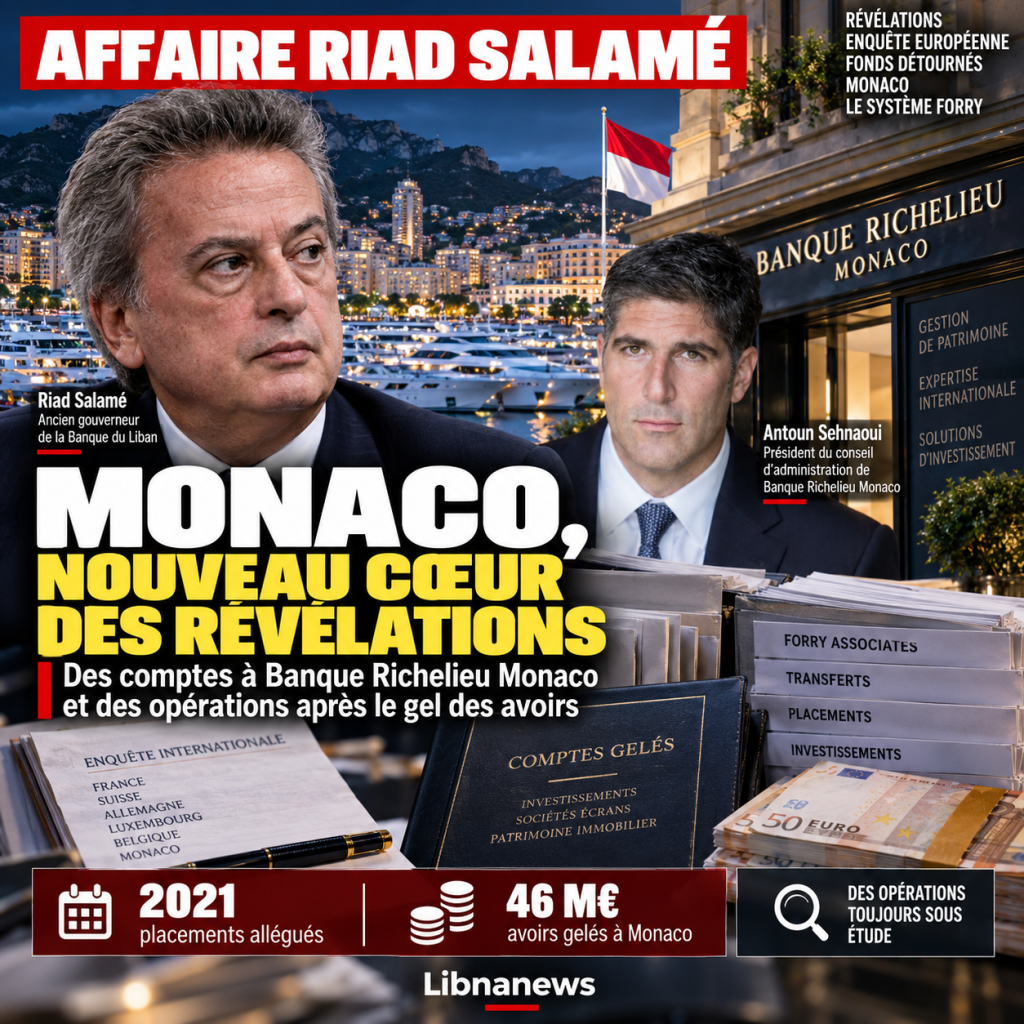
Funds were reportedly invested in 2021 in Antoun Sehnaoui-controlled bank, while investment operations continued after the assets freeze
A new part of the Riad Salamé case brings back part of the financial circuits of the former Governor of the Bank of Lebanon to Monaco. According to information published on 5 October by Intelligence Online, a significant part of the funds suspected of being diverted by the former governor were reportedly placed in 2021 with Banque Richelieu Monaco, a financial group owned by Lebanese banker Antoun Sehnaoui. Even more disturbing, according to the same survey, investments in the institution continued after the authorities seized the accounts concerned.
This information adds a new piece of evidence to a judicial case that has long been beyond the borders of Lebanon. For several years, European magistrates have sought to reconstitute the circulation of hundreds of millions of dollars from, among other things, the commissions paid by the Lebanese banks to Forry Associates, a company controlled by Raja Salamé, the brother of the former governor. Investigations carried out in France, Switzerland, Germany, Luxembourg, Belgium and Monaco have gradually led to the identification of bank accounts, companies and a considerable property base.
Banque Richelieu Monaco now appears as one of the institutions through which part of the capital would have passed through or been administered.
Several accounts related to Riad Salamé in Monaco
The file does not simply deal with the existence of a personal account opened by Riad Salamé. There is evidence in European proceedings that several accounts are held by companies whose former governor would have been the economic beneficiary. Recent procedures include eight accounts opened with Banque Richelieu Monaco and attached to structures linked to Riad Salamé.
This distinction is important. Large international fortunes do not necessarily hold their assets directly in their name. They may use heritage companies, holding companies or other legal structures that appear formally as account holders. The key question for the anti-money laundering authorities then becomes that of the beneficial owner: the person who, behind the intermediary companies, actually controls the capital.
In the case of Riad Salamé, this issue is particularly sensitive. For nearly thirty years, from 1993 to 2023, he led the Bank of Lebanon. His status made him a politically exposed person, a category for which financial institutions are subject to enhanced due diligence obligations, particularly regarding the origin of assets and funds.
The presence of several structures related to the former governor in the same bank does not in itself constitute proof of an offence committed by that institution. However, it raises the question of the checks carried out at the time of opening the accounts, and then at the time of arrival and management of capital.
Year 2021 becomes central
The revealed chronology is particularly important. Intelligence Online places in 2021 the investment with Banque Richelieu Monaco of a significant part of the funds allocated to Riad Salamé. However, on that date the former governor was already receiving increasing attention in Europe.
In France, a preliminary investigation into the heritage of Riad Salamé and his entourage had been opened in May 2021, before the opening of judicial information in July of the same year. Investigations included suspicions of organised money laundering and the conditions under which a considerable asset had been created in Europe.
European investigators were also interested in the Forry mechanism. For years, Lebanese banks buying financial instruments from the Bank of Lebanon had paid commissions to Forry Associates. The company was controlled by Raja Salamé. The amounts involved are estimated at several hundred million dollars.
The investigators suspect that some of these amounts were then redistributed through a complex set of accounts, companies and investments owned or beneficial to Riad Salamé and his entourage. The former governor, for his part, challenged the charges brought against him and maintained, inter alia, that his wealth came from his assets prior to his arrival at the Bank of Lebanon and his investments.
The alleged placement of large sums in Monaco in 2021 therefore takes on a particular dimension: it would have taken place at the same time as European investigations into the legacy of the former governor were beginning to grow.
EUR 46 million frozen in Monaco
A new stage took place in March 2022. As part of a coordinated operation between several European countries, the authorities are announcing the freezing of approximately EUR 120 million of assets related to the investigation of Riad Salamé and his entourage.
The amounts seized include real property and bank accounts distributed among several jurisdictions. In Monaco, approximately €46 million is then frozen.
This amount is considerable. The Monegasque component alone accounts for more than one third of the approximately EUR 120 million in assets frozen during this European operation.
It is also from this moment that new revelations become particularly sensitive. According to Intelligence Online, the seizure of accounts did not completely interrupt financial transactions: Riad Salamé continued to invest with Banque Richelieu Monaco after the freezing of its assets.
This statement should be interpreted with caution. A judicial freeze does not automatically mean that any portfolio management operation becomes legally impossible. The exact scope depends on the decision of the competent authority. Some assets may mature, generate interest or require technical management operations without the owner being able to withdraw or transfer the funds.
The whole question is, therefore, what exactly was covered by the transactions carried out after the seizure: simple safeguard management of assets already present in the portfolios, automatic reinvestment of liquidity, trade-offs between different financial products or new investments made on instructions from the customer or his representatives.
The difference is fundamental.
A bank controlled by a major player in the Lebanese banking sector
The case is all the more sensitive because Banque Richelieu Monaco is not unrelated to the Lebanese banking system. It belongs to the financial group developed around the Société Générale de Banque in Lebanon and d’Antoun Sehnaoui.
SGBL acquired Richelieu activities in France and Monaco in 2018, as well as Richelieu Gestion. These establishments were then consolidated under Compagnie Financière Richelieu. Antoun Sehnaoui also chaired the Board of Directors of Banque Richelieu Monaco.
The case thus involves two important figures in Lebanon’s pre-crisis financial system: on the one hand, Riad Salamé, governor of the Bank of Lebanon and principal regulator of the banking sector; and on the other, a Lebanese private banking group that has developed a wealth management activity in Europe and Monaco.
Of course, this institutional proximity does not mean that Antoun Sehnaoui would have personally known of the origin of the capital or transactions in the accounts concerned. There is no public basis at this stage for establishing such personal responsibility. Similarly, the existence of accounts belonging to a subsequently prosecuted customer does not automatically mean that the depositary bank participated in the offences against it.
But it makes the issue of compliance procedures for these accounts particularly important.
How can we control the fortune of the governor who controls the banks?
The file poses a particular problem for the Lebanese banking system. Riad Salamé was not an ordinary customer. He was the governor of the Central Bank of the country from which Bank Richelieu Monaco came through its shareholding.
For almost three decades, the Bank of Lebanon has supervised Lebanese banks and played a key role in their operations. The relationship between the Central Bank, commercial banks and their main shareholders was therefore permanent.
For a European or Monegasque bank hosting the capital of a foreign public official, the status of politically exposed person requires more vigilance. It is not enough to know the identity of the client. The institution must be able to understand the origin of its assets, the origin of the amounts transferred and, where circumstances so require, the economic justification of the transactions.
In the case of a central bank governor with a wealth of several tens or hundreds of millions of dollars, the question of the origin of the funds thus becomes central.
It is even more so when accounts are held in several companies.
The Forry system at the centre of the survey
To understand why these accounts are of equal interest to European investigators, we must go back to the mechanism which is the financial heart of the Salamé case.
Forry Associates, a Raja Salamé-controlled company, received commissions on certain operations carried out by commercial banks with the Bank of Lebanon. European investigations have been looking for several years to determine how several hundred million dollars from these commissions were subsequently used.
The case therefore does not concern merely the personal fortune of a former governor. He seeks to answer a much more precise question: have funds derived indirectly from operations involving the Bank of Lebanon been diverted to private structures controlled by Riad Salamé or his entourage?
Once this first stage is established or suspected, a second begins: follow the money.
It is this work that leads investigators to Swiss, French, Luxembourg, German and Monegasque banks, but also to real estate companies and property structures used to acquire or administer assets.
Bank Richelieu Monaco appears in this second part of history: that of the conservation and management of a part of the heritage whose exact origin the authorities are now seeking to determine.
The decisive point: what happened after the freeze
The new revelations however slightly move the centre of gravity of the file. So far, most attention has focused on the source of money and its arrival in European banks. The issue now also becomes one of the management of funds after the intervention of justice.
If investments have actually been continued after the accounts have been seized, their nature, dates and authorisation mechanism will have to be determined.
Above all, it will be necessary to know who could still intervene on the portfolios.
Riad Salamé himself? Agents? Bank managers Richelieu Monaco with a discretionary mandate? Automatic reinvestment mechanisms? The answers to these questions would profoundly change the interpretation of operations.
These movements should also be compared with the exact terms of Monegasque judicial decisions. A frozen asset can continue to exist economically without being exempt from justice. The real red line would therefore be less the existence of a financial transaction than the possibility of freely disposing of assets, changing their ownership, transferring them or circumventing the effect of the seizure.
At this stage, the information available does not indicate that such a violation has taken place.
A new branch of a file far from over
The interest of these revelations finally exceeds the only Riad Salamé and Antoun Sehnaoui. They show how the investigation into the former governor has become an investigation into the entire financial architecture used to move, conserve and invest capital from Lebanon.
For a long time, the case was presented essentially as that of a governor and his brother. European investigations are gradually showing a much more complex reality: hundreds of millions of dollars have circulated between companies, bank accounts, wealth managers and real estate investments in several jurisdictions.
Each new step then asks the same question: who knew what, when, and what controls were carried out?
In the case of Banque Richelieu Monaco, this question now takes on an additional dimension. It is no longer just a question of why structures linked to Riad Salamé had several accounts in the establishment and how the origin of the capital had been verified. We must also understand how these assets were administered when European justice began to seize them.
The answer could shed light on a still ill-known part of the Salamé case: not only the way money would have left the original circuit, but what happened once in the establishments responsible for keeping it and producing it.





Comments