

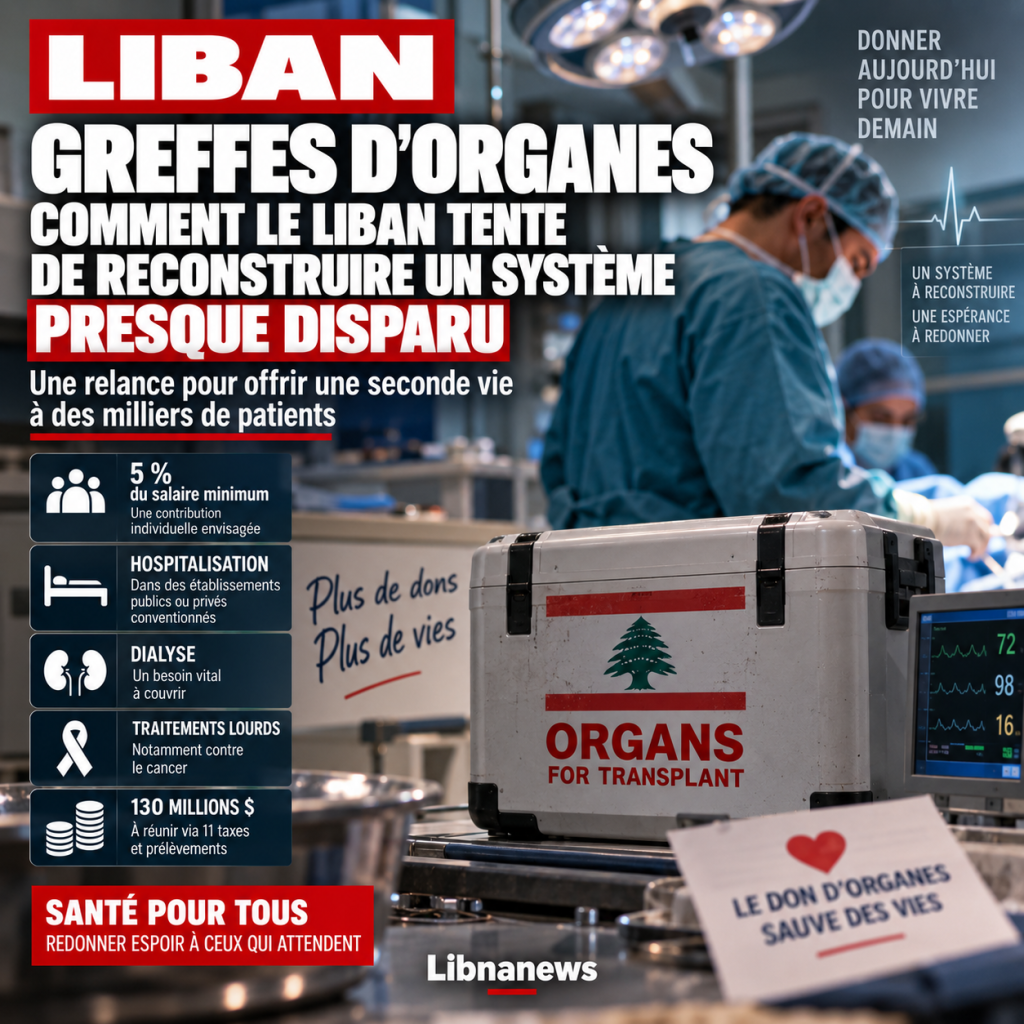
A revival that starts from a system to rebuild, not a white page
Minister of Health Rakan Nassereddine announced the reactivation of a national structure to organise organ donation and transplantation and to prepare the necessary implementing legislation for the resumption of operations financed by the Ministry. The ad may seem technical. However, it affects a medical chain that is among the most complex that a health system can maintain: to identify a donor, to confirm the medical conditions of the sample, to coordinate several teams, to keep the organs, to select recipients, to perform the transplant and to follow up for life.
Lebanon does not discover this medicine. He had gradually built a national experiment, with a structure dedicated to the donation and transplantation of organs and human tissues. This organization worked for years before its activities were gradually paralyzed. The financial crisis triggered from 2020 onwards, the pandemic, the inadequacy and irregularity of budgets and, later, the disappearance of a central figure in the scheme weakened a system that already depended on permanent coordination between ministries, hospitals, doctors, laboratories, families and religious authorities.
The announced revival does not, therefore, involve inaugurating a new programme. It consists of re-establishing an architecture that has already existed, understanding why it has almost stopped and ascertaining whether the state is today capable of financing not only surgical surgery, but everything that makes this operation possible.
1999: building a national framework
A National Commission on Organ Transplantation was established in 1999 by Ministerial Decision No. 1:59. Other decisions then organized successive administrative councils, notably between 2005 and 2009. This institutionalization was indispensable. Transplantation cannot be based solely on the initiative of a surgeon or hospital. It requires common rules for collection, consent, selection of recipients and the flow of information.
That same year, on the night of 23-24 January 1999, a natural cardiac transplant was reported to the Hammoud University Hospital in Saida, under the guidance of the cardiac surgeon Mohammad Saab and with the cooperation of a team from Rizk Hospital. This episode belongs to the medical memory of a country that then had the human and hospital skills needed to perform very high-level interventions.
The challenge, however, was broader than surgery. In order for a national programme to function, a death likely to allow a donation must be promptly reported, medical criteria checked, family accompanied, collection teams available and compatible recipients identified without delay. A single step failure may render the organ unusable. The function of the national structure was precisely to link these actors.
The problem was not just medical: a culture of giving had to be created
The program quickly found that medical competence was not sufficient. Organ donation affects death, body, family and religious beliefs. In 2006, a survey of 2,500 people indicated that 52 per cent were in favour of the donation, while 22 per cent opposed it. Religion appeared to be the first ground for refusal. This result directed an important part of the work towards raising awareness.
For several years, campaigns were organized in schools, universities and other public spaces. The aim was not only to distribute donor cards. It was necessary to explain what a levy is, to distinguish the gift after death from the gift of living, to respond to the fears of the families and above all to obtain a clear word from the religious authorities.
This strategy led to an in-depth dialogue with community leaders. In 2015, a cooperation protocol was signed with the Episcopal Commission for the Pastoral Care of Health, represented by Bishop Maroun Ammar. Then, in May 2016, the work resulted in the obtaining of fatwas, ecclesiastical letters and signatures from community representatives on gift cards. This stage, carried out under the mandate of Health Minister Wael Abu Faour, had a very concrete scope: to lift the idea that the gift would automatically be contrary to religion.
In a country where denominational membership is a part of social life, this recognition was indispensable. A family faced with the brutal death of a relative did not have time to open a theological debate. Knowing that his religious authority has already taken a position can reduce uncertainty when a decision is to be taken quickly.
From 2020, the chain breaks down in several places
The decline in the programme is not explained by a single cause. The financial crisis first hit public budgets and hospitals. Transplants require biological examinations, compatibility tests, drugs, specialized teams and conservation capabilities. Some of these expenditures depend on imported products or expensive technologies. When public funding becomes irregular, the entire chain becomes fragile.
The Covid-19 pandemic added another break. Awareness campaigns were interrupted or reduced, while health facilities concentrated on health emergencies. A donation program also depends on the continuity of its public presence. When campaigns disappear, registration decreases, families are less familiar with the subject and professionals themselves may lose some reporting reflexes.
The budget of the national structure then remained insufficient and irregular. It is not enough to have a legal existence. A transplant organisation must have available permanences, coordinators and operational means when a potential donor appears, including at night or during a weekend. The lack of stable funding transforms a theoretically national structure into a device unable to react with the speed required by transplant medicine.
The disappearance of Antoine Georges Stephan left a human vacuum
In addition to the financial and institutional crisis, Professor Antoine Georges Stephan, medical director and founder of the national structure, disappeared at the end of 2024. His death created a leadership vacuum in an area where accumulated experience is very important. National coordination does not only work with texts; It is also based on people who can work together with teams from different institutions.
This dependence on a few figures is itself an institutional weakness. A robust system must survive the departure of its founder. The new structure announced should therefore avoid replicating an over-personalized organization. It must allocate responsibilities, train coordinators, document procedures and integrate several academic institutions so that the operation is not based on one person.
Stephan’s disappearance also recalls the loss of skills in the Lebanese health care system since the crisis. Transplantation requires surgeons, anaesthetists, reactors, nephrologists, cardiologists, immunologists, specialized nurses and technicians. The relaunch will therefore have to check not only that the texts exist, but that the necessary teams are still available and can be mobilised.
Paying the transaction is not enough
The announcement of a department’s ownership of operations is one of the most obvious obstacles: cost. But transplantation cannot be financed as an isolated surgical act. Prior to intervention, the recipient must undergo examinations and be enrolled in a system for determining eligibility. When an organ becomes available, the necessary tests must be carried out quickly. After transplantation, the patient should be monitored and treated to prevent rejection.
The real cost is therefore spread over several periods. There is a pre-transplant cost, a collection and transportation cost, an operating cost and a post-intervention cost. A programme that finances hospitalisation but allows the patient to pay for examinations or medicines necessary for follow-up alone creates incomplete coverage. The survival of the graft depends precisely on this continuity.
The department will also need to clarify how hospitals will be paid. If public refunds are too late, institutions may be reluctant to incur significant expenses. Recovery therefore requires a specific financial procedure, fast enough to ensure that the medical decision is not paralyzed by the fear of an unpaid invoice.
The deceased donor, the most difficult link to rebuild
Part of the transplants can be performed by living donors, especially in certain kidney transplants. But a comprehensive national program also depends on post-death donation. This is where coordination becomes the most complex. It is necessary to quickly identify compatible medical situations, apply legal and medical criteria, contact the family and organise the collection within a very short time.
Consent is therefore a central element. Donor cards and awareness campaigns can express a will, but the practical functioning depends on the legal framework and how families are involved. A hospital team facing a grieving family must be able to explain the process accurately, without pressure and without ambiguity.
Trust is essential. Any suspicion of favouritism in organ allocation can destroy a program. The new structure will therefore have to establish transparent criteria for waiting lists and allocation. The medical emergency, compatibility and rules must be known. Social status, relationships or financial capacity cannot become implicit criteria.
Regional figures show what an organised system represents
The Arab experiments cited in the dossier give useful orders of magnitude without allowing direct classification. In the United Arab Emirates, the Hayat programme had more than 39,000 registered donors as at 12 August 2026 and had contributed to more than 1,195 transplants since its inception. These figures do not mean that the 39,000 enrolled actually gave an organ; they measure a base of volunteers and a cumulative volume of operations.
In Tunisia, estimates published on 17 May 2026 reported more than 1,500 patients on the kidney transplant waiting lists, compared with about 16,000 registered donors. Again, the categories are not directly comparable with those of the United Arab Emirates or Lebanon. Some figures measure registrations, others of transplants or patients waiting.
The interest of these examples is elsewhere. They show that a modern program is based on registers, data and the ability to track potential donors and recipients simultaneously. The Lebanese recovery will therefore have to produce its own updated figures. How many patients are waiting for a transplant today? How many are eligible? How many donors are registered? How many hospitals can perform each type of intervention? Without this data, it is impossible to plan the needs.
The first months will be those of architecture, not yet promises
Rakan Nassereddine said that the new structure should soon hold its first meetings and prepare the necessary implementing decrees for the organisation of the sector. This step is less visible than a successful transplant, but it will determine what follows. The composition of the organization, medical and administrative responsibilities, relations with hospitals and funding arrangements should be clarified.
The new architecture will also have to incorporate the lessons of the previous stoppage. An occasional budget is not enough. A structure without organized succession is vulnerable. Ad hoc awareness campaigns do not replace an ongoing strategy. And public management of the operation must be linked to that of examinations and follow-up.
The challenge is therefore to move from an announcement to a real operational chain. On the day a potential donor is identified in a hospital, the system will need to know who to call, who to check the criteria, who to contact the family, who to organize the tests, how the recipient is selected, who to perform the operation and who to pay for each step. It is at this very moment that we will know whether the structure really exists.
Rebuilding confidence with medicine
Lebanon had succeeded in changing the outlook on organ donation by involving doctors, public institutions, schools, universities and religious authorities. This construction took years. Its weakening shows that a culture of gift is never definitively acquired. When institutions disappear from public space, the subject becomes distant again and families find themselves alone in the face of an extremely difficult decision.
The relaunch will therefore have to resume awareness work almost at the same time as regulatory work. It will have to explain the procedures, recall the religious positions obtained, train hospital teams and show that the attribution of organs is based on fair rules. Trust is not decreed by ministerial decision.
The country still has the necessary history, skills and experience to rebuild this mechanism. But the stake is now more demanding than in 1999. It is no longer a question of proving that Lebanon knows how to carry out transplants. It must demonstrate that it can maintain an institution capable of functioning despite crises, fund the entire care chain and survive the departure of the people who created it. Success will therefore not be measured by the first operation announced. It will measure the ability to make this first operation the beginning of a sustainable system.





Comments