

Joseph Aoun reaffirmed on 3 November that Lebanon could no longer accommodate more Syrian internally displaced persons. The demand for progressive returns faces two distinct questions: the conditions of resettlement in Syria and the exact measurement of population movements.
The Lebanese President received in Baabda Susanne Raab, Director General, International Centre for Migration Policy Development. He indicated that contacts with the Syrian State were continuing to organize returns in stages. He also called for international assistance to accompany people in their country.
This position is a priority for the Lebanese authorities. It does not constitute an individual assessment of the safety of each family. The decision to return also depends on the place of destination, housing opportunities and continuity of services.
Return to Syria: two figures that did not escape
An estimate of about 700,000 returns since the fall of Bashar al-Assad’s regime at the end of 2024 is advanced by a Lebanese official quoted by Asharq Al-Awsat, November 4, 2026. It describes a cumulative movement over a period. The figure of 854,633 persons corresponds to Syrian files active in the uNHCR data in Lebanon as at 30 September 2026.
So the two numbers do not measure the same thing. The first concerns cumulative departures. The second describes a set of persons followed administratively at a given date. It would not be possible to calculate the remaining Syrian population or the exact decrease in it.
The date counts as much as the perimeter. A September count does not automatically describe the situation in early November. A total since December 2024 cannot be compared with a single month of movements without specifying what each series includes.
Active files, not a national census
UNHCR ‘ s data contain significant precision. The registration of Syrian refugees in Lebanon has been suspended by government decision since May 2015. The published figure includes Syrians with active records, including individuals whose data were collected for humanitarian assistance after information on the suspension.
To present this total as the exact number of all Syrians present in Lebanon would therefore be inaccurate. The absence of an active record does not prove the physical absence of the territory. Conversely, administrative monitoring requires audits and updates.
A net change would require comparable series. They should cover the same people, the same period and the same definitions. Arrivals, departures and possible repeated passages should be identified without counting several times the same route.
Sustainable return is not measured at border crossing
Political debate often favours the pace of departure. Family concerns continue beyond the border. The uNHCR voluntary return programme provides information to families on their needs, documents and resettlement conditions. Security, housing, access to services and livelihoods remain distinct challenges to transportation.
These obstacles are not uniform on Syrian territory. Housing does not guarantee access to school or care. A family may also need to have its documents recognized before it can return to stable daily functioning.
The distinction between political will and material conditions does not make it possible to conclude that all returns would be impossible. However, it prevents them from deducing their security from the mere change of power in Damascus or from the number of departures already made.
Results to be followed separately
The follow-up of the next steps will have to isolate several indicators: the actual departures recorded, the people accompanied by a programme and the conditions observed after arrival. These measures answer different questions. The number of seats in a convoy does not indicate the availability of accommodation.
Bilateral exchanges still have to produce sufficiently precise arrangements for the persons concerned. The scope of the commitments will be examined through start-up schedules, documentation procedures and local service information. A reliable national balance will require compatible data on movements in both directions.
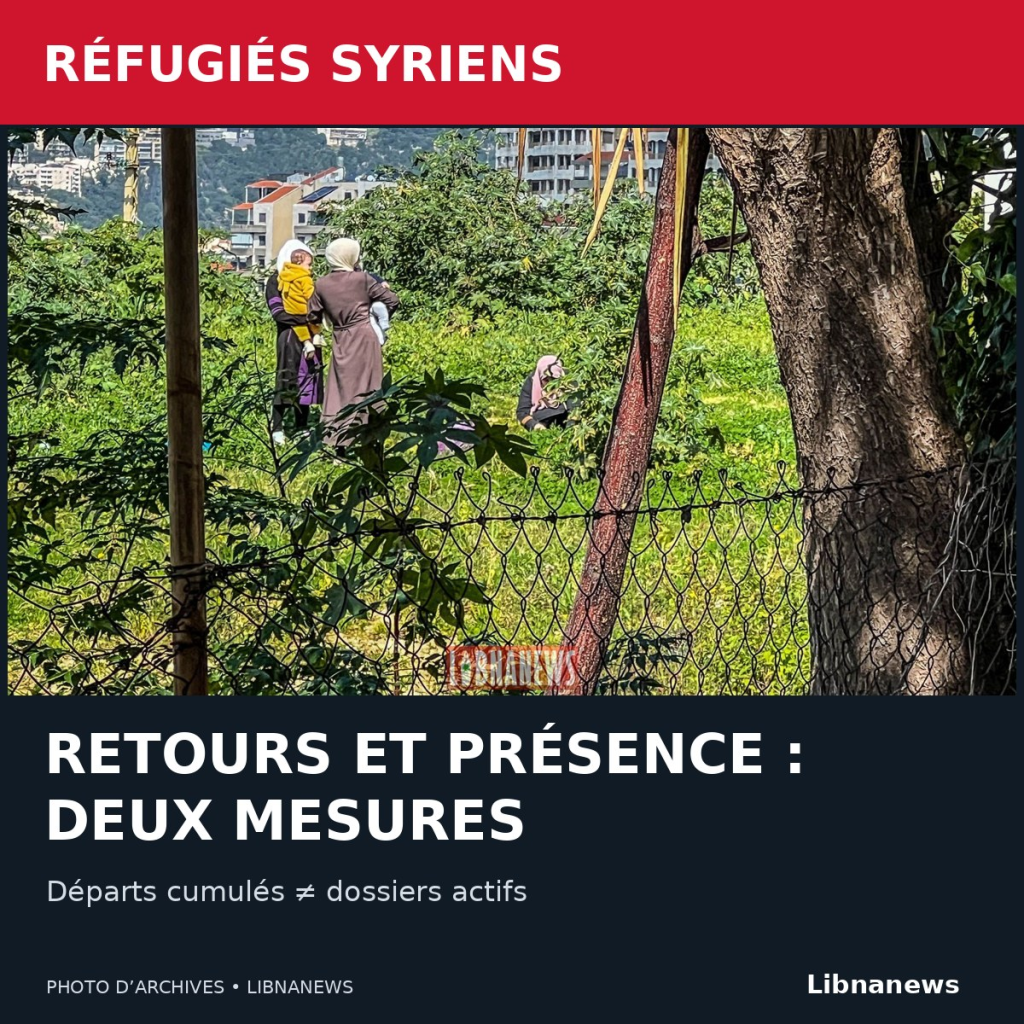
Cover: photo of Libnanews archives, preserved in the photo library since March 2024. Unestablished shooting date. This illustration does not represent a current departure.





Comments