

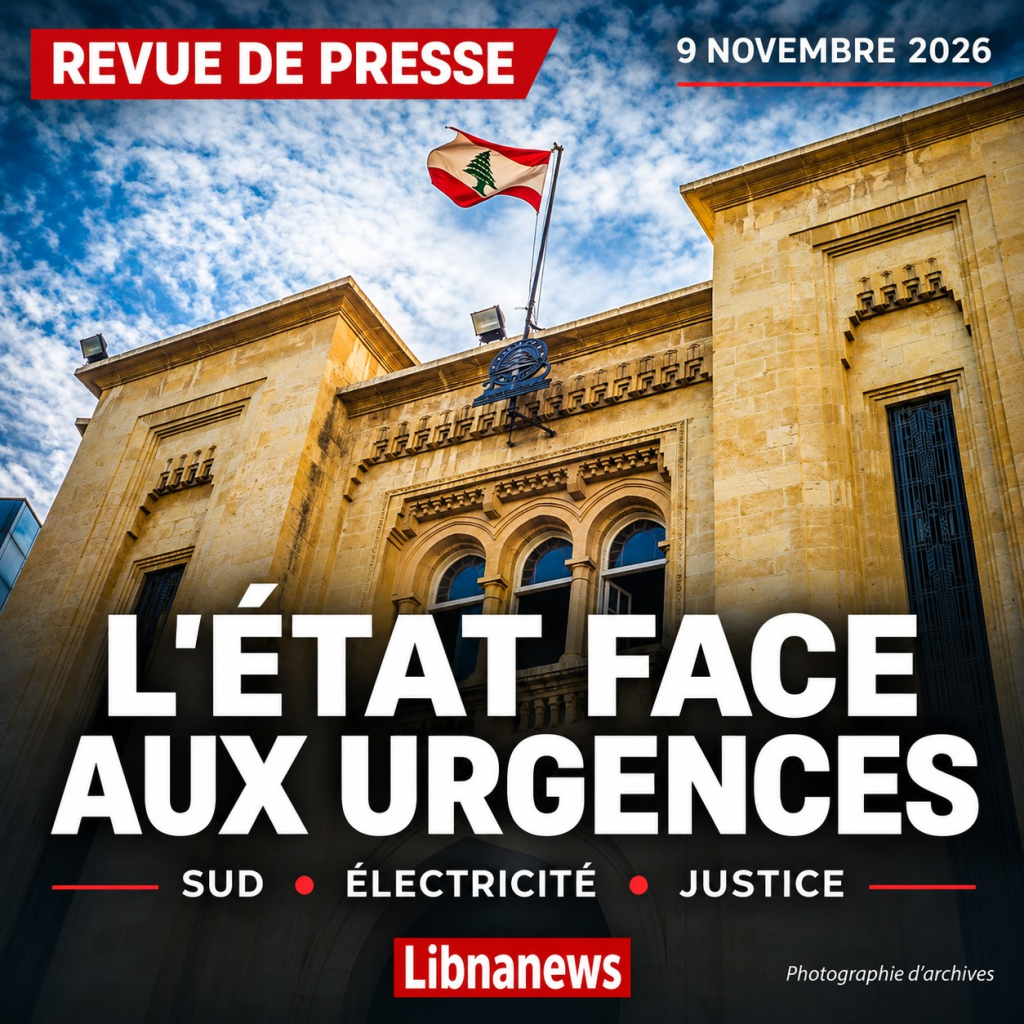
On the front page: the South, the weapons and the means of the State
The maintenance of an international presence in the South and the authority of justice occupy a central place in the press of 9 November 2026. Behind these two issues is the same question: how can the State protect the territory and enforce its decisions? The newspapers do not give the same answer, but they all describe a government facing concrete deadlines.
Asharq Al-Awsat, in its 9 November 2026 edition, devotes his Lebanese page to the preparation of the post-FINUL. The daily resumed a communiqué from the international force announcing the end of its mandate on 31 December 2026, before a drawdown and withdrawal. The diplomatic sources he cites describe a gradual departure, spread over several months. They do not therefore present the December deadline as the immediate evacuation of all positions.
The newspaper details above all the functions Lebanon might lose without replacement. UNIFIL maintains a field presence, documents violations and facilitates contacts between the parties. It also accompanies residents travelling between certain localities and the rest of the country. Rmeich, Débel and Ain Ebel illustrate this issue: according to the daily newspaper, their inhabitants currently benefit from international escorts, and then from an accompaniment of the army on part of the journey.
Asharq Al-Awsat reports that a corridor proposed by Lebanon, including Tibnin and Beit Yahoun, was allegedly refused by Israel. This information is based on diplomatic sources. The daily newspaper does not mention any replacement devices already adopted. He referred to President Joseph Aoun’s efforts to promote an international presence and to Nabih Berri’s reminders of the scope of resolution 1701.
On the internal front, Al Liwaa of 9 November 2026 places the arms monopoly at the heart of its front page. His editorial defends the action of the government and the justice system after the interception of an explosive truck in Dahr al-Baidar. It presents impunity as a danger to the State, rather than prosecution as the inevitable cause of a civil confrontation. This position clearly falls within its editorial line.
Al Akhbar of 9 November 2026 presents a different reading in his pages of opinion. A forum believes that safeguards must accompany choices about weapons and contests the bet placed in the United States. The divergence is therefore not only about the disarmament timetable. It concerns guarantees deemed necessary and the capacity of external partners to provide them.
The explosives procedure focuses on these tensions. Asharq Al-Awsat reports the interrogation of the two detainees and the prosecution of eleven other persons by default. Patriarch Béchara Rai asks that the investigation proceed without political recovery. Hizbullah, by the voice of Hussein Hajj Hassan, on the contrary, denounces foreign interference after the communiqué of the embassies of the United States, British, Australian, Canadian and Japanese. This text concerns Dahr al-Baidar, not the investigation into the explosion of the port of Beirut.
Local politics: the army at the centre of a disagreement over political decision
Ad Diyar of 9 November 2026 devotes his pages 2 and 3 to Rodolphe Haykal’s comments and their reception. The army commander presents the Israeli occupation as the first danger to Lebanon. It also reaffirms that the military will not allow internal destabilization. These two commitments are not interchangeable: they are aimed at the protection of the territory and the protection of civil peace. The newspaper reports a meeting in Yarzé where the commander insists on state authority, enforcement of political decisions and preparation for all scenarios. It calls for the continuation of UNIFIL to observe resolutions and document violations. He finally defended the army’s record despite its limited resources and the campaigns that challenged it.
In the same issue, Michel Nasr interprets this intervention as a refusal to let the army pay the price of political differences alone. His article is based in part on unnamed sources describing Yarze’s atmosphere. They distinguish the principle of arms monopoly from its application. According to them, the command cannot choose a strategy itself and then assume the consequences alone. The title on « scapegoats » should therefore be understood as reading the newspaper, not as an additional official citation. This discrepancy explains part of the debate: those responsible can display the same objective of sovereignty while diverged over the means, deadlines and risk of internal confrontations.
Dialogue with Hezbollah and the bet on negotiations
Ad Diyar of 9 November 2026 also describes, under Paula Mourad’s pen, an interrupted dialogue between Baabda and Hezbollah. Anonymous sources attribute the party preconditions for its resumption. They cite in particular the withdrawal of a government decision concerning its military wing. The daily does not report a new meeting or agreement on these conditions. Rather, there is an expectation: each camp hopes for regional data allowing concessions. The same analysis considers it premature to conclude that a change of Israeli leader would result in a withdrawal from the South.
Al Jumhouria of 9 November 2026, on pages 2 and 3, however, reports an opening of Hizbullah sources to Saudi efforts of internal de-escalation. This availability for dialogue is not an announcement of disarmament. Nor is it sufficient to establish that the blocking described by Ad Diyar would be resolved. Both stories focus on different degrees of engagement: accepting contacts or mediation does not mean accepting their final conditions. Caution must also be exercised in the face of Israel’s threats, mentioned in these pages. They are conditional on Hezbollah’s involvement in an Iranian attack, not the published evidence of a new operation decided.
Amal reorganizes its structures, the Current of the Future maintains its presence
Al Akhbar of 9 November 2026 devotes his page 3 to the internal work of the Amal movement. Central and regional workshops began about two weeks earlier and are expected to continue until the end of the year. They concern external relations, youth, sports, municipalities and organisation. The daily describes a meeting of officials at different levels. Its sources link this reorganization to the consequences of war, displacement and social needs of the Shiite population. They indicate that Nabih Berri is more closely following the structures of the movement. No list of appointments or conference dates is announced.
A box in the same newspaper evokes rumours about a possible succession of Nabih Berri by his son Bassil. It grants the President of Parliament a refusal to pass on hereditary transmission. But this scene is reported by internal sources and a relative, not by a recorded interview or a statement. It attests to a debate in Al Akhbar’s account, without establishing an adopted succession process. No formal designation procedure is described.
Ad Diyar of 9 November 2026 addresses another movement through an interview by Hiyam Eid with Mohammad Hajjar. He claims that the Current of the Future has not disappeared. It distinguishes the cessation of governmental and parliamentary political participation from social and territorial activities. In the context of Rafic Hariri’s birthday, he discusses the capacities of the movement and the follow-up provided by Saad Hariri. He also reported that a candidate scenario had been considered if the elections had been held at their due date. No full return calendar is given. The formula that every thing will come in its time keeps this uncertainty instead of lifting it.
Confidences are not worth decisions
Nida Al Watan of 9 November 2026 publishes, on page 6, a critique of the fragmentation of Sunni representation signed Tarek Abu Zeineh. The author refuses to hold the Mufti Abdellatif Deriane responsible. It also involves heads of government, ministers, elected officials and parties. It defends Dar el-Fatwa’s autonomy and transparent management of religious property, in particular for widows, orphans, poor households and displaced persons. This is a proposal for reorganization, not a measure already taken by the institution.
Al Liwaa of 9 November 2026, in his confidences on page 2, simultaneously criticizes the differences in treatment between former ministers before the courts. He quotes Amine Salam, but does not provide the names and references necessary to compare all other files. His denunciation of a two-speed justice must remain presented as a judgment of the newspaper. Similarly, its references to additional appropriations for an institution are not sufficient to identify beneficiaries or amounts. These headings offer political avenues; they do not exempt from distinguishing anonymous statements, documents and public decisions.
Annahar of 9 November 2026 gives Nawaf Salam’s answer to a question from the newspaper. The Prime Minister claims that only the surrender of the peace and war decision and the arms monopoly can protect Lebanon. He ensures that external changes will not change this line. It invokes the Constitution, laws, ministerial declaration and two votes of confidence. This position contradicts the image of a government simply waiting for its salvation from foreign recompositions.
Quotes and speeches: several concepts of sovereignty
Al Sharq and Ad Diyar of 9 November 2026 report Samir Geagea’s comments at a dinner of the Lebanese Kesrouan Forces in Meerab. He estimated that the country had travelled three quarters of the way towards a State capable of controlling military and security decisions. He placed the last stage on the horizon of a few months, not several years. This figure is a political image, not a measured indicator. Geagea admits that the pace is slower than he wants. It also regrets that progress depends on external pressure rather than a fully assumed Lebanese decision.
In the same editions of November 9, 2026, Taymour Jumblatt defended the negotiation as a means of securing Israeli withdrawal and restoring State authority. He refuses to present this option as a betrayal. His reasoning lies in the liberation of the territory, the cessation of attacks, the Taif agreement and the state monopoly on arms. On the 2027 budget, he demanded a more progressive tax and a tax on wealth. Ad Diyar highlights the nuances with Walid Jumblatt’s reservations to direct negotiations. However, the newspaper does not document a family or partisan breakdown.
Al Sharq and Ad Diyar of 9 November 2026 took over the homily of Béchara Rai. The patriarch demanded a stable peace and refused to allow the country to become the land of the wars of others. It refers to a call from five Christian border villages: Rmeich, Débel, Ain Ebel, Alma al-Sha`b and Qauzah. Ten urgent requests were submitted, but the articles do not reproduce the details. The patriarch links sovereignty, public services and responsibility. It also requests that the investigation into the Dahr al-Baydar explosives continue without political recovery.
Al Bina of 9 November 2026 presents different positions within Hezbollah. Hussein Hajj Hassan denounces the communiqué of the five embassies as interference. Ali Fayyad states that electoral changes abroad do not alter the right to resist and criticizes the government’s action. Ibrahim Moussaoui argues that the resistance has fulfilled the tasks of defence and aid abandoned by the State. These speeches shed light on the lines of confrontation. They do not alone demonstrate the accusations they contain. In the same issue, Hagop Pakradounian insists on the real capabilities of the army and the risk of an internal confrontation without consensus. His approach makes the choice of means as decisive as the affirmation of the principle.
Diplomacy: Southern guarantees and embassy messages
Asharq Al-Awsat of 9 November 2026 treats post-FINUL as a practical and diplomatic problem. The international presence documents violations, facilitates contacts and accompanies certain movements of civilians. Its disappearance without a suitable device would therefore leave several functions to be taken over. Al Quds Al Arabi of 9 November 2026, page 6, evokes a French track of strengthening of the Armistice Monitoring Commission. The newspaper does not present this option as a decision taken. It would be premature to see a mission already established, with agreed staffing, mandate and funding.
Al Bina of 9 November 2026 reports on the meeting of the deputy Qassem Hashem with the Spanish commander of Sector East of UNIFIL, Antonio Martinez. Hashem pleads for the maintenance of force or other presence under UN flag. It highlights its role as a witness to violations and difficulties of access to land, in particular for olive harvest. This political appeal differs from a decision of the Security Council. The support expressed locally does not yet resolve the issues of mandate and international acceptance.
Ad Diyar of 9 November 2026 examines the guarantees of withdrawal in an analysis of Dolly Bechaalani. Anonymous diplomatic sources are considering reciprocal steps rather than immediate Israeli departure. They also report an Israeli interpretation allowing the temporary maintenance of a buffer zone. This reading is not presented as accepted by Lebanon. The lack of a clear timetable, security conditions and future monitoring remain unresolved. Eisenkot’s military past feeds into questions about his method; it does not automatically deduce the content of a future agreement.
A common communiqué, opposing interpretations
Nida Al Watan of 9 November 2026 analyses the communiqué of the American, British, Australian, Canadian and Japanese embassies on Dahr el-Baidar. Former Secretary General of the Ministry of Foreign Affairs William Habib sees it as a very advanced position in favour of the State. According to the newspaper, the text supports an independent judicial procedure and calls on political leaders to support state authority on decisions of war and peace. Habib said, however, that he did not know why some European states were not included. This absence therefore does not prove either refusal or rupture.
Al Joumhouria of 9 November 2026 develops, under the pen of Johnny Mounayer, four readings of the same text. He sees it as support for the state, a request for positioning addressed to the entire political class, the assertion that solutions must go through institutions and a test of their ability to implement their commitments. The possibility of conditioning the aid belongs to its analysis. It must not become a announced financial measure. In contrast, Hussein Hajj Hassan, quoted by Al Bina and Al Arabi Al Jadid on 9 November 2026, denounces a foreign intervention. The disagreement thus concerns the legitimacy of external support as well as the judicial file.
Iraq and Qatar: Visits are not contracts
Nida Al Watan on 9 November 2026 announces a visit to Beirut by Iraqi Prime Minister Ali al-Zaïdi. The daily puts the Kirkuk–Tripoli project in this perspective. He sees it as a Mediterranean outlet for Iraq and a possible regional function for Northern Lebanon. No funding, work contract or schedule is given. The newspaper also claims that Lebanese arrears in excess of $1.2 billion have weighed on the oil agreement. This amount remains allocated to his investigation. The envisaged recovery cannot be confused with the settlement of these previous commitments.
Ad Diyar of 9 November 2026 announces at the same time a technical and administrative Qatari delegation in the electricity sector. It refers to three possible plants or an improvement of the existing one. The objective of continuous feeding is not a contractual guarantee. Al Bina of the same day brings another aspect of cooperation: Minister Mohammad Haidar exchanged in Turkey on vocational transition, training and social protection. A visit by his Turkish counterpart to Beirut was planned in January 2027 to prepare for cooperation and tripartite dialogue. Again, the planned appointment precedes the eventual agreement.
Detroit: Diplomatic measure and disputed charges
Al Liwaa of 9 November 2026 reports that consul Ibrahim Charara was declared persona non grata after publications attributed to him. He states that his diplomatic passport was cancelled and relayed the defence of a relative referring to an old hacking account. This version is not technical expertise. Al Akhbar of the same day develops a political reading of the case and reports accusations against several actors. He also evokes a possible hearing of Michel Issa by democrats, without an announced summons. The measures reported, the reasons given and the reactions envisaged must therefore remain separate.
Al Quds Al Arabi of 9 November 2026 adds an episode of community mobilization. He told Ali Mansour that he had refused to host a departure ceremony at Bint Jbeil’s club. He then quoted the offer of a Dearborn church by Father Halim Choukeir. This episode describes reactions in the diaspora. It does not prove a new American sanction or a list of other diplomats. The concerns expressed in Al Liwaa’s confidences remain concerns at this stage.
International policy: negotiating under threat without confusing announcements
The formation of the next Israeli government and the exchanges between Washington and Tehran occupy a prominent place in the 9 November 2026 editions. In both files, newspapers describe negotiations, threats and scenarios. They do not yet see a final arrangement.
Asharq Al-Awsat of 9 November 2026 reports that Isaac Herzog entrusted Gadi Eisenkot with the mission of forming a government. The recommendations received do not constitute a coalition already assembled. The newspaper distinguished the 48 seats in its camp from the support for its designation. The role of Arab parties, discussions with religious groups and Avigdor Lieberman’s demands make the equation uncertain.
Al Akhbar of 9 November 2026 examines several scenarios: minority government, agreement with haredim parties, unity with Likud or return to elections. His analysis of Netanyahu’s means of blocking training includes the hypothesis of military escalation. It does not demonstrate that such a decision has been taken. The distinction between political possibility and established preparation must remain visible.
On Iran, Asharq Al-Awsat reports that Donald Trump finds a resumption of strikes very unlikely if negotiations progress, while maintaining the military option. Abbas Araghchi, for his part, makes a proposal including the cessation of war on all fronts. Iranian and American conditions are not presented as reconciled.
The daily takes several precautions on the Ormuz incidents. He writes that he did not independently verify the Iranian announcement of four oil tankers affected. British maritime alerts describe incidents, but do not allow them alone to link them to all the ships mentioned by Tehran. Similarly, the announcement of a two thousand-kilometre ceiling for Iranian missiles does not establish the commissioning of a new system or the success of a longer-range test.
These reservations constitute information in themselves: in a context of military pressure, a statement of capabilities or a claimed balance sheet does not replace their demonstration. Mediation continues while the parties maintain their threats.
Al Bina of 9 November 2026 brings an indispensable clarification to information taken from elsewhere: the Yashar party denies the report giving Eisenkot withdrawal commitments in Lebanon, Gaza and Syria. The presence of rumours in several newspapers does not constitute several confirmations. The denial prohibits the presentation of this undertaking as acquired. Two analyses of the same issue also differ on the extent of the powers of the interim government. These opposite readings do not allow a precise limitation of its powers to be established.
Al Arabi Al Jadid of 9 November 2026 devotes its regional pages to operations claimed by the Houthis and to Saudi responses. The Saudi Ministry of Energy describes limited damage due to fragments, without victims, while the Houthis claim several targets. These accounts do not describe the same level of confirmation. The newspaper also reports denials about the sending of Syrian troops to Yemen. A military cooperation or training agreement is not evidence of combat deployment.
The same daily presents the opening of the climate conference in Antalya, scheduled from 9 to 20 November, around implementation and financing. It distinguishes between reducing emissions, adaptation, waste, cities and industrial transition. The commitments and objectives announced must still become investments and results. This gap is also going through his report on Quneitra, where schools, water, transportation and agriculture suffer from both weak services and security constraints. The testimonies of school officials and farmers describe specific needs, without providing a comprehensive assessment of the entire province.
Economy: Qatar’s offer does not pay the bill yet
The negotiation with Qatar on electricity is a common issue for several newspapers on 9 November 2026. Asharq Al-Awsat approached her through government discussions. Al Akhbar is interested in the duration of the contract, the guarantees and the price. These approaches converge on one point: the modalities remain to be defined.
According to Asharq Al-Awsat on 9 November 2026, the government’s meeting on electricity was postponed pending the return of energy minister Joe Saddi from Qatar. A Qatari delegation is expected at the beginning of the week to continue technical and financial exchanges. The newspaper evokes a possible agreement of intent, without announcing a signed final contract.
The project presented by Nawaf Salam provides for the partner to finance, implement and operate infrastructure. The absence of an initial investment from the Treasury is one of its arguments. But it alone does not make it possible to know the cost of the current for the user. Repayment of the investment, fuel, operation and maintenance must find their place in the assembly.
Al Akhbar of 9 November 2026 highlights this distinction. The newspaper evokes a model of construction, operation and transfer, with a duration of up to 20 years. It reports a $1 billion guarantee claim and work on the tariff structure. These elements are presented as those of negotiation. No final price per kilowatt hour is given as adopted.
The prospect of using gas feeds the hope of cheaper production than that based on diesel or fuel oil. Al Akhbar warns, however, that the cost of production is not confused with the full tariff. His anticipation of an increase must remain attributed to the newspaper; It does not constitute the announcement of a government decision.
The same daily newspaper compares equipment needs and public accounts. The investment in the first half of 2026 amounted to $173 million, or 7.9 per cent of expenditures, compared to a surplus of $1.21 billion. He insists on the place of maintenance in expenses classified as investment. This distinction is important to measure what sustains the existing one and what actually increases the capacity of the country.
Nida Al Watan of 9 November 2026 moves the gaze towards agriculture. In an interview with Minister Nizar Hani, the newspaper mentions about 56,000 hectares affected, or 22.5 per cent of the country’s agricultural land. Some 52,000 hectares are said to be in the South and Nabatiyah. The support programme described is targeted at 25,000 farmers, but it would still cover only 15,000 beneficiaries. Of the $12.5 million required, $7.5 million would be raised. The shortfall of five million leaves ten thousand farmers waiting for cover.
Al Bina and Ad Diyar of 9 November 2026 also distinguish the Qatari project from the settlement of public invoices. They announced the parliamentary review of an appropriation of £8,950 billion, or about $100 million, for part of the arrears towards Electricity in Lebanon. The draft is presented as submitted to the Finance and Budget Committee before a possible vote is taken. More affirmative formulations in other accounts do not allow payment to be held for payment. Ibrahim Kanaan claims that subscribers who paid are not penalized and that responsibilities are established. The question therefore concerns recovery as much as production.
Al Bina and Al Sharq of 9 November 2026 finally report the arrest of Nawaf Salam and Yassine Jaber by Bassam Tlais. The union leader demanded the execution of the assistance to drivers covering October to December 2026. He recalled that the mobilisation had been suspended on the basis of an agreement. No individual amount is specified in these passages. The difference between the announced decision and the expected payment forms the concrete fact here, without making it possible to calculate the income to which each driver can claim.
Annahar of 9 November 2026 addresses these arbitrations in a contribution by Mazen Abboud, on page 15. Budget 2027 is presented at $7 billion, $1 billion more than in 2026, based on 3 per cent growth and 10 per cent inflation assumptions. The author argues for a restoration of public capacity: electricity, digital infrastructure, education, tax collection and customs. In its analysis, nominal revenue growth is not sufficient to measure the real improvement in services. Its proposals on the digitisation of public procurement are part of an approach to be defended, not an already generalized one.
Al Joumhouria of 9 November 2026 reports, on page 8, the leads put forward by Farid Boustani for depositors. The MP plans to mobilize a fraction of the gold, around a quarter of the stock, part of the public land and funds available at the Bank of Lebanon. He mentions approximately 118 state-owned real estate and mentions about $8 billion to the central bank. These estimates and proposals are attributed. They would require legal and financial reviews, including on the nature and availability of assets. The journal does not describe any approved sales authorization or binding repayment schedule.
Al Quds Al Arabi of 9 November 2026 extends, on page 11, the issue of infrastructure to the Gulf rail network. He reported the signing of a general agreement between the six countries in Manama for an announced 2,117 kilometres. The full operating horizon remains set at the end of 2030, with the possibility of previous bilateral links. The signature is an institutional step; It does not mean that travellers or goods can already travel the entire network.
Justice: open cases without an anticipated verdict
Al Akhbar of 9 November 2026 devotes its last page to the judicial proceedings initiated in France after the death of the parents of artist Ali Cherri in Noueiri. The newspaper describes the initiation of an investigation following a complaint filed on April 1, 2026, concerning a suspected war crime and attack on civilian property.
The stage of the proceedings is that of investigations. Two judges were mentioned, as well as the possibility of searches in Lebanon and requests for assistance. The daily does not report an open trial or an arrest warrant issued. Future judicial consequences will depend on the evidence, qualifications and responsibilities that can be established.
Ali Cherri asks that the investigation go beyond the general designation of a State. In the interview published by Al Akhbar, he insists on the identification of those who made the decisions. This request reflects the search for individual responsibility; It does not announce that these authors are already identified by the courts.
The newspaper highlights the work led by the family, Clémence Bectarte, Forensic Architecture and Amnesty to bring together elements. These include strikes, trajectories and victims. The artist indicates that he has no contact with the Lebanese authorities and wishes their cooperation. Mutual assistance thus appears to be a concrete question for the continuation of the case, not as a formality already completed.
The text highlights the gap between the time of mourning and the time of justice. French nationality makes it possible to bring the proceedings before the French authorities, but it does not prejudge its outcome. The classifications of war crimes remain those covered by the complaint and examined in the investigation, not those of a final judgement.
Dahr al-Baidar: the Prosecutor’s Office’s clarifications limit interpretation
Annahar of 9 November 2026 brings a more direct element to the explosives case. On page 6, Radwan Akil questions Attorney General Jamal Haj. The case concerned 13 suspects, including two detainees, before the military courts. The magistrate states that at this stage there is no evidence of a project to use explosives inside Lebanon. The newspaper distinguishes the prosecution of transportation, internal security and criminal association from a terrorist characterization that is not retained at this stage in its account. These clarifications are neither acquittal nor conviction. They set the limits of what the investigation then allows to assert.
The debate on a possible referral to the Justice Council should not be confused with the court already in charge of the procedure. The political confrontation around the truck does not provide further proof of its destination. This separation between the judicial file and the public battle joins calls to let the magistrates work. She also urged that the accused should not be considered guilty before trial.
Al Bina of 9 November 2026 reports, in another file, a guide of the Supreme Council of the Judiciary on the application of the general amnesty. The newspaper refers to offences prior to 1 March 2026, as well as exclusions involving, inter alia, public funds, corruption, banking, terrorism, intentional homicide and money laundering. The effects vary according to the legal qualifications and conditions. An end of the proceedings or a reduction of the sentence cannot therefore be inferred for a particular person from that summary alone.
Nida Al Watan of 9 November 2026 finally recalls, in the rostrum of Tarek Abu Zeineh, an appeal concerning decision number 55 of 9 September 2023 on the Mufti’s mandate. The author reports preliminary conclusions in favour of annulment, but states that no final decision of the Council of State has been delivered. The status of the procedure must remain clearly separated from the outcome desired by the columnist.
Society: health, school and daily safety
Al Liwaa of 9 November 2026 provides several public service information that complements the political debates. The newspaper announced a free PSA dosing campaign for men aged 50 to 70 in public hospitals until 15 February. Minister of Health Rakan Nassereddine presents this device as part of the screening. The announcement is not an individual medical recommendation: the modalities and appropriateness of an examination are part of the dialogue with health professionals.
The afternoon teaching provides another concrete dossier. Al Liwaa reports a call to a sit-in on Tuesday and requests to resume prices, against a background of financial blockage linked to Unicef. Contract teachers call for intervention to resolve the crisis. The question goes beyond the payment of remuneration: it affects the continuity of education. The newspaper does not yet report a settlement of the conflict.
Security in Beirut contrasts, in the same pages, the feelings of some inhabitants and the institutional response. Al Liwaa takes up the figures presented by the Internal Security Forces to challenge the most alarmist accounts: eighty-three arrests during the reporting period, of which forty-seven related to theft and twenty-three related to narcotics. These data measure police activity, not directly the total number of offences. They are therefore not sufficient to conclude alone that crime has increased or decreased overall.
A daily column links mistrust of institutions to the circulation of rumours. It calls for cooperation between citizens, justice and security forces, while refusing to assimilate poverty and crime. Its social reading remains separate from administrative statistics.
Housing finally appears through the announced launch of prefabricated housing financing by the Habitat Bank. Al Liwaa states that the product must start on 9 November, but its conditions will be specified later. At this stage, the information does not determine the rate, duration, ceiling or personal contribution. These parameters remain necessary to measure the real value of the scheme to households.
Food security: controlling the chain rather than generalising suspicions
Ad Diyar of 9 November 2026 develops a dossier on food poisoning and the means of the Food Safety Authority. Amina Chamseddine reports on meat investigations, storage conditions and samples. It also cites further reports in the North and seizures in the South. These investigations do not allow all suspicions against institutions to be turned into definitively established responsibilities. The newspaper highlights a control chain: slaughter, import, storage, cold, preparation and distribution.
Billy Aouad, President of the AMF, asks for unified official data, traceability and analysis. It recalls the framework of the 2015 Act and administrative, regulatory and financial obstacles. The presence of a parasite in a sample does not mean that all meat sold in Lebanon would be contaminated. His call is to strengthen controls without fuelling a general panic. The daily reports a meeting convened by Nawaf Salam and a 48-hour deadline requested by Amer Bisat for warehouse lists. The results of these audits are not yet included in this account.
Culture: open places, a memory to rebuild
The press of 9 November 2026 offers a Lebanese cultural subject that is not limited to commemorations. Nida Al Watan announces a new edition of Beirut Chants, from December 1 to 23, with free programming by reservation. The same newspaper reports on an artistic place opened in Bayssour by Ribal Molaeb. Programming, access to works and cultural presence outside the capital are all subjects in their own right.
For its nineteenth edition, Beirut Chants has to welcome Abdel Rahman El Bacha and his son Camille at the opening. Nida Al Watan mentions churches, universities and cultural centres in Beirut, as well as a repertoire combining classical music, sacred songs, jazz and Arabic singing. Reservations are announced on Ihjoz. The figure of twenty-three concerts quoted in the report should not be confused with the duration of the festival: the official programme consulted includes twenty-six appointments over twenty-three days. In Bayssour, the place inaugurated on November 7 with the gallery Saleh Barakat brings together on four levels exhibition, music and creation. Ribal Molaeb intends to develop an artistic offer outside Beirut.
Asharq Al-Awsat of 9 November 2026 goes back to Chouchou’s journey through Fares Yawakim’s book, published by Dar al-Furat. The review is based on the testimony of an author who accompanied him and wrote for him for ten years. It traces the opening of the National Theatre on November 11, 1965, in a 450-seat room, and the installation of a regular meeting with a popular audience.
The repertoire mixed adaptations and comedies in spoken language. The shows followed each other during the year, with tours during the summer. The article describes an artist who can play with his voice, body and the immediate reaction of the room. It also recalls its films, children’s shows and its presence in festivals.
This public success has not eliminated economic fragility. The book tells about borrowing, interest and debt accumulation. The war interrupted the prospects for financing and the activity of the theatre. The portrait thus links the memory of an artist to the material conditions of a cultural institution. Chouchou died on November 2, 1975, at 36 years of age. The newspaper’s reference to half a century must be understood as an evocation of this memory, not as the exact calculation of an anniversary in 2026.
Al Akhbar of 9 November 2026 opened another debate with his critique of the documentary dedicated to Edward Said. The daily is interested in the use of family archives and the place given to the voice of the thinker. He also questions how the film presents it to the Western public. This critical reading should not be confused with the announcement of a local screening: no specific Lebanese appointments are provided in this article.
Exhibitions: Constitutional archives and contemporary creations
Al Sharq of 9 November 2026 devotes his page 8 to the exhibition on the centennial of the Constitution at the National Library of Sanayeh. Presented under the title « Between the lines of the Constitution », it brings together documents, photographs and archives. The newspaper announces that it will continue until December 23. The comparison of historical and institutional developments gives concrete access to political history. This is not a new constitutional act, but a work of presenting public memory.
Ad Diyar of 9 November 2026 presents, on page 8, the exhibition « Seuils » in Kulturnest, Sin el-Fil, from 24 October to 2 December. Fifteen artists explore passage, identity, memory and relationship to the territory. Painting, sculpture, photography, collage and mixed techniques are co-ordinated by Amal Charabieh. The diversity of practices gives the transformation material content, through bodies, architecture and nature. The event remains open to the public for the following weeks.
In the same issue, Thérèse Tawil reports on the oil day in Kfeir. The festival, opened the day before under the patronage of the Minister of Tourism Laura Khazen Lahoud, combines tastings, harvest, pressure, rural products and hiking. Nuncio Paolo Borgia and elected representatives are mentioned. The report sees a gesture of attachment to the South and its olive groves. It thus combines the maintenance of production and the presence of the inhabitants in their territory.
Sport: Safa advances, Olympism remains under pressure
Al Akhbar of 9 November 2026 highlights the start of the Safa season. The club scored five wins in five games and fifteen points after winning 4–0 against Tripoli. The newspaper highlights the combination of a productive attack, thirteen goals, and a defence that has granted only two.
The ranking, however, requires careful reading of the calendar. Safa has two points ahead of Jouaya, who played six games. Nejmeh posted eight points in four games, while Ansar had seven in three. Differences in ranking therefore do not indicate all possible power ratios once the calendars are balanced.
The day described by Al Akhbar also includes Ansar 4–3’s victory over Tadamon Tyre and Nejmeh 2–0’s victory over Ahed. Al Liwaa of 9 November 2026 confirms the goals of Tomiwa and Ali al-Fadl for Nejmeh. Safa’s balance sheet gives strong sports information without clearing out the differences in matches played between his pursuers.
The other major issue concerns Olympic governance. Al Akhbar of 9 November 2026 reports a letter from the International Olympic Committee and the Asian Olympic Council to Minister Nora Bayrakdarian. A response is expected before 15 November in the conflict of recognition between the competing leadership of the Lebanese committee.
The newspaper refers to the risk of protective measures under the Olympic Charter. It does not report a suspension already pronounced. This clarification changes the reading of the deadline: Lebanese sport still has a dossier to solve, and the consequences will depend on institutional responses. Athletes may experience the effects of a conflict they do not control.
Nida Al Watan of 9 November 2026 finally brings a positive collective result with the regional title of Lebanese rugbywomen. The daily awards them six wins, 155 points entered and seventeen cashed. This performance contrasts with the institutional uncertainty described in the same editions.
The selection won the West and Central Asian Championship in Aqaba, with a final won 22–0 against Jordan. In another sport, Nida Al Watan reports the victory of Lebanese Mahmoud Ghandour by KO in the first round in Bangkok, during a meeting of Muay-Thai RWS. The thirty-year-old, classed 61 kilograms, is announced for an appointment in Beirut on 28 November.
Technology: the new cable and the less visible costs of digital
Al Bina of November 9, 2026, page 4, reports an announcement by Ogero on the ship Sophie Germain d’Orange Marine. It is reported off Nahr Ibrahim-Aqaybeh for the laying of the CADMOS-2 cable between Lebanon and Cyprus. The newspaper presents this project as the first new international cable since 2010. It is to take over CADMOS-1, which entered into service in 1995. The distinction between installation and commissioning is essential: commercial opening must follow work and testing. The arrival of the vessel therefore does not mean that the additional capacity is already available for subscribers.
Al Sharq of 9 November 2026 completes this dossier with Charles Hage’s remarks at the Doha Mobile Congress. It refers to solar energy, infrastructure sharing, national homelessness and fibre. These guidelines affect costs and continuity of service. The newspaper presents them as projects or lines of work, not as a completed deployment. International cable and domestic networks are two different levels. A new external link alone does not make it possible to deduct a price drop or an identical improvement in all localities.
Artificial intelligence in the face of resources and rights
Annahar of 9 November 2026 devotes his pages 8 and 9 to climate. A contribution from Najwa Azhar examines the energy and water needed for artificial intelligence. It cites data centre consumption estimated at 485 terawatt hours in 2025 and projected at 950 in 2030. The second figure is a projection, not a consumption already seen. The text describes a voluntary commitment linked to Antalya on decarbonised energy, cooling and publication of data. The challenge is to make needs visible and comparable; the undertaking should not be presented as a universal obligation already implemented.
Al Arabi Al Jadid of 9 November 2026 addresses another cost of developing these models: the rights to books used for training. On page 25, he reports the creation of an association of ten independent French houses. Yannick Dehée of New World defends a joint action to coordinate files and costs. The newspaper indicated that members plan to devote a portion of the compensation received to collective financing. The approaches envisaged include notifications, negotiations and, in the event of failure, legal actions. They are not acquired convictions.
The same article recalls that Mistral denied the charge of unauthorized use made against her. It also distinguishes the debate on the training of a model from that on the acquisition and retention of pirated copies. This legal distinction prevents all procedures from being summarized on a single issue. The French draft presumption of use, adopted in the Senate according to daily practice, still needs to be discussed in the Assembly. A parliamentary step announced is not a law that has finally entered into force.





Comments