

On Sunday, November 8, 2026, the Central Bank of Libya announced the signing of the final minutes between Naji Issa and Fawzi Abu Khazam. This administrative step follows the parliamentary appointment on November 2 and the swearing-in of the new governor on November 4. It formalizes the transfer of responsibilities, without being confused with a political agreement of all the institutions.
According tocentral Bank communiqué of 8 NovemberThe ceremony was attended by members of the Board of Directors and officials of the institution. The bank presents the signature as the completion of its administrative procedures and as a means of ensuring continuity of work.
The Libyan House of Representatives appointed Fawzi Abu Khazam as Governor of the Central Bank on Monday, 2 November 2026 in Sebha. According to the parliamentary communiquéreported by Anadolu78 of the 90 deputies present approved the resignation of Naji Issa and the choice of his successor. Abu Khazam had been acting on an interim basis since 22 October.
Thepress release of 4 novemberhad confirmed the oath of Abu Khazam before the Speaker of the Chamber and some of its members, pursuant to the decision of 2 November.
The vote brings a decision of the House to a succession previously organized by its presidency. The distinction counts: the first act expressly provided for the resignation to be submitted to Parliament at a future sitting. This step comes as the Central Bank continues its activities and reorganises its internal bodies.
After the interim vote decided on 22 October
On 22 October 2026, according to the decision reported on the same day by the LANA public agency, the presidency of the House had accepted in principle the resignation of Naji Issa. His decision number 5 of 2026 temporarily entrusted the functions of governor to Fawzi Abu Khazam, a member of the Board of Directors.
This arrangement was to ensure continuity of operations until a decision was taken by the Assembly. He relied, inter alia, on the Governor’s request for resignation and on correspondence from the Speaker of the House dated 30 August.
In its announcement on Monday, the House brought together two decisions: to accept the resignation of the former governor and to appoint Abu Khazam as head of the institution. The 90 Members mentioned correspond to the present at this sitting. The communiqué does not detail the distribution of other votes between votes against and abstentions.
The Central Bank had already acquired the contract
The parliamentary appointment comes after the effective assumption of office announced by the Central Bank of Libya. On 25 October, its Board of Directorsconfirmed, according to the public agency LANAthat Fawzi Abu Khazam had been exercising his responsibilities since 22 October. He referred to the decision of the parliamentary presidency.
At that meeting, the board had supported the bank’s legal tasks. It had also initiated the revision of its rules of procedure. Governance, audit and risk management committees and appointments were announced. He had asked to reorganise the Monetary Policy Committee.
Dialogue with the High Council of State
At the time of the previous succession, in September 2024, the House and the High Council of State had reached an agreement. In its communiqué of 30 September 2024, the UN mission confirmed the consultation of the High Council before the parliamentary appointment, in accordance with the Libyan political agreement.
On 27 October 2026, Fawzi Abu Khazam met Mohamed Takala, President of the High Council of State. According to the communiqué issued on the same day by the Central Bank, they addressed inter-institutional cooperation and economic and financial issues. The Governor introduced the procurement procedures and stated that the services continued to function normally.
Both officials stressed the importance of dialogue and consultations. Press release No.
UN calls for preserving bank independence
In adated 23 october 2026The United Nations Support Mission in Libya had taken note of the decisions of the Parliamentary Presidency. It called for the integrity, independence and functioning of the Central Bank to be preserved. It also called for compliance with the procedures provided for in the Libyan legal framework.
The mission also cautioned against pressure from the bank to finance increased public spending. In her view, such practices could increase exchange rate and inflation tensions while reducing reserves.
Budget and currency among cases to be processed
The first meetings of Abu Khazam specify the financial records already committed. On 26 October, he met Finance Minister Rashid Abu Ghefah. Masoud Suleiman, president of the National Petroleum Company, also attended the meeting. According to the Central Bank, the exchanges were aimed at coordinating procedures and sharing information between these three institutions.
In its communiqué of 28 October 2026, the Governing Council called for speeding up the unification of the general budget and further economic reforms. He also stressed the use of foreign exchange to finance basic needs for goods and services, with the aim of preserving reserves and exchange rate stability.
The Council also decided to strengthen risk monitoring and the preparation of monetary policy decisions. He asked to develop electronic payments to reduce the use of cash.
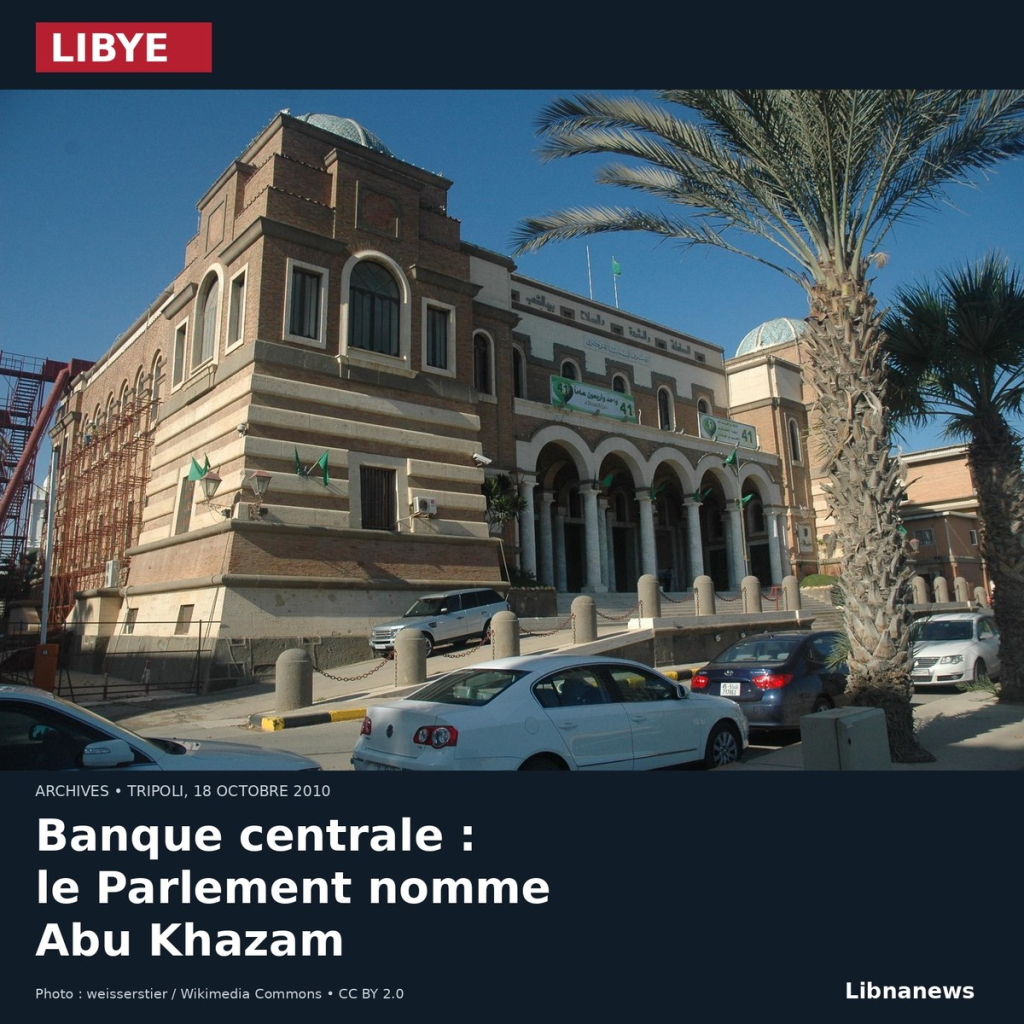
Cover: Headquarters of the Central Bank in Tripoli, photograph of archives of 18 October 2010. Weisserstier /Wikimedia Commons,CC BY 2.0. Proportional scaling and graphic dressing outside photography; no scene of November 2026 is shown.






Comments