

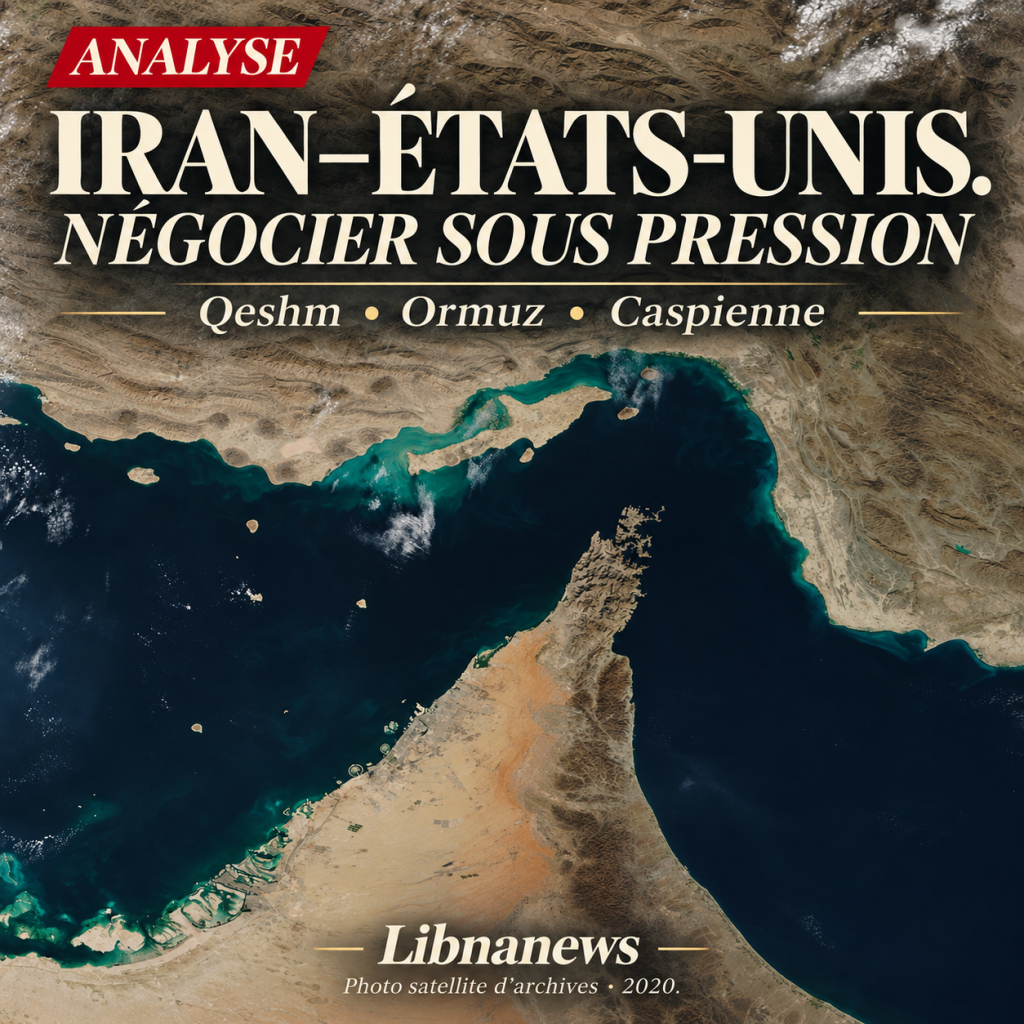
Donald Trump leaves a door open to an agreement with Iran, while maintaining the opportunity to strike. The statements of 8 November, the operations around Qeshm and the creation of Iron Gate show the same logic: negotiate without immediately releasing pressure. Tehran responds with a conditional offer in two days, backed by its lever on Ormuz. After the American elections, each seeks to transform the other’s constraints into concessions.
The appointment scheduled for Monday 9 November at the White House with Qatari Prime Minister Mohammed bin Abdelrahmane Al-Thani gives a concrete deadline for this diplomatic confrontation. Qatar continues to mediate between Washington and Tehran. But a summit meeting is not enough to demonstrate that a compromise is ready. Public positions still leave open some central questions: the order of commitments, their control and the scope of a possible cessation of hostilities.
Iran: Trump Maintains Conditional Military Option · Global Voices
On Sunday, November 8, Donald Trump deemed the need for further attacks « highly unlikely », subject to diplomatic progress and a solid agreement. At the same time, he mentioned 38 Iranian bridges among the infrastructure that could be targeted. His statement therefore associated a preference for negotiation with an explicit threat. It does not constitute a general waiver of force or the announcement of an additional ceasefire.
This formulation leaves the US President a great deal of discretion. No public criteria specifically define the progress sufficient to avoid a strike. Washington may consider a proposal serious and then consider it insufficient. Tehran must therefore evaluate words that still depend on an American decision, rather than an agreed mechanism between the two parties.
Marco Rubio used a less optimistic tone before leaving for Paris on Sunday. The Secretary of State rejected the idea of an imminent breakthrough and denounced Iranian demands which he considered unrealistic. It also maintained the possibility of American actions against threats against their forces or navigation. These statements express an American justification for operations, not an independent validation of each target.
The difference in tone does not prove a disagreement within the administration. It may correspond to separate roles in the same negotiation. Trump stresses that a solution remains possible; Rubio states that the current conditions do not satisfy Washington. The practical result remains the same for mediators: turning a general political opening into commitments that are sufficiently precise to be implemented.
Qeshm prevents confounding negotiation and stopping strikes
The Iranian island of Qeshm, at the entrance to the Strait of Ormuz, illustrates the persistence of military activity. US officials confirmed a 2 November operation as a defensive measure against anti-aircraft means. Donald Trump also confirmed on 6 November limited strikes against Iranian defences. Public announcements, however, do not provide an exhaustive chronology of all operations.
At the same time, explosions were reported in southern Iran during the weekend. Their attribution, nature and effects are not all established. It would therefore be abusive to transform each reported noise into a confirmed American strike. The distinction counts: a claimed transaction allows analysis of a decision; an unassigned incident requires several possible explanations.
Qeshm shows above all that Washington can distinguish an expanded military campaign of ad hoc actions presented as defensive. A declaration temporarily precluding the return to a more intense war can thus coexist with limited strikes. It is within this period that the risk of escalation remains: an action deemed circumscribed by its author can be interpreted otherwise by its opponent.
The risk of surprise therefore exists without the need to announce an imminent attack. It is the result of the absence of a public undertaking excluding any operation and of intervention criteria still unilaterally assessed. However, the public information available does not provide a date, hour or future strike plan. An available military capability is not evidence that an order has been issued.
Iron Gate targets land and Caspian supplies
On 7 November, the United States Middle East Command announced the establishment of Task Force Iron Gate. Admiral Brad Cooper has placed this team of about twenty civilian and military personnel in Tampa, Florida. Its mission is to coordinate US services against the passage of advanced weapons, dual-use technologies, sanctioned materials and qualified illegal revenues through Washington, through Iranian land borders and the Caspian Sea.
The measure broadens the scope of US pressure beyond ports. It alone does not demonstrate the existence of a material land blockade of Iran. The communiqué describes a coordination structure. It does not announce the occupation of the borders, nor does it announce an American force controlling the Caspian, nor does it announce a verified halt to all Iranian trade.
This difference determines the necessary means. At sea, interception can physically immobilize a ship. On a land supply chain, checkpoints can be carriers, payments, intermediaries or border crossings. Their effectiveness depends on the information available and the decisions taken by the authorities concerned. The creation of a staff does not yet reveal which of these possibilities will be used.
The Caspian reference adds a geographical difficulty. This closed sea opens up to Iran exchanges with other riparian states. Tackling these flows requires something other than an American naval presence in the Gulf. Pressure on transactions or companies does not produce the same effects as interception. Consolidating these instruments would appear to have acquired a capacity that the announcement does not demonstrate.
The stated objective is to limit Iranian rearmament and resources. The result shall be measured by the cargo actually interrupted and the channels affected. It will also be necessary to distinguish between military goods, dual-use goods and civilian trade. Without this distinction, an announcement of prohibited transfers could be misrepresented as a total closure of borders.
The two days of Araghchi remain a proposal
Abbas Araghchi reiterated Sunday, 8 November, that the Iranian proposal in two days remained valid. The Minister for Foreign Affairs has been linked to the observance of Tehran’s demands, particularly at the end of hostilities on all fronts. It accompanied this opening by a threat of a response in the event of renewed attacks. His message also combines the possibility of agreement and military pressure.
This timetable does not mean that the war will end within 48 hours of the declaration. He describes a conditional offer. The mechanism discussed concerns in particular Ormuz and the conditions of de-escalation. Iran’s requests include lifting the US counterblock, measures on oil sanctions and frozen assets. Their acceptance and implementation are not established.
The disagreement therefore concerns both the order of the acts and their content. Tehran wants concrete changes in economic and military pressure. Washington awaits commitments that it can present as sufficiently robust, particularly on nuclear. If each requires the other to begin, a very short calendar can remain for a long time without application.
The formula « on all fronts » further complicates the agreement. It raises the issue of actors and operations covered by a commitment. The United States and Iran can commit themselves to their own decisions, but the cessation of regional hostilities requires the clarification of the place of other belligerents. This difficulty does not condemn negotiation. It makes it necessary to define its perimeter.
Qatar Seeks Executable Commitments
On November 6, Emir Tamim ben Hamad Al-Thani exchanged with Donald Trump on de-escalation. The official Qatari record mentions support for negotiations, freedom of navigation and security of energy supplies. Doha then denied that its Prime Minister had announced the failure of the discussions. Mediation continues, without a final agreement being announced.
Qatar’s role is not limited to delivering messages. The challenge is to reconcile the commitments that must be fulfilled in a compatible manner. A lifting of economic restrictions, a maritime guarantee and a nuclear control measure involve different authorities and procedures. Putting them in the same political declaration is not enough to make them simultaneous.
A gradual arrangement would test limited commitments before a broader settlement. It would also pose a risk: each party might consider its first gesture irreversible and that of the other as insufficient. The credibility of an agreement would then depend on the modalities of verification, the handling of incidents and the consequences of a breach.
The appointment announced in Washington must be read on this scale. It may allow clarification of American requirements or political arbitration. It does not prove that Iran has accepted a formula or that technical difficulties are resolved. The useful announcement would be that of identifiable obligations, with responsibilities and a timetable.
Ormuz retains a human and economic cost
Maritime confrontation is not just a diplomatic lever. As at 6 November, the International Maritime Organization recorded 130 confirmed incidents in its regional follow-up and 25 dead seamen. His chart includes a death on the Velos Sapphire, which was damaged off Qatar on 4 November. These figures are dated: they do not constitute an update of each incident reported since.
The threat to navigation gives Iran a means of influencing regional trade. The American counterblock, for its part, targets the resources that Tehran derives from its trade. These pressures can increase the interest of a compromise. They can also strengthen the political conditions of the latter, if each government presents any concession as a reward for opposing coercion.
An announced reopening would not necessarily be sufficient to immediately restore flows. Crews and operators must be able to assess the safety of passages. comprehensible and applied rules therefore count as much as a declaration. De-escalation would occur in the actual movement of ships, the decline in incidents and the fulfilment of maritime commitments.
After midterms, increased political constraint
The American elections of 3 November weakened the Republicans and put the cost of war back into political debate. Donald Trump acknowledged that the conflict had contributed to their defeat. This recognition does not allow Iran to attribute the entire electoral result. However, it establishes that the White House cannot treat war as an external issue without internal consequences.
The change of majority does not immediately remove the President’s powers. The new parliamentary mandates begin on 3 January in accordance with the constitutional timetable. The Congress had legislative, budgetary and supervisory powers, but their effects depended on the texts adopted. The November vote is therefore not in itself an order to stop military operations.
This situation can push Trump to seek a presentable agreement as a result. It can also encourage the demonstration that electoral defeat does not weaken its ability to act. None of these behaviours can be mechanically deduced from the vote. For Tehran, overestimating the American impossibility to strike would be as risky as neglecting the new political cost of escalation.
A possible diplomatic legacy, not an acquired result
Donald Trump could seek to include an Iranian agreement among the lasting results of his second term. It would be a plausible reading of his political interest, not a motivation demonstrated by his statements alone. Such an ambition could promote a compromise; It could also lead to demands for a victory scene that is difficult to accept for Tehran.
The value of an agreement would, however, be measured by less spectacular elements: maritime road safety, controllable nuclear commitments and lasting reduction of attacks. A text signed without application would offer a fragile communication success. Conversely, real step-by-step measures could change the situation even before a general settlement.
Washington and Tehran thus retain two simultaneous means of pressure: the promise of a profit in case of agreement and the threat of an additional cost in case of failure. Qeshm, Iron Gate and Ormuz give this negotiation its concrete dimension. The next decisive step will be whether the contacts of 9 November produce verifiable public commitments, beyond the assertion that the other side must now choose.





Comments